Inspiration
Growing up in Africa with my dad being a doctor, I've always been interested about his experiences at work, his concerns, the problems both patients and healthcare workers faced. We didn't have issues getting the medical care we needed, in fact, it was pretty easy to get diagnosis thanks to my father or his colleagues if it was outside his domain. Meanwhile I saw our own relatives living with health conditions that seemed to run in the family for generations, minimizing their pain saying "it'll pass" when it only seemed to worsen. Now guess what? 10 years later here we are and not much has changed, yes there is great progress made in the medical field in Africa but the problem of late diagnosis or just no diagnosis due to people's lack of knowledge in symptoms and illnesses, the negative connotation they tie to hospitals and doctors, the lack of financial support, the time lost when looking for the right specialist and eventually finding one etc, is still persistent. That shouldn't be acceptable in 2025. As a little girl I dreamed of being a doctor, but along the years, dreams stayed with the little me because I slowly got driven by overall problem solving, conception, technology, and decided to pursue engineering but that love for the medical fields still drives me and most of my projects are oriented in that way. That's why with this hackathon i finally took the leap and decided to solve this issue.
What it does
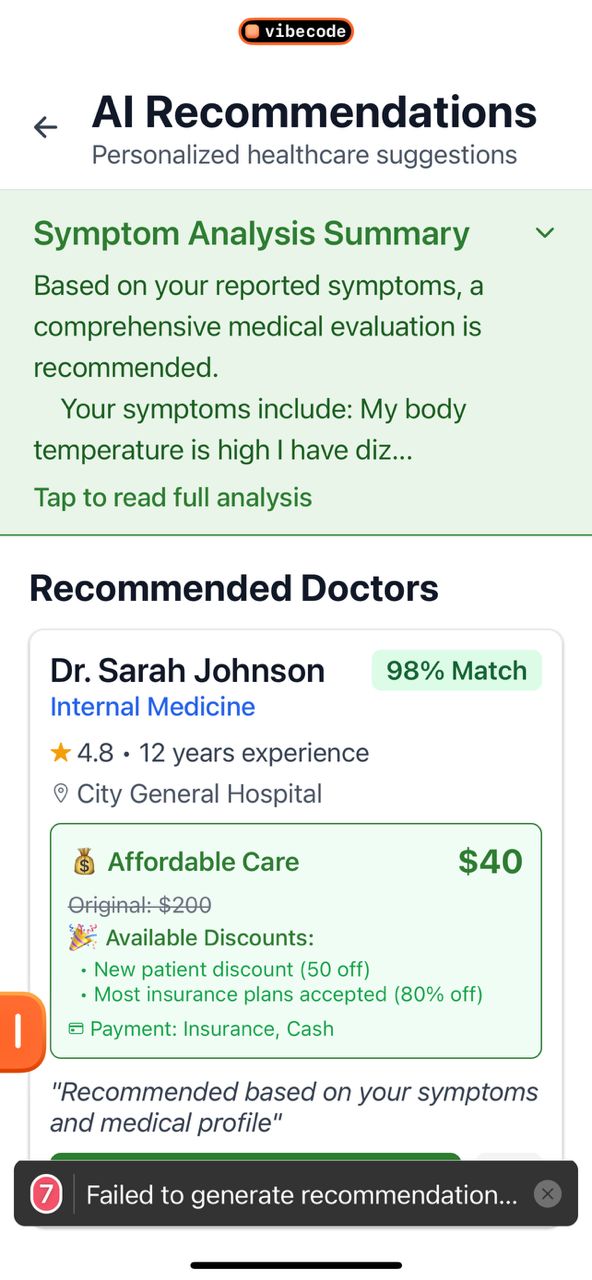
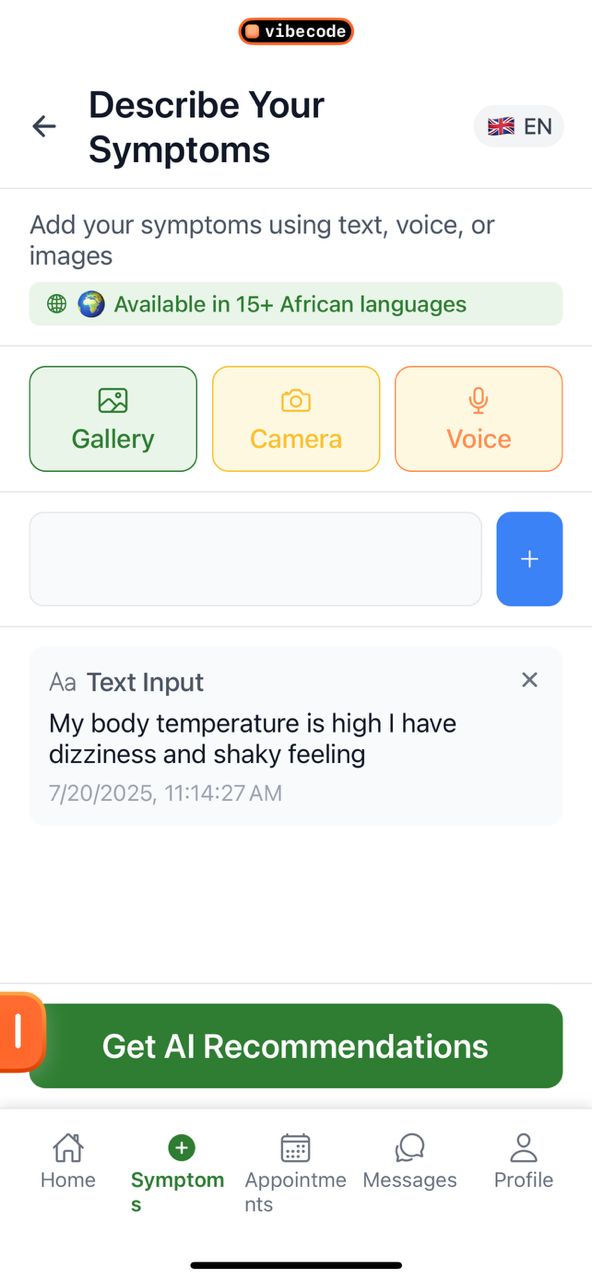
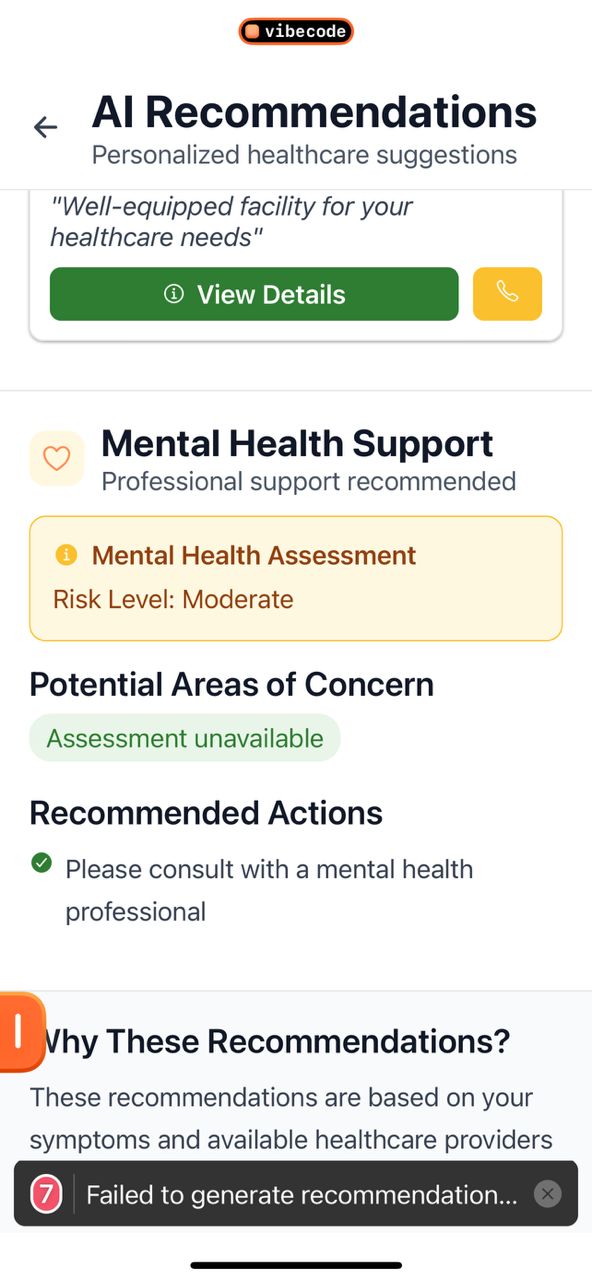
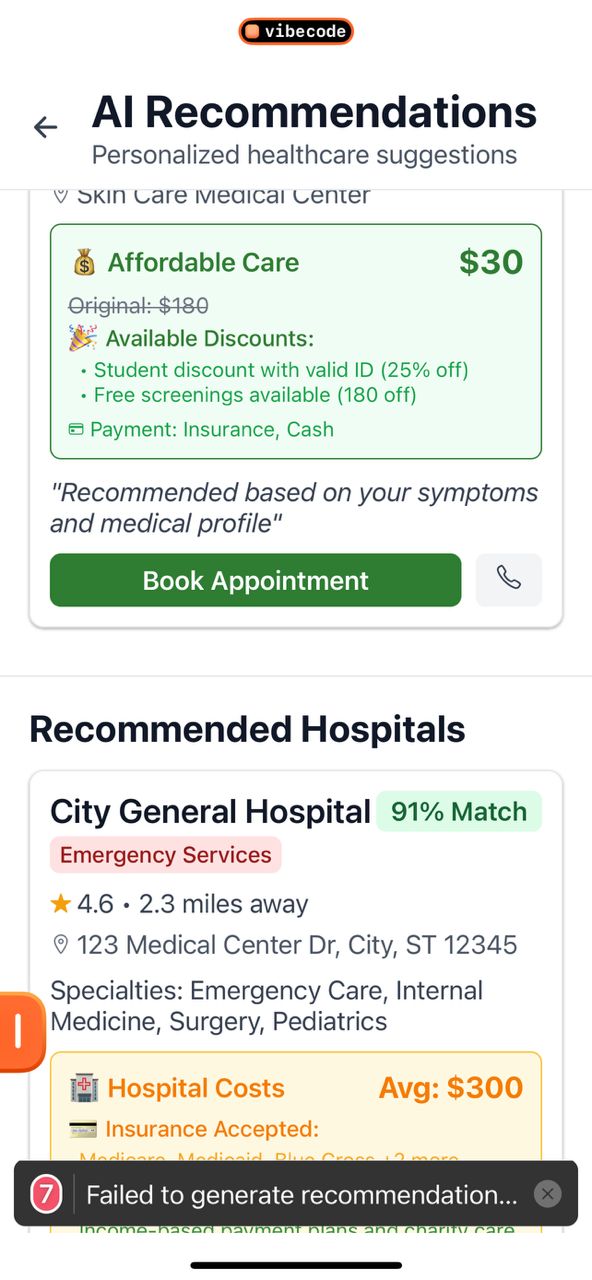
WemaCARE isn't just "another healthcare app" ,it's the bridge I wish existed to facilitate access to specialists and save time to the ones I saw suffer around me. At its core, WemaCARE connects patients to the right healthcare specialists using AI that actually understands African contexts. When a mother in Lagos types symptoms in Yoruba, or a farmer in Tanzania sends a voice note in Swahili describing chest pains, or someone uploads a photo of a concerning skin condition, our AI processes all of this through three specialized models: Gemini 2.5 Flash for complex multi-modal analysis, Gemini 2.0 Flash-Lite for routine cases, and Gemma 3 for offline emergency situations. But here's what makes it real: the app doesn't just recommend "see a doctor." It tells you Dr. Amara at Mbagathi Hospital has a 2-day wait time, charges $15 for consultations, accepts your insurance, and specializes exactly in your condition. It works offline when the internet fails, speaks your language when English doesn't, and remembers that in Africa, healthcare isn't just medical,it's financial, geographical.
How we built it
Building WemaCARE was challenging, exhausting but insightful and beneficial in knowledge and research. I started with my Python background, but quickly realized mobile development meant diving deep into cross-platform frameworks. React Native became my new best friend, even though I was simultaneously learning C++ for the embedded systems in my mechatronics studies. ( can we highlight the? I was building an AI healthcare app while learning both software and hardware sides of technology). The real breakthrough came when I realized that most medical AI models are trained on Western datasets. For the technical architecture, I optimized everything for Africa's reality: TensorFlow Lite models under 50MB, offline-first design, and battery optimization that I learned from my Arduino projects. Every line of code had to justify its existence in a resource-constrained environment. The hardest part was the multi-modal integration – getting text, voice, and image processing to work seamlessly on devices that might have intermittent connectivity and limited processing power. But that's where my engineering mindset helped: if it can't work on a $100 smartphone in rural Africa, it's not solving the real problem!!
Challenges we ran into
I think personally the biggest challenge was emotional. Every piece of research revealed another heartbreaking statistic about preventable deaths due to late diagnosis. At some point, I questioned whether a student like me could actually build something that matters at this scale. The offline functionality nearly broke me. How do you compress complex AI decision-making into something that works without internet? I had to completely rethink the architecture, moving from cloud-dependent to edge-computing models. My C++ learning actually helped here – understanding memory management made me obsessive about optimization. Then there was the reality check: I'm building for communities I've never lived in, most conditions? I've never experienced. I had to kind of myself in their shoes and understand through research, papers and my father I most certainly annoyed.
Accomplishments that we're proud of
It's definitely the fact that we didn't give up because WemaCARE went through so many ideation phases, redefinition, we literally had to build everything in less than 3 days due to last minute changes and having to restart everything. But no regrets because we can now see that WemaCARE is more impactful and polished.
What we learned
Perseverance...so many times I felt like we wouldn't deliver our project on time. Dealing with stress and last-minute changes. Personally, I learnt something new about myself: I will push and give my best to deliver the best and won't give up unless i have tried everything I could!
What's next for WemaCARE
The immediate next step is expanding our pilot program across Kenya, Nigeria, and Sénégal whilst implementing the rest of the features. We're partnering with local healthcare facilities to integrate WemaCARE into existing patient flow systems. By the end of 2025, we aim to have at least 500 patients using the platform. The big vision? I want WemaCARE to become the healthcare nervous system for Africa. Not just patient-doctor matching, but real-time disease surveillance, public health insights, and healthcare resource optimization. Imagine health ministries using aggregated, anonymous WemaCARE data to predict disease outbreaks or optimize specialist placement? (I dream big!) We're also exploring hardware integration – working with my mechatronics background to develop low-cost diagnostic devices that sync with WemaCARE. Solar-powered health kiosks for remote communities. IoT sensors for continuous patient monitoring. The intersection of software intelligence and hardware accessibility(something I love to create). But here's what drives me most: I want every African, regardless of where they live or what language they speak, to have the same healthcare access as anyone in New York or London. WemaCARE is just the beginning of that journey. Five years from now, I want a child in rural Chad to have better healthcare outcomes than a child in urban America – not despite technology, but because we built technology that actually serves humanity. That's not just a business goal, that's a moral imperative. WemaCARE isn't just what's next for the platform – it's what's next for African healthcare innovation. And I'm just getting started!!
Built With
- expo.io
- express.js
- figma
- firebase
- gemini
- google-maps
- google-speech-to-text
- javascript
- json
- node.js
- react-native
- rork
- sql
- stitchai
- typescript


Log in or sign up for Devpost to join the conversation.