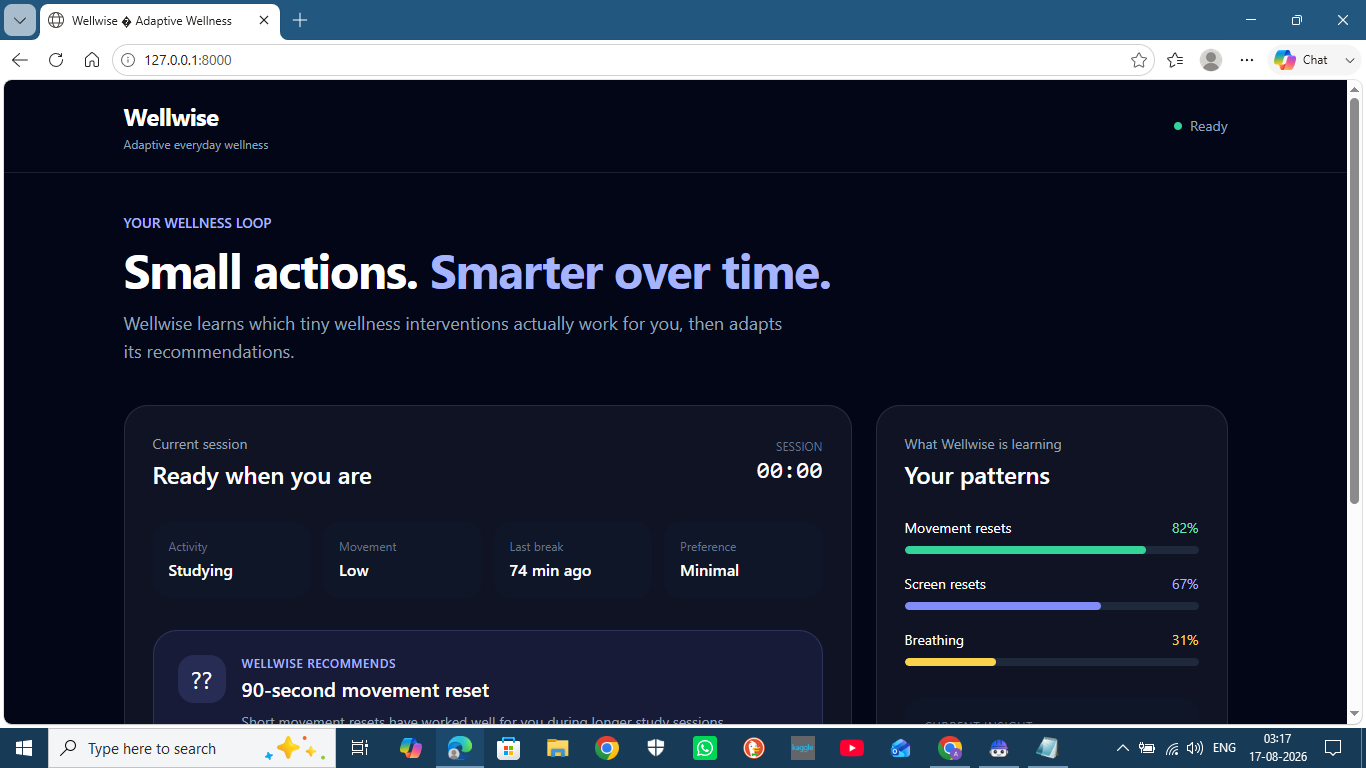
Inspiration We wanted to address a simple problem: people often spend hours studying or working without taking small breaks that could help them feel better and stay productive. Most wellness apps either rely heavily on manual tracking or provide generic reminders. We wanted to explore whether AI could make these interventions more contextual, personal, and less disruptive. What it does Wellwise is an adaptive everyday wellness companion. It uses lightweight context such as activity, session duration, time since the last break, and interruption preferences to generate a small, practical wellness intervention using Gemini AI. Instead of simply saying “take a break,” Wellwise tries to determine what kind of intervention makes sense right now and explains why it was selected. The experience is designed around a simple loop: Observe → Intervene → Learn. How we built it We built Wellwise using Python, FastAPI, Google Gemini API, HTML, JavaScript, Tailwind CSS, SQLite, and Uvicorn. The frontend provides the wellness dashboard and interaction experience, while FastAPI handles the application logic and communicates with Gemini. Gemini receives structured contextual information and generates a personalized intervention. SQLite provides the foundation for storing user interaction and learning data as the project evolves. Challenges we ran into The biggest challenge was building a meaningful AI experience within a very limited development timeframe. We also encountered issues with Python environments, API configuration, JSON response handling, frontend-to-backend communication, and Unicode rendering. Rather than building a large and fragile system, we focused on getting the core AI workflow working reliably and connecting it to a usable interface. Accomplishments that we're proud of We are proud that Wellwise goes beyond a static wellness-tip generator. It demonstrates a working AI-driven loop where contextual information is sent to Gemini and transformed into a personalized intervention. We also built the project with a clear separation between the user experience, backend logic, AI layer, and data layer, giving us a foundation for future improvements. What we learned We learned that effective AI integration is not simply about adding a chatbot. The value comes from giving the model the right context, constraining its role, and turning its output into a useful product experience. We also learned how important it is to prioritize a reliable core experience when working under a tight hackathon deadline. What's next for Wellwise Our next version will reduce manual input by incorporating passive signals and optional sensors. We plan to explore webcam-based posture and activity signals, device-based context, richer personalization, stronger privacy protections, and more meaningful long-term learning. Ultimately, we want Wellwise to become a wellness companion that quietly adapts to the user's day rather than constantly asking the user to track themselves.
Wellwise
An adaptive wellness companion that learns what small interventions actually help you—and delivers the right one at the right moment, without disrupting your day.
Updates

Leave feedback in the comments!
Log in or sign up for Devpost to join the conversation.