Inspiration
WellAware was inspired by a very real gap in women’s health today. Most tools either focus on tracking data (like periods and symptoms) or provide generic advice that doesn’t actually adapt to the individual. There’s very little that helps users truly understand what’s happening in their bodies.
As someone passionate about AI and healthcare, I wanted to build something that bridges that gap—something that listens, interprets, and responds in a way that is personalized, contextual, and safe. The goal was to move from simply logging information to actually making sense of it.
What it does
WellAware is an AI-powered, cycle-aware women’s health companion.
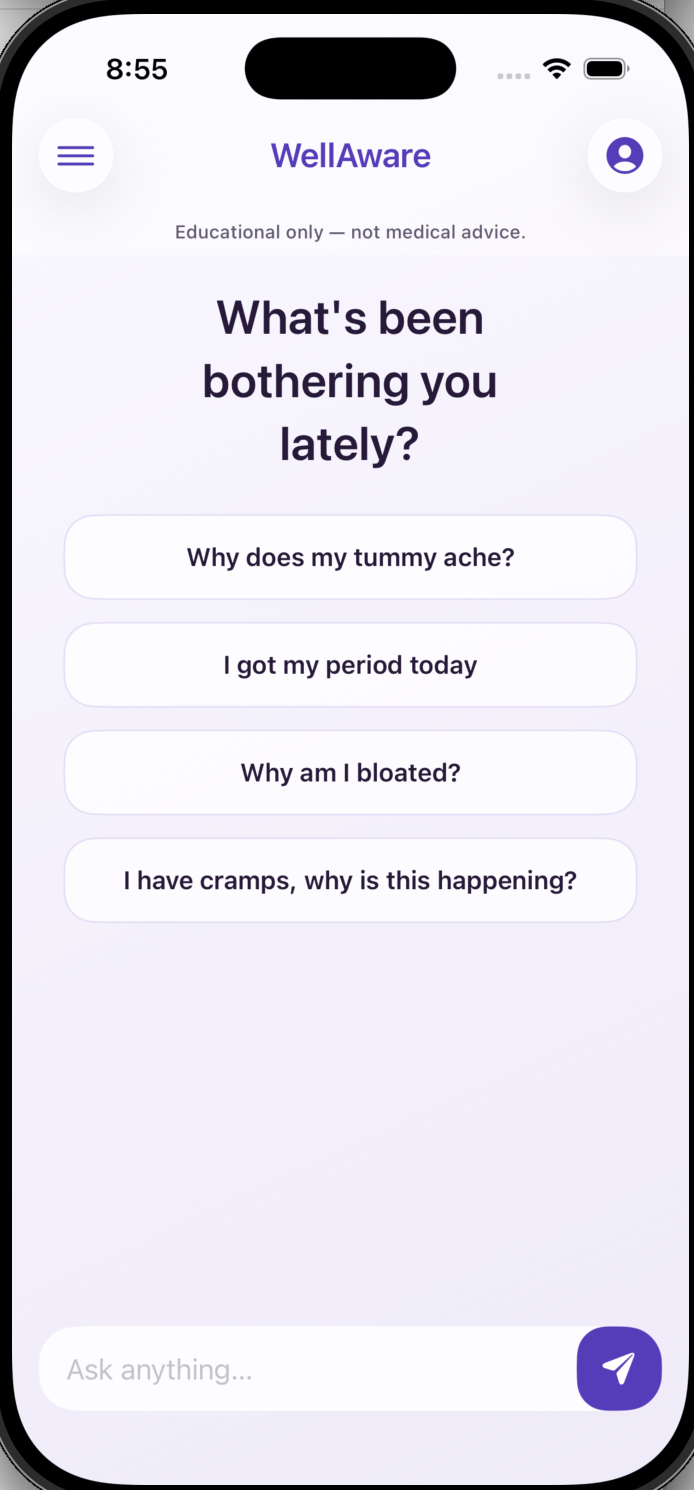
Instead of manually entering structured data, users can simply talk to the app:
“I feel tired and bloated today” “I got my period this morning”
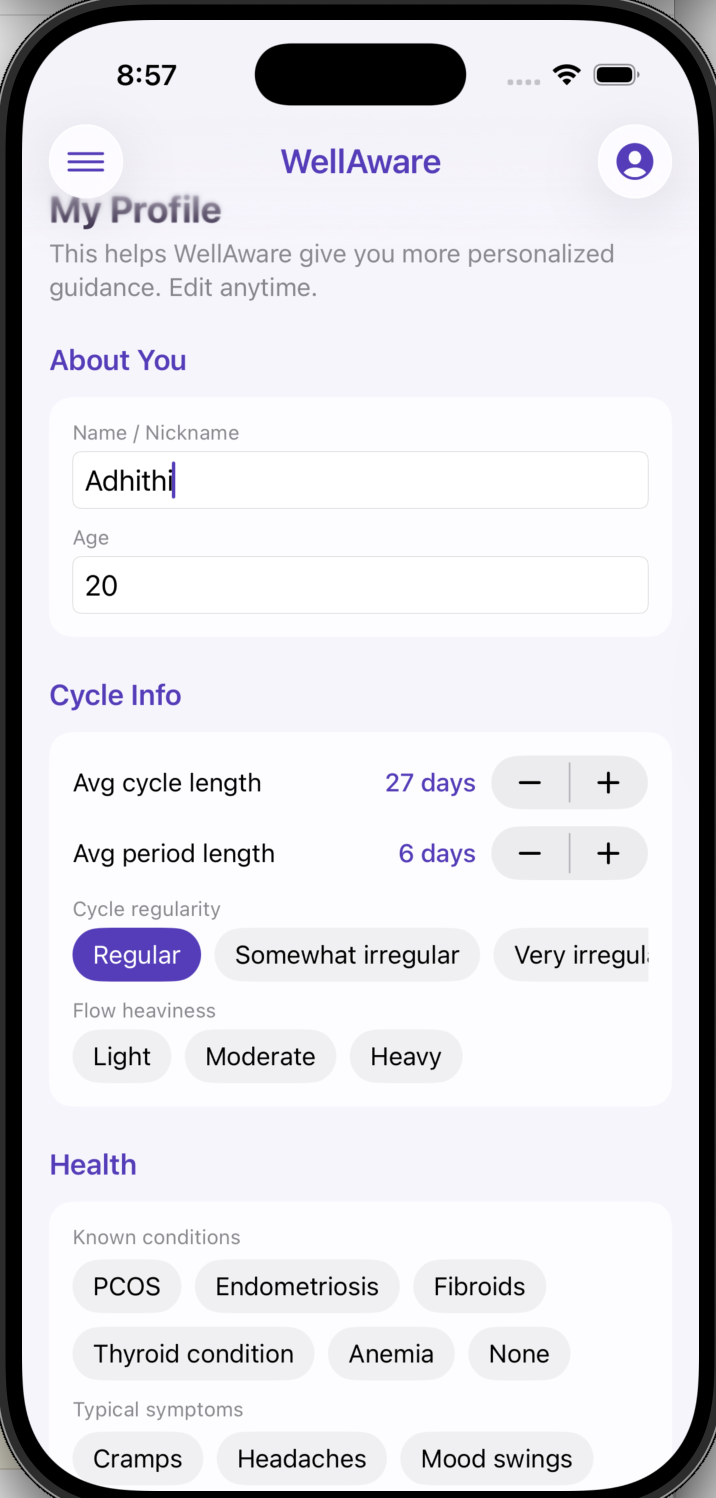
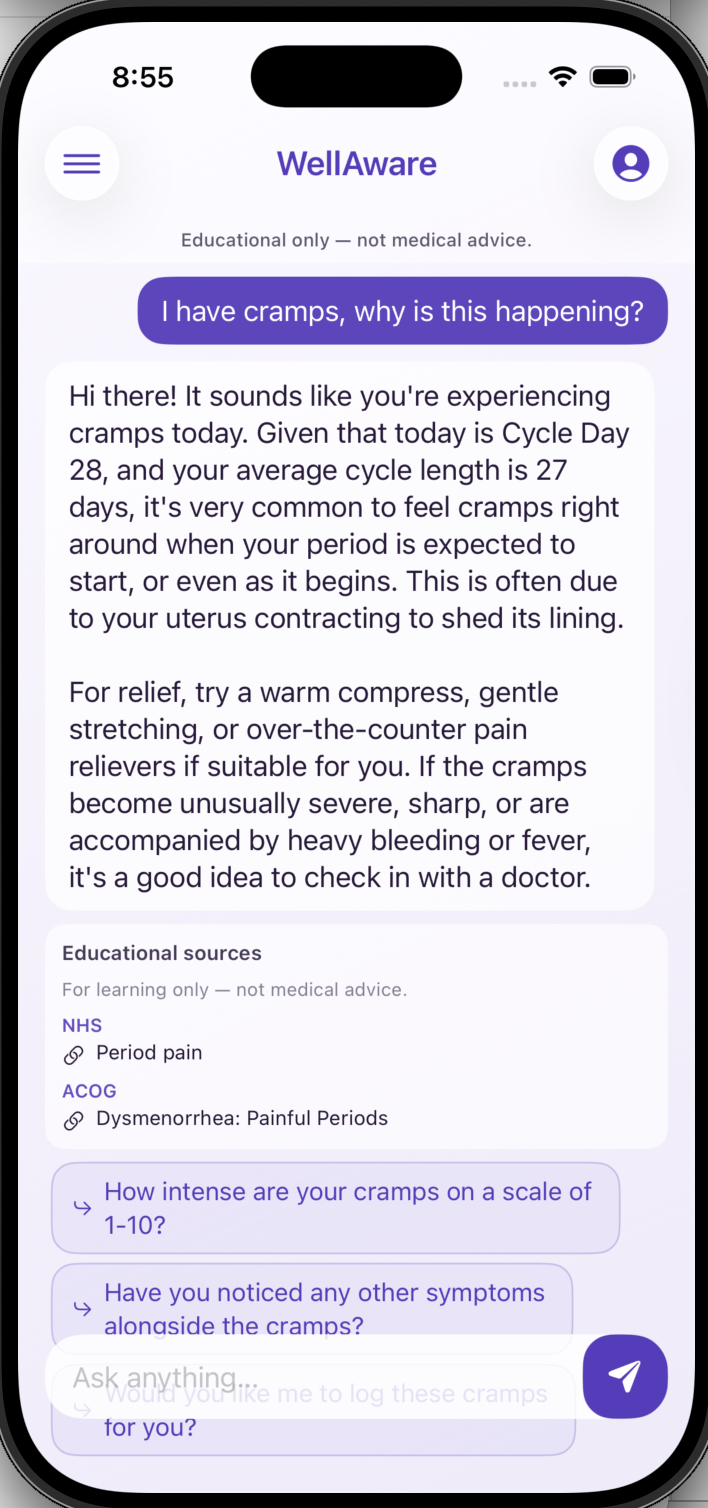
From this, WellAware: • Understands the user’s cycle context (cycle day, phase, history) • Interprets intent using AI • Generates personalized, educational responses (non-diagnostic) • Suggests or performs automatic logging • Flags when-to-seek-care signals for safety • Optionally shows credible medical sources
How we built it
WellAware is designed as a full-stack AI system: • Frontend: SwiftUI (iOS) with a chat-first experience • Backend: FastAPI for interpretation, safety checks, and structured outputs • AI Layer: Powered by Google Gemini for natural language understanding • Data Storage: Local-first (on-device) storage for logs and chat history to prioritize privacy
The backend processes user input and returns structured JSON including: • intent classification • generated response • follow-ups • log update suggestions • safety flags • source links
Fallback logic ensures the app still functions even if the AI model or network fails.
Challenges we ran into
One of the biggest challenges was balancing:
personalization vs. safety
We needed to ensure the system: • Felt intelligent and context-aware • Did not cross into medical diagnosis • Clearly guided users when professional care might be needed
Another challenge was designing agentic behavior: • Interpreting free-form input • Deciding when to automatically log events • Keeping the experience seamless but still transparent
We also dealt with: • API reliability → built fallback systems • Data consistency → syncing chat with logging • UX complexity → simplifying everything into a chat-first flow
Accomplishments that we're proud of
Built a working AI-powered system, not just a prototype • Created cycle-aware personalization, which most generic AI tools lack • Designed a trust-first experience with safety signals and disclaimers • Implemented automatic logging from natural language • Developed a multi-feature ecosystem (chat + log + insights + content)
Most importantly, we built something that feels like a real product, not just a hackathon demo.
What we learned
This project taught us that in healthcare, technical accuracy isn’t enough—trust is everything.
We learned: • The importance of explainable AI responses • How to design systems that are helpful but not diagnostic • That context (like cycle phase) dramatically improves relevance • How to structure AI outputs into something usable and actionable
What's next for WellAware
The next step is to evolve WellAware into a personalized women’s health intelligence platform.
We plan to: • Improve the insight engine with deeper pattern detection • Strengthen clinical credibility with verified medical sources • Collaborate with doctors and healthcare professionals • Expand AI capabilities while maintaining safety and trust • Explore integrations with wearables and health data

Log in or sign up for Devpost to join the conversation.