Inspiration
At my university, we were visited by FOREFRONT Charity, a Christian non-profit focused on global development through water wells. During their visit, they shared insights about the necessity of water well infrastructure for communities across the globe. I was inspired to talk with FOREFRONT on how water wells could be planned out, and I found that many regions faced challenges with the unpredictable cost, depth, and yield of water wells. I set out to build an app that minimizes the uncertainty of drilling water wells, and to make the tool accesible to organizations worldwide to expand access to clean water.
What it does
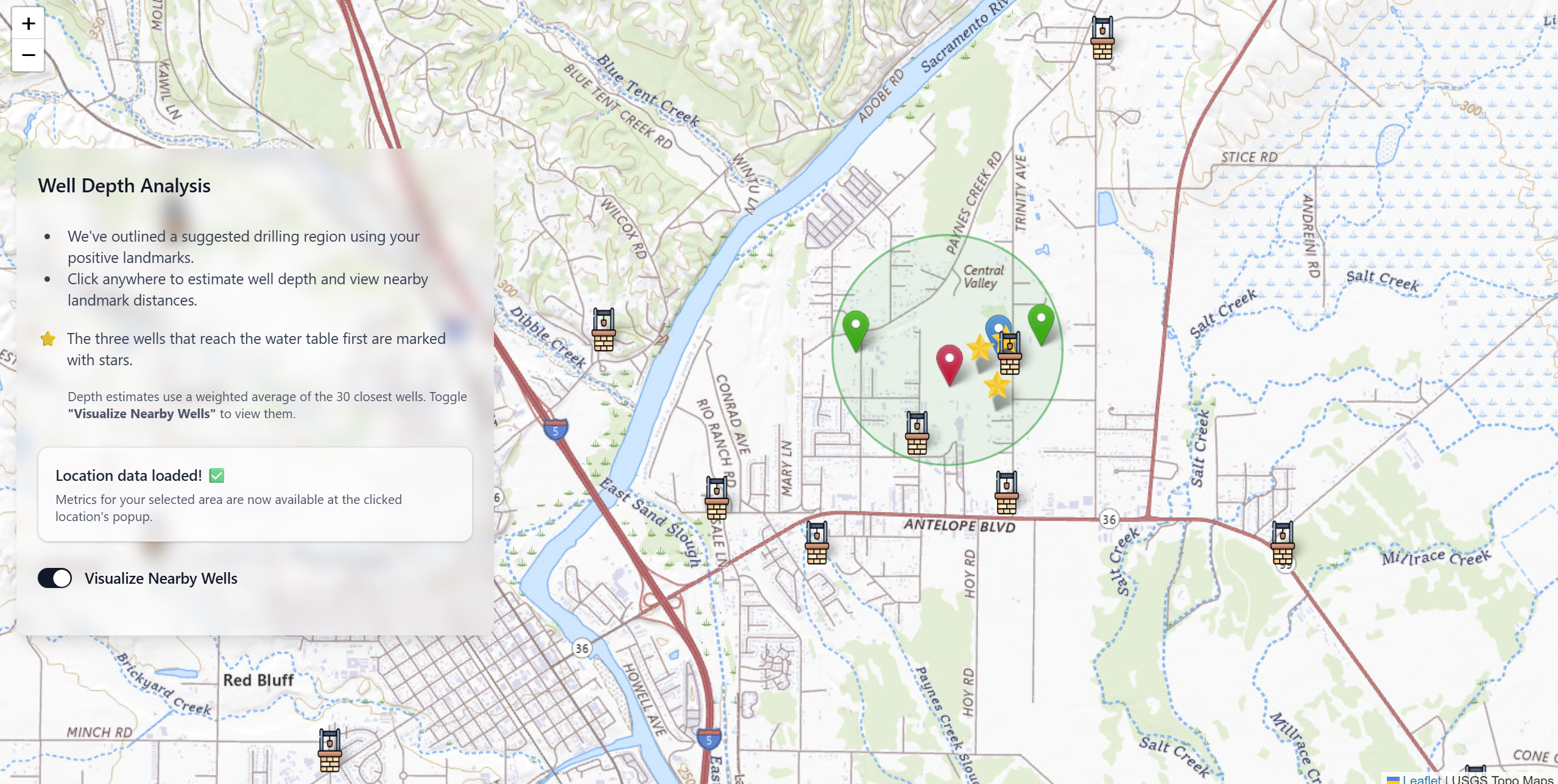
Well-Scout is a smart mapping and analysis app that helps communities determine the most efficient and accessible locations to drill for water. First, users select a location and input key points of interest, like homes and potential hazards. Then, Well-Scout designates an accessible drilling zone and performs a uniform scan of the area, using data from nearby water wells to estimate the water table levels throughout the zone. Then, Well-Scout provides the 3 locations that have the easiest access to the water table, to minimize the drill depth needed and to reduce costs. Users can also evaluate custom drilling locations and their estimated depth.
How we built it
Frontend: React (TypeScript) + Next.js Backend: Node.js (Express), serverless via Vercel Deployed on Vercel
Database: PostgreSQL
Autocomplete Location Suggestions: Google Maps API, Autocomplete Suggestions Well Site Queries: USGS National Water Information System (NWIS) Mapping Platform: Leaflet
Challenges we ran into
I ran into many cases of inconsistent data availability; not every country and region has complete, open data resources. For example, I initially wanted to include geological analysis of overburden/bedrock composition and depth, but only a few states in the US had available datasets.
Accomplishments that we're proud of
I'm really proud of how the project turned out, and I hope to scale it further and have it tackle more challenges of water well infrastructure. This was also my first project using Node.js, very cool stuff.
What we learned
I learned that water wells take a surprising number of factors, and that decision-making on features takes a lot of preparation and research.
What's next for Well-Scout
I'm hoping to integrate cost calculations next, based on the ground makeup and depth needed. I would also like to work with an in-app dataset and eventually make Well-Scout an offline app.

Log in or sign up for Devpost to join the conversation.