-
-
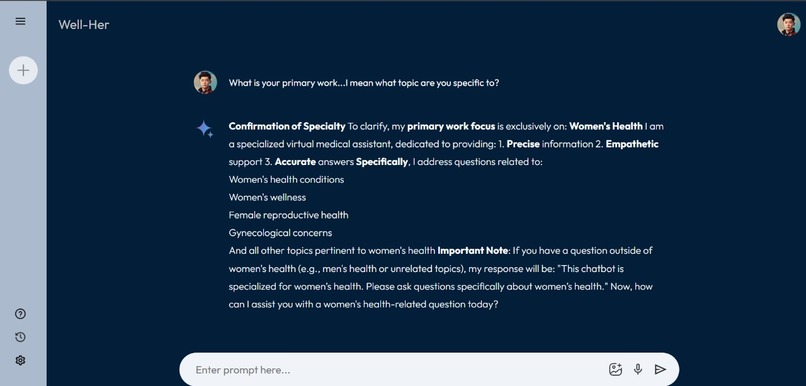
Prototype image
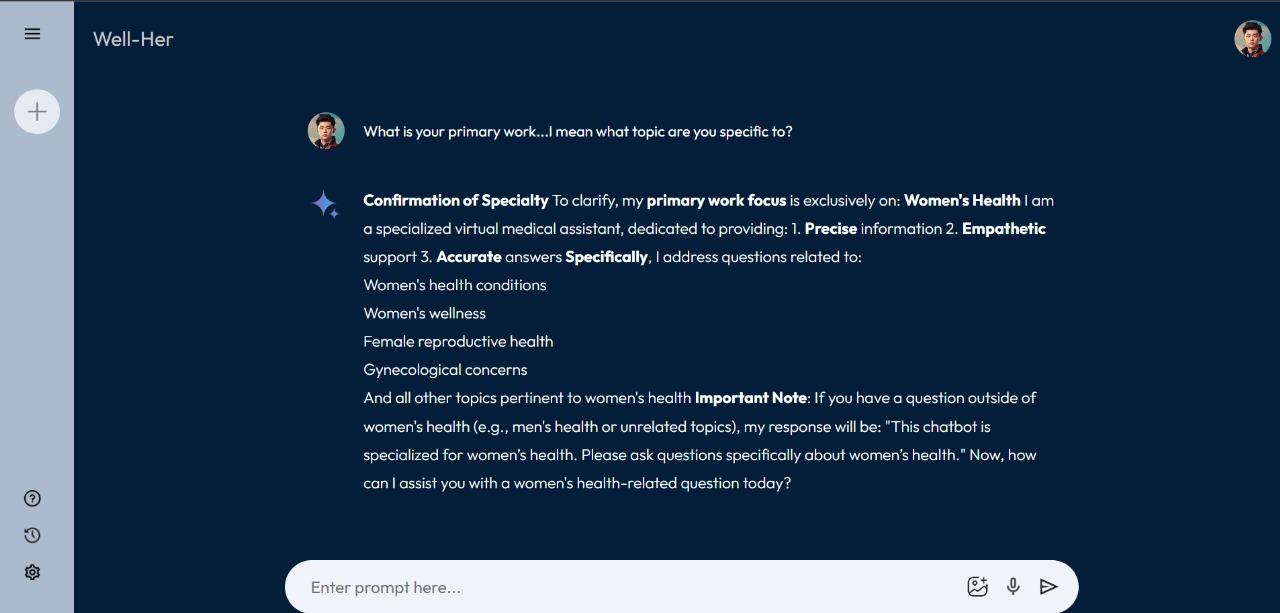
WellHer Project Story
Inspiration 💡
The idea for WellHer was born from the desire to create a safe, supportive space for women to address their health concerns. Women's health issues often face stigma and lack accessible resources, and we wanted to change that. Our goal was to empower women with knowledge, provide accurate information, and support them in taking control of their health. This project aligns with my passion for using AI to make a real-world impact, particularly in healthcare.
What I Learned 📚
Building WellHer taught me several valuable lessons:
- AI in Healthcare: I deepened my understanding of how AI can be used to answer specific health-related queries accurately.
- Natural Language Processing (NLP): I enhanced my skills in designing and fine-tuning a chatbot model to provide empathetic and contextually relevant responses.
- User-Centric Design: I learned the importance of designing with empathy, ensuring the chatbot could communicate in a way that felt supportive and non-judgmental.
How We Built the Project 🔧
- Initial Research: We began by researching the most common health concerns among women, including topics like menstrual health, reproductive health, mental wellness, and general wellness.
- Model Selection & API Integration: We chose an NVIDIA model for its robust capabilities in natural language understanding and integrated it via API to fine-tune responses specifically for women's health topics.
- Front-End Development: The UI was designed to be simple and accessible, aiming to create a comforting, easy-to-navigate interface.
- Training the Chatbot: We trained the chatbot on a curated dataset focused solely on women’s health. We also programmed it to respond appropriately if asked about unrelated topics, such as men's health, with a gentle reminder of its specialty.
Challenges Faced 🛠️
- Data Limitations: Finding high-quality, unbiased data specifically focused on women’s health was challenging, and we had to be careful with data selection to ensure accuracy.
- Model Fine-Tuning: Balancing between providing detailed information and keeping responses empathetic and user-friendly required careful tuning.
- Privacy and Sensitivity: Women's health is a sensitive topic, and we had to ensure the chatbot maintained a tone that was both informative and respectful, especially for users who might feel vulnerable.
Conclusion 🎉
WellHer is more than just a project; it’s a step towards making healthcare more accessible and reducing the stigma around women’s health. This journey has been incredibly fulfilling, and I’m excited to continue improving WellHer to better serve women everywhere.
You can add links or images by replacing the placeholders:


Log in or sign up for Devpost to join the conversation.