-
Well-being Nexus
-
Full Dashboard
Inspiration
We were inspired by a limitation we saw in how global well-being data is typically presented. Most visualizations are static leaderboards—a list of who’s #1 and who’s last. This felt incomplete. It tells you where a country stands, but not why, how fast it's changing, or who is being left behind within its borders. Our inspiration was to build a tool that moves beyond the ranking to reveal the hidden story in the data: the complex interplay between different aspects of life, the momentum of national progress, and the crucial issue of internal equality. We wanted to create a data app that sparks curiosity and provides a more holistic, dynamic view of what it means to live a good life.
What it does
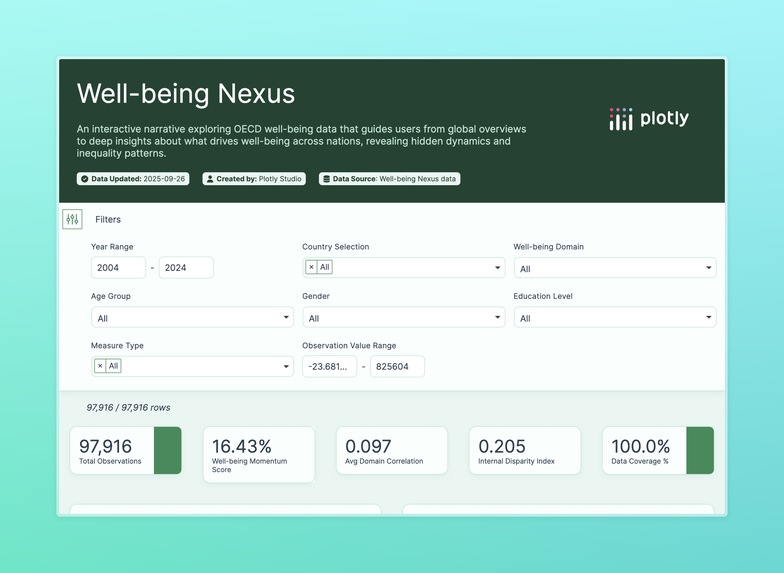
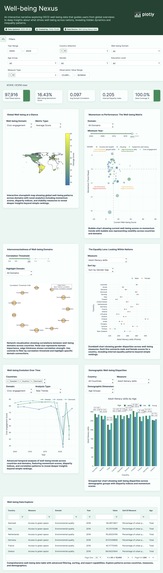
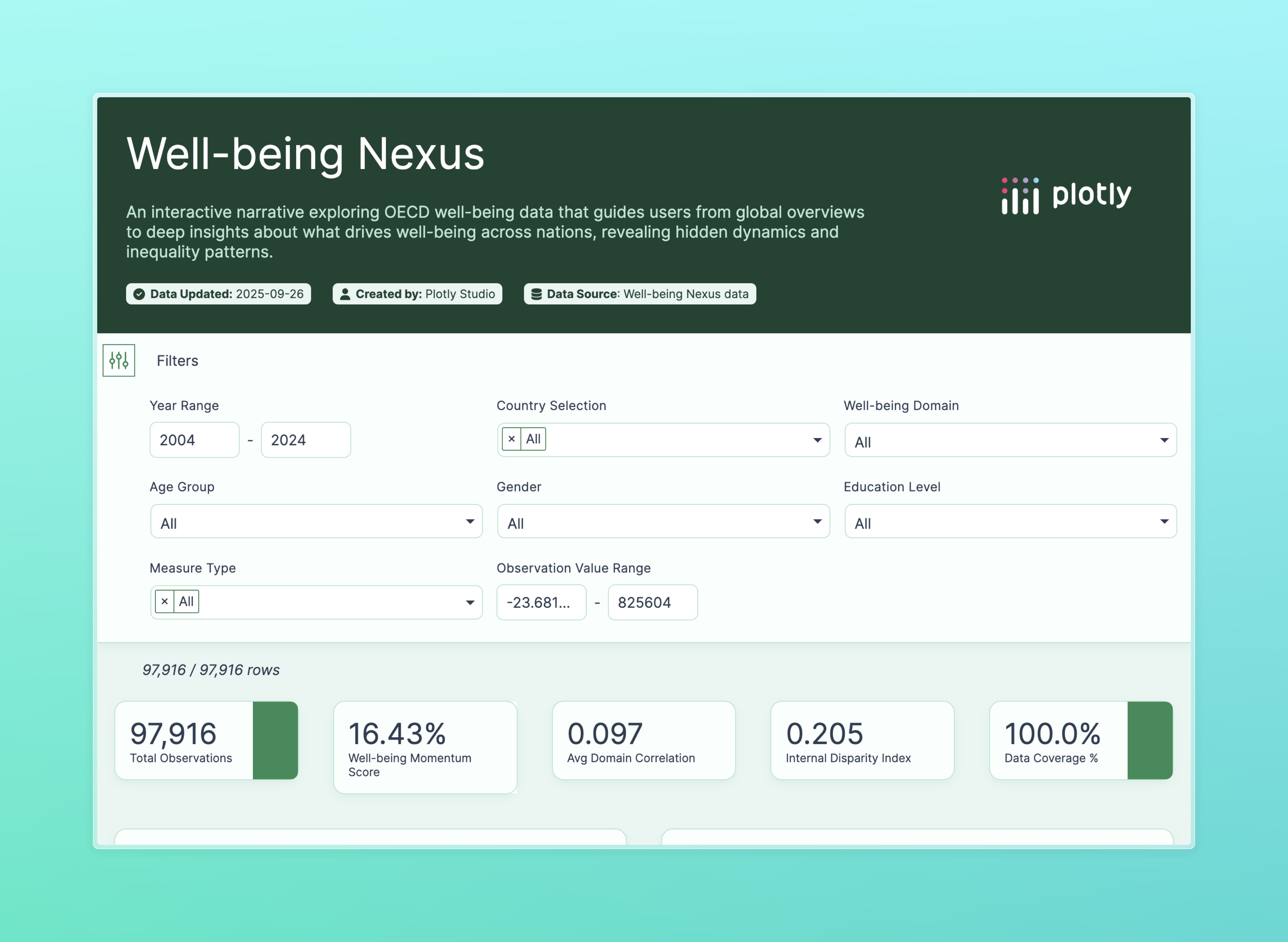
"Well-being Nexus" is an interactive data application that transforms the OECD Better Life Index from a static dataset into a dynamic exploratory narrative. It allows users—from policy analysts to curious citizens—to understand global well-being through three distinct lenses:
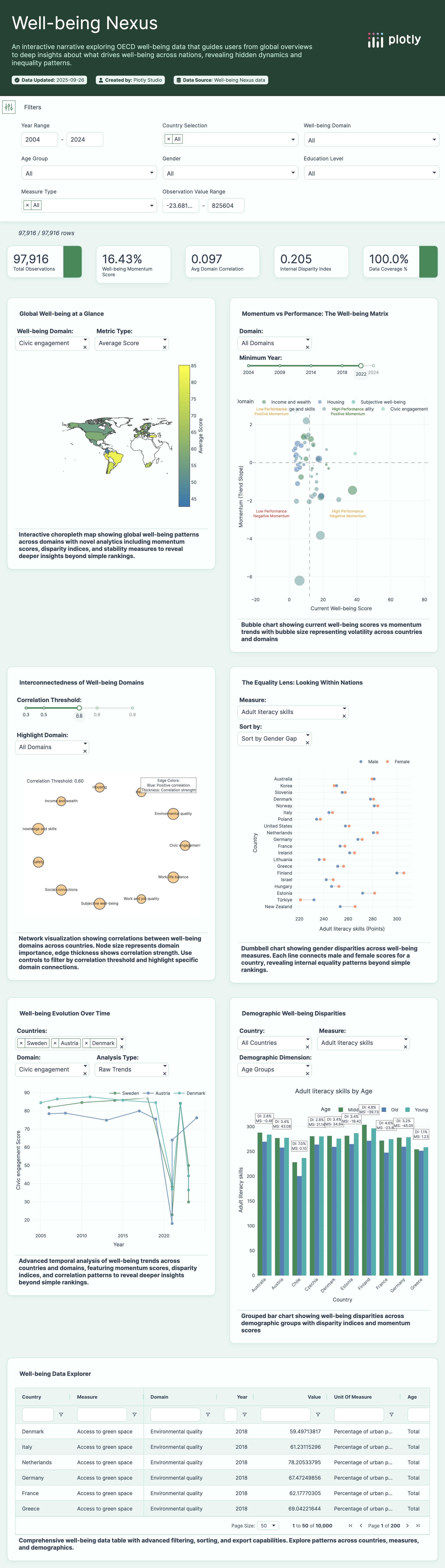
A High-Level Overview: Users can instantly see the global distribution of any of the 11 well-being topics on an interactive choropleth map.
Deep Dynamic Insights: The app reveals novel insights through two unique visualizations:
The Well-being Matrix plots a country's current performance against its historical momentum, showing who is truly accelerating.
The Interconnectedness Network visualizes the statistical relationships between topics like 'Income', 'Health', and 'Life Satisfaction', revealing the hidden drivers of well-being.
A Focus on Inequality: The Equality Lens shifts the perspective from national averages to internal disparities, using a dumbbell chart to starkly visualize the gender gap for each topic within every country. A unique toggle allows users to re-rank nations not by their average score, but by the size of their gender gap.
How we built it
Our strategy was to push the boundaries of what's possible within Plotly Studio by combining its powerful front-end capabilities with rigorous back-end data engineering.
Challenges we ran into
Coming up with a vibecoding killer prompt for plotly to generate a really good app. In this vibecoding challenge, we did not want to touch any Python code at all, and that is a new experience for someone like me in a technical background.
Accomplishments that we're proud of
We are incredibly proud of successfully engineering and visualizing completely new metrics from the source data. Creating the Well-being Momentum Score gives a forward-looking perspective that simple rankings lack.
Furthermore, we're proud of our creative implementation of the Network Graph and Dumbbell Chart. By combining external scripting with an advanced understanding of Plotly's Scatter and Shapes features, we built visualizations that are both unique and deeply insightful.
Finally, we're proud of the app's narrative flow. The simple click of the "Sort by Gender Gap" button, which re-orders an entire chart to tell a story of inequality instead of performance, is a powerful moment of discovery for the user that we worked hard to design.
What we learned
Throughout this project, we learned that the most powerful insights often lie one step beyond the raw data. The process of creating new metrics was a profound lesson in data exploration.
Technically, we learned to view Plotly Studio not just as a dashboarding tool, but as a creative canvas. By understanding its fundamental building blocks (like traces and shapes), we could construct visualizations far beyond the standard library.
Most importantly, we learned that how you frame the data is as important as the data itself. The design decision to focus the final "act" of our app on inequality transformed the project from a simple data analysis into a compelling story about the human condition.
What's next for Well-being Nexus
This project feels like the beginning of a much larger story. We have several exciting ideas for the future:
A Predictive Policy Simulator: We want to leverage our correlation model to build a new interactive card. Users could use a slider to simulate a policy change (e.g., "Improve Education score by 10%") and see the predicted ripple effects on other aspects of well-being like Income and Health.
Deeper Data Integration: We plan to incorporate more granular time-series data to refine our momentum calculations and even introduce sub-national data to explore well-being at a regional level.
Personalized Well-being Index: We aim to add a feature allowing users to weight the 11 topics according to their own personal values. The entire dashboard would then dynamically update to reflect their personalized "Better Life Index," making the exploration of data a truly individual experience.

Log in or sign up for Devpost to join the conversation.