-
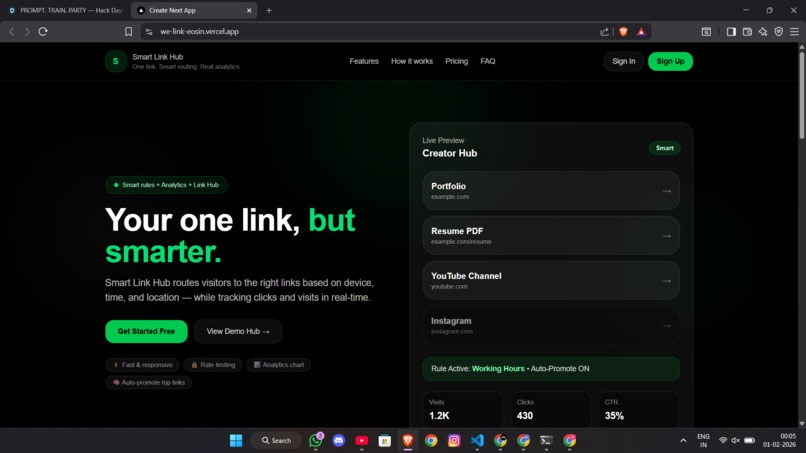
Landing page of the website
🌿 Inspiration The digital world is fragmented. Most social media platforms limit you to a single link in your bio, forcing creators to constantly manually update that link or use static "link-tree" clones that treat every visitor the same. We wanted to build a smarter bridge. Inspired by the need for dynamic content delivery, we created WeLinK—a platform that doesn't just list links but optimizes them based on who is looking and when.
🔗 What it does WeLinK is a premium link-in-bio platform that transforms a single URL into a powerful, automated marketing hub.
Context-Aware Links: Uses "Smart Rules" to show/hide links based on the user's device (Mobile/Desktop), time of day (Working hours/Night), or location.
Auto-Promote: An intelligent algorithm that automatically moves the most-clicked links to the top of the hub when they match active rules.
Real-Time Analytics: Tracks visits and clicks with interactive 7-day trend charts, identifying your "star" content and least-performing links.
Instant Sharing: Every hub automatically generates a custom QR code for physical marketing and easy digital sharing.
Premium UI: A sleek, high-contrast Black × Green design focused on mobile responsiveness and modern aesthetics.
🛠 How we built it We leveraged a modern full-stack architecture to ensure speed and scalability:
Frontend: Built with Next.js 16 (App Router) and TypeScript for a robust, type-safe development experience.
Styling: Tailwind CSS was used to craft the signature premium dark theme and ensure a fully responsive layout.
Database: MongoDB Atlas with Mongoose stores user profiles, dynamic link data, and engagement metrics.
Analytics: Recharts handles the data visualization, turning raw click-streams into actionable insights.
Security: Integrated custom Rate Limiting to prevent spam clicks and fake visits, ensuring data integrity.
🚧 Challenges we ran into Dynamic Rule Engine: Implementing the logic for "Auto-Promote" was tricky. We had to balance database performance with the need to re-order links in real-time based on fluctuating click data.
Time-Zone Management: Since the "Time Rule" (e.g., "Show during working hours") depends on the visitor's local time, we had to ensure the server and client-side clocks were synced correctly across different regions.
Hydration Errors: Managing complex UI states (like drag-and-drop reordering) within Next.js’s server-side rendering environment required careful use of client-side components.
🏆 Accomplishments that we're proud of The "Smart" Logic: Moving beyond a basic list to a hub that "thinks." Seeing a link automatically jump to the top because it's trending is incredibly satisfying.
High-Performance UI: Despite having analytics and dynamic rules, the public hub pages load almost instantly, which is critical for mobile social media users.
End-to-End Security: Successfully implementing a custom rate-limiter and a robust authentication flow with password strength indicators.
📖 What we learned Data Aggregation: We learned how to efficiently aggregate MongoDB data to generate daily click trends without slowing down the dashboard.
User Experience (UX): We discovered that "less is more." While we wanted many features, keeping the "Create Hub" flow simple was the key to making the tool accessible.
Next.js 16 Patterns: Deepened our understanding of Server Actions and optimized data fetching within the new App Router structure.
🚀 What's next for WeLinK The journey doesn't stop here. Our roadmap includes:
Custom Domains: Allowing users to point their own domains (e.g., links.yourname.com) to their hub.
A/B Testing: Letting creators run two versions of their hub to see which layout or color scheme converts better.
Social Embeds: Direct integration to show latest Tweets, YouTube videos, or Spotify tracks directly on the hub page.
Built With
- framer
- mongodb
- next.js
- tailwind

Log in or sign up for Devpost to join the conversation.