Inspiration
Social media has made it easier than ever to connect with people, but we started wondering whether it could do more to bring people together in real life. It's easy to spend hours scrolling through what everyone else is doing without actually getting involved in anything ourselves.
That got us thinking: What if we could use some of the same features that make social media so engaging to encourage people to get outside, meet others, and make a difference in their communities?
We took inspiration from BeReal's spontaneous notifications, Pokémon GO's location-based exploration, and Duolingo's reward system. We liked how these apps gave people a reason to come back, but wanted to apply those ideas to something that could have a positive impact beyond the screen.
We also felt that community involvement and personal development should go hand in hand. After all, becoming a better member of your community starts with working on yourself.
That idea became WeGo: Grow yourself. Grow your world.
What it does
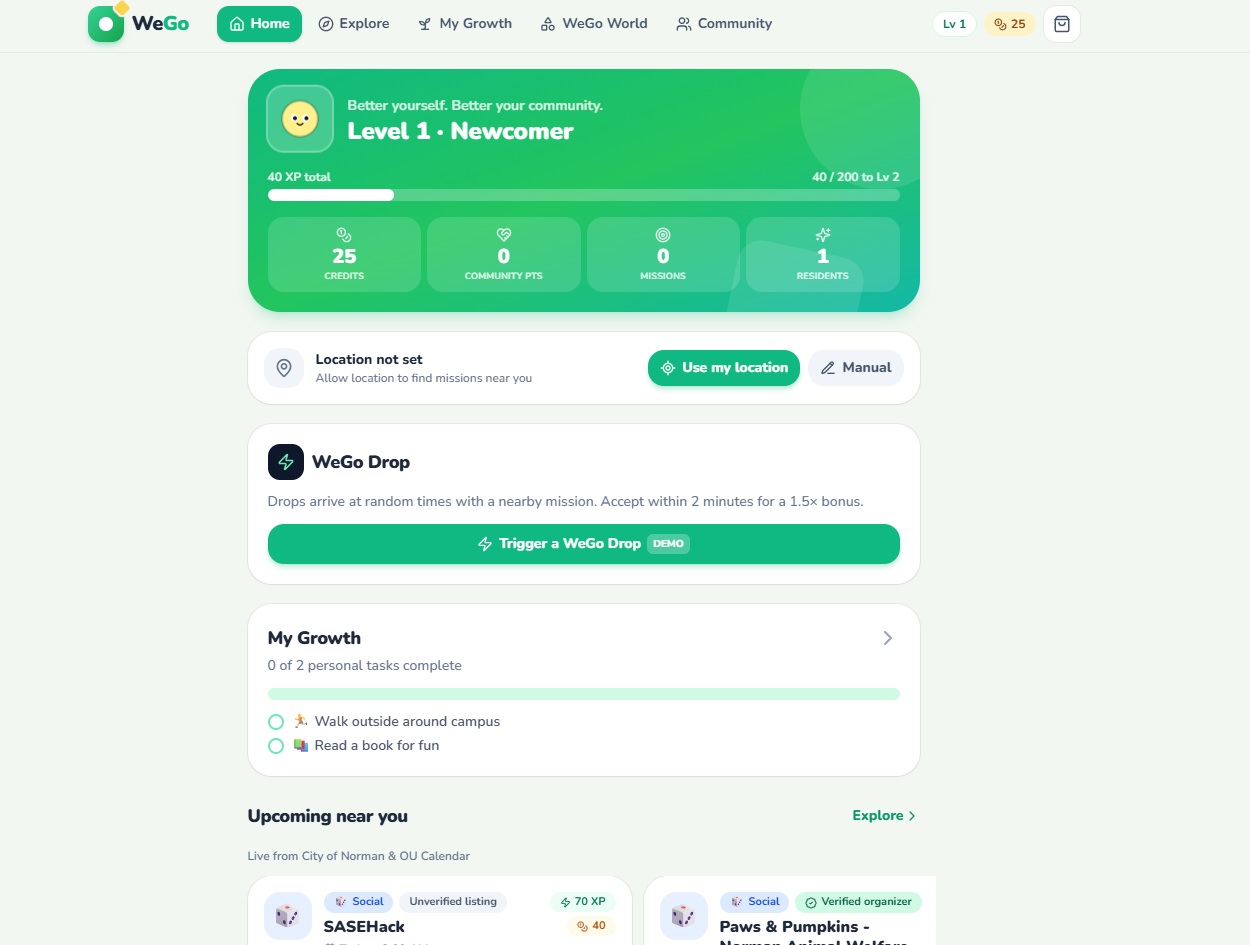
WeGo is a web app that makes personal growth and community involvement feel more like a game.
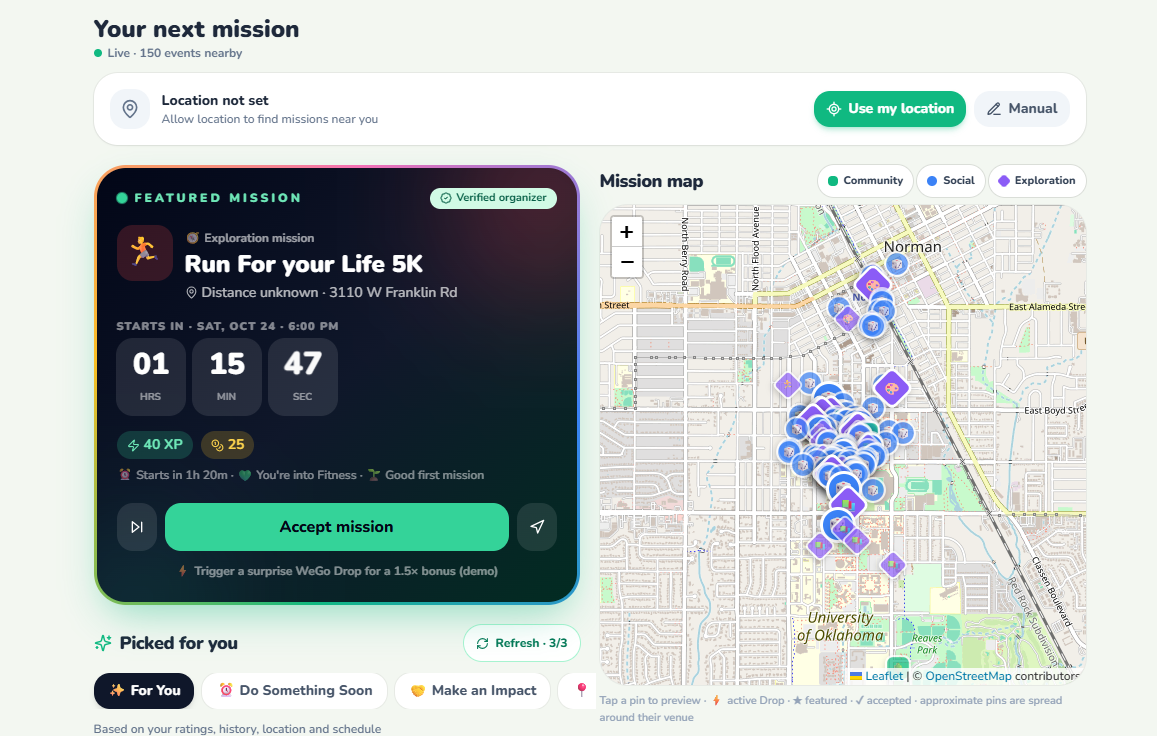
Instead of having to search through dozens of event websites, users can discover community activities happening near them through an interactive map. WeGo also introduces spontaneous WeGo Drops, which challenge users to get out and participate in local events.
To make finding something to do easier, we built a recommendation system that suggests two missions based on user preferences and past experiences, along with a third "Mix It Up" option that encourages trying something new.
But we didn't want WeGo to focus only on helping others. Our My Growth feature lets users work on personal goals like exercising, studying, cleaning, and learning new skills. Completing these tasks earns XP and helps users build better habits.
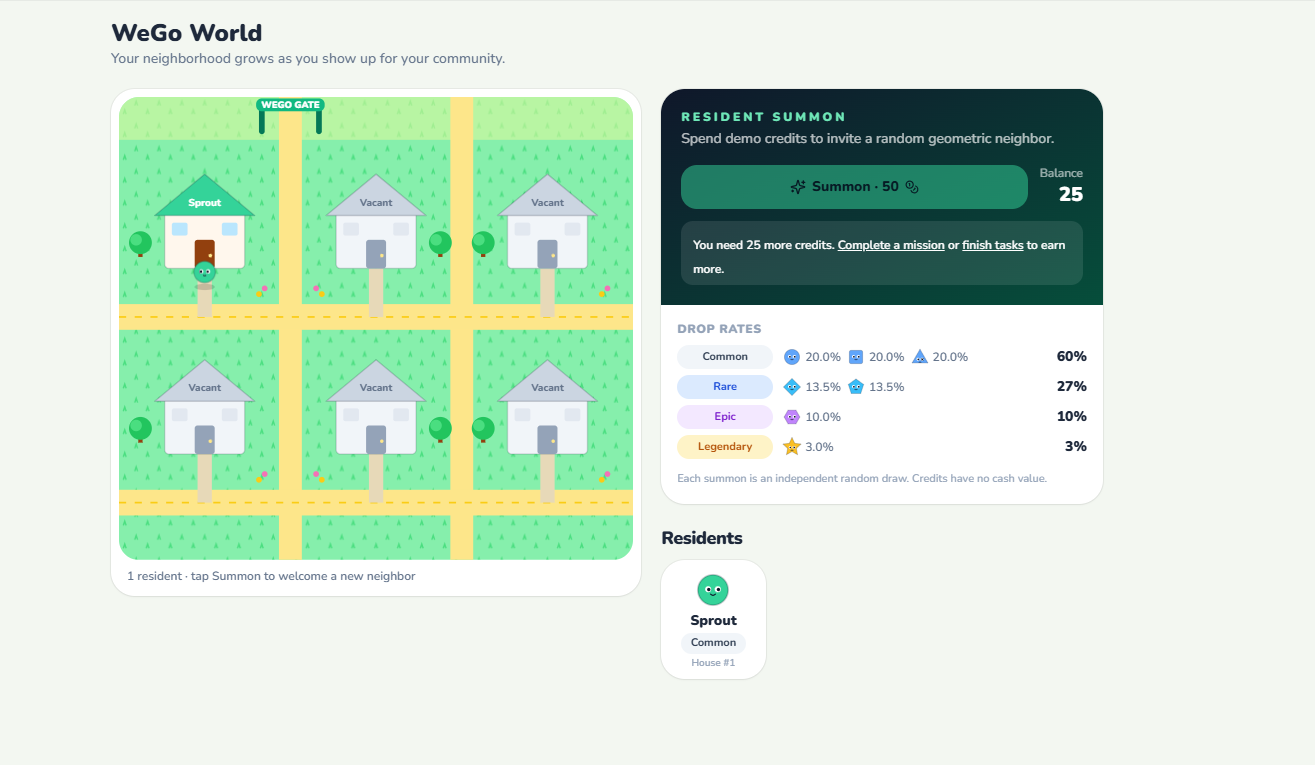
Users can also earn credits and spend them in WeGo World, where they collect little geometric characters through a gacha system. Each character gets its own house in a miniature neighborhood, giving users something fun to build as they make progress in real life.
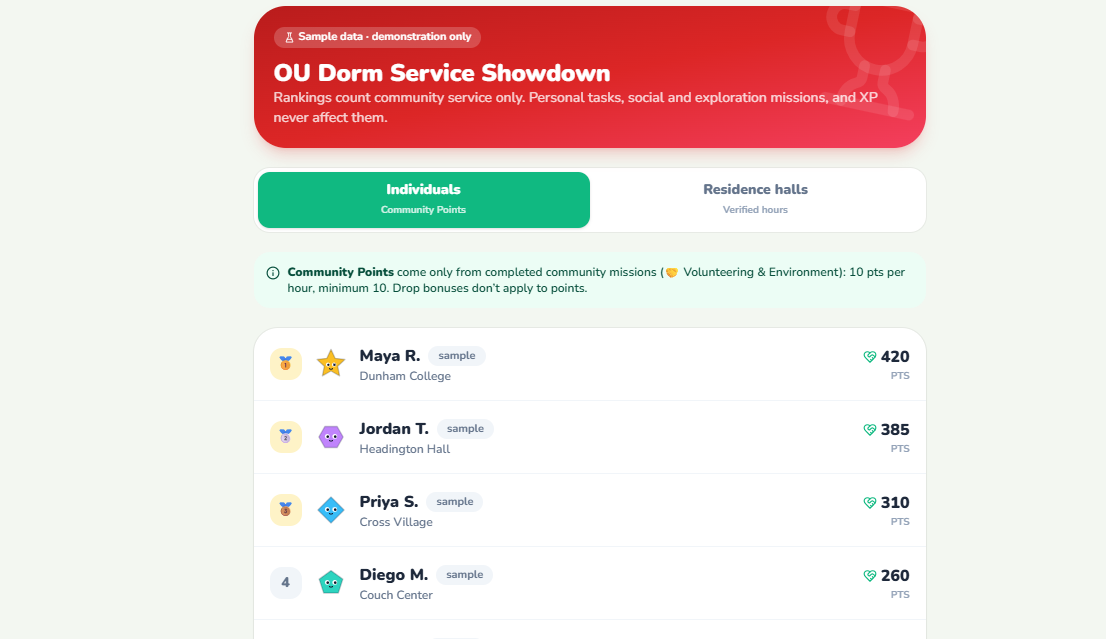
Finally, WeGo includes community leaderboards and group challenges, where users and organizations can compete based on community service rather than personal productivity.
Our goal is simple: give people a reason to put their phones down and do something meaningful, while still making the experience fun.
How we built it
We built WeGo using React, TypeScript, and Tailwind CSS for the frontend, with Vite handling development and builds.
For the backend, we used Node.js to collect local event information from public websites. Because different websites organize their information differently, we created modules that gather, clean, categorize, and cache event listings before sending them to the app.
We also integrated Leaflet to display nearby events on an interactive map and use browser location services to help users find opportunities in their area.
On the frontend, we organized our code into separate features, including Explore, My Growth, Missions, Community, Rewards, and WeGo World. We used centralized state management to handle player progress, task completion, points, and collectibles, with browser storage to keep that information saved between sessions.
For recommendations, we used a lightweight scoring system instead of a complicated machine learning model. It considers things like mission categories, previous participation, and enjoyment ratings to help suggest activities users might actually want to attend.
We also used Vitest for testing, along with ESLint and Prettier to keep our code organized and consistent.
Challenges we ran into
One of our biggest challenges was figuring out how to make WeGo feel exciting without overwhelming users.
Our original Explore page looked more like a traditional event calendar. While it displayed plenty of opportunities, we realized that giving people too many options could make it harder for them to choose anything at all.
We ended up redesigning the page around three recommended missions, with one option specifically meant to introduce users to something outside their usual interests. We also made the mission cards horizontally scrollable to improve the experience on mobile devices.
Another challenge was collecting information about local events. Unlike larger event platforms, community organizations don't all use the same system to advertise their activities. We had to figure out how to collect information from different sources and organize it into a format our app could use.
We also spent time thinking through how our rewards should work. Originally, we considered letting users create personal tasks with their own XP values, but realized that would make the system easy to exploit. We switched to predefined task templates with fixed rewards and separated personal XP from community rankings.
Throughout development, we had to balance our bigger vision for WeGo with what we could realistically build during a hackathon.
Accomplishments that we're proud of
We're proud that we were able to bring several different ideas together into one working concept.
We didn't want to build just another productivity app or another website for finding volunteer opportunities. We wanted the different features to work together and give users multiple reasons to participate.
One of our favorite parts is WeGo World. Even though we're currently using simple shapes instead of fully designed characters, seeing users earn credits and gradually build their own little neighborhoods helps bring the reward system to life.
We're also proud of how Explore evolved. Moving away from a calendar toward spontaneous Drops and personalized missions helped the app feel closer to what we originally imagined.
Another accomplishment was organizing our codebase so that different features are easier to understand and maintain. Since we hope to continue developing WeGo after the hackathon, we wanted to build something we could actually return to and improve.
Most importantly, we're proud that our project is centered on encouraging people to do something positive for themselves and the people around them.
What we learned
One of the biggest things we learned is that more features don't necessarily make an app better.
Early on, we had a lot of ideas for what WeGo could become. But as we started building, we realized that even useful features can make an application harder to navigate if they aren't presented in the right way.
We learned to think more carefully about the experience from the user's perspective. For example, instead of asking how many events we could display, we started asking how we could make someone excited enough about one event to actually attend it.
On the technical side, we gained more experience working with React, TypeScript, backend services, location-based features, and managing data across different parts of an application.
We also learned how important it is to organize code as a project grows. Keeping components and logic separated made it easier to understand what different parts of WeGo were responsible for.
Overall, this hackathon showed us how much planning, problem-solving, and iteration goes into turning an idea into something people can actually use.
What's next for WeGo
We see this hackathon as the beginning of WeGo rather than the finished product.
One of our first goals is to test the platform with students at the University of Oklahoma. We'd love to partner with residence halls and student organizations to organize community challenges, like seeing which dorm can contribute the most verified volunteer hours in a week.
We also want to work with local businesses to offer real rewards, such as coffee, discounts, or other perks that users can redeem with credits earned through the app.
Another priority is expanding our event discovery system and working directly with community organizations to ensure opportunities are accurate and participation can be verified.
For WeGo World, we eventually want to replace our geometric placeholders with original characters, more detailed houses, and additional ways to customize neighborhoods.
We also hope to build a dedicated mobile app with better notifications, location-based experiences, and social features that make it easier for friends to participate together.
Ultimately, we want WeGo to become something people use not just to keep track of what they're doing, but to discover what they could be doing.
Grow yourself. Grow your world.

Log in or sign up for Devpost to join the conversation.