-
-
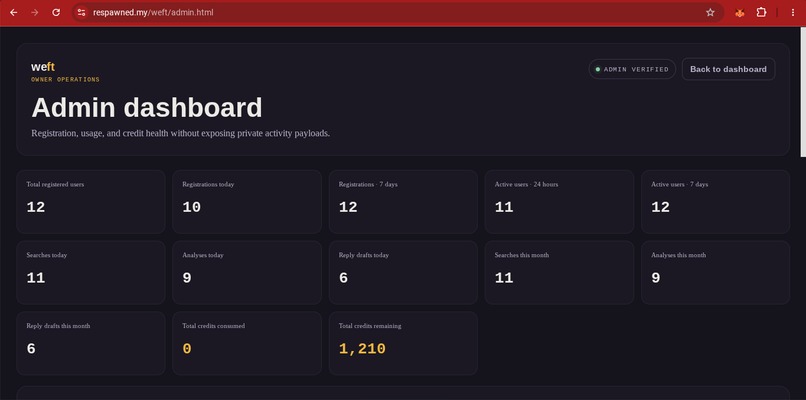
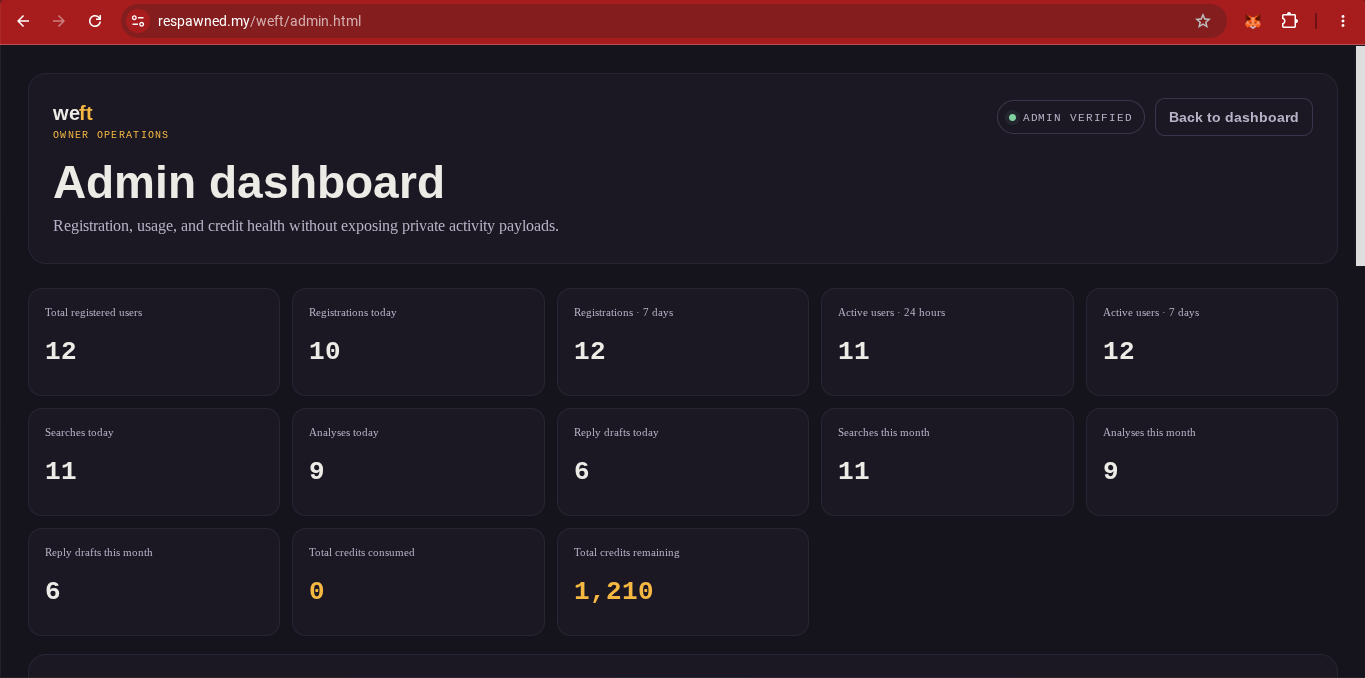
Admin Dashboard
-
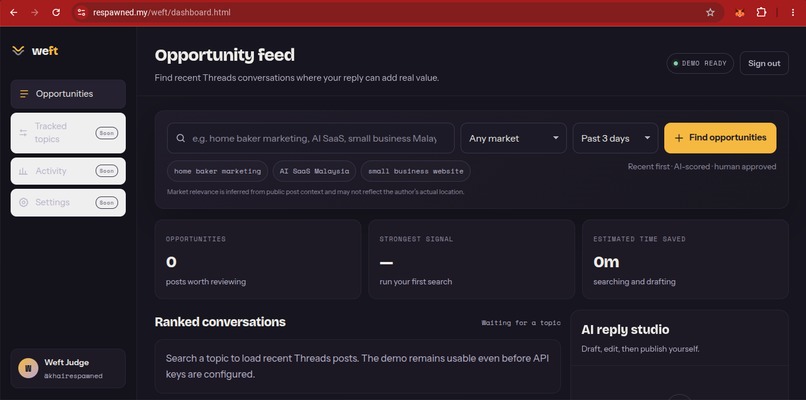
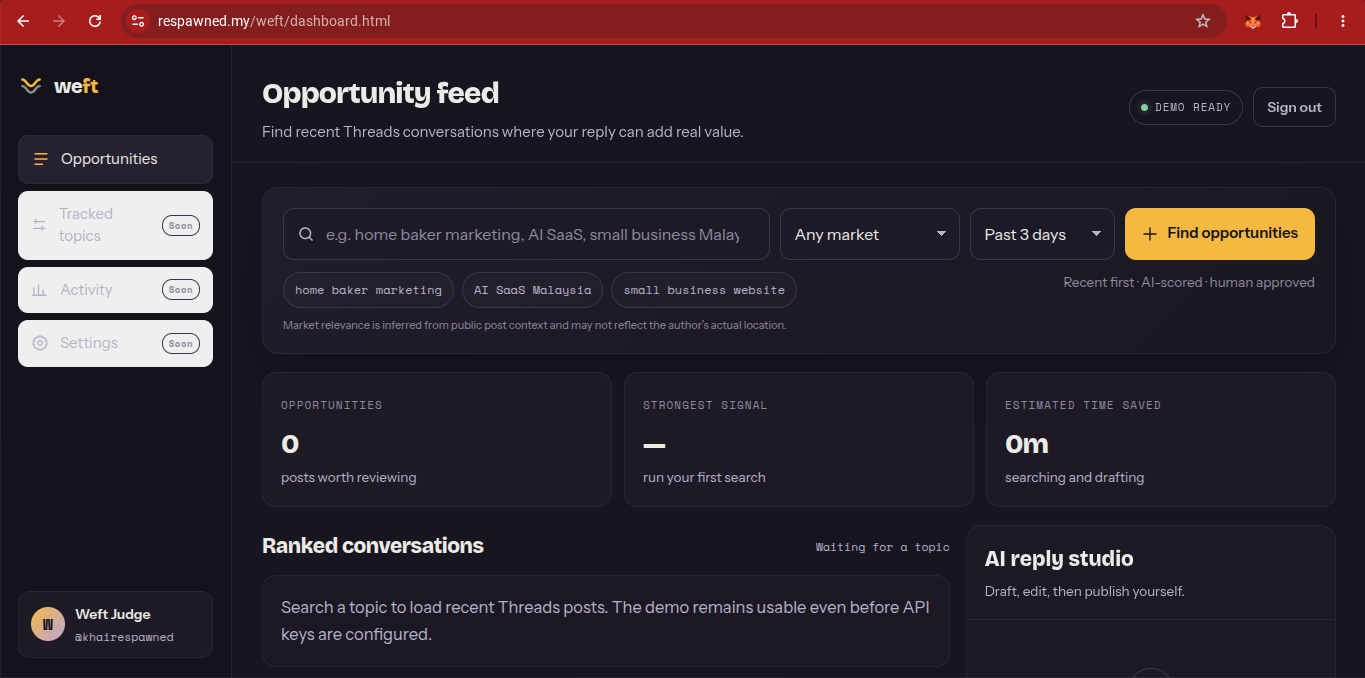
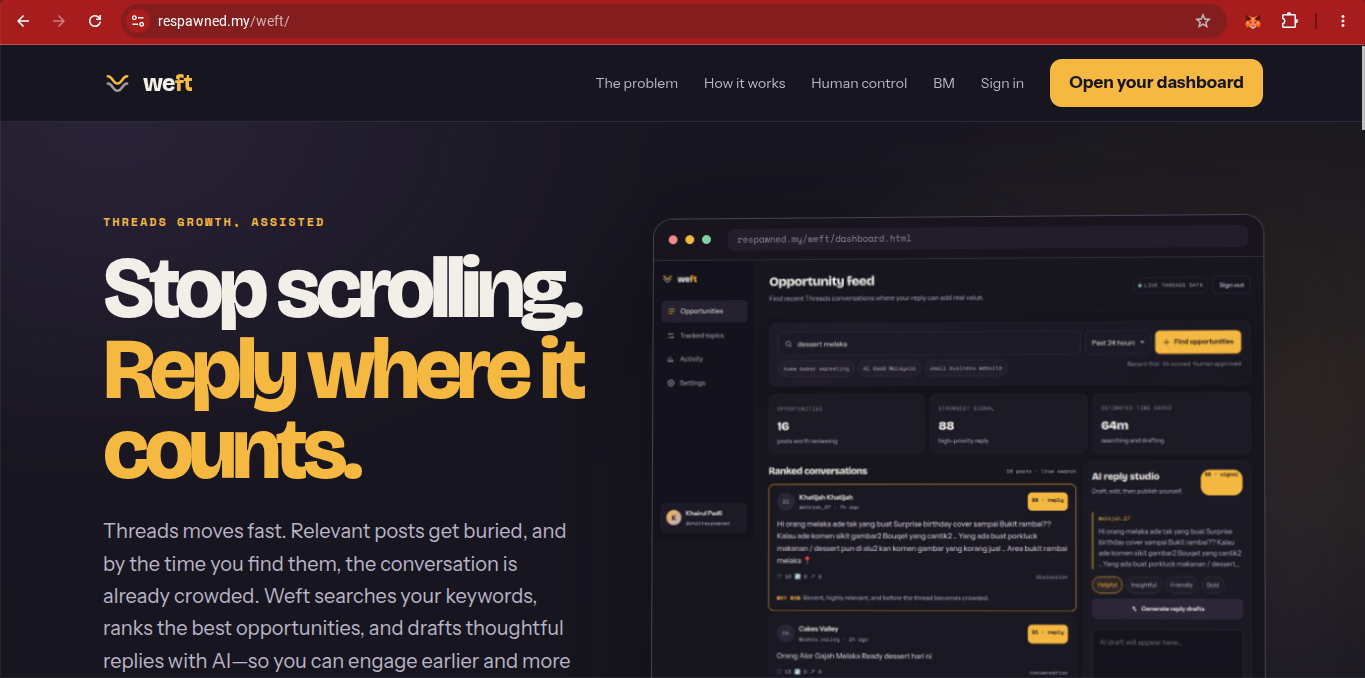
User Dashboard
-
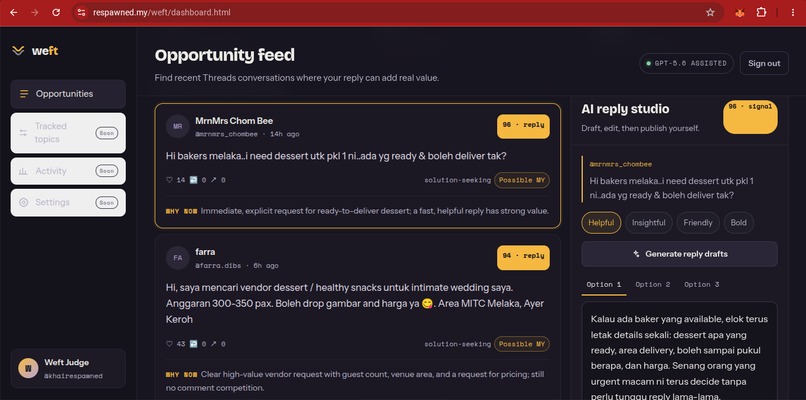
User Search Keywords
-
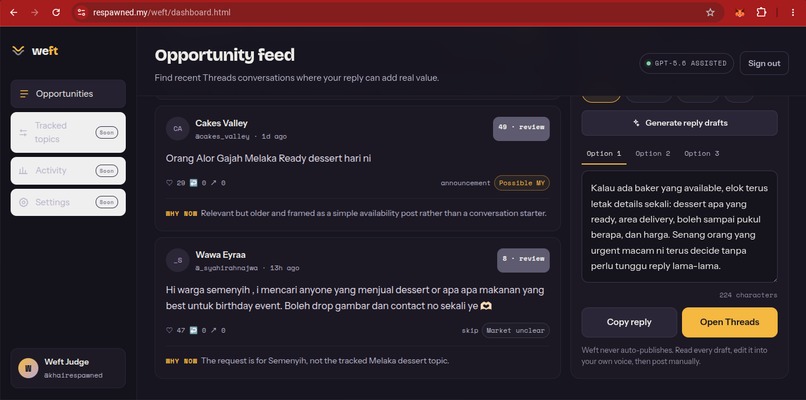
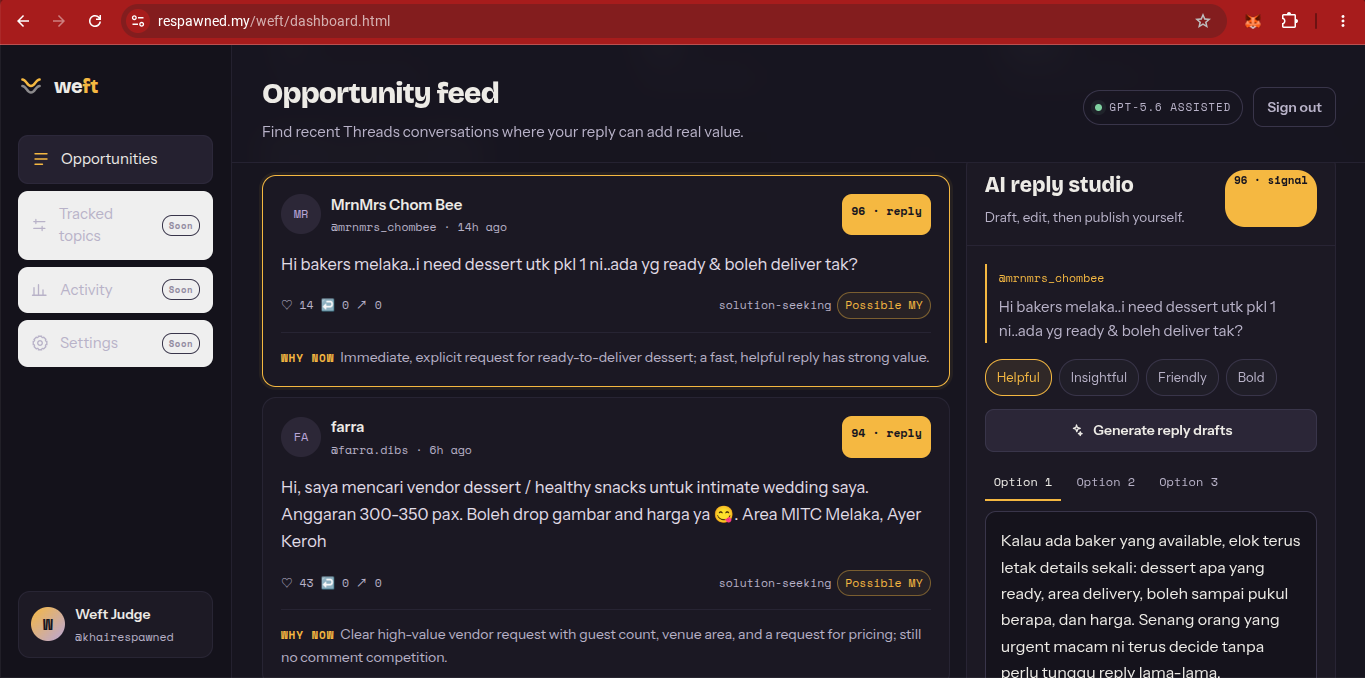
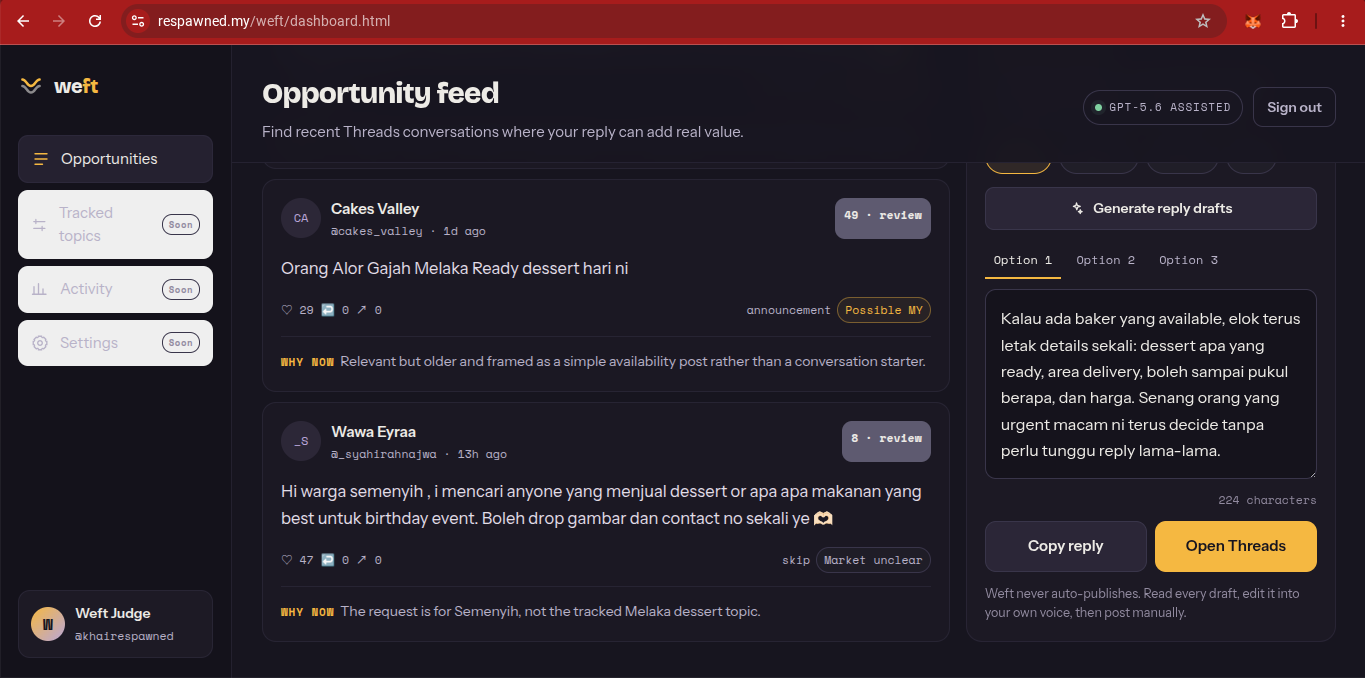
AI Reply Generator
-
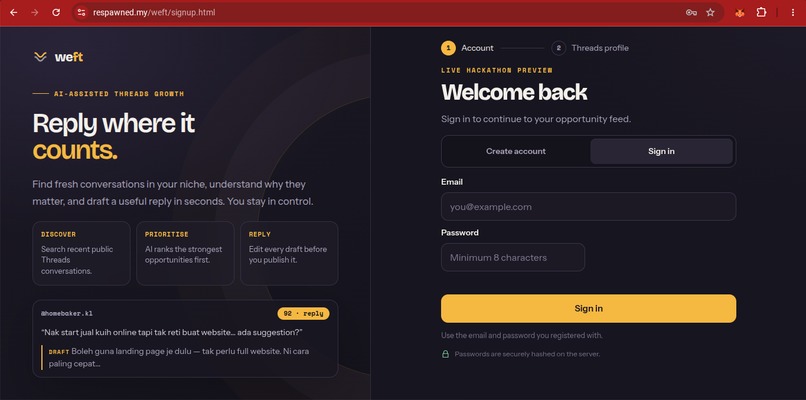
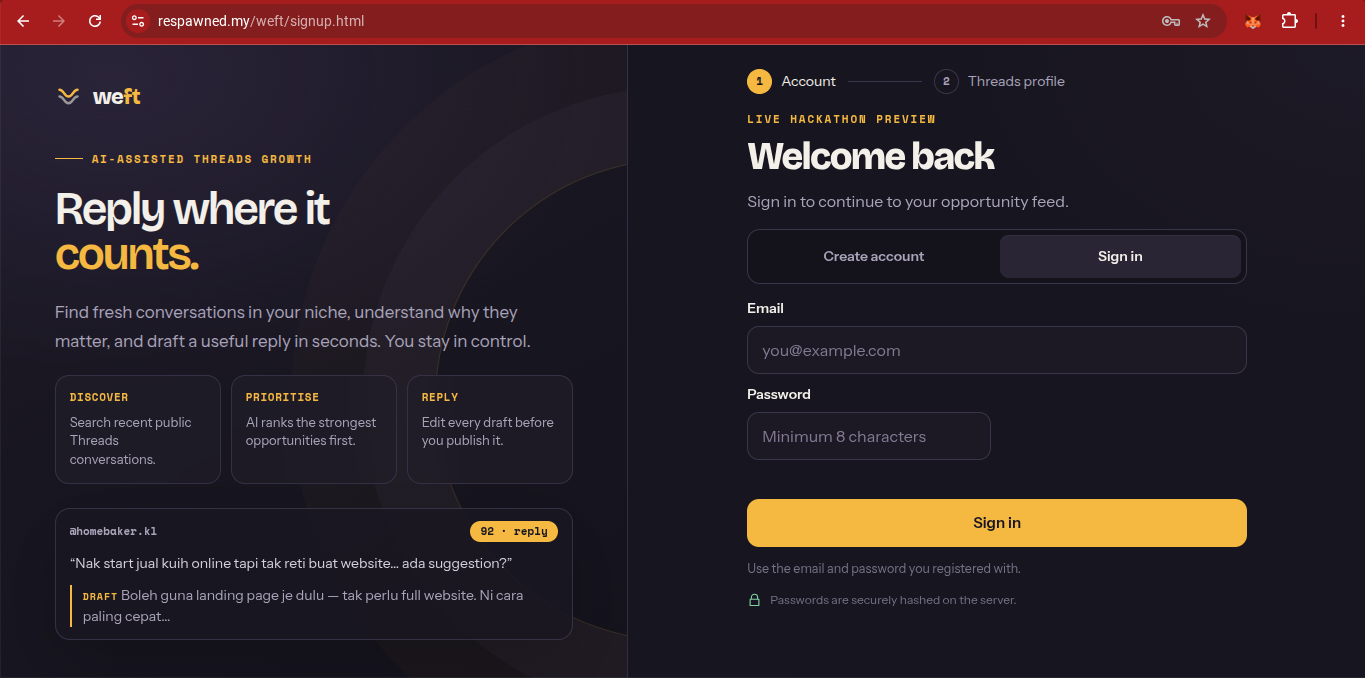
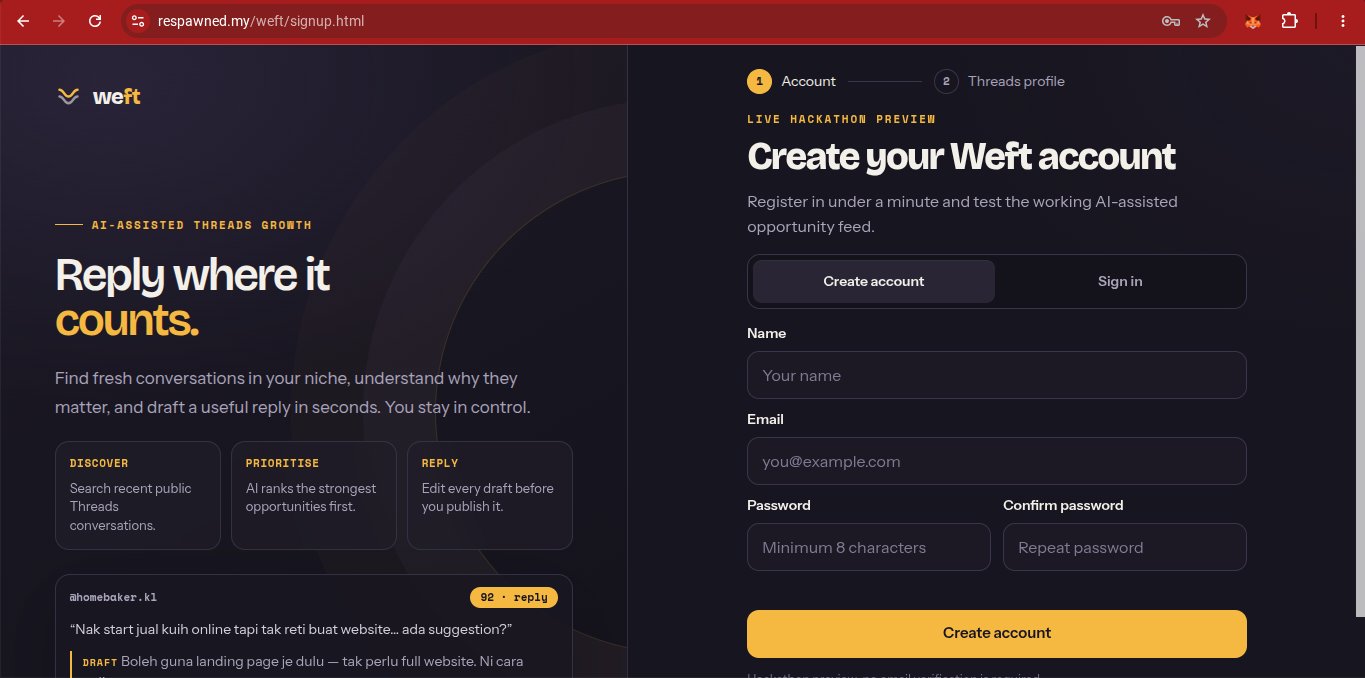
Sign up form
-
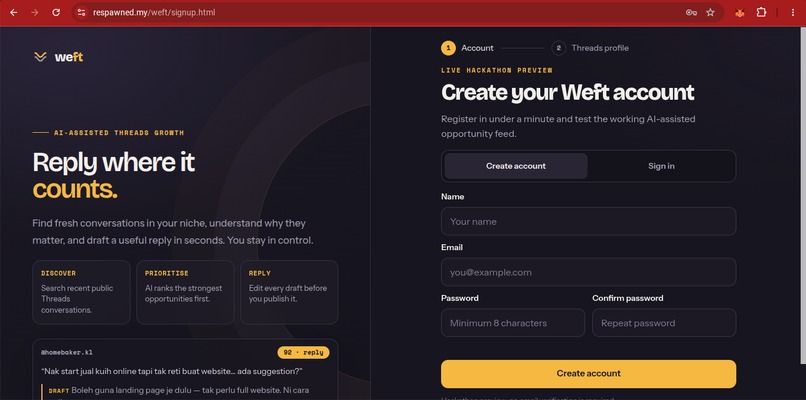
Sign in form
-
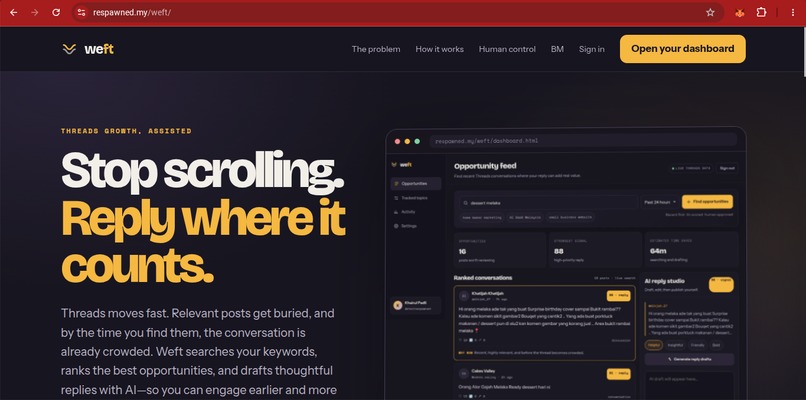
Inspiration
I am Khai, a solo developer from Malaysia.
I spend a lot of time on Threads, both observing how people behave and learning what actually creates engagement. One thing became very obvious to me: posting on your own account is only half the game.
Some of the best opportunities happen inside other people’s conversations.
Someone may be asking where to order a dessert in Melaka, looking for a reliable service provider, comparing business tools, or describing a problem that a seller already knows how to solve. But these conversations move quickly, and manually searching for them takes too much time.
That was the idea behind Weft.
I did not want to build another content generator or auto-posting bot. I wanted to build something that helps businesses discover the right conversations, understand which ones are worth responding to, and prepare a useful reply while keeping the human fully in control.
For me, Weft is not about creating more noise. It is about helping businesses participate in conversations where they can genuinely add value.
What it does
Weft searches recent public Threads conversations based on a topic selected by the user.
The user can enter a keyword, choose a time range, and select a target market such as Malaysia, Singapore, Indonesia, or global conversations.
Weft retrieves public posts through the SocialCrawl API and uses GPT-5.6 to analyse each conversation based on signals such as:
- Commercial or buying intent
- Topic relevance
- Recency
- Engagement potential
- Language and visible market context
The strongest opportunities are ranked first.
Each result includes an opportunity score, engagement information, an inferred market-relevance label, and a short explanation of why the conversation may be worth responding to.
After selecting a post, the user can generate several context-aware reply drafts. Weft can also match the language of the original conversation, including English, Malaysian Bahasa Melayu, and natural mixed BM-English conversations.
The reply is never published automatically.
The user can change the tone, edit the draft, copy it, and open the original Threads post before deciding whether to publish it manually.
The Build Week version also includes a secure admin dashboard that tracks registrations, active users, searches, AI analyses, generated drafts, credit balances, and administrative credit adjustments.
How we built it
Weft is deliberately built as a lean PHP application that can run on ordinary shared hosting.
I wanted the product architecture to match the reality of the users I hope to serve: small businesses should not require expensive infrastructure just to use a useful AI workflow.
The main stack includes:
- PHP for authentication, API endpoints, usage tracking, credits, and server-side logic
- JavaScript, HTML, and CSS for the user interface
- SocialCrawl for retrieving public Threads conversations
- GPT-5.6 for opportunity analysis, structured scoring, explanations, and reply generation
- Codex as my engineering collaborator during Build Week
- GitHub for version control and submission review
Weft already existed as an early functioning MVP before Build Week. It could retrieve public Threads posts, score opportunities, and generate editable reply drafts.
During Build Week, I used Codex to meaningfully extend and harden the product.
Codex helped me:
- Audit and sanitise the repository
- Establish a safe Git baseline
- Implement inferred target-market ranking
- Improve Malaysian BM and mixed-language reply consistency
- Build the administration and credit system
- Add structured usage tracking
- Create automated PHP and JavaScript tests
- Review security and billing behaviour
- Prepare production deployment packages
- Document the final repository and submission
I remained responsible for the product direction, architecture decisions, command approvals, production deployment, and live testing.
Challenges we ran into
One major challenge was market relevance.
Threads posts do not always include a verified location, and I did not want Weft to pretend that it knew where a user was physically located.
Instead, Weft treats market relevance as an inferred signal based only on visible public context, such as place names, language, currencies, local terminology, and the content of the conversation.
The interface clearly describes this as inferred relevance rather than verified location.
Another important challenge involved the credit system.
During a Codex review, we discovered that credits were being deducted before a request was sent to SocialCrawl or OpenAI. If the provider request failed, the credits were not automatically returned.
That was a real billing defect.
Codex helped implement an idempotent, file-lock-protected refund flow and added regression tests to prevent failed requests from charging users or producing duplicate refunds.
The other challenge was security on shared hosting.
Sensitive configuration, API keys, password hashes, runtime data, usage logs, and audit records had to remain protected from both direct web access and the public repository.
We separated live configuration from version-controlled files, added server access rules, ignored runtime data in Git, scanned the repository for secrets, and validated protected endpoints before submission.
Accomplishments that we're proud of
I am proud that Weft is not only a prototype or a collection of screenshots. It is a working product running on a live server.
During Build Week, we successfully:
- Searched and ranked real public Threads conversations
- Added market-aware opportunity discovery based on actual product feedback
- Generated natural English, Bahasa Melayu, and mixed BM-English replies
- Kept every reply editable and human-approved
- Built a secure admin, usage, audit, and credit foundation
- Found and fixed a real credit-refund defect before submission
- Added automated regression tests
- Sanitised and published a clean private GitHub repository
- Deployed and validated the complete workflow in production
I am also proud that Weft takes a responsible approach to AI-assisted engagement.
It does not auto-post, impersonate users, or try to generate mass replies. It helps users identify relevant conversations and prepare a thoughtful response, but the final decision always remains with the human.
What we learned
This project reinforced something I strongly believe about building products with AI: speed is useful, but judgement still matters.
Codex allowed me to move much faster, especially when reviewing a large codebase, tracing dependencies, writing tests, and checking security-sensitive flows.
But the most productive workflow was not giving an AI unlimited control.
The best results came when I provided the product direction, Codex proposed or implemented a solution, and I reviewed, tested, challenged, and approved each meaningful change.
I also learned that real user observations are often more valuable than adding random features.
The target-market system was built because English search terms were returning too many overseas conversations for Malaysian users. That feedback produced a practical improvement that immediately made Weft more useful.
Finally, I learned that a lean shared-hosting architecture can still support a serious working MVP when the boundaries are designed carefully.
What's next for Weft
The next stage is to validate Weft with Malaysian small businesses, service providers, founders, and independent professionals who are already active on Threads.
Future development may include:
- Saved searches and tracked topics
- Notifications when strong opportunities appear
- Team accounts and shared workflows
- Subscription billing and configurable credit plans
- Richer performance and conversion analytics
- Better personalisation based on the user’s business
- Official Threads integrations where they genuinely improve the workflow
The core principle will remain the same.
Weft will help users discover and understand valuable conversations, but publishing will remain manual and human-approved.
The goal is not to automate spam.
The goal is to help businesses show up in the right conversation, at the right time, with something useful to say.

Log in or sign up for Devpost to join the conversation.