Inspiration
Climate change often feels like a global problem that ordinary people cannot influence. During our research, we realized that many schools, eco-clubs, nonprofits, and even small businesses genuinely want to become more sustainable, but they face a simple problem: they cannot improve what they cannot measure.
What it does
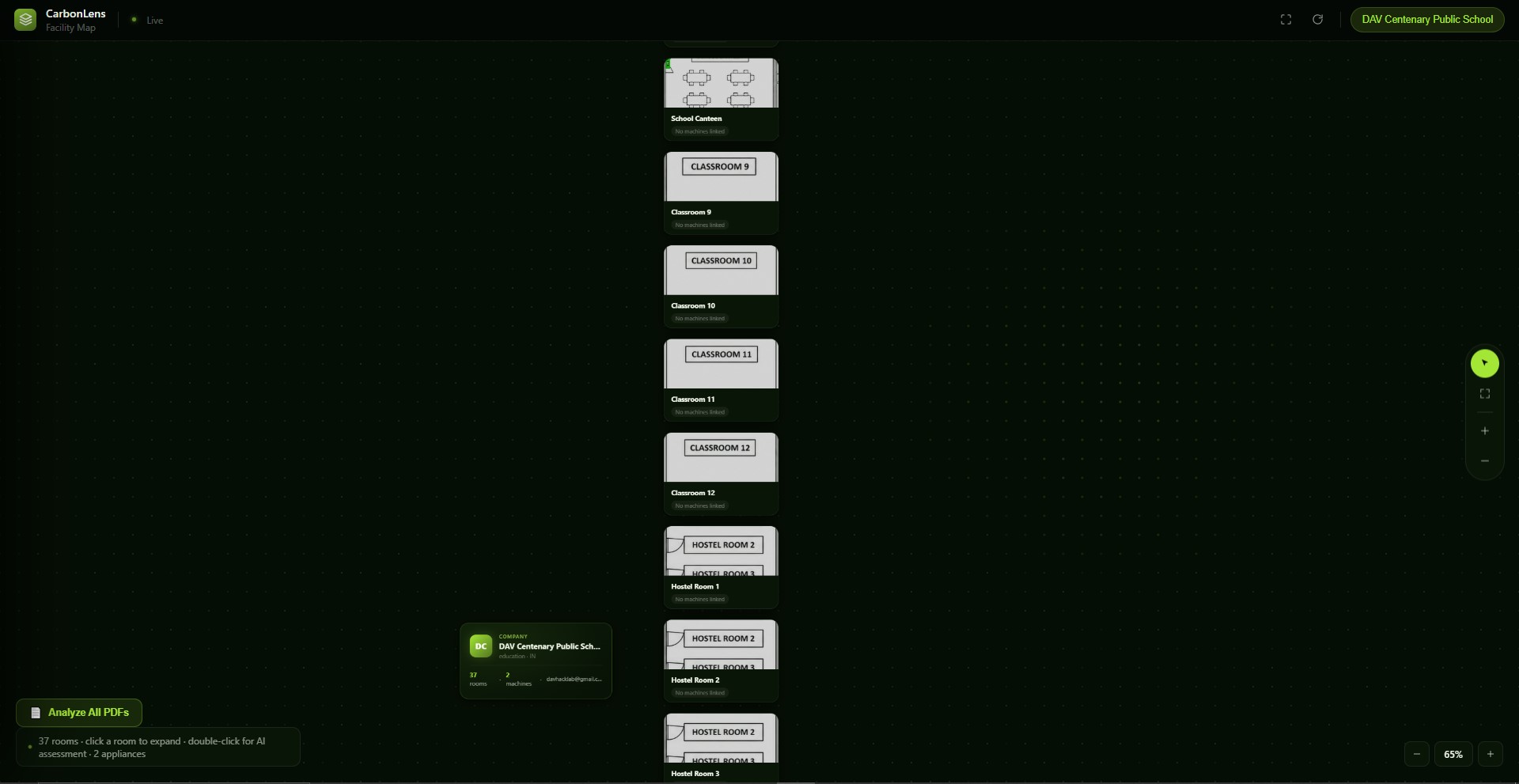
CarbonLens is an AI-powered carbon intelligence platform that helps schools, MSMEs, and organizations uncover their hidden environmental footprint. Users can upload utility bills and operational records, describe assets in everyday language, and visualize their emissions through a digital twin workspace. CarbonLens then identifies emission hotspots and converts complex carbon data into practical "Green Nudges" such as optimizing HVAC schedules, reducing waste, and prioritizing cost-effective sustainability actions. The platform generates audit-ready reports while maintaining strong privacy and keeping humans in control of final decisions.
How we built it
CarbonLens combines several technologies working together: Gemini API for adaptive onboarding and natural language understanding. A custom LLM strategy engine to generate localized recommendations. A deterministic Python backend that performs all carbon calculations and eliminates mathematical hallucinations. Semantic Vector Databases that translate informal asset descriptions into verified emission factors. OpenCV and EasyOCR pipelines for automated document and floor-plan processing. Spatial Digital Twin mapping to support organizations with shared utility infrastructure. This layered architecture allows CarbonLens to remain both user-friendly and technically reliable.
Challenges we ran into
One of our biggest challenges was balancing simplicity with accuracy. Most users do not know technical engineering terminology, while carbon accounting requires precise emission factors.
Another challenge involved AI reliability. Language models are excellent at communication but not always at calculations. To prevent errors, we completely separated language generation from mathematical processing and delegated all emissions equations to a hardcoded Python engine.
We also faced challenges related to privacy, shared utility meters, and ensuring that uncertain AI outputs never become official records without human verification.
Accomplishments that we're proud of
Building a hallucination-resistant carbon accounting workflow. Creating a semantic translation layer that removes technical barriers for non-experts. Designing a system that works not only for schools but also for MSMEs and community organizations. Making sustainability reporting accessible without expensive consultants. Incorporating responsible AI practices through confidence scoring and human oversight.
What we learned
This project taught us that technology alone does not create impact. People need solutions that are understandable, affordable, and actionable.
We learned the importance of responsible AI, data integrity, and keeping humans involved in important decisions. We also discovered that solving real-world problems requires understanding user frustrations as much as building advanced technology.
What's next for CarbonLens
Our immediate goal is to expand CarbonLens beyond schools and support MSMEs, nonprofits, and local organizations that struggle to access sustainability expertise.
Future plans include:
Integration with IoT sensors for real-time monitoring. More detailed Scope 1, Scope 2, and Scope 3 emissions analysis. Expanded regional emission databases. Automated sustainability benchmarking. Support for green financing applications and compliance reporting.
Ultimately, we envision CarbonLens becoming an affordable climate intelligence platform that empowers local communities around the world to turn awareness into meaningful action.

Log in or sign up for Devpost to join the conversation.