-
-
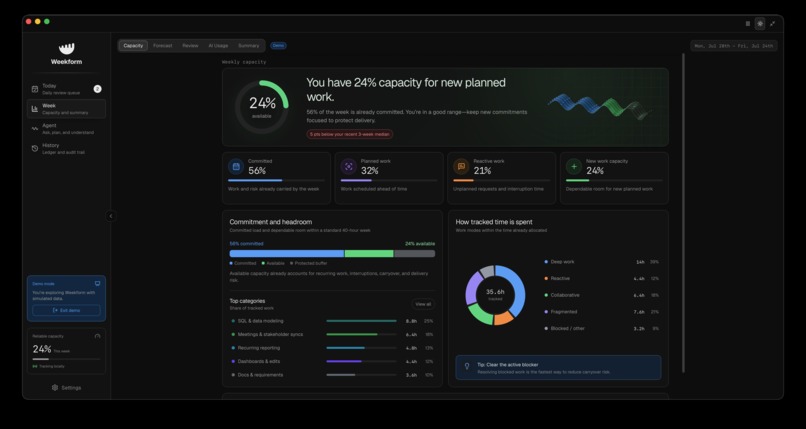
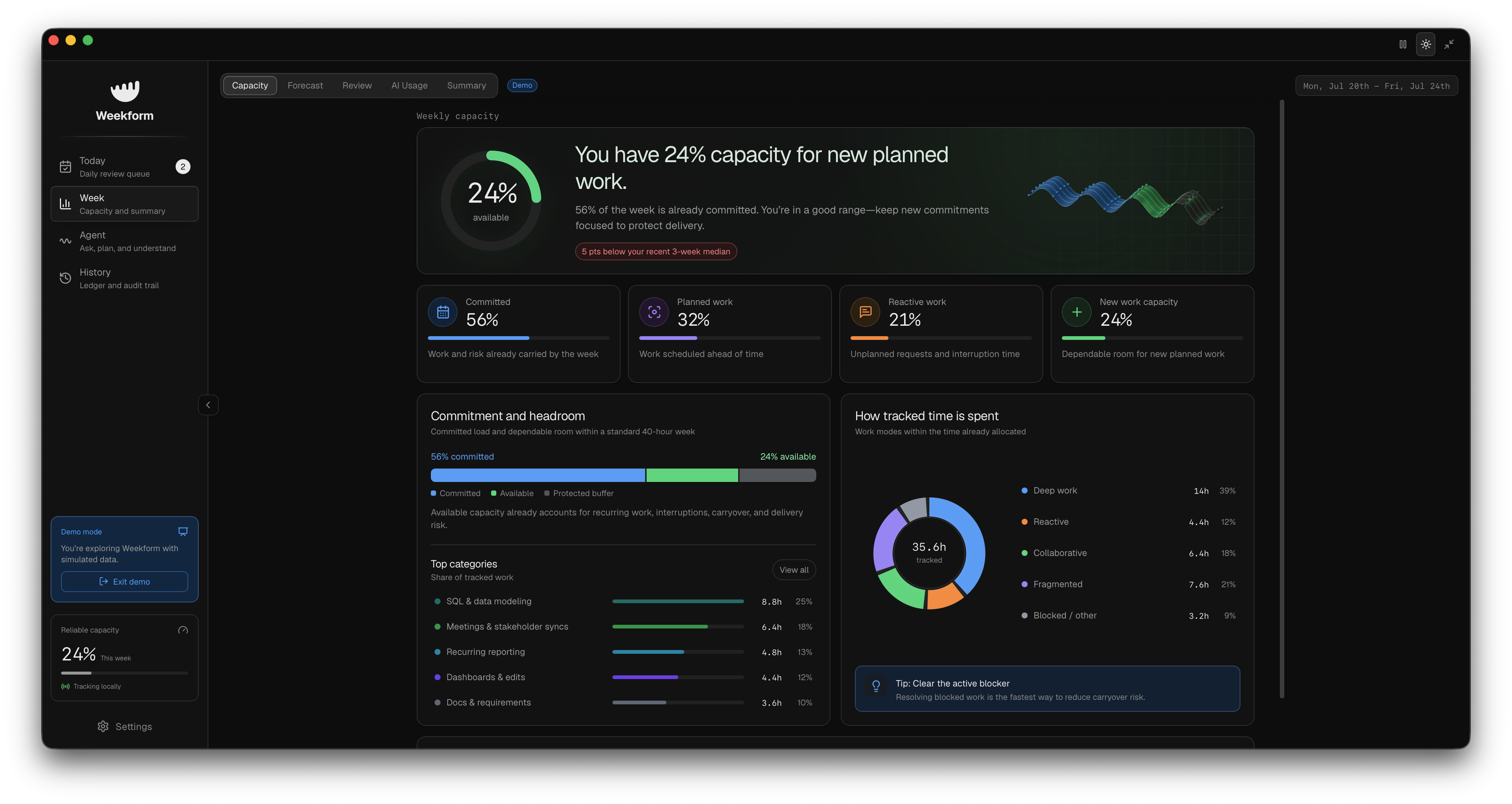
Weekly capacity view
-
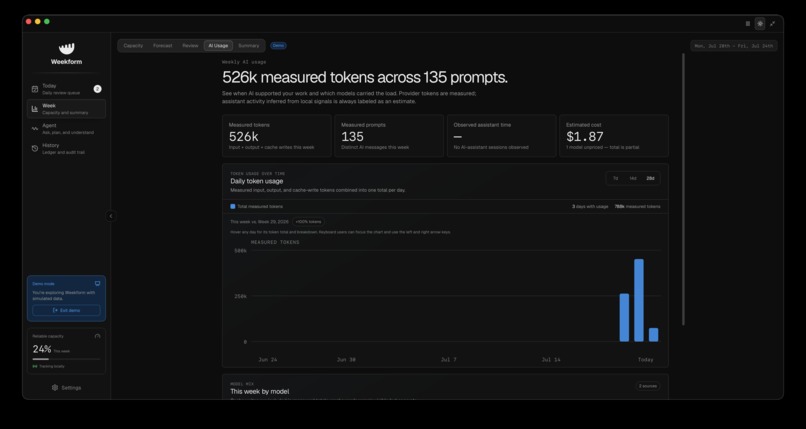
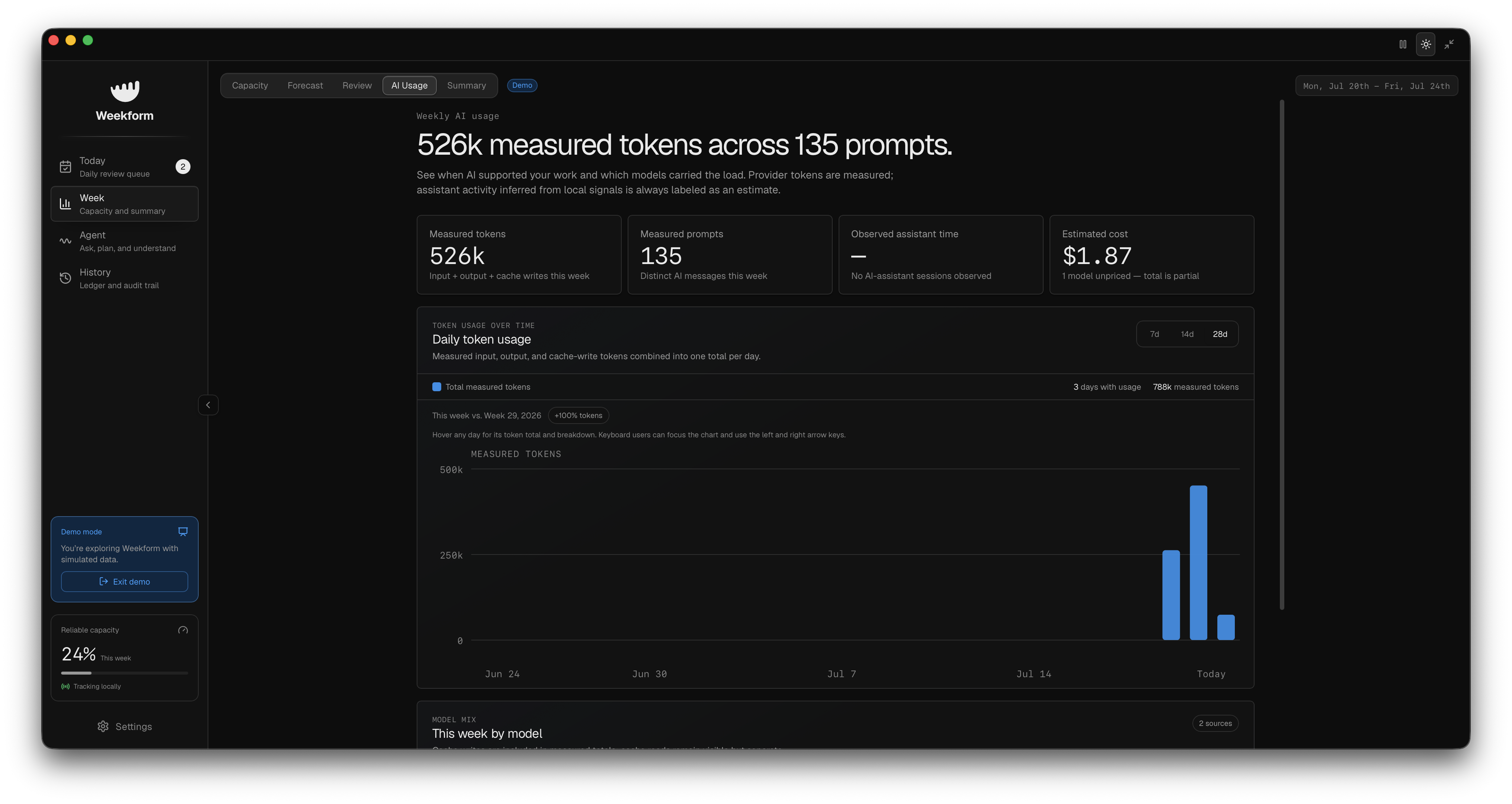
AI usage tracker
-
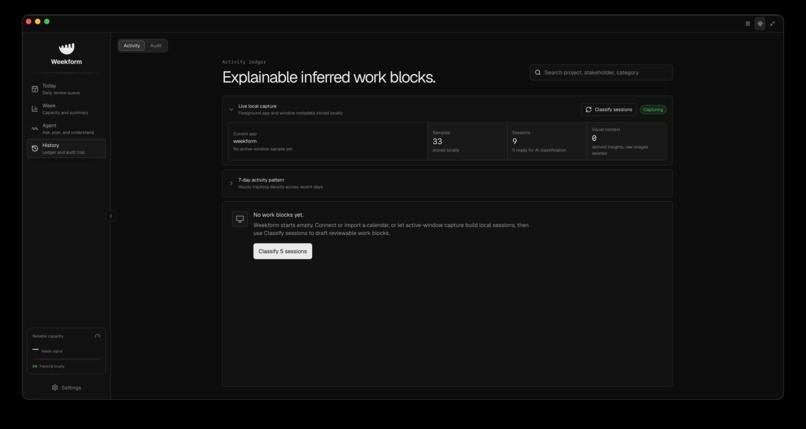
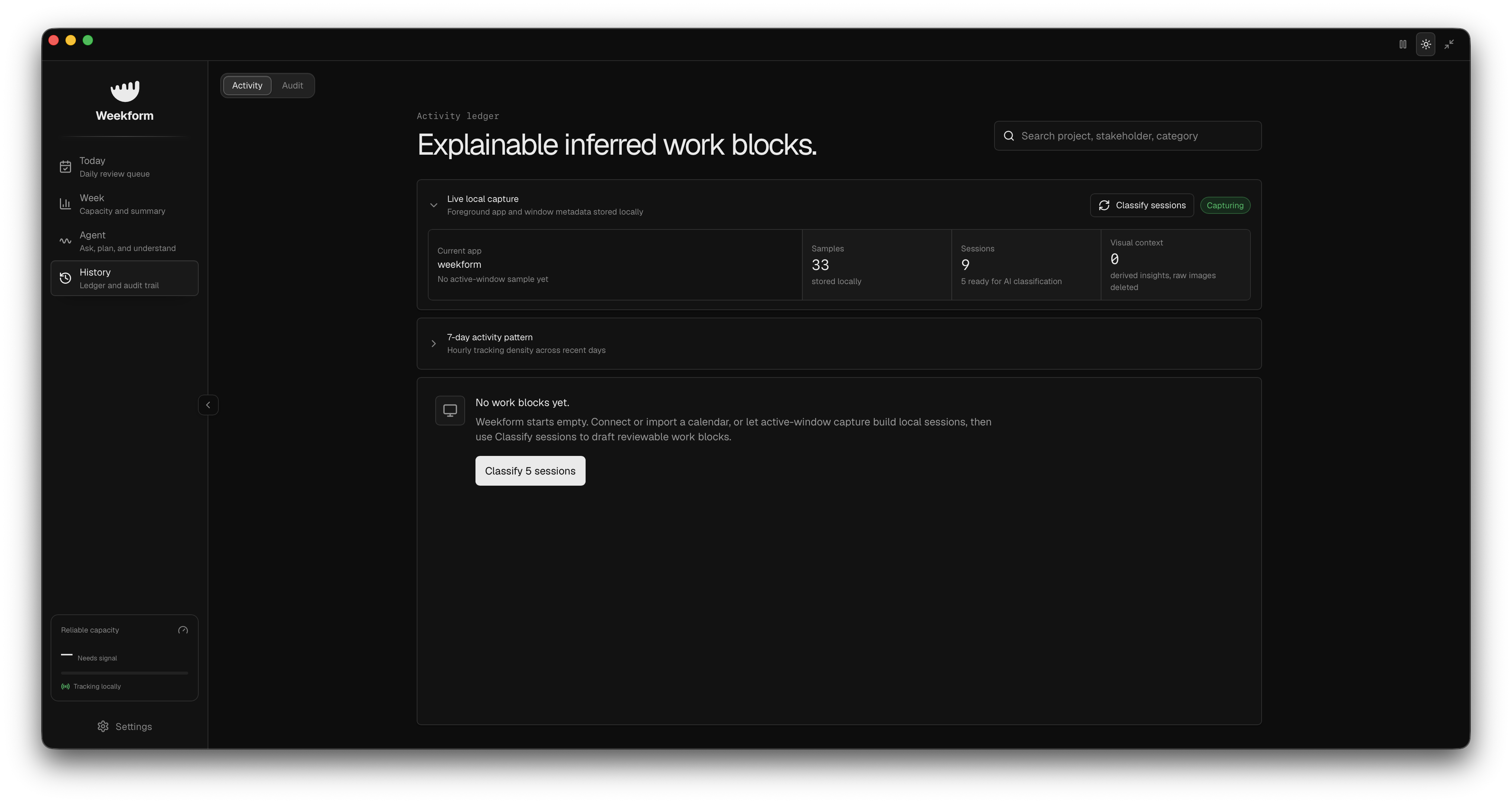
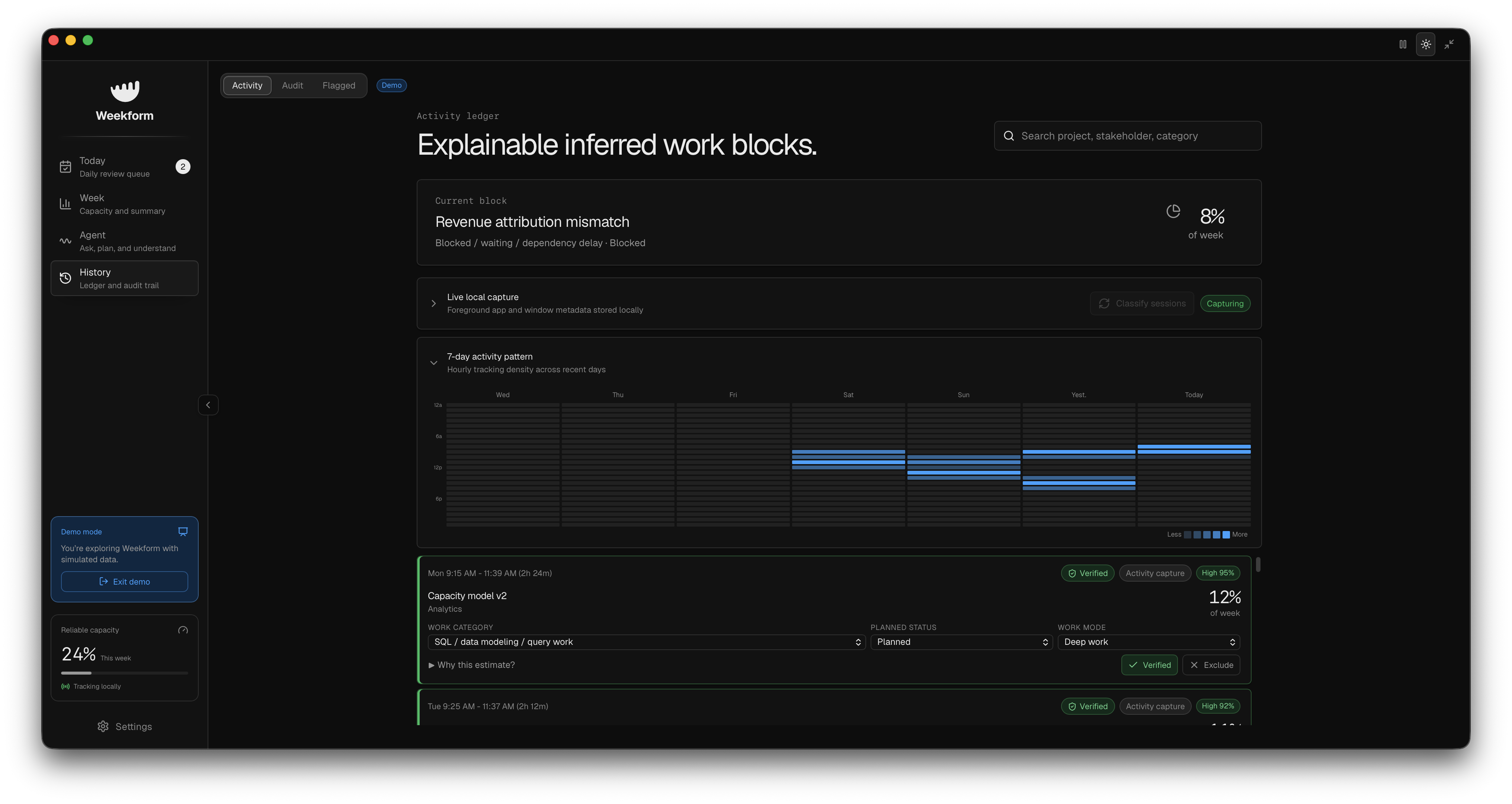
Activity ledger
-
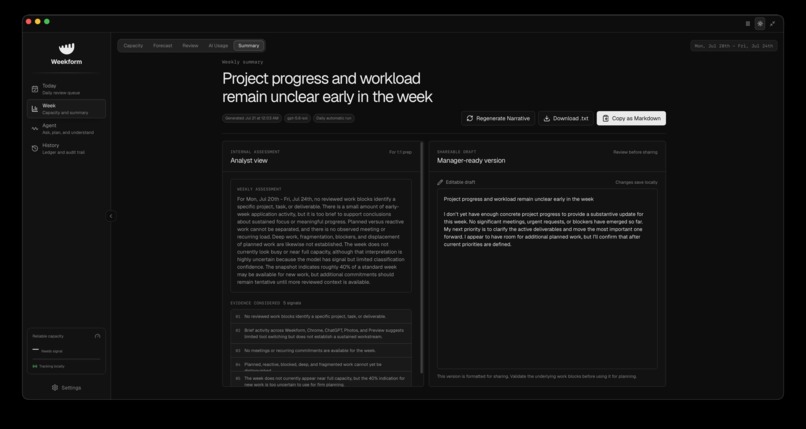
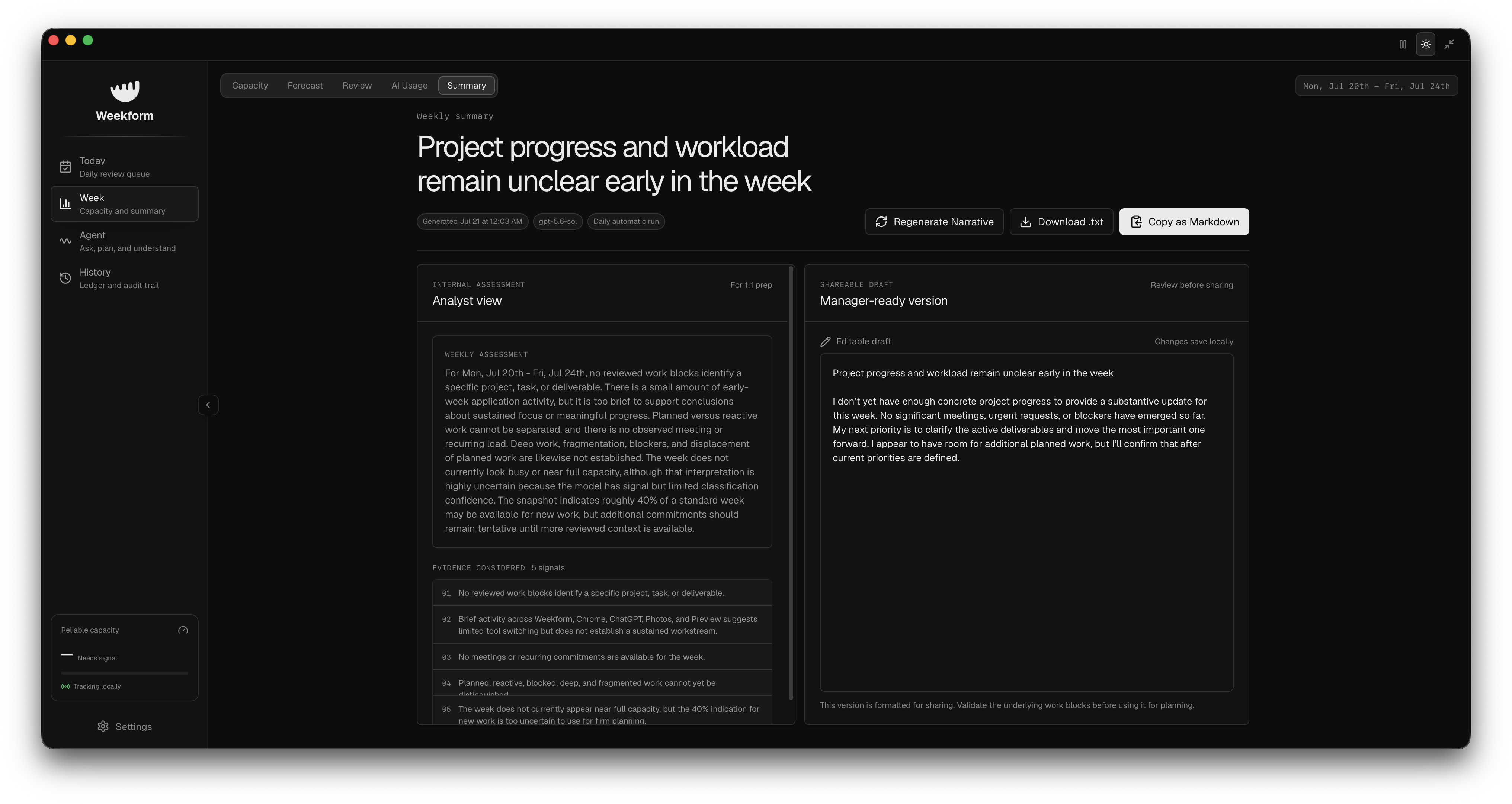
Weekly summary for managers
-
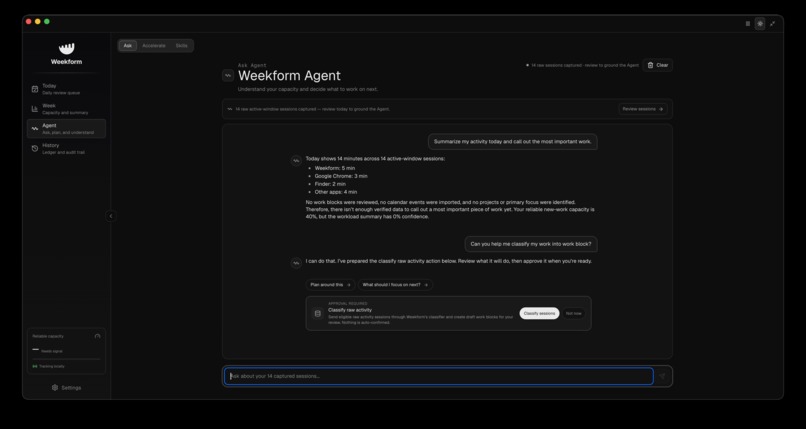
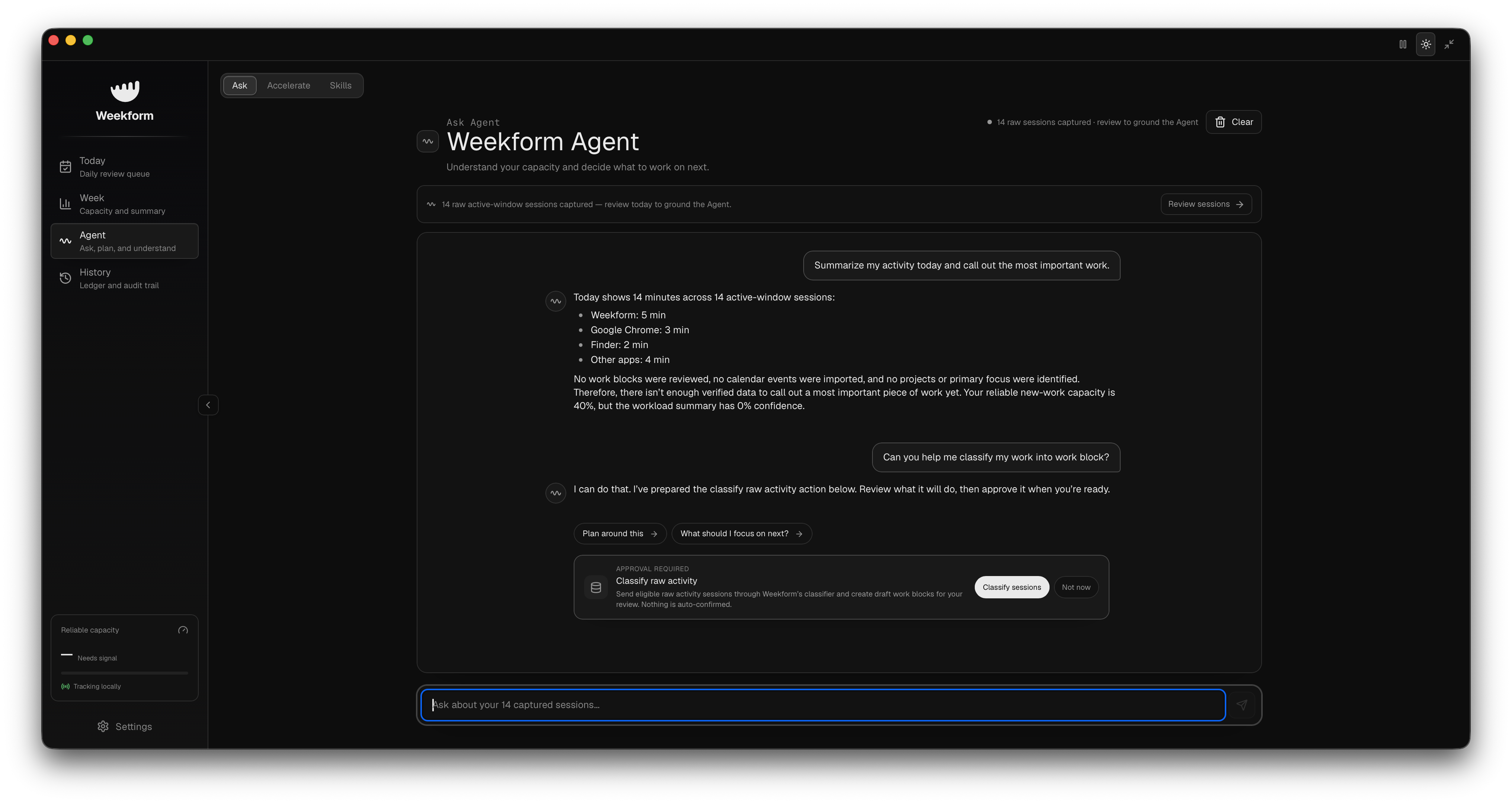
Weekform agent
-
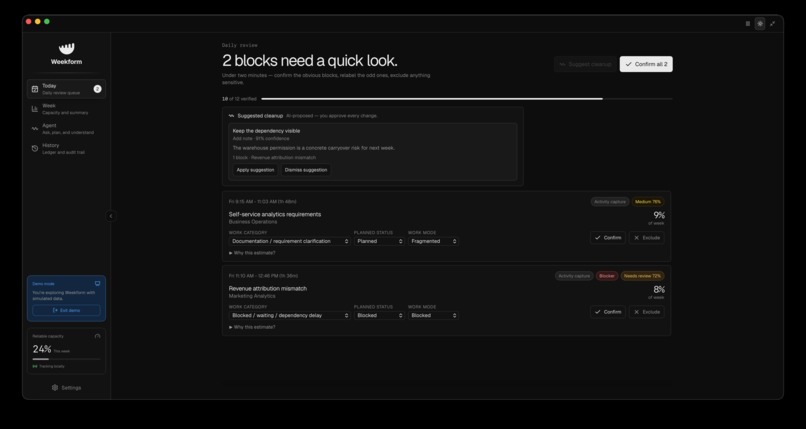
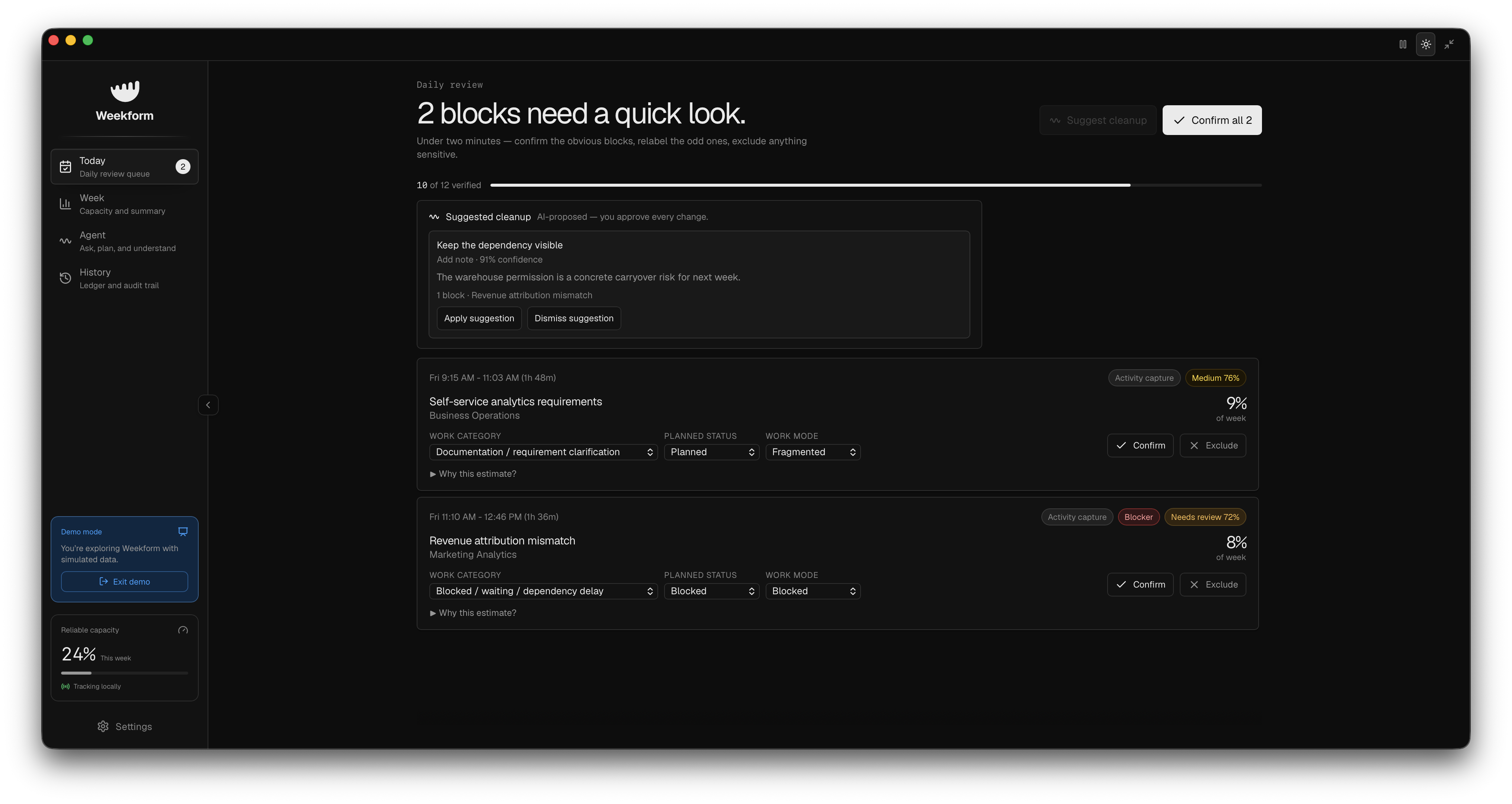
Daily review
-
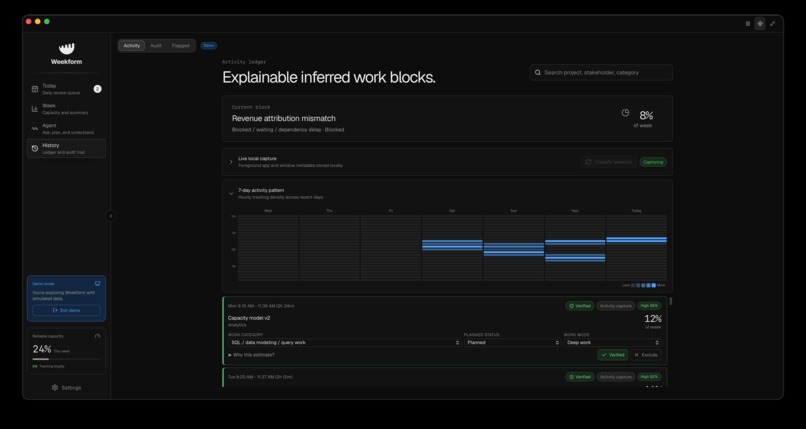
Activity pattern
-
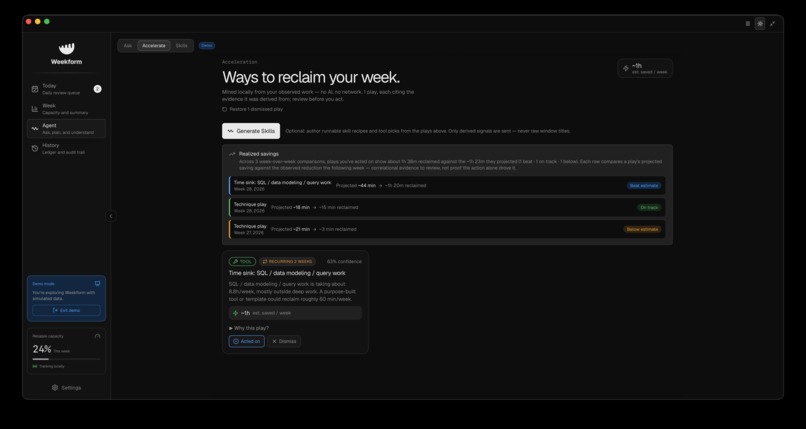
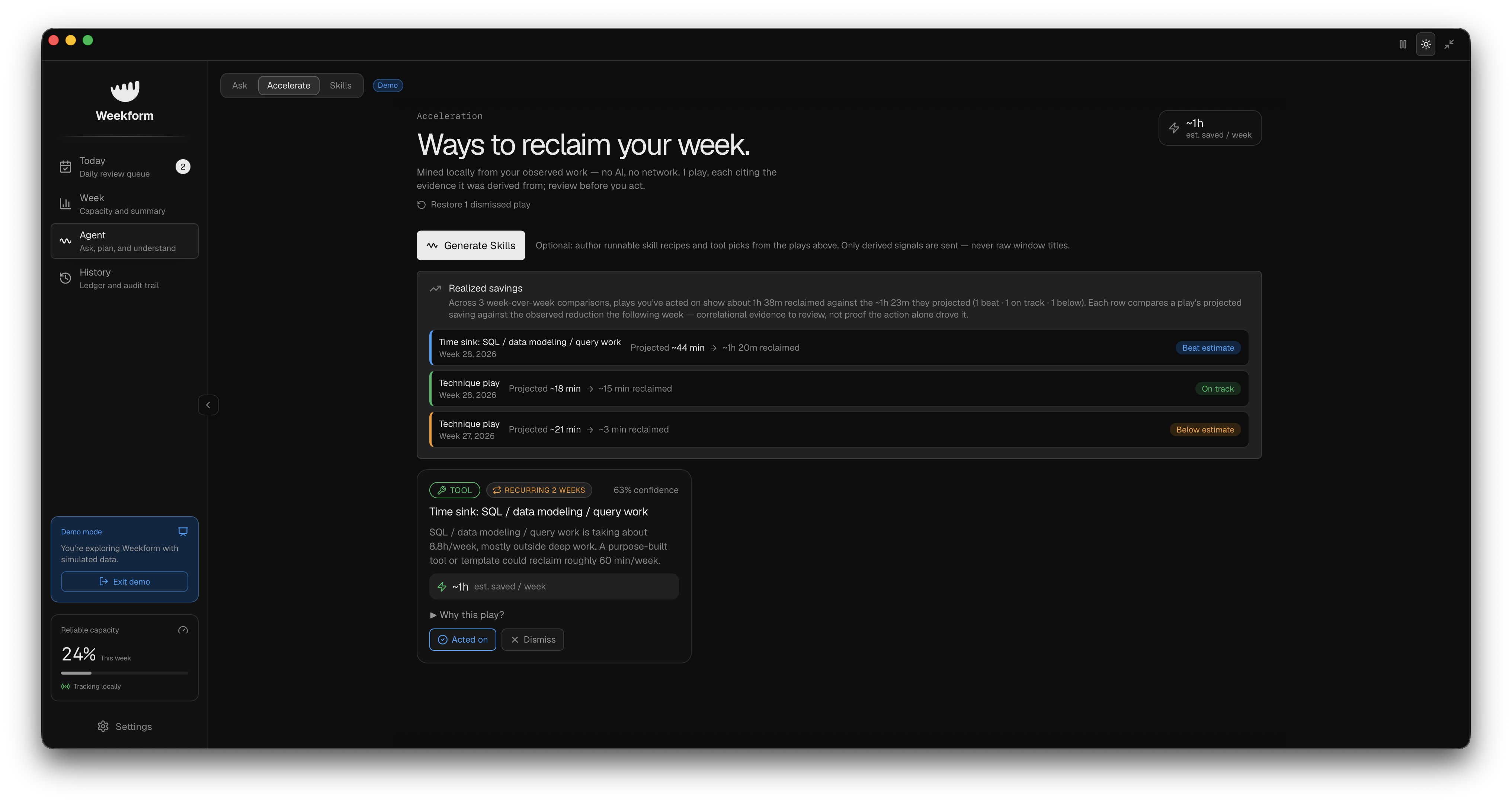
Inferred acceleration
-
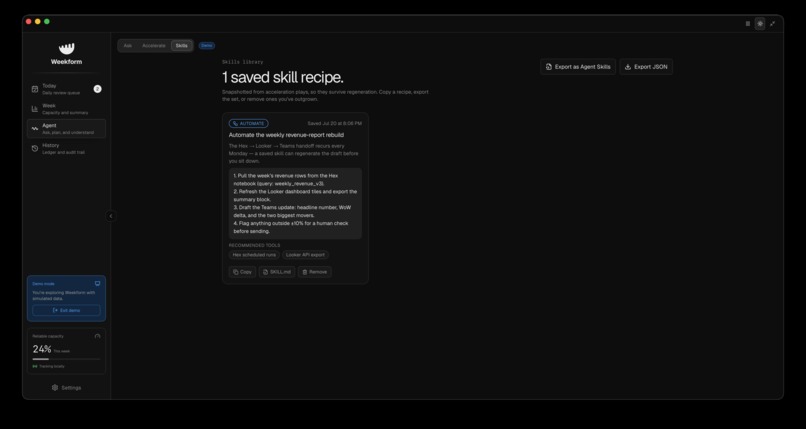
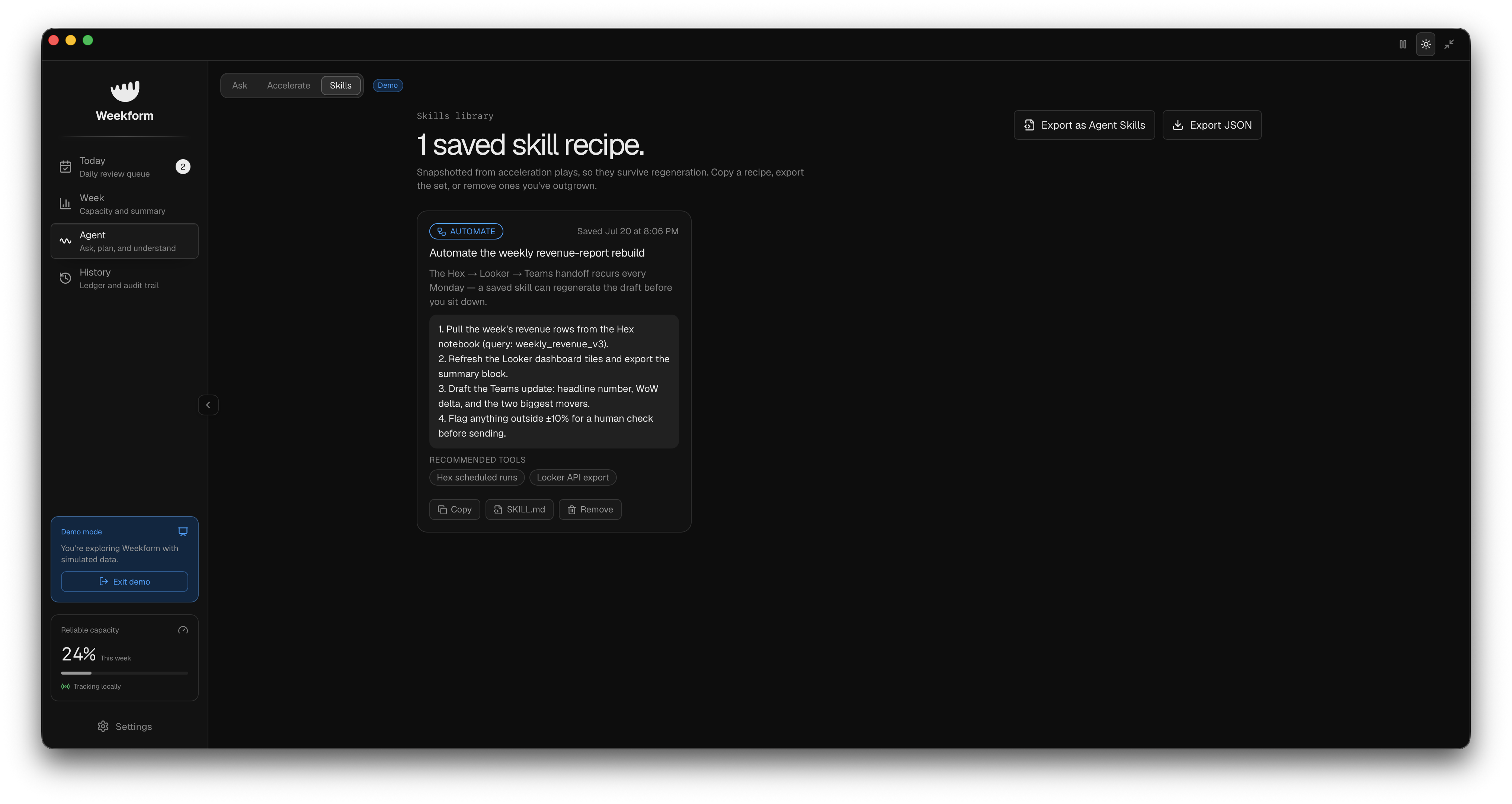
Skills library
-
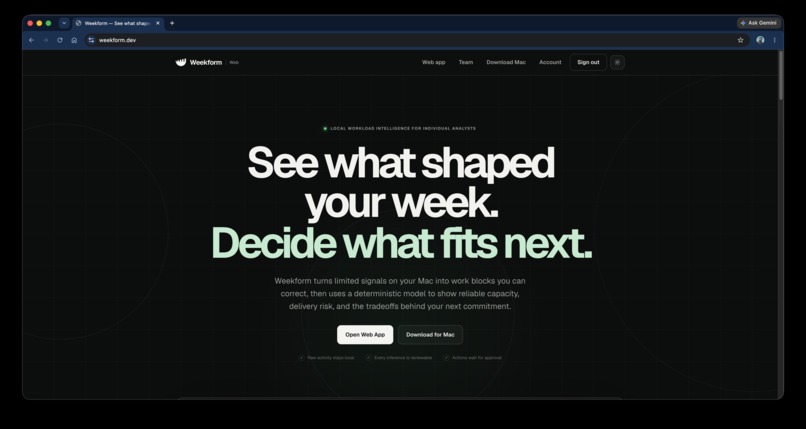
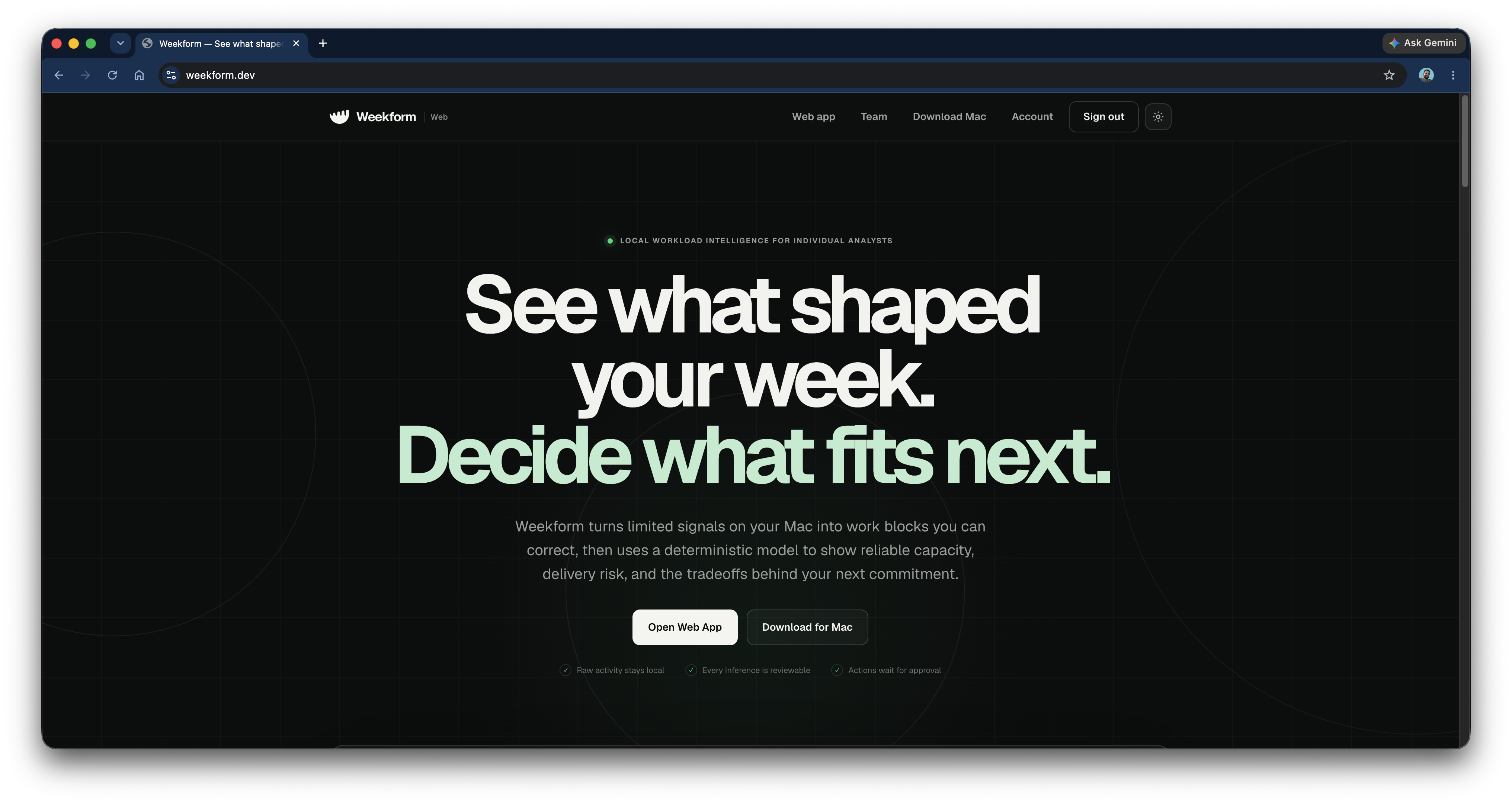
Weekform.dev landing page
-
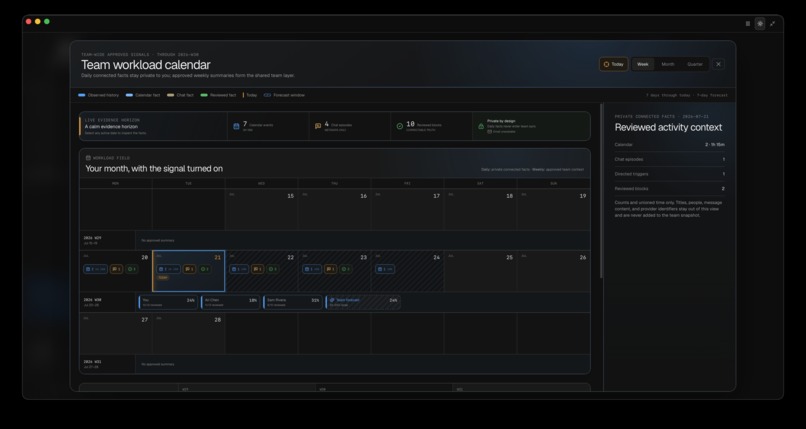
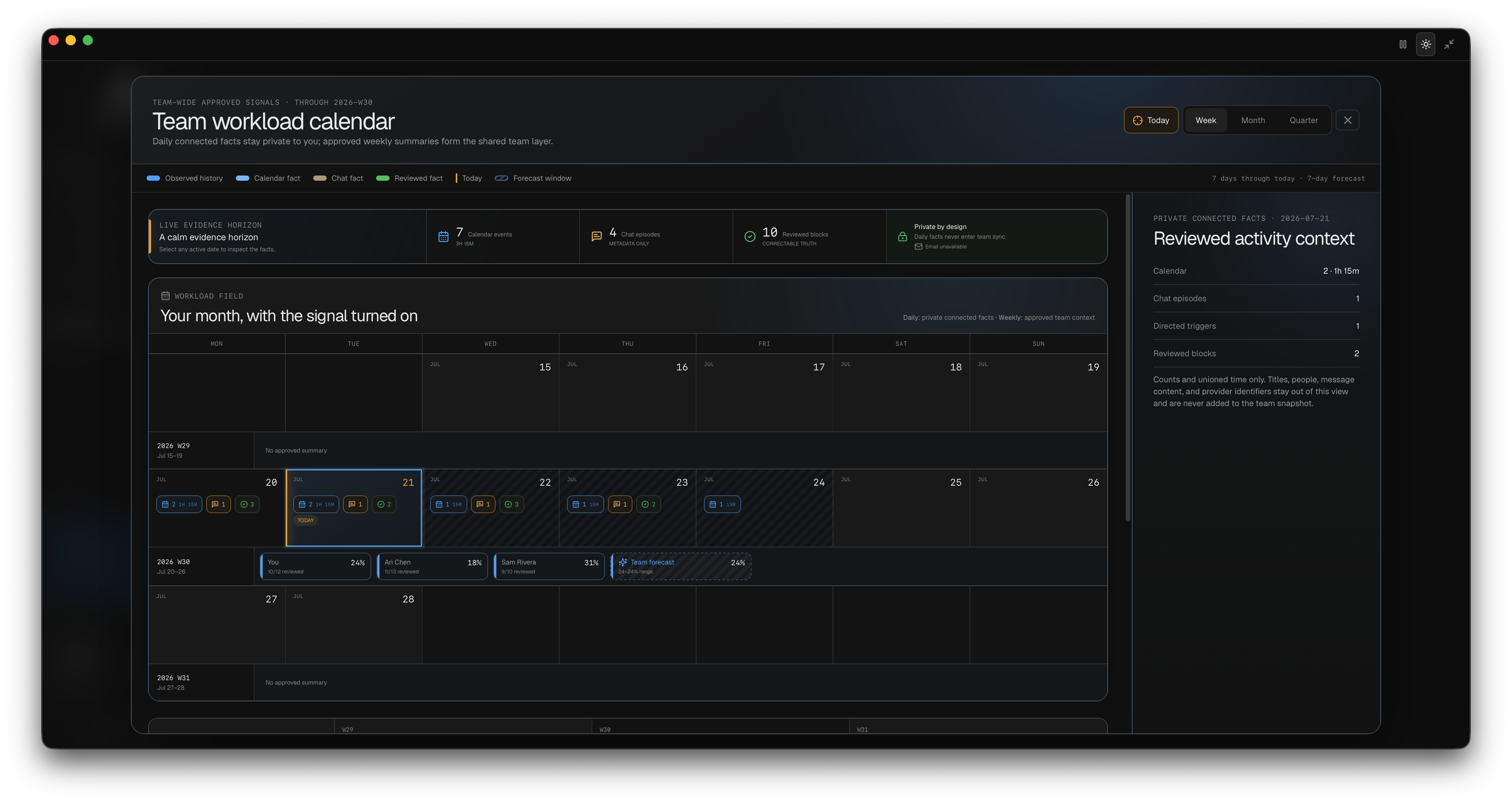
Workload calendar
-
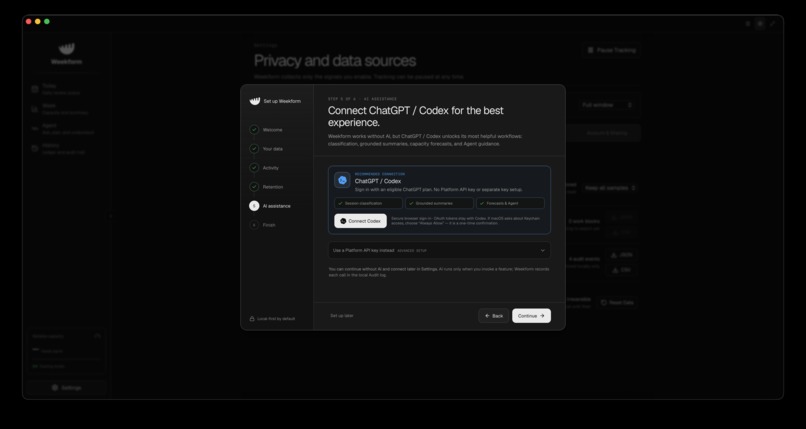
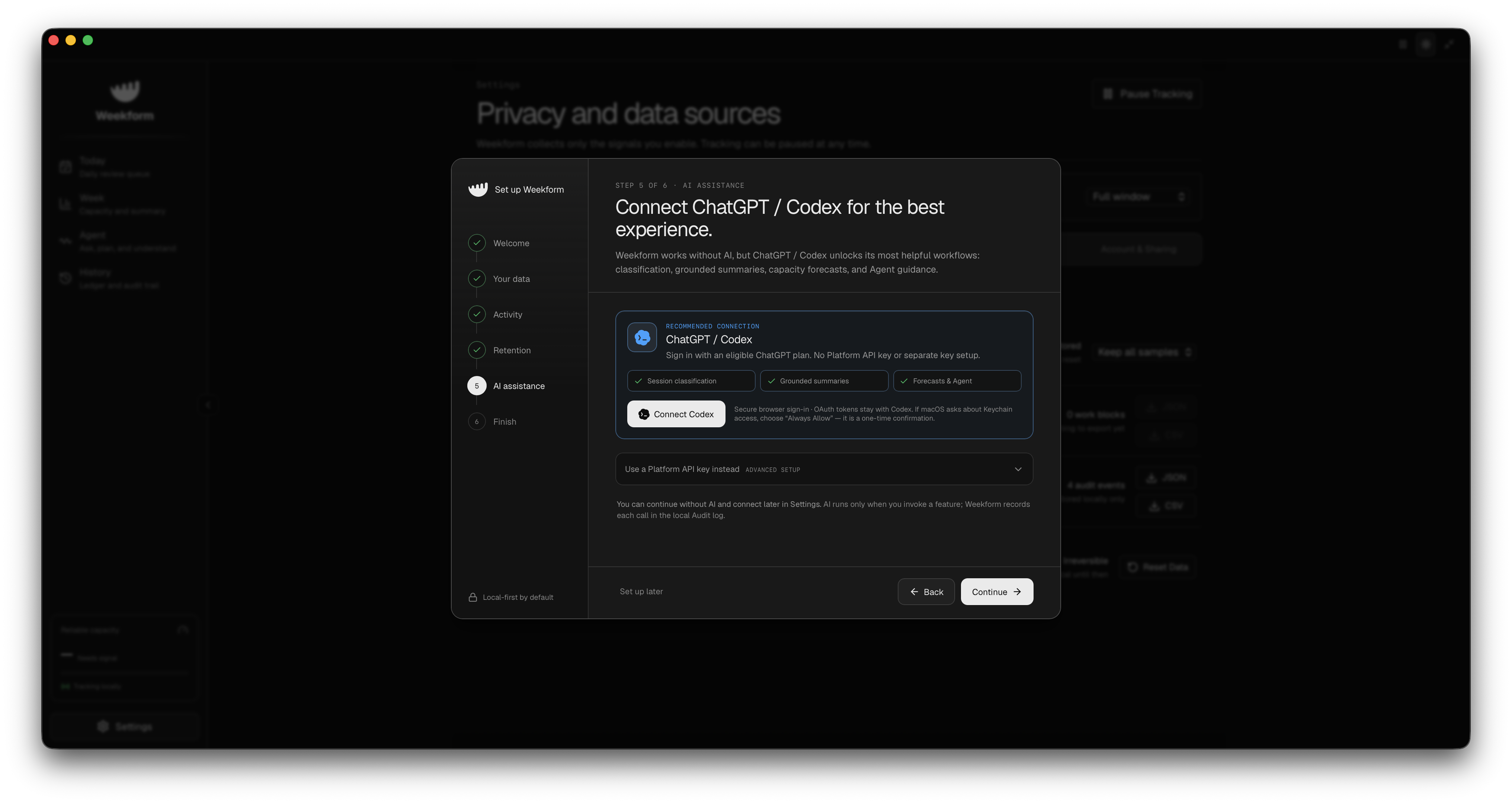
Connect Codex
-
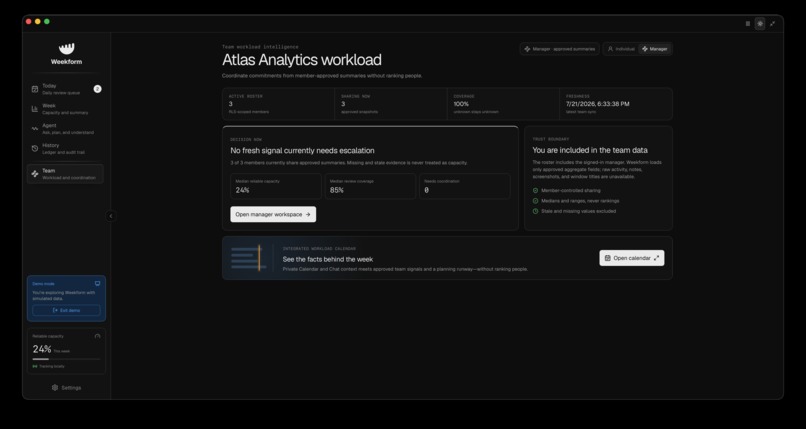
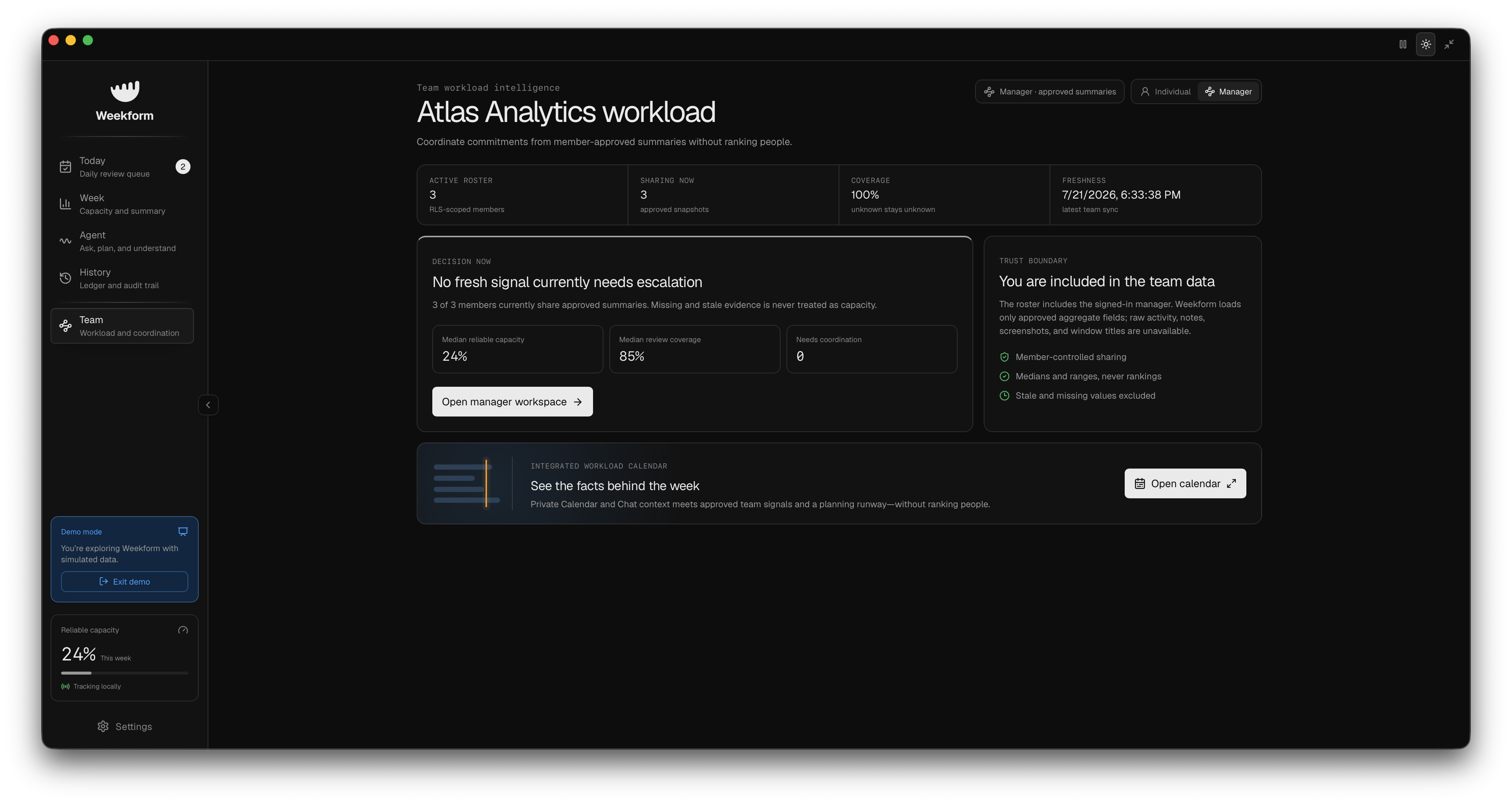
Team workload
Inspiration
Weekform began with a simple question: “Can you take this on next week?”
Calendars show scheduled time. Task trackers show planned work. Neither reflects the full reality of knowledge work, where meetings, chat requests, recurring tasks, urgent analysis, and unfinished projects compete for the same limited capacity.
Weekform helps people understand what is already in motion and what can realistically fit next.
It is designed as a private planning tool, not a timesheet, productivity score, or surveillance system. Users control what is reviewed, corrected, and shared.
What it does
Weekform is a local-first macOS workload intelligence app.
It turns limited signals from calendars, applications, chat activity, Git history, and local imports into reviewable work blocks. Users can confirm, relabel, annotate, or exclude those blocks before they affect the workload model.
Weekform then estimates:
- Planned and reactive workload
- Recurring commitments
- Fragmentation and carryover risk
- Reliable capacity for new work
It also includes optional AI-assisted classification, forecasts, summaries, and workload questions. The core capacity model remains deterministic and inspectable.
Users can optionally share approved weekly aggregates with a team. Raw activity, application titles, and unreviewed evidence are not shared.
How we built it
Weekform is built with Tauri, React, TypeScript, and Rust.
The desktop app handles local activity review, workload modeling, forecasting, and privacy controls. Shared packages process signals, group sessions, calculate capacity, and manage approved data sharing.
We also built a Next.js web experience using Supabase for authentication, teams, invitations, shared snapshots, and manager dashboards.
Kyle led the product direction, Mac experience, privacy model, and workload design. Rohn led the web application, deployment, authentication, and team workflows.
We used Codex powered by GPT-5.6 for repository analysis, implementation, debugging, testing, and design iteration. Codex accelerated development, while all major product and engineering decisions remained human-reviewed.
Challenges we ran into
The hardest challenge was turning fragmented activity into trustworthy evidence.
Calendar events and application titles rarely tell the full story, so Weekform keeps uncertainty visible and allows every inferred work block to be corrected or excluded.
Privacy was another major challenge. Raw activity stays local, keystrokes are never captured, tracking can be paused, and AI features are optional. Team sharing requires explicit consent and payload review.
We also had to define capacity more realistically than simply counting open calendar hours. The model accounts for reactive work, recurring commitments, unfinished tasks, fragmentation, and delivery risk.
Finally, the project spans React, Rust, Tauri, Next.js, Supabase, authentication, testing, and native macOS behavior, making cross-system changes complex.
Accomplishments that we're proud of
Weekform became a functioning native product rather than remaining a concept.
It can move from limited activity signals to reviewed work blocks, an explainable workload model, and a concrete capacity decision.
The project includes:
- A native macOS menu-bar app
- A browser demo with synthetic data
- A guided installer
- A Next.js team experience
- Supabase-backed authentication and sharing
- Manager dashboards and Team Briefing
- Approval gates for AI-assisted actions
We are especially proud that privacy and user control remain central to the product.
What we learned
Knowledge work cannot be understood from calendars or task lists alone. Much of the real workload exists in interruptions, follow-ups, recurring responsibilities, and unfinished work.
We also learned that reliable capacity is not the same as unused time. A realistic plan needs room for uncertainty.
Inference is more useful when users can inspect and correct it, and privacy must shape the product architecture from the beginning.
Finally, AI-assisted development works best when paired with clear goals, deterministic rules, testing, and human review.
What's next for Weekform
The next step is testing Weekform with real users and refining the workload model, thresholds, and explanations.
We also plan to improve integrations, expand test coverage, strengthen production security, and complete the Mac signing and distribution process.
The product’s north star remains:
“Can you take this on?”
Weekform replaces a guess based on open calendar slots with a reviewable decision grounded in real workload and dependable capacity.


Log in or sign up for Devpost to join the conversation.