-
-
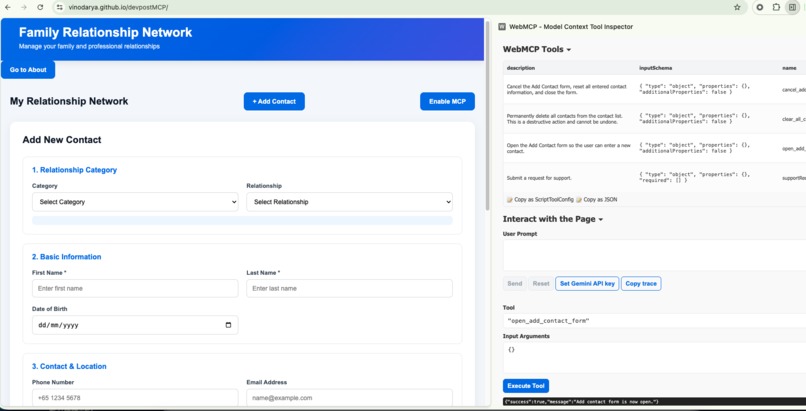
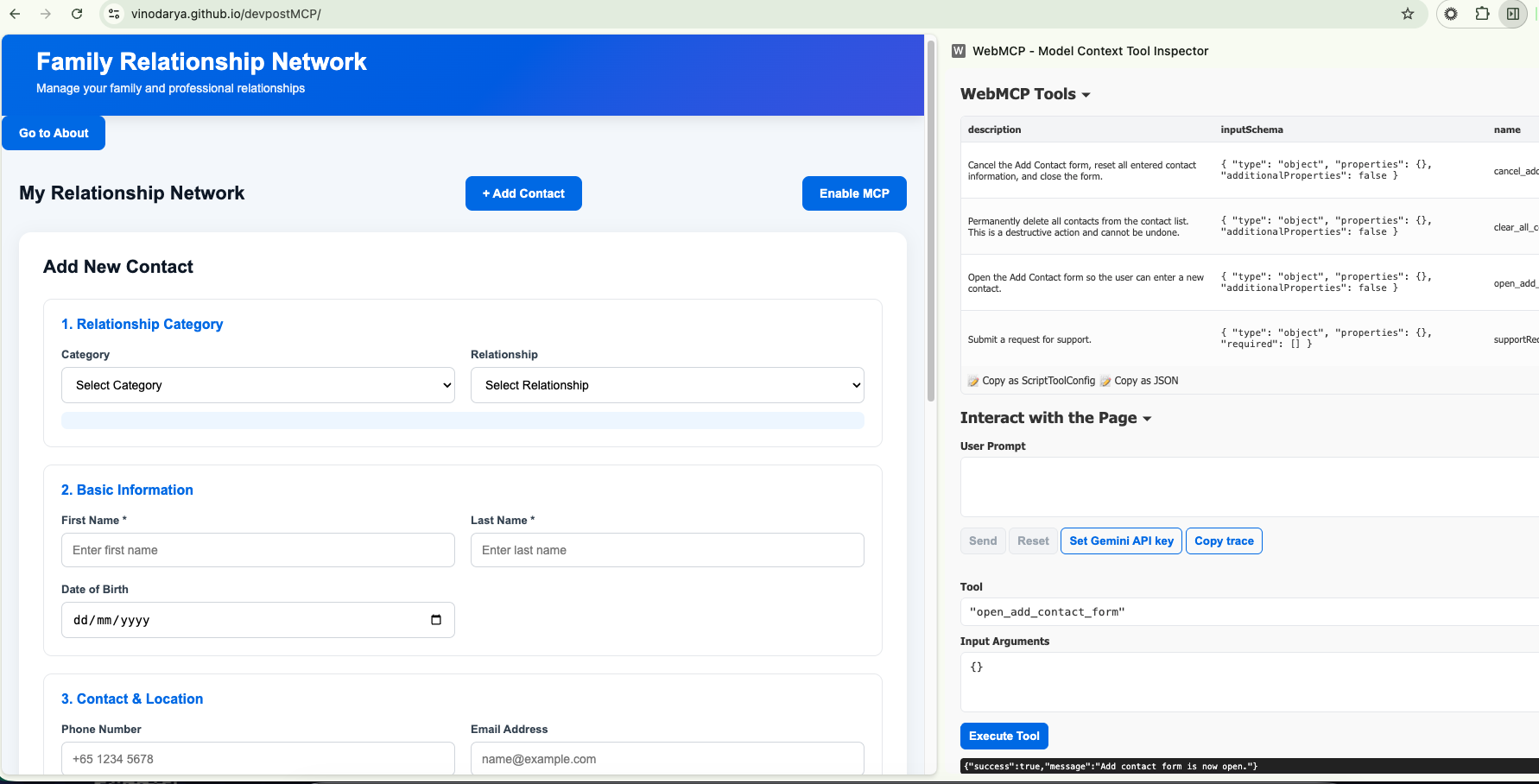
Home page of Project
Inspiration
The web has been built primarily for human interaction, while the next generation of applications will increasingly be accessed by AI agents. Today, agents often have to scrape the DOM, interpret screenshots, and simulate clicks and form inputs—making interaction fragile, slow, and highly dependent on page structure.
With WebMCP, websites can expose structured, machine-readable tools and page states that AI agents can understand and interact with directly. This inspired us to ask: How can we make the billions of existing websites ready for this agentic web without forcing developers to rebuild them?
That led to WebMCPify - a simple bridge that transforms existing HTML forms into WebMCP-ready interfaces.
What it does
WebMCPify converts existing web forms into WebMCP-ready tools that AI agents can discover and interact with directly.
For example, traditional automated form testing typically requires developers to:
- Identify form fields and attributes
- Write automation scripts to populate and submit the form
- Execute and maintain those scripts
With WebMCPify, the existing form can expose a structured tool interface to an AI agent. The agent can understand the available inputs, provide the required values, interact with the form, and execute the desired action - without manually hard-wiring the DOM elements or writing custom interaction scripts.
In essence, WebMCPify turns “web pages built for humans” into “web pages ready for AI agents.”
How we built it
We built WebMCPify as a lightweight transformation layer between existing HTML pages and AI agents.
The solution analyzes existing web forms, identifies their structure and input elements, and generates the required WebMCP-compatible tool definitions and interactions. This allows an AI agent to discover what Tools are available, understand the required inputs, and invoke those actions through a structured interface rather than relying on visual or DOM-based guessing.
Our approach focuses on bringing WebMCP capabilities to existing websites with minimal or no changes to the underlying application.
Challenges we ran into
The biggest challenge was bridging the gap between unstructured legacy web interfaces and structured agent interactions.
Existing forms can have inconsistent HTML structures, different input types, validation mechanisms, dynamic fields, and complex submission workflows. We needed to determine how these elements could be reliably interpreted and represented as tools that an AI agent can understand.
Another challenge was ensuring that the generated interface remains aligned with the website's actual behavior, particularly when forms contain client-side validation, dynamic states, or dependencies between fields.
Accomplishments that we're proud of
We demonstrated that an existing web form can be transformed into an AI-agent-ready interface without requiring developers to manually identify every form attribute and write custom automation scripts.
Our biggest accomplishment is proving the concept of “WebMCP enablement without rebuilding the web.”
WebMCPify has the potential to significantly simplify agent-based website testing and, more broadly, enable AI agents to interact with existing web applications through structured contracts rather than fragile screen scraping and DOM automation.
What we learned
We learned that the biggest opportunity in the agentic web may not be creating new AI-native websites—it may be making the existing web agent-ready.
We also learned that structured tool contracts can fundamentally change how agents interact with applications. Instead of asking an AI to figure out how to use a website, we can give it a clear interface describing what the website can do, what inputs it needs, and what state it can produce.
This can make agent interactions more reliable, deterministic, maintainable, and scalable.
What's next for WebMCPify
Our next step is to evolve WebMCPify from a form converter into a broader “Agentification Layer for the Web.”
Future capabilities could include:
- Automatic WebMCP discovery across complete websites, not just forms
- Conversion of buttons, search, navigation, APIs and workflows into agent-accessible tools
- Support for dynamic and multi-step forms
- Automatic generation of tool descriptions and schemas
- AI-powered mapping of complex legacy web applications to WebMCP
- Integration with AI-powered testing agents for autonomous functional testing
- A browser extension/developer tool that can WebMCPify a website with one click
- Enterprise capabilities around security, authorization, governance and observability
The vision
WebMCPify aims to make the existing web ready for the agentic era—turning billions of human-first web pages into structured, discoverable and AI-agent-ready experiences.

Log in or sign up for Devpost to join the conversation.