-
-
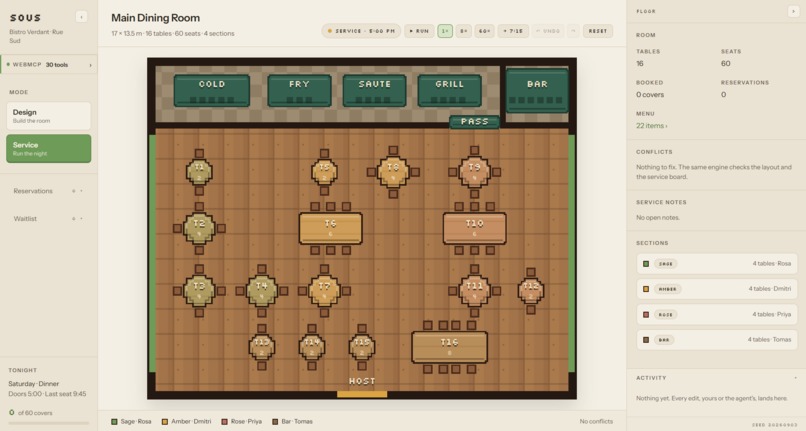
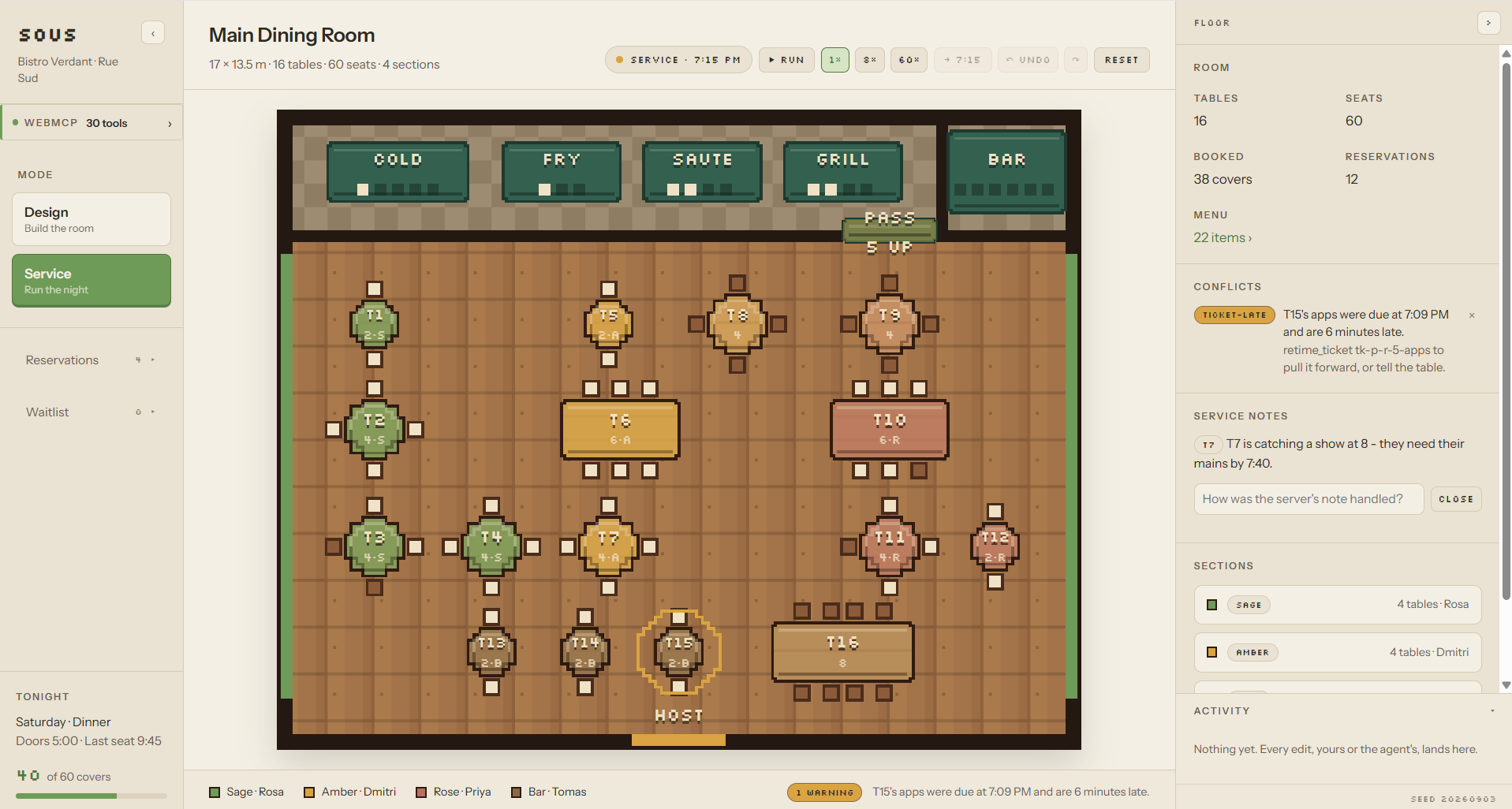
Service Mode
-
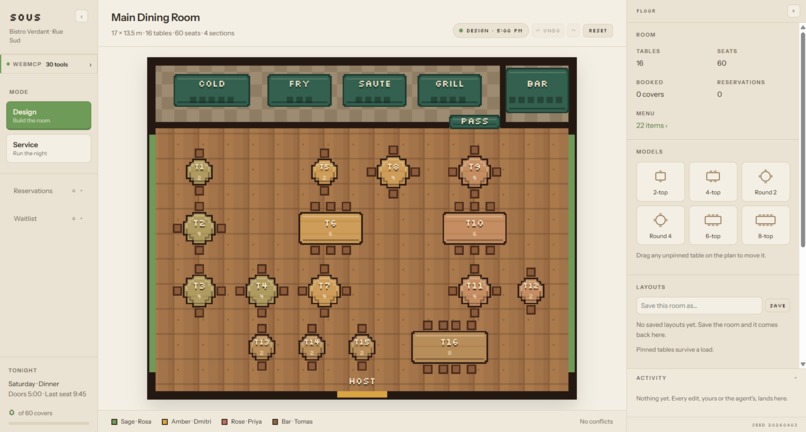
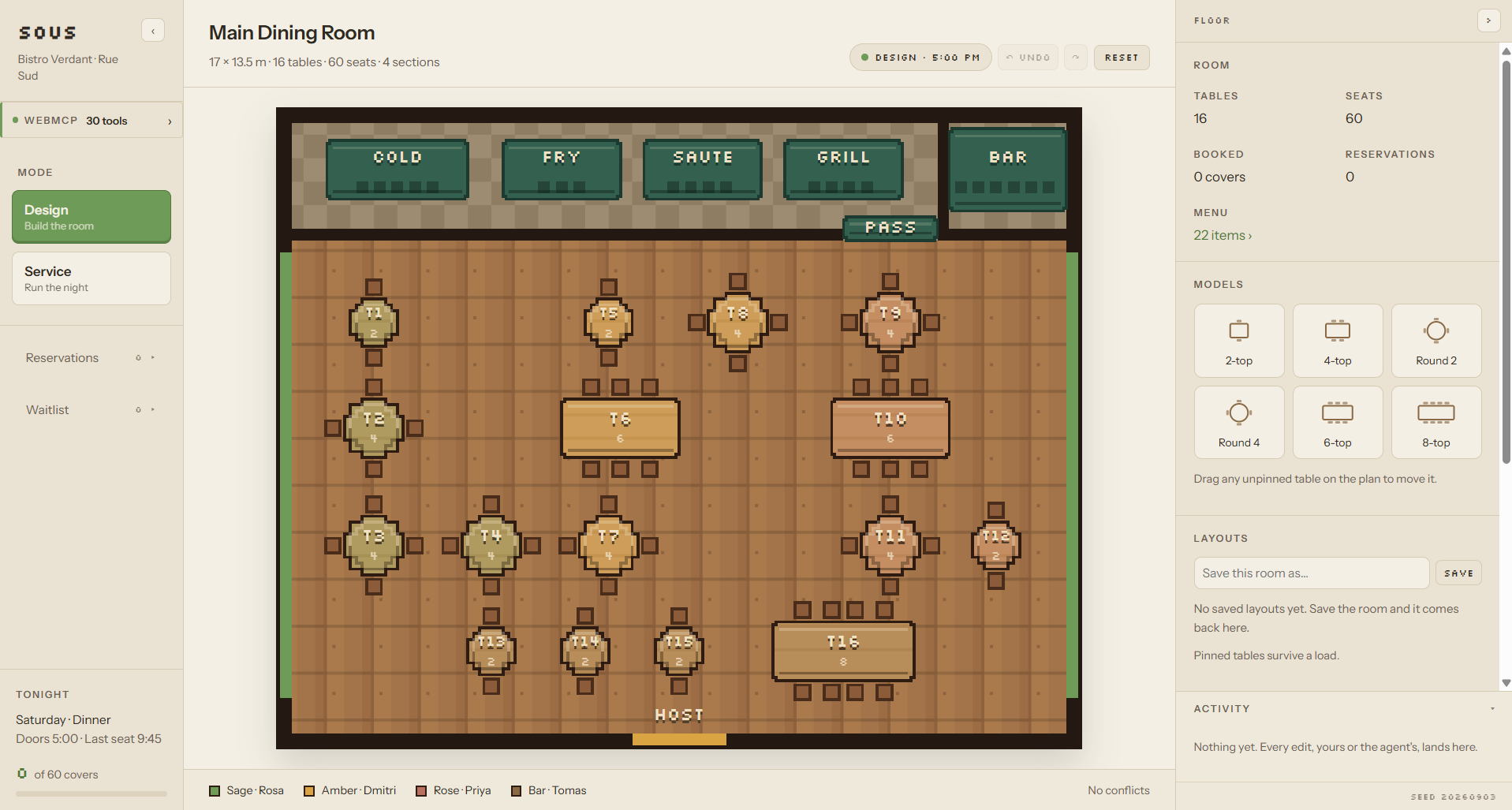
Design Mode
-
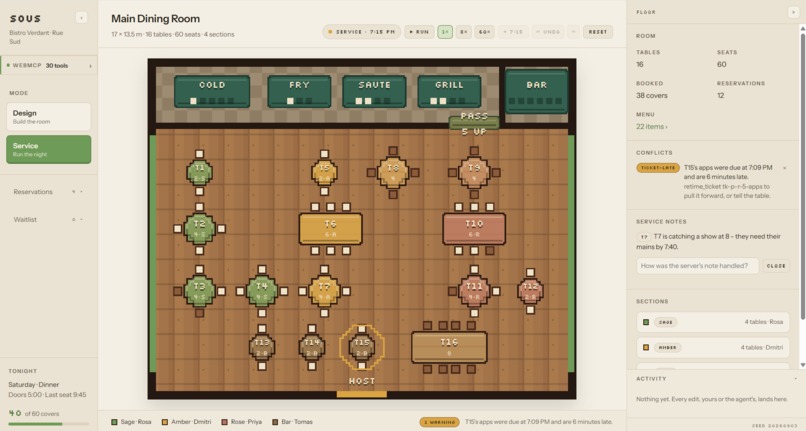
Simulation at 7:15
Inspiration
After first learning about the WebMCP Challenge, I ran through a list of ideas I always wanted to try building: an outfit generator, a groceries tracker and recipe book, a sleep productivity app, and others, but none of these seemed to really fit the use case. Then, while sitting down at a restaurant with a few friends, a waiter accidentally brought us the wrong item. An honest mistake, something that I'm sure most people have experienced, and one of the difficulties that come with managing a restaurant. After coming home, and following a bit of research into restaurant software, I decided to build a live restaurant manager, where a manager can operate from a live view of their restaurant, aided by an agent to lessen the workload on the employees. That product is now Sous.
What it does
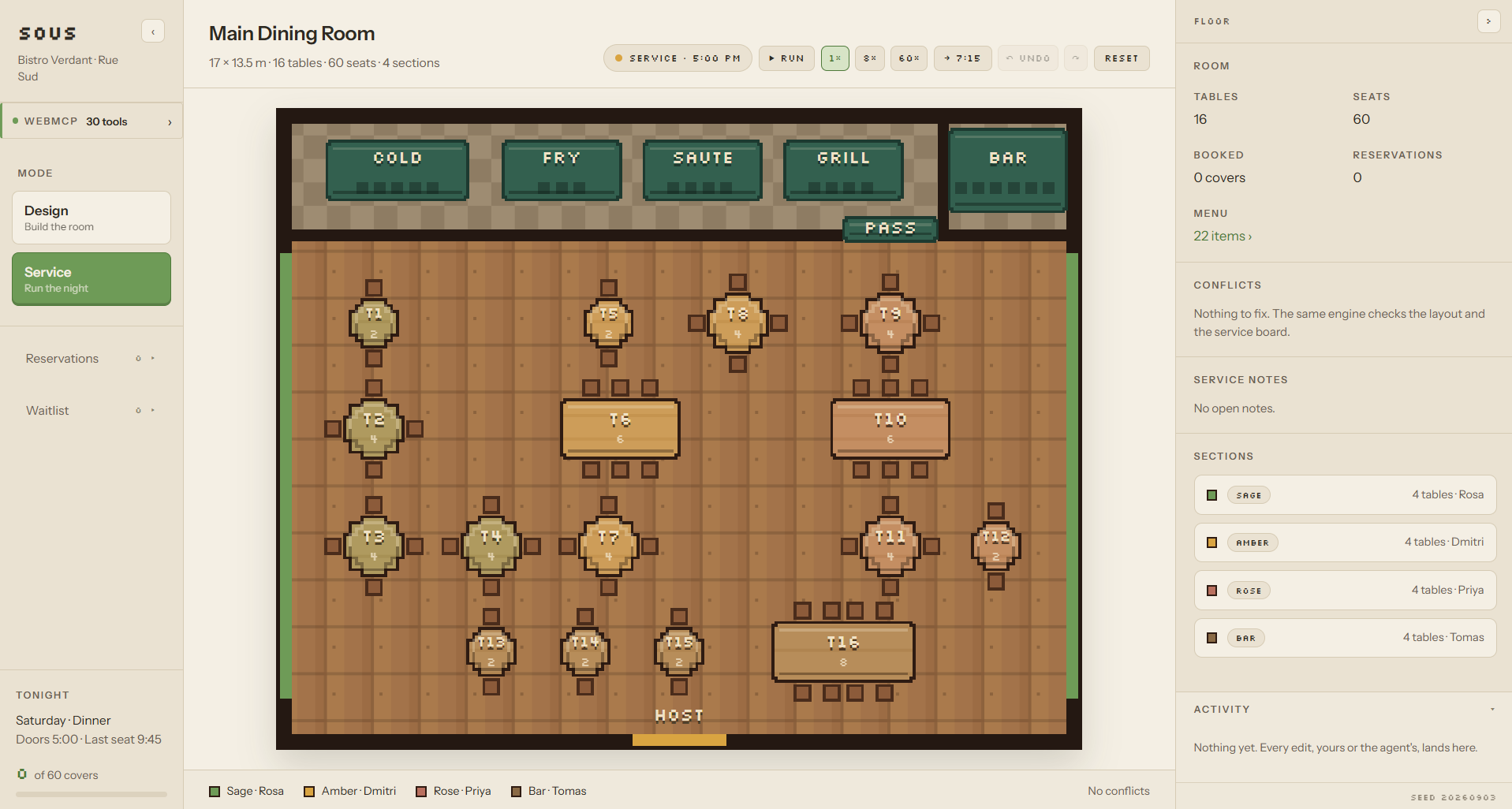
Sous is a live dashboard where you and your agent can design and manage your restaurant.
Starting with design mode, both a manager and an agent can rearrange and edit the floor layout to design or match their restaurant. Each table has its own controls, with the ability to change the size, number of seats, name, and waiter section. With WebMCP integration, the agent could simply be given a picture of the restaurant and call tools to match the in-app layout to the real thing.
Service mode is where you actually run the restaurant. Assigning tables, taking orders, delivering orders, and managing all the work in between happens here. Humans can perform all the functions, but the agent side is where it shines. By connecting the agent to a Yelp waitlist, a live feed, or other sources of information, it can automatically track and manage everything that is happening within the restaurant, with all the changes reflecting visually for the manager to see. WebMCP allows the agent to manage all the smaller functions, with only physical interactions left to employees, lessening the friction that comes with running the restaurant.
How we built it
As I am non-technical, this project was mostly built with the help of Claude. The app runs on React, Vite, and TypeScript, and all changes on it are saved locally to the user's browser without the need for logging in, so there is no backend or database. It runs similarly to the apps seen in OpenAI's WebMCP showcase.
WebMCP's whole author-facing surface is registerTool: a name the agent calls, a description it decides with, an inputSchema for the arguments, and an execute that runs. Sous makes that call once, over a table of 30 definitions, rather than writing thirty literal copies of it, so grep registerTool src/webmcp.ts finds the wiring, and src/tools.ts holds the tools themselves.
Challenges
Since this was my first time building an app, naturally it was filled with challenges, especially since I don't have a technical background. One of the biggest problems I came across was realizing midway that the app did not really match my vision. While AI has been a huge help in this challenge, I had essentially allowed it to build everything from scratch, without providing a list of exactly how I wanted the app to look and function. The main canvas in the middle took multiple iterations, including hours spent in Claude Design, before I arrived at something I believed fit the app.
Takeaways
As I mentioned above, I had multiple other app ideas before Sous, but I never got myself to actually build them out until now. The WebMCP Challenge finally pushed me to build my first app, and that experience is definitely my biggest takeaway from this challenge. Also, while I knew about APIs and MCPs before, this challenge introduced me to WebMCP, and seeing and building the possibilities myself makes me excited for the future of this technology.
What's next for Sous
Sous is an app I built on a whim with Claude Code, but it does help solve a problem that many restaurants face. Past this challenge, Sous could be integrated with existing POS systems in restaurants and other software like Yelp or Stripe, in order to help it move past simply being a dashboard and become an all-in-one app for restaurant management. Likely, this would include building out the backend, so that will be another learning opportunity for the future.

Log in or sign up for Devpost to join the conversation.