Inspiration
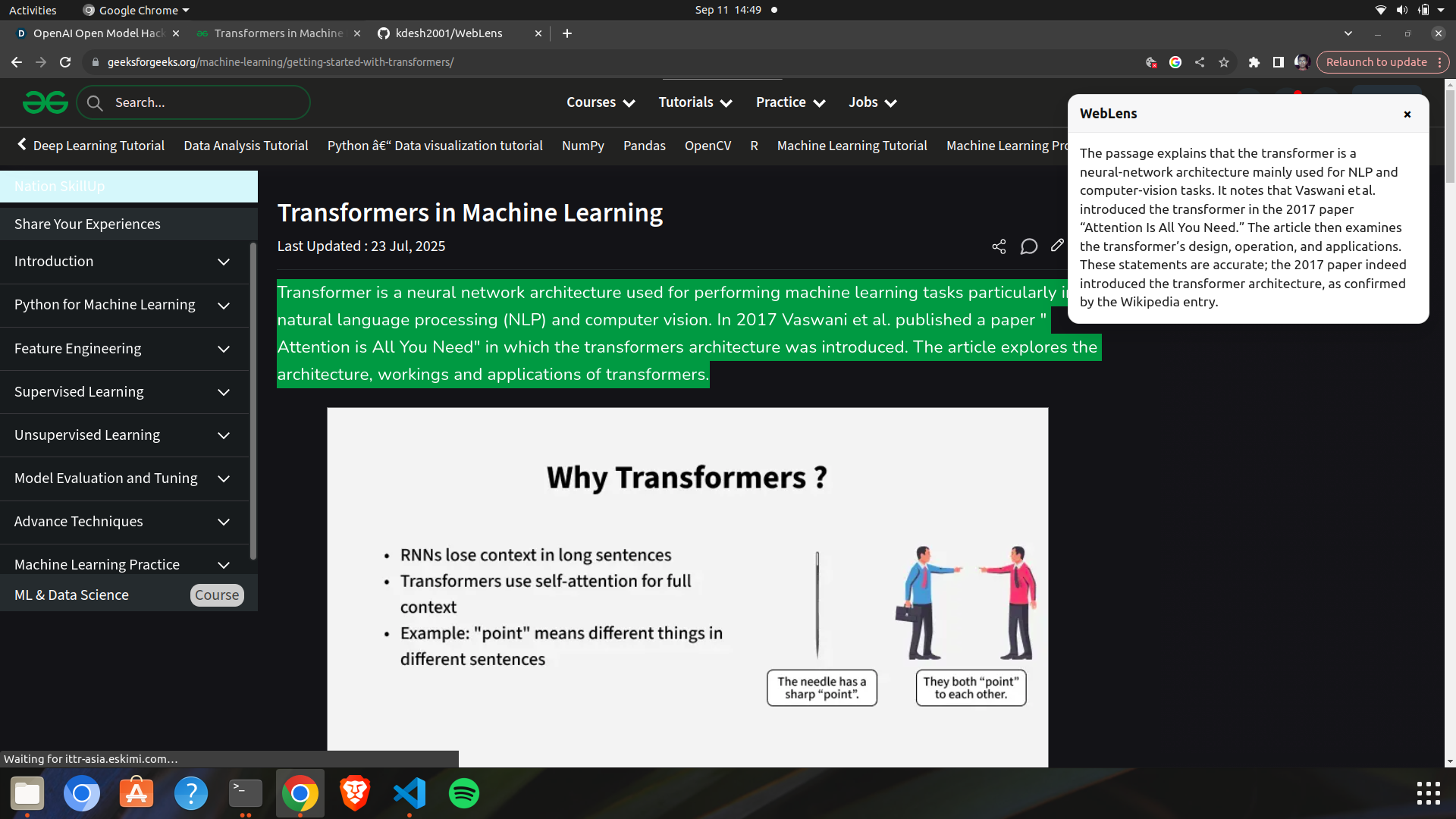
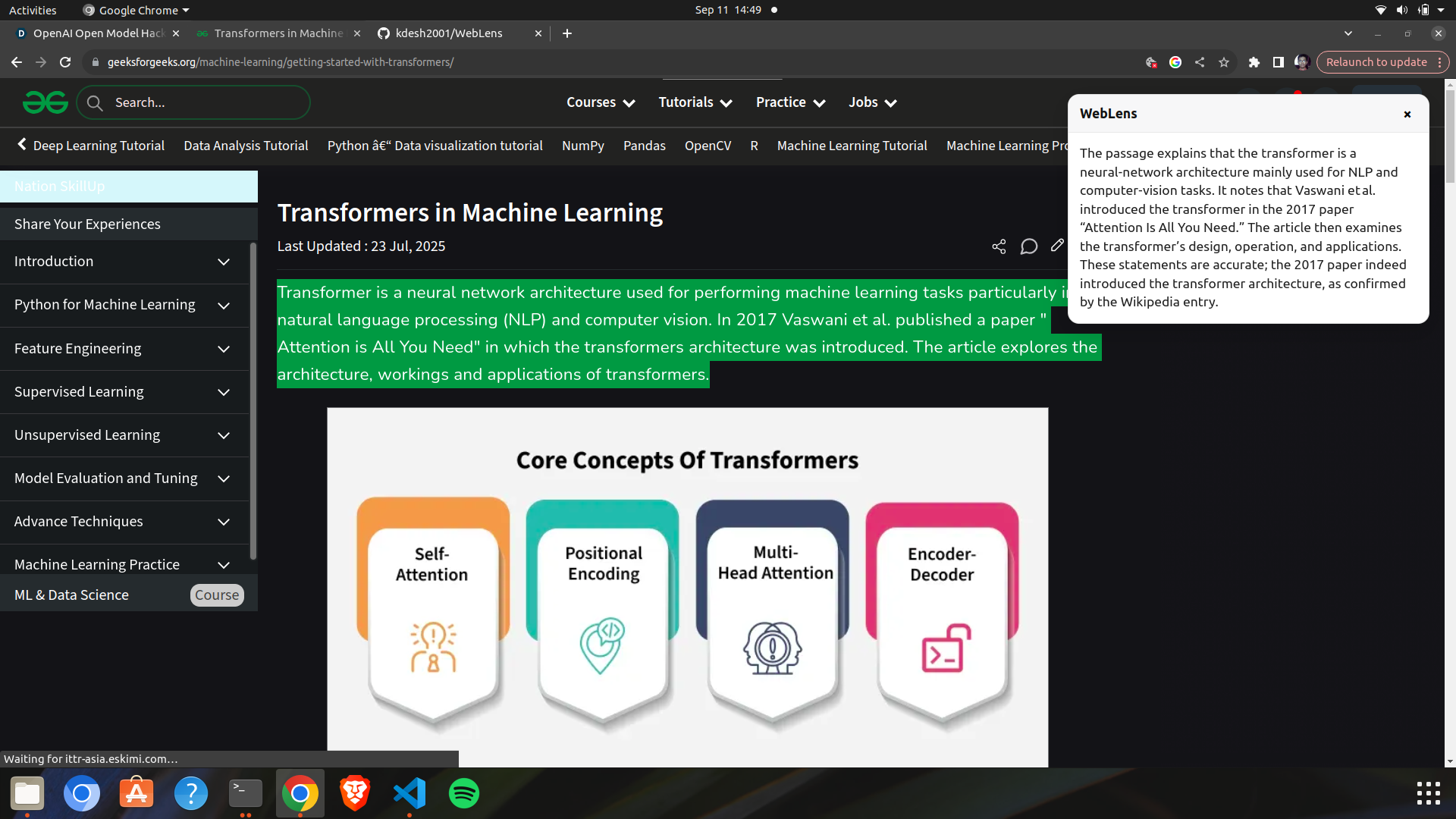
We wanted to create a smarter way to consume information on the web. With so much content available, it’s easy to get overwhelmed by long articles, foreign-language text, or misleading claims. Our goal was to build an intelligent assistant that helps users instantly understand, summarize, translate, and fact-check any web content they see — without leaving the page.
What it does
WebLens is a Chrome extension that helps you:
- Summarize any web text into clear 2–3 sentence summaries.
- Translate foreign-language content into fluent English or summarize it.
- Analyze the content for key statistics or structured data and present them in clean table formats.
- Verify factual claims by searching multiple sources: web search, recent news, Wikipedia, and academic research (arXiv).
- Flag false or misleading claims with evidence from trusted sources.
It makes web browsing smarter, safer, and more efficient.
How we built it
We built WebLens Assistant using LangGraph and gpt-oss-20b.
The tool uses a ReAct-style agent architecture that allows the LLM to reason about the input text, decide which external tools to use, and synthesize a final, fact-checked summary.
Key components include:
- Web search (DuckDuckGo)
- News search (Google News)
- Wikipedia lookup
- Research paper search (arXiv)
- URL reading for full content analysis
We wrapped all tools in LangGraph’s Agent, and built a robust loop to handle tool calls and reinject outputs into the model flow, ensuring no steps are skipped.
Challenges we ran into
The biggest challenge was that Hugging Face models do not naturally follow the ReAct tool usage flow like OpenAI models. Hence we decided to use Groq's API for gpt-oss-20b.
Accomplishments that we're proud of
- A fully functional Chrome extension that can summarize, translate, analyze, and fact-check web content in real time.
- Built a robust reasoning loop that ensures tool calls are properly handled and the final answer is always polished and complete.
- Successfully integrated multiple free and open tools (DuckDuckGo, Wikipedia, arXiv, Google News, trafilatura) into a coherent system.
- Handled multi-language input and structured data representation automatically.
What we learned
- Open-source large language models often require explicit prompting and its important to properly choose a model or a provider.
- System prompt design is critical: instructing the LLM never to output intermediate reasoning drastically improves reliability.
- Translating vs summarizing foreign language text needs careful handling to avoid truncating important context.
What's next for WebLens
- Improve response speed by optimizing tool execution and parallelizing web searches.
- Add support for user-customizable fact-checking depth (e.g., control how many sources to verify).
- Build a UI inside the plugin for interactive explanations (show users the sources used for fact-checking).
- Expand support for specialized domains like medical research, legal documents, or financial data.
- Allow users to build graphs and charts on any data.
- Open the system for community contributions of new tools and data sources.

Log in or sign up for Devpost to join the conversation.