-
-
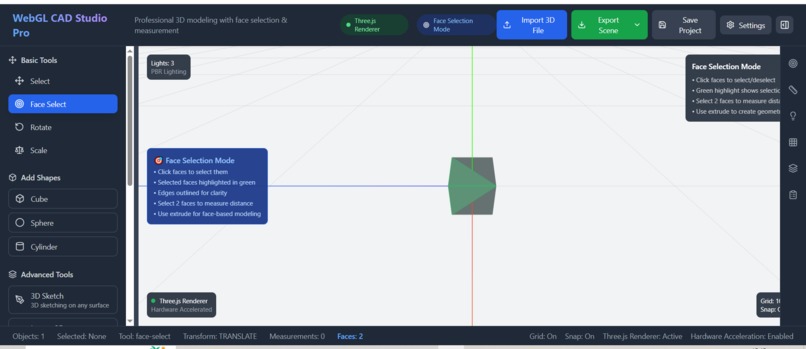
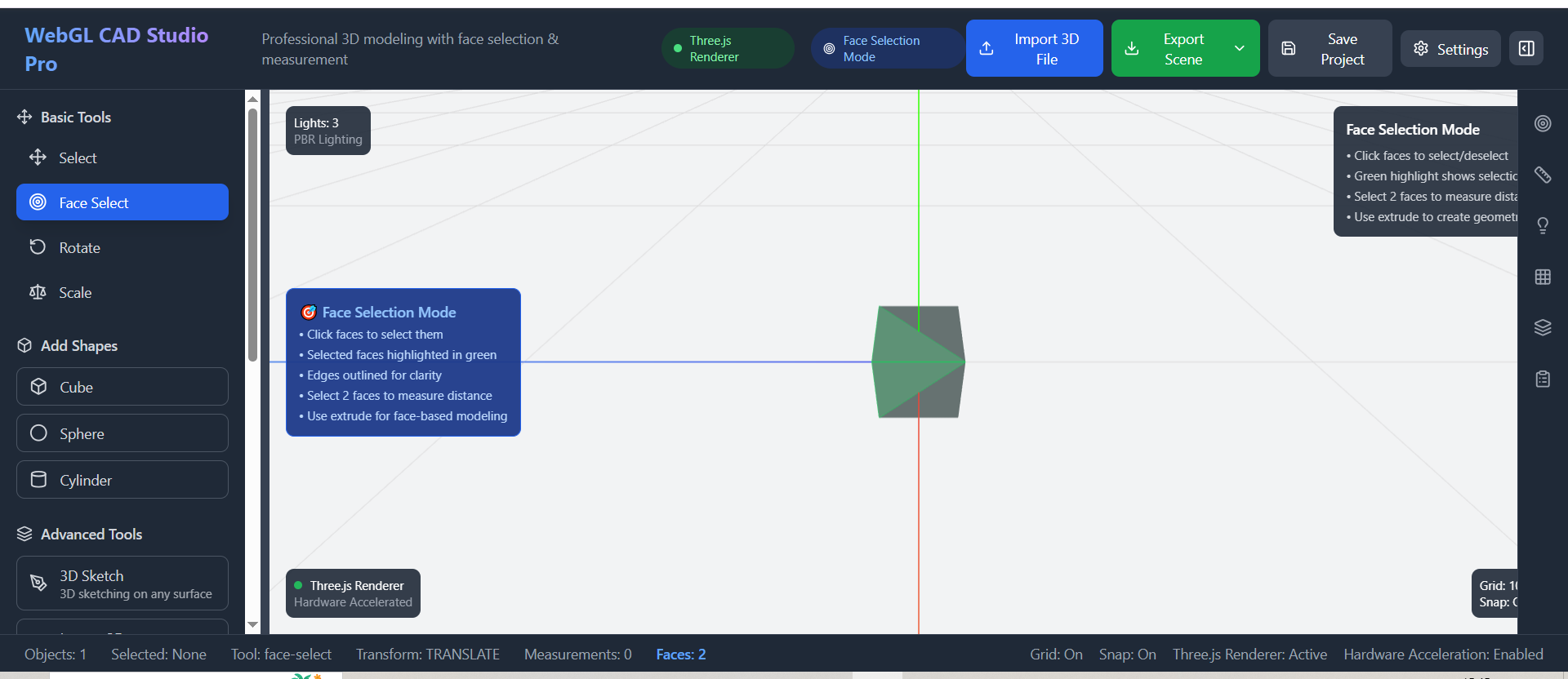
face select mode to select faces of 3d object
-
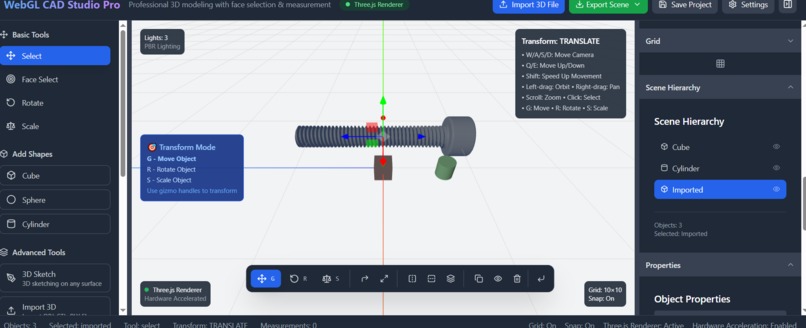
selected
-
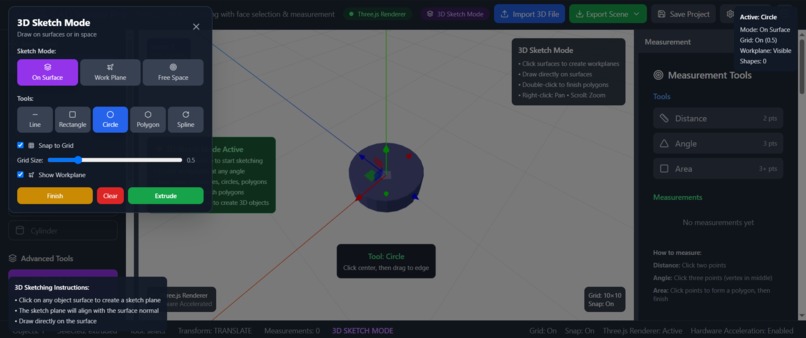
sketch mode u need to select on surface or work pace or free space an dextruid
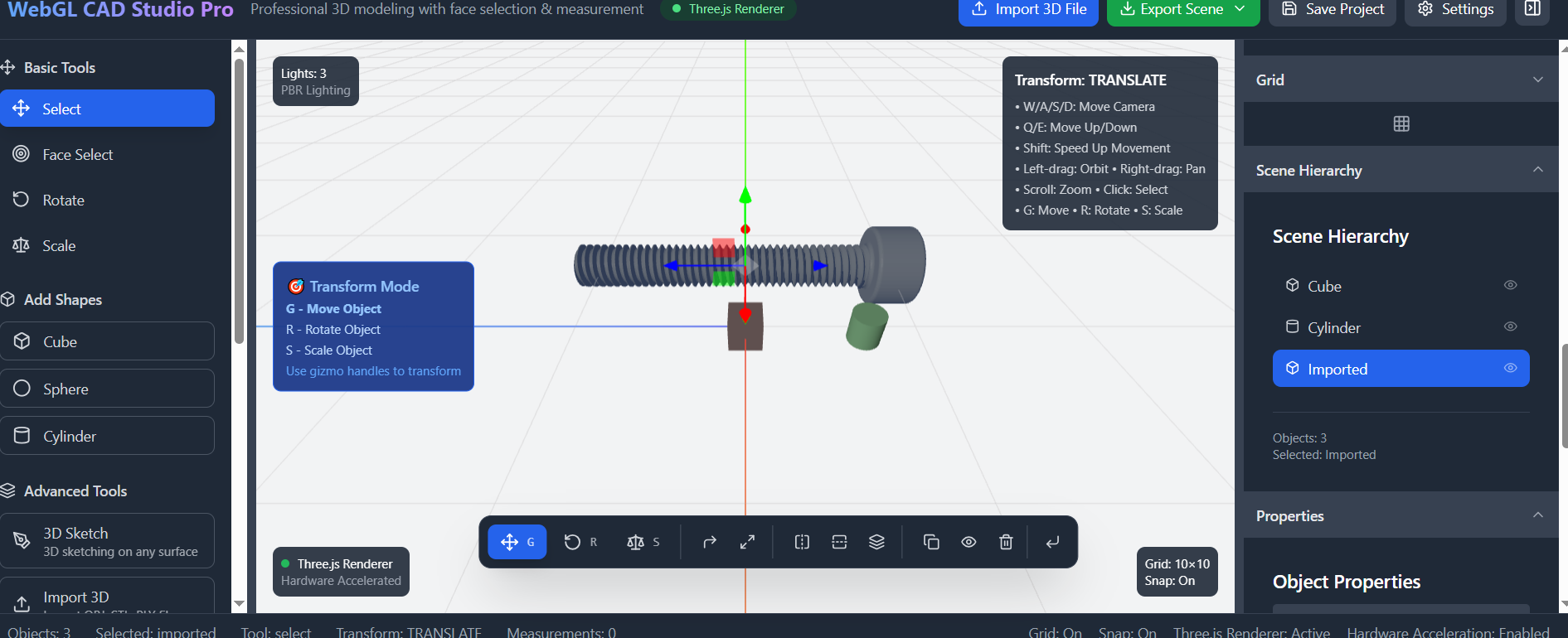
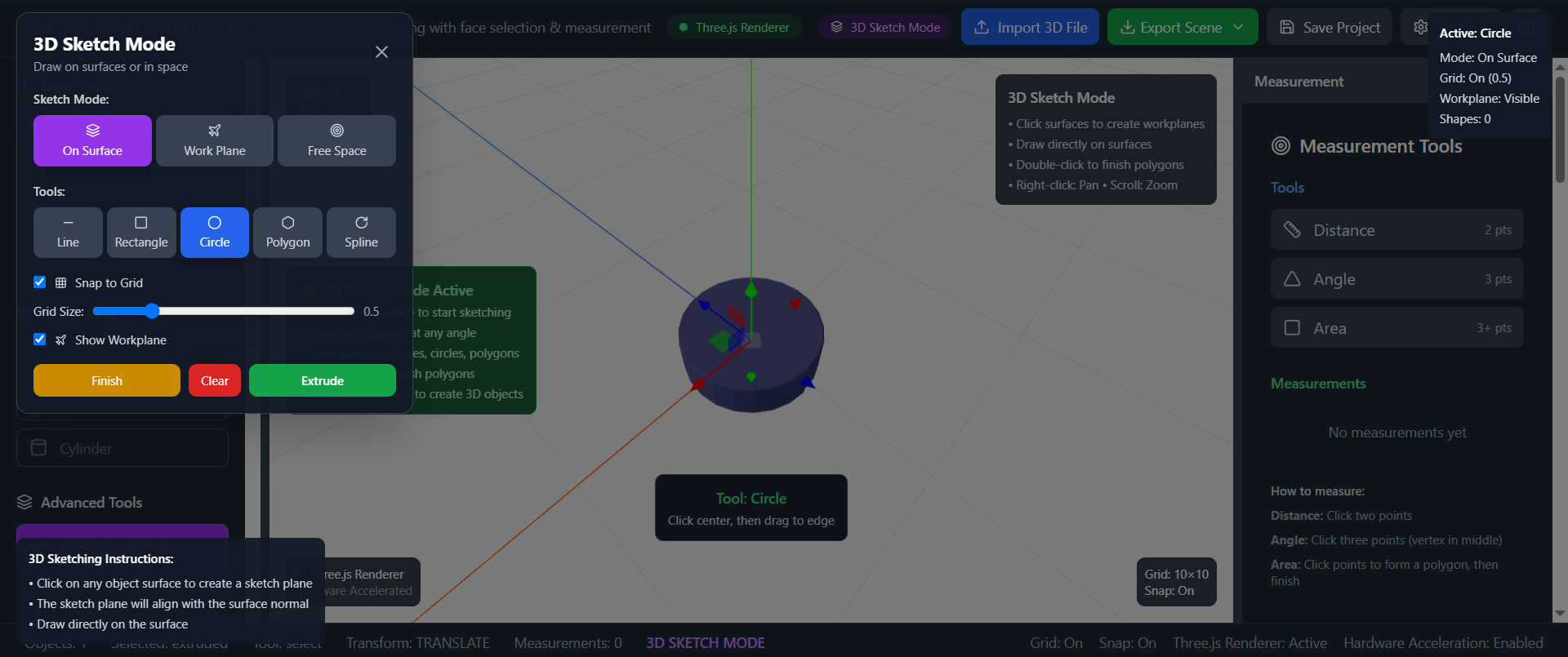
Inspiration My inspiration for developing WebCAD stemmed directly from a critical gap I observed in the existing landscape of computer-aided design (CAD) software. While powerful tools abound, both free and commercial, they are frequently characterized by steep learning curves and often rigid, unintuitive control schemes. This inherent complexity acts as a significant barrier to entry, deterring aspiring designers, makers, and students, thereby stifling broader creative adoption. My objective was to democratize access to design capabilities by building a CAD platform that drastically reduces this learning curve through intuitive design and unparalleled user customization, making CAD accessible to everyone.
What it does WebCAD is a web-based CAD application engineered for intuitive 3D modeling and design directly within a standard web browser. Its core functionality enables users to create, manipulate, and visualize 3D models with fundamental CAD operations. A paramount distinguishing feature of WebCAD is its dynamic and fully customizable control mapping, allowing users to personalize key bindings (e.g., 'W', 'A', 'S', 'D' for navigation, or specific keys for tool activation) to precisely match their ergonomic preferences and workflow, much like remapping controls in a modern video game. This adaptability ensures that the software fluidly conforms to the user, rather than imposing a rigid interaction model, thereby significantly lowering the barrier to entry and optimizing design efficiency for diverse user habits.
How i built it WebCAD was developed as a solo project, leveraging a robust and modern technology stack to achieve its web-based capabilities. The backend logic and API services are powered by Node.js, providing a scalable and responsive foundation for handling geometric data and application state. For the interactive 3D rendering and real-time visualization, WebGL was utilized, directly harnessing the client's GPU for high-performance graphics within the browser. I implemented the core basic logic of essential CAD functions from the ground up, focusing on a streamlined approach to common operations. This included foundational geometric transformations, object manipulation, and the underlying mathematical principles necessary for a functional CAD environment. The user interface was meticulously crafted with standard web technologies (HTML, CSS, JavaScript), prioritizing a clean, accessible, and responsive design. A custom event handling system was central to managing the dynamic key remapping feature, ensuring a seamless and persistent personalized user experience.
Challenges we ran into As a solo developer, I encountered several significant technical hurdles. Two primary challenges involved implementing robust sketching and drawing functionalities directly onto existing 3D objects within the 3D view, a complex task requiring precise projection and intersection calculations in WebGL. Furthermore, developing a reliable system for extrusion that included accurate selection of individual faces of an object and the subsequent interactive manipulation of their extrusion size proved particularly demanding. These challenges required deep dives into geometric algorithms and WebGL rendering pipelines to ensure accuracy, performance, and a fluid user experience. Beyond these, optimizing WebGL performance for smooth interaction with complex geometries within a browser environment and ensuring cross-browser compatibility were ongoing considerations.
Accomplishments that we're proud of I am immensely proud of the rapid progress achieved on this project within a compressed timeframe, specifically reaching this level of functional completion within just one week of focused development. Successfully implementing key CAD features like sketching on 3D surfaces and interactive extrusion with face selection, as a solo endeavor, stands as a significant technical accomplishment. Most importantly, I am proud of creating a CAD application that genuinely democratizes access to 3D design by drastically lowering the barrier to entry through its intuitive interface and the groundbreaking user-customizable control mapping.
What we learned This project has been an invaluable learning experience. Technically, I gained profound, hands-on insights into advanced WebGL rendering techniques required for interactive 3D applications, mastering the implementation of geometric algorithms for sketching, face selection, and extrusion, and optimizing web-based performance. As a solo developer, it reinforced the importance of modular code design and efficient problem-solving. Beyond technical skills, I significantly deepened my understanding of user-centric design principles, specifically how intuitive interaction and personalization, such as dynamic control remapping, can profoundly impact user adoption and satisfaction.
What's next for WebCAD The immediate next steps for WebCAD involve preparing for public deployment and open-sourcing the project on my GitHub repository soon. This will foster community collaboration and accelerate development. I am committed to continuing weekly updates to introduce new features and refine existing ones. Future functional enhancements include expanding the library of fundamental 3D primitives and advanced modeling tools, exploring collaborative design functionalities for real-time multi-user editing, further optimizing performance for increasingly complex models, and integrating import/export capabilities for common CAD file formats (e.g., STL, OBJ). My long-term vision is to establish WebCAD as a go-to, truly accessible, and powerful online CAD platform for a global community of hobbyists, students, and professionals.


Log in or sign up for Devpost to join the conversation.