Project Story
Inspiration
Our project was born from a moment of inspiration while we were engrossed in the Indonesia Ecotourism Summit 2023, themed "Ecotourism for A Sustainable Future." It was a presentation by Ms. Wiwin Tribuani Wiyono Putri that truly ignited our imaginations. Her talk, titled "The Role of Interpretation in Ecotourism", introduced us to a world of possibilities surrounding interpretation.
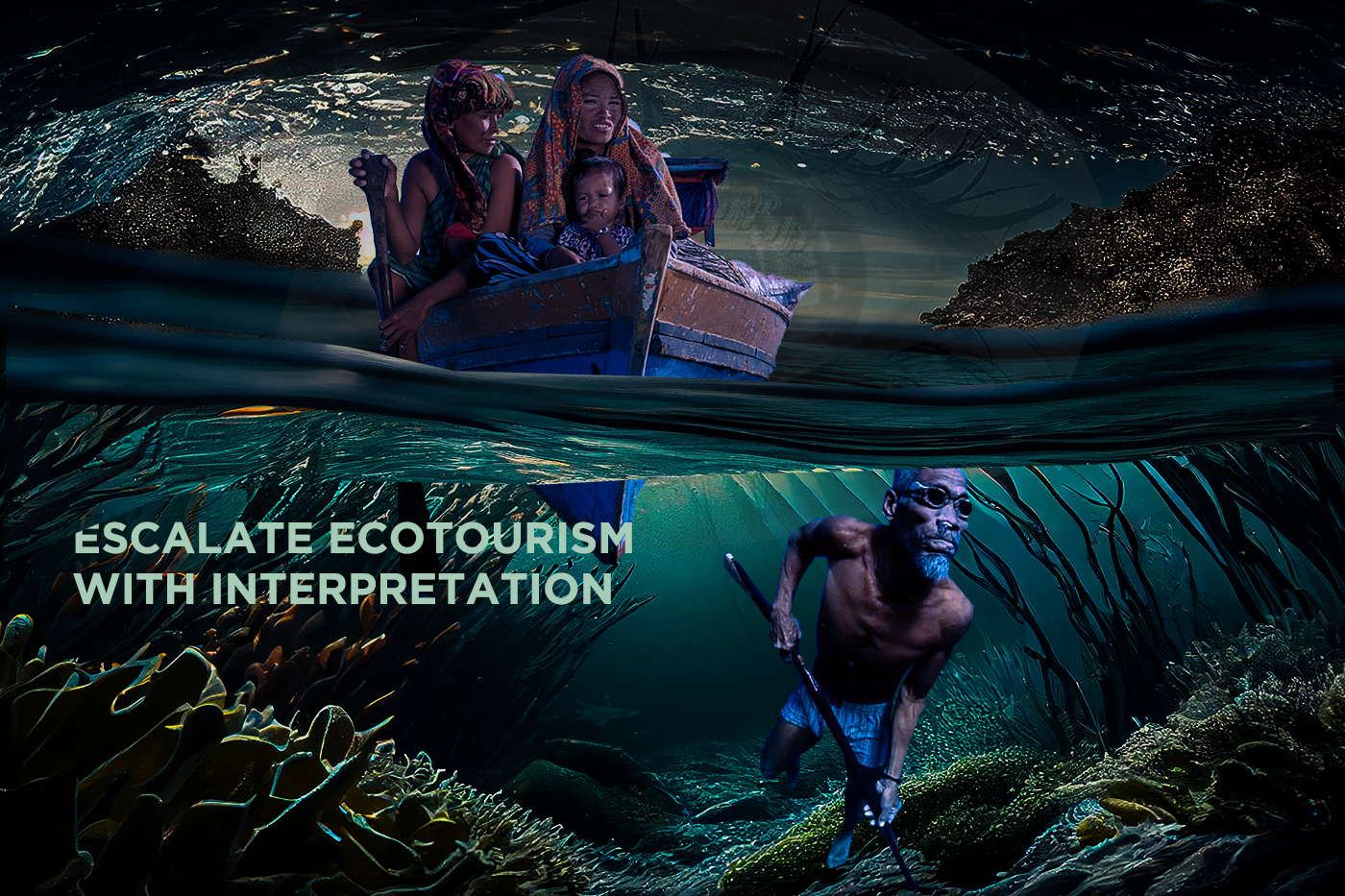
In particular, Ms. Wiwin challenged the audience to stand for just one minute, a seemingly simple task. However, her underlying message was clear: to instill empathy for the Bajo tribe, who must dive underwater for three minutes just to sustain their lives. The profound empathy that her presentation conveyed resonated deeply with us, even though we were only watching online. It struck a chord, and we couldn't ignore the urgency of sharing this empathy more widely, with high accessibility and minimal cost. Thus, the idea to create a web-based interpreter was born.
What it Does
"Our vision for this project was to weave a narrative rich in storytelling to ignite people's imaginations. Therefore, the primary objective of this interpretative web app is to elevate ecotourism through the power of interpretation. We aimed to make this web app a delightful and accessible resource for a broad audience."
We pursued this vision through three key approaches:
- Narrative Introduction: We crafted interpretative stories to unveil the empathy within our readers. Our stories are designed to immerse readers in the experiences of the Bajo tribe and other local communities, fostering a deeper connection with their way of life.
- Environmental Monitoring: Leveraging technology, we provided environmental monitoring data. This enables users to grasp the environmental challenges and changes in Wakatobi, enhancing their understanding of the ecosystem's fragility.
- Interactive Tourist Experience with TOBI: We introduced an interactive feature that allows tourists to engage with TOBI, our virtual guide. Through this feature, tourists can map their journeys, share their experiences, and become storytellers themselves.
In pursuing these avenues, our goal was to fulfil the role of interpretation in ecotourism, fostering empathy, understanding, and engagement among travellers.
How We Built It
Our web app is constructed on ESRI-based applications, adhering to competition guidelines. The Web Experience Builder provided the foundational infrastructure for our user-friendly platform.
- To portray the distinctive narratives of the Bajo tribe, we harnessed ArcGIS Story Maps “The Eyes of Bajo Tribe”. This journey began with extensive literature reviews and in-depth discussions, including interviews with Mr. Manan, the President of the Bajo tribe. These insights were meticulously crafted into compelling narratives within the Story Maps.
- Our web app was enriched with data processed using ArcMap. We then seamlessly integrated this data into Webmap, transitioning from ArcMap to the integrated ArcGIS Online platform. This allowed us to create an immersive storytelling experience.
- In addition to storytelling, we employed ArcGIS Dashboard to visualize geographic data, enhancing user engagement and understanding of the environmental context.
- For two-way interactions with users and the tourist community, we utilised Survey123 and Quick Capture. These tools facilitated engagement, feedback collection, and active participation.
Environmental monitoring was a critical aspect, covering land, sea, and air parameters. Land monitoring included vital indices like NDVI, SAVI, and LST. Sea monitoring extended to Benthic Classification, SST, salinity, and more. Air monitoring encompassed the aerosol index.
All data processing was meticulously executed using JavaScript in the Google Earth Engine code editor. This comprehensive approach allowed us to create an interactive and informative web app that seamlessly integrates empathetic storytelling with critical environmental insights.
Challenges We Ran Into
One of the primary challenges we encountered was the intricate task of effectively translating the complexities of the Bajo tribe's local wisdom into a comprehensive and accessible form of interpretation. This challenge was magnified by the fact that none of us are native to the Bajo community or had direct exposure to their way of life.
To overcome this obstacle, we embarked on an extensive journey of reading literature and engaging in insightful discussions. Notably, we had the privilege of conducting a Zoom meeting with Mr. Manan, the President of the Bajo tribe, who generously shared his invaluable perspectives and experiences. His guidance and insights became a cornerstone in our efforts to authentically convey the Bajo's local wisdom.
Furthermore, as interpretative methods of this nature are not widely practised in Indonesia, we found ourselves in relatively uncharted territory. We had to navigate and experiment with these methods, paving the way for a more widespread adoption of interpretation techniques in the context of Indonesian ecotourism.
Accomplishments That We're Proud of
In Indonesia, interpretation as a method to enhance ecotourism is relatively uncommon and lacks widespread recognition. Several factors contribute to this, including the cost of training and the communication skills gap in many communities. Rather than adhering to conventional methods that limit interpretation to tourist sites, we sought to integrate digital technology into the interpretation of the Bajo tribe's culture, with the aim of escalating ecotourism in Wakatobi.
We take great pride in our achievement of delving into the essence of what Ms. Wiwin Tribuani conveyed during her presentation. Her brief but impactful message served as a catalyst, inspiring us to transform interpretation into a tangible reality. We are eagerly anticipating the launch of our web app, as we believe in its potential to be a valuable resource. Our web app marks a fresh approach, one that seeks to escalate ecotourism without commercialising it. It revolves around empathy and information sourced from various references, culminating in a meaningful and accessible interpretation.
Our accomplishment lies in bridging the gap between local wisdom, technology, and ecotourism, offering a novel way to experience and appreciate the culture of the Bajo tribe and the ecological wonders of Wakatobi.
What We Learned
What we've been studying is all about ecotourism itself, which is quite new to us because it's not our main area of expertise. We've been learning about interpretation methods, and we find them really fascinating. Besides, while creating this web app, we feel like we've used a bit of philosophy and anthropology knowledge.
The Bajo tribe faces a lot of challenges, like land rights, poverty, and climate strikes, for example. There's also the issue of making money from tourism. Even though the Bajo culture is a big attraction, they often get caught up in incidents, like being accused of harming the environment or not getting fair benefits from tourism that uses the Bajo name. That's why we need to thoroughly understand and explain these things, especially for Indonesia
What's Next for Tales of Wakatobi (Tobi)
As the TOBI team, we're very eager to visit the Bajo and Wakatobi. Mr. Manan has hinted that it would be much better if we could experience things firsthand to sharpen our interpretation.
In doing so, we can enhance the quality of our website and interpretation. We can obtain valuable documentation and incorporate it into the web app we're creating. Additionally, we're thinking about the possibility of handing over this website to local youth communities. This would be highly beneficial for inventorying the natural and cultural aspects of the Bajo, as maps can help with that. Moreover, by connecting with youth communities, we can make the platform more interactive and shareable. We're also planning to add CSR (Corporate Social Responsibility) features to involve corporations looking for CSR opportunities that align with the Bajo's needs.
Built With
- arcgis-dashboard
- arcgis-experience-builder
- arcgis-quick-capture
- arcgis-storymap
- arcgis-survei123
- arcgis-webmap
- arcmap
- google-earth-engine
- javasripct


Log in or sign up for Devpost to join the conversation.