-
-
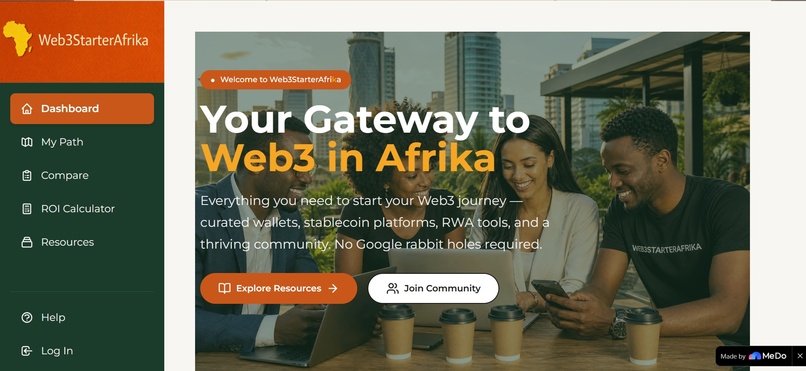
WEB3STARTERAFRIKA DASHBOARD
Web3StarterAfrika — Project Story
Devpost Submission | Build with MeDo Hackathon 2026
Inspiration
I've spent years creating Web3 content for African audiences through my brand AiWeb3SimplifiedLab. In that time, one pattern kept repeating itself.
Every time I explained stablecoins, crypto payments, or RWA tokenization to an African SME owner — a Lagos fabric seller, a Nairobi freelancer, an Accra supplier — the reaction was the same: "Why hasn't anyone explained it like this before?"
The tools existed. The technology worked. But the onboarding layer for African small business owners had never been built.
Consider the scale of the problem. African SMEs lose between 5% and 15% on every cross-border transaction to traditional banking fees. For a business doing $10,000/month in international transactions, that's:
$$\text{Annual bank fees} = \$10,000 \times 12 \times 0.05 = \$6,000$$
$$\text{Annual stablecoin fees} = \$10,000 \times 12 \times 0.005 = \$600$$
$$\text{Annual savings} = \$6,000 - \$600 = \$5,400$$
That is not a statistic. That is school fees. Business inventory. A product launch.
And yet — 44 million African SMEs remain unboarded into Web3, not because they lack interest, but because nobody has built the front door in their language, for their context, around their business realities.
When the Build with MeDo Hackathon launched, I saw the opportunity. Not just to build a tool — but to prove that the barrier to building is gone, and that an educator with deep community knowledge could build what a developer team never prioritised.
Web3StarterAfrika was born from that conviction.
What it does
Web3StarterAfrika is an AI-powered Web3 onboarding and education platform built specifically for African small business owners across Nigeria, Ghana, Kenya, and South Africa.
🤖 AI Onboarding Guide
An intelligent chat interface that meets users where they are. Users describe their business and biggest payment challenge — the AI responds with a personalised, jargon-free Web3 learning path anchored in real African business contexts. Starter prompt chips eliminate the blank-box problem for first-time users.
🗣️ Local Language Support
The first Web3 education platform to support African local languages:
- Nigerian Pidgin English 🇳🇬
- Swahili 🇰🇪
- Twi 🇬🇭
- Zulu 🇿🇦
A simple toggle switches the entire experience — because Web3 knowledge shouldn't require a university degree or a second language.
🗺️ Personalised Learning Path Generator
Users select their country and business type (Freelancer, Product Seller, Service Provider, Trader) and receive a custom 5-step action roadmap. Each roadmap is locally specific — Nigeria references Binance P2P and cNGN; Kenya references M-PESA bridges and KES context.
💰 ROI Calculator
An interactive slider-driven calculator that makes the cost of inaction visible in real numbers:
$$\text{Savings} = V \times 12 \times (r_{bank} - r_{crypto})$$
Where $V$ = monthly transaction volume, $r_{bank}$ = average bank wire fee rate (5%), $r_{crypto}$ = average stablecoin fee rate (0.5%).
📊 Stablecoin Comparison Tool
An interactive side-by-side comparison of USDC, USDT, and cNGN — filtered by country, with the recommended stablecoin highlighted for each African market.
🏆 Milestone Badge System
Nine milestone badges from Afrika Explorer to Afrika Pioneer — rewarding every step forward in the Web3 journey. Each badge includes a one-click share button to drive organic community growth.
📚 Resource Hub
Curated, trusted tools organised into four categories: Wallet Setup, Stablecoin Platforms, RWA Tools, and Community — so users never have to Google their way into a scam.
📈 Progress Dashboard
A personalised journey summary showing steps completed, annual savings identified, and the next recommended action — giving users a reason to return every session.
How we built it
Web3StarterAfrika was built entirely using MeDo — Baidu's AI no-code platform — through natural language conversations. Not a single line of code was written manually.
The Build Architecture
The build was structured across 7 conversation turns, each targeting a specific feature layer:
| Prompt | Feature Built |
|---|---|
| 1 | App scaffold, brand design system, sidebar navigation |
| 2 | AI Onboarding Guide with chat interface |
| 3 | Personalised Learning Path Generator with progress tracker |
| 4 | ROI Calculator with live slider |
| 5 | Stablecoin Comparison Tool with country filter |
| 6 | Resource Hub with categorised links |
| 7 | Final polish, mobile optimisation, deployment |
Additional correction prompts were used to fix mobile layout issues, add the language toggle, implement milestone badges, and optimise chat UX (starter chips, typing indicator, auto-scroll).
Design System
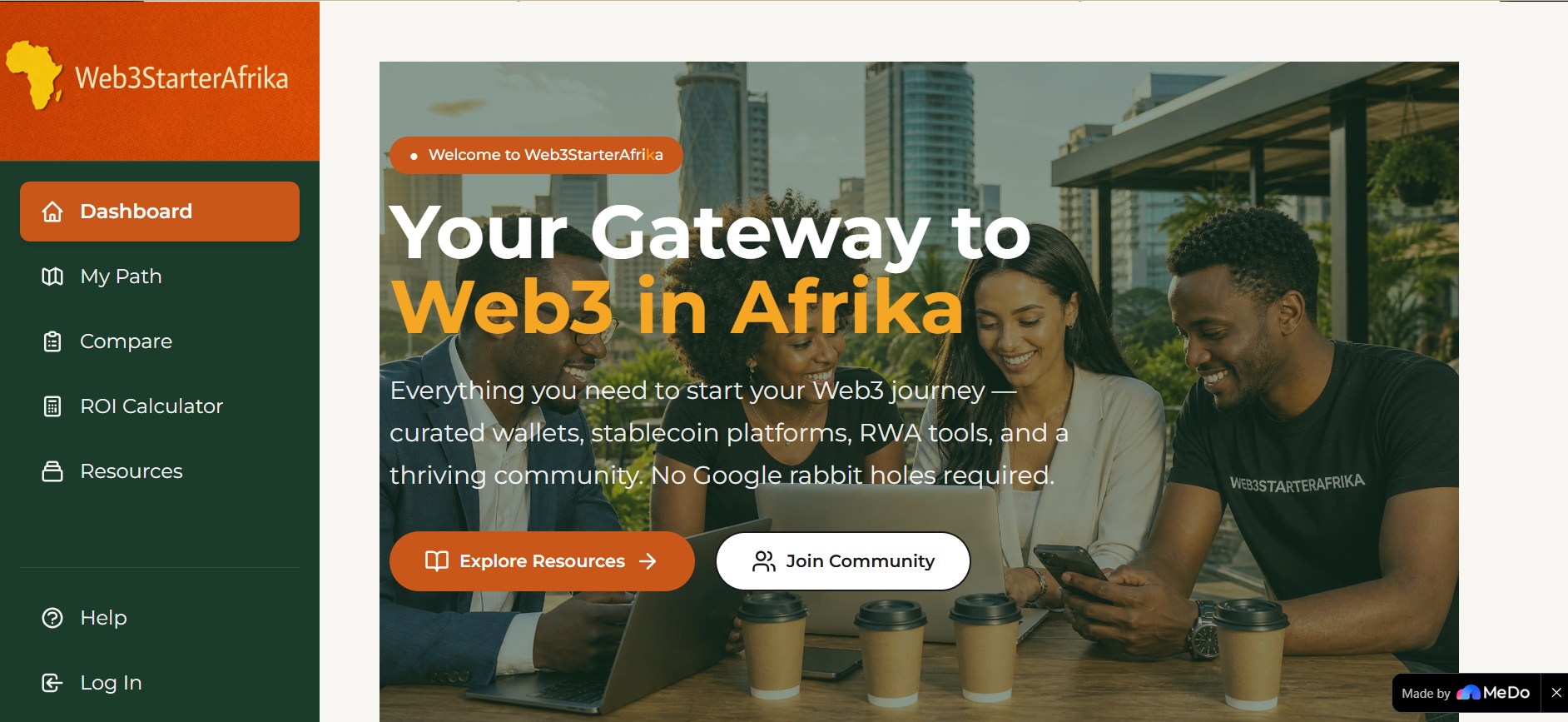
The visual identity was inspired by leading African fintech apps — a PiggyVest-style hero layout with floating UI stat cards, a forest green sidebar (#1A3C2A), burnt orange active states (#C9571A), amber gold accents (#F5A623), and a warm off-white background (#F5F4F0).
The hero image features four diverse young entrepreneurs — representing Nigeria, Ghana, Kenya, and Ethiopia — collaborating on a rooftop in a modern African city. One entrepreneur wears a WEB3STARTERAFRIKA t-shirt, generated via Midjourney.
The "Afrika" Naming Convention
The K in "Afrika" is intentional — a Pan-Africanist identity statement that signals this platform was built for Africa, by someone who understands Africa. The K is styled in amber gold (#F5A623) wherever the brand name appears.
Challenges we ran into
1. Mobile Layout Cutoff
MeDo's initial build set fixed container heights that caused content to overflow and get clipped on small screens. The AI chat input was invisible below the fold on 375px-width devices. This required targeted correction prompts specifying min-height, overflow-y: auto, and responsive grid breakpoints.
2. Hero Image Coverage Gap
The hero background image left a visible white gap on the right edge of the desktop view. This was resolved by explicitly setting object-fit: cover, object-position: center 15%, and width: 100% to force full viewport coverage.
3. External Link Restrictions in Preview
MeDo's preview sandbox restricts navigation to external URLs (LinkedIn, Discord) for security — causing links to appear "blocked" during testing. This is a platform constraint, not a code error. Links function correctly on the published live URL.
4. MeDo Interpreting Prompt 1 as the Complete Brief
On the first build attempt, MeDo built only the Resources section and treated it as the entire app. This required rebuilding the full navigation structure and all core feature sections through correction prompts.
5. Getting Local Language Right
AI-generated Pidgin English tends toward "textbook Pidgin" — grammatically structured but without the rhythm and texture that native speakers use. Authentic Pidgin required community review from native speakers in the AiWeb3SimplifiedLab Discord — a process that also strengthened community engagement around the project.
Accomplishments that we're proud of
🌍 First Web3 education platform with African local language support No other Web3 onboarding tool supports Nigerian Pidgin, Swahili, Twi, and Zulu. This is a genuine global first for the category.
📱 A fully mobile-responsive product Every feature — AI chat, ROI calculator, roadmap generator, language toggle, badge system — works correctly on 375px Android and iOS screens. This matters enormously for an African SME audience that is overwhelmingly mobile-first.
💡 Built entirely without code in under a week A fully-featured, production-grade web application — with AI integration, interactive calculations, personalised content, and multi-language support — built through conversation. This demonstrates what becomes possible when domain expertise meets AI tooling.
🏆 A complete product, not a demo Web3StarterAfrika is live, deployed, and connected to a real community of 3,000+ African Web3 learners through AiWeb3SimplifiedLab. It will continue to grow and serve users long after this hackathon ends.
🤝 Community-validated Native speakers from Nigeria, Kenya, Ghana, and South Africa within the AiWeb3SimplifiedLab community reviewed and contributed to the local language content — making this a community-built product, not just a solo project.
What we learned
MeDo works best with structured, specific prompts
Vague prompts produce partial results. Detailed prompts — specifying exact colours, component behaviour, responsive breakpoints, and content — produce production-quality outputs. The quality of the output scales directly with the clarity of the input.
Domain expertise is the real superpower
Technical tools have become commoditised. What remains scarce is deep knowledge of an underserved problem. Understanding African SMEs' Web3 onboarding needs — built over years of community work — was more valuable than any coding skill in this build.
The blank box problem is real
Adding starter prompt chips to the AI Guide dramatically improved the user experience. Many users — especially non-technical African SME owners — freeze in front of an empty input field. Reducing that friction to a single tap is a small change with outsized impact.
Community is both your quality control and your distribution
The AiWeb3SimplifiedLab Discord community validated the Pidgin translations and became the primary channel for driving Community Choice votes. The same people who made the product better are the ones who will champion it.
Local language is not a feature — it's respect
Building in Pidgin, Swahili, Twi, and Zulu is not a differentiator on a feature list. It is a statement about who this product considers a first-class user. That shift in perspective changes every subsequent design decision.
What's next for Web3StarterAfrika
Immediate (Post-Hackathon)
- Community review and expansion — integrate all Pidgin, Swahili, Twi, and Zulu translations reviewed by native speakers from the AiWeb3SimplifiedLab community
- Amharic language support — adding Ethiopia as a fifth supported country, aligned with Rwanda's new digital assets legislation and East African crypto adoption
- Live crypto price feeds — integrating real-time stablecoin rates into the comparison tool
Short-term (Q3 2026)
- AiWeb3SimplifiedLab integration — embedding Web3StarterAfrika as the official onboarding tool for new community members
- Mentor matching — connecting users who complete their roadmap with experienced Web3 practitioners in their country
- Africa Blockchain Festival partnership — exploring collaboration with ABF 2026 to use Web3StarterAfrika as an onboarding resource for festival attendees
Long-term Vision
Web3StarterAfrika becomes the default Web3 onboarding layer for African SMEs — the platform that any African entrepreneur visits first, before any exchange, wallet provider, or DeFi protocol.
With Meta expanding USDC creator payments to 160 countries by end of 2026, Rwanda passing landmark digital assets legislation, and institutional players like Shopify, Western Union, and DoorDash moving into crypto payments — the window for African SME onboarding is open right now.
Web3StarterAfrika intends to be standing in it.
$$\text{44 million African SMEs} \times \text{right knowledge} \times \text{right tools} = \text{Africa's Web3 economy}$$
Because Afrika deserves its own starting point.
Built by Benedict Okole — Founder, AiWeb3SimplifiedLab Build with MeDo Hackathon 2026 Live app: https://app-awwslq7i9kw1.appmedo.com
Built With
- anthropic-claude
- baidu-ai
- conversational-ai
- css3
- discord
- html5
- javascript
- medo
- medo-cloud
- midjourney
- natural-language-processing
- nigerian-pidgin-english
- responsive-web-design
- swahili
- twi
- zulu


Log in or sign up for Devpost to join the conversation.