-
-
project cover
-
system architecture
-
guided workflow
-
technical evidence package
-
human revision
-
thumbnail
-
screenshot dashboard
-
screenshot new protocol
Inspiration
As an epidemiologist and public-health professional, I have repeatedly seen research protocols written as documents before the methodological decisions behind them were made explicit.
A researcher may begin with a promising question, but then face a difficult sequence of choices: how to frame the objective, which study design is appropriate, what information is still missing, which risks of bias matter, whether the protocol is ready to advance, and how every decision should be documented.
General-purpose AI can help draft text, but a fluent answer is not the same as a governed methodological process.
I created Weavidence Journey to address that gap: not a chatbot that simply writes a protocol, but a deterministic, human-controlled decision journey that makes the construction of a research protocol visible, reviewable, and auditable.
What it does
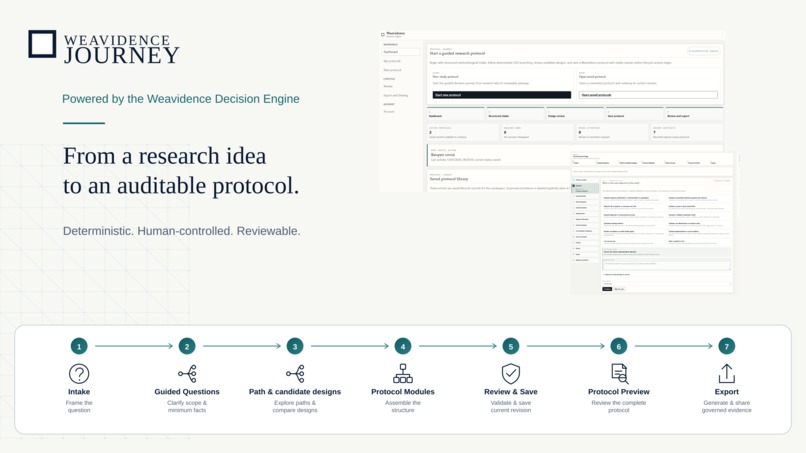
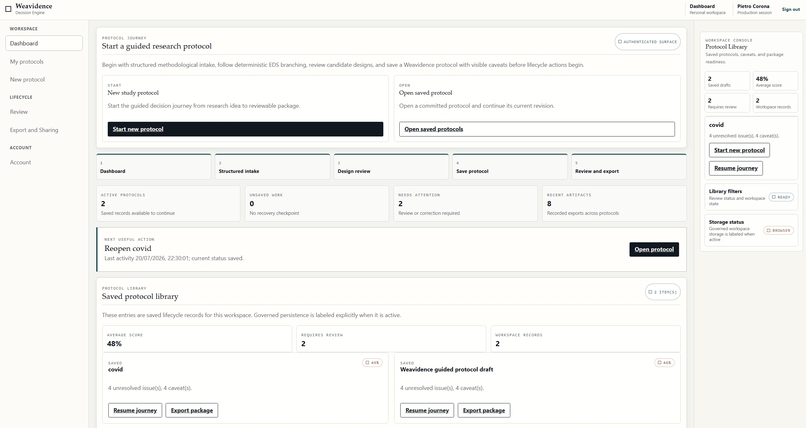
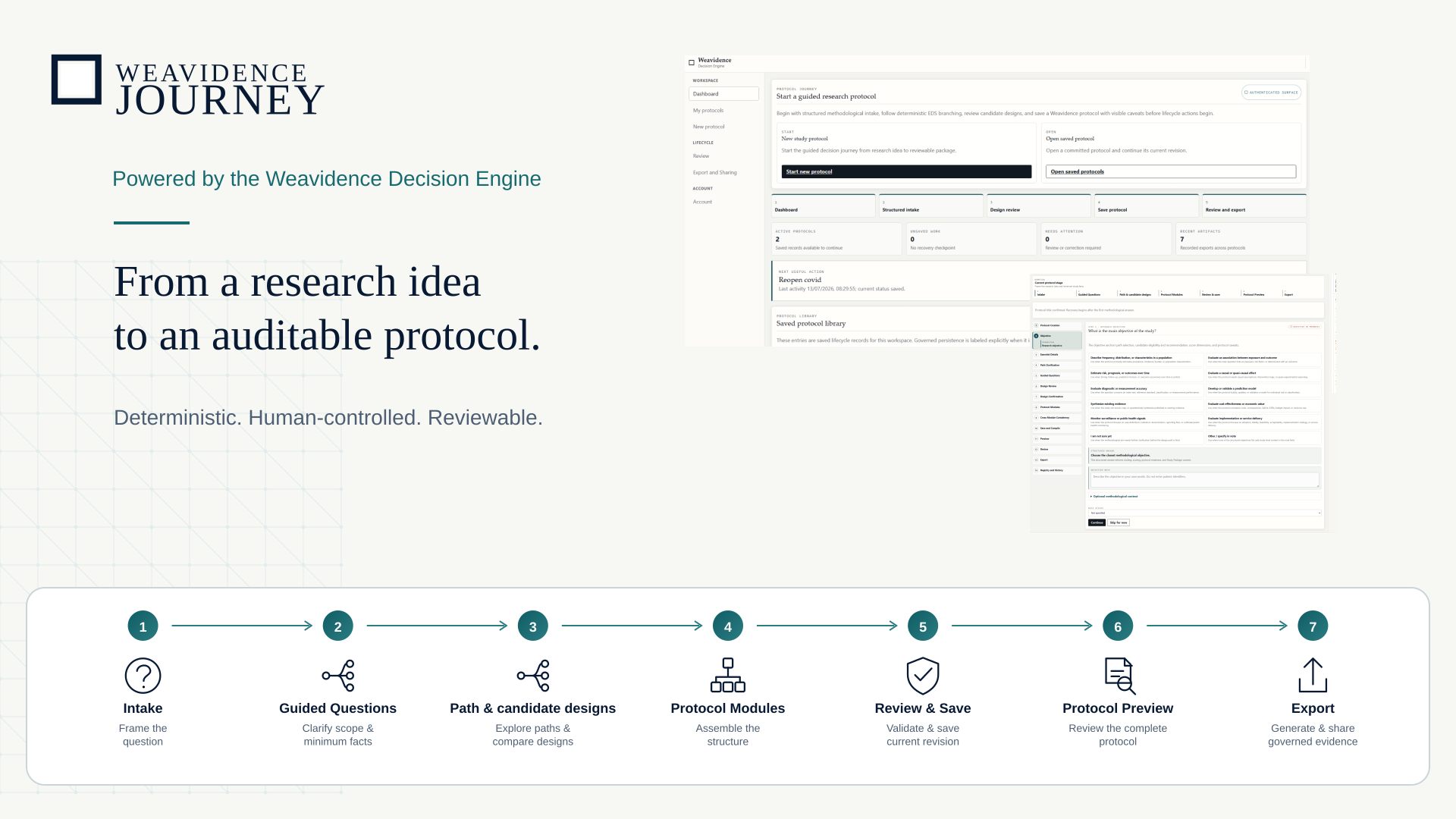
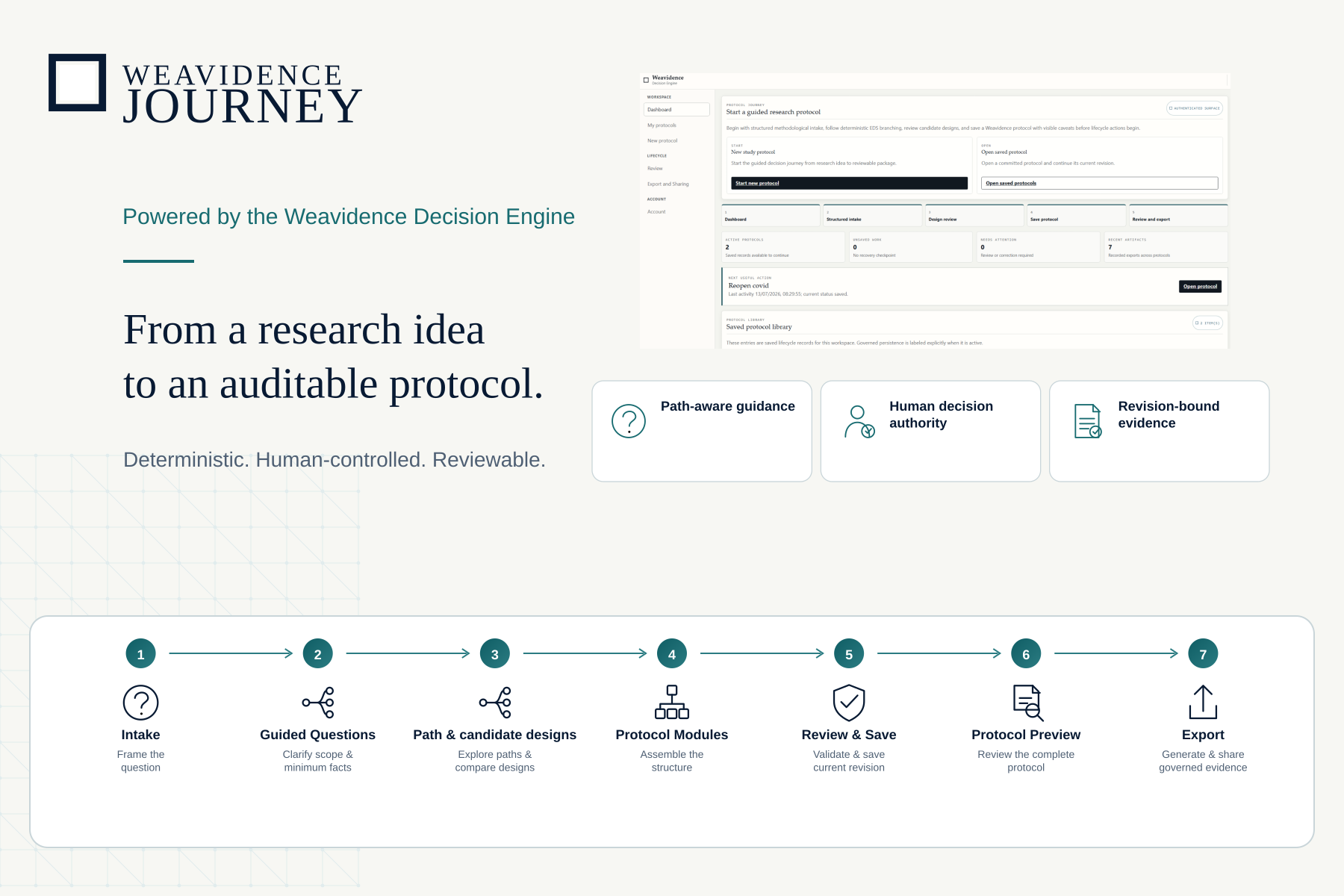
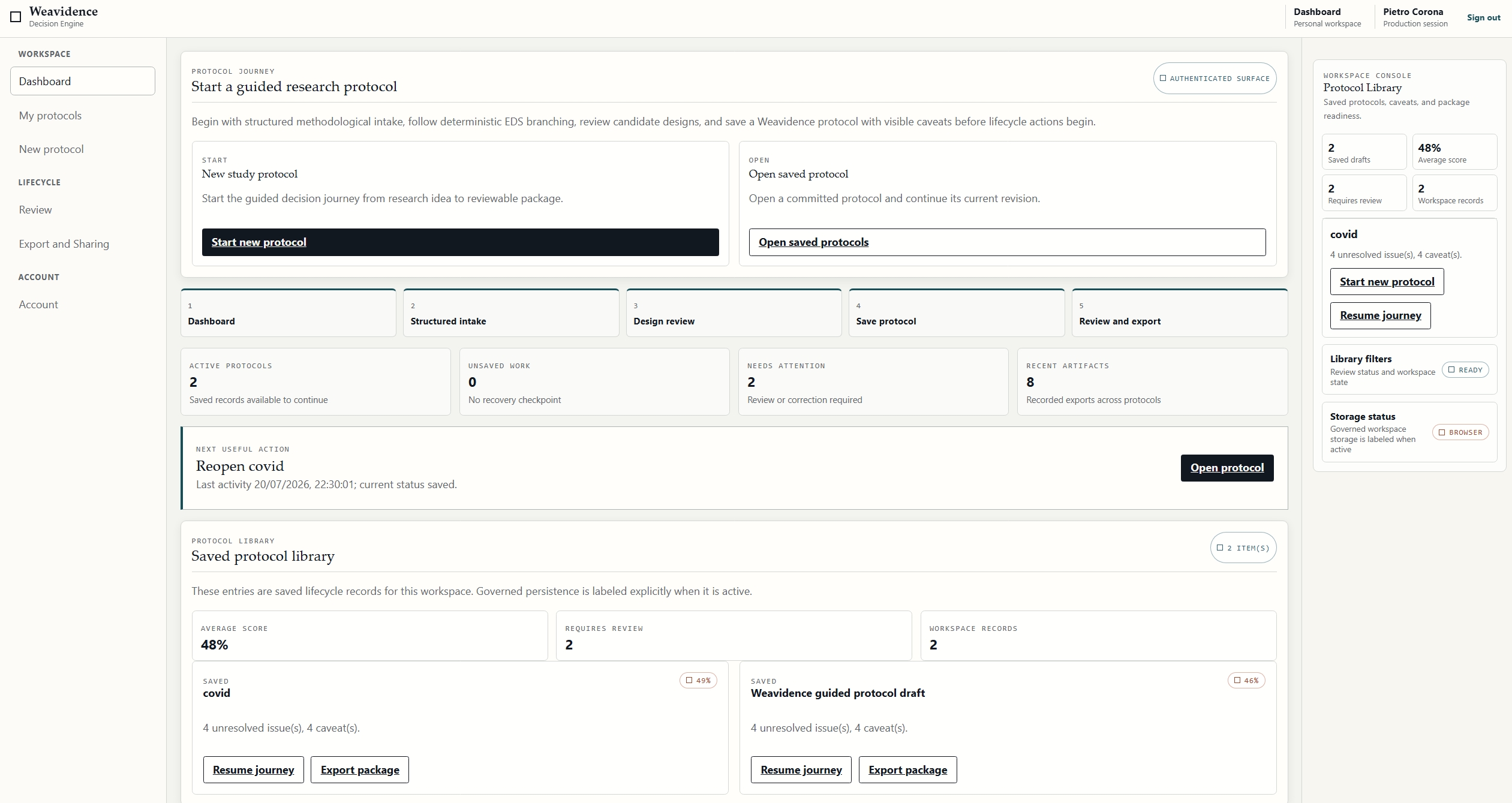
Weavidence Journey — powered by the Weavidence Decision Engine — guides a researcher from an initial research idea to a structured and auditable protocol.
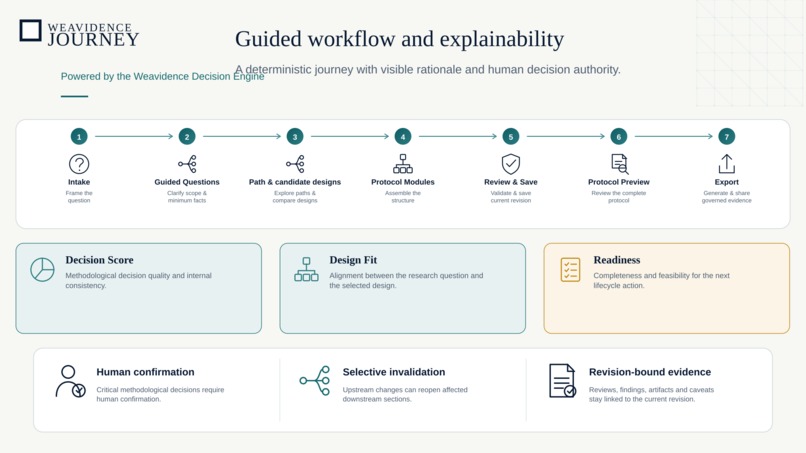
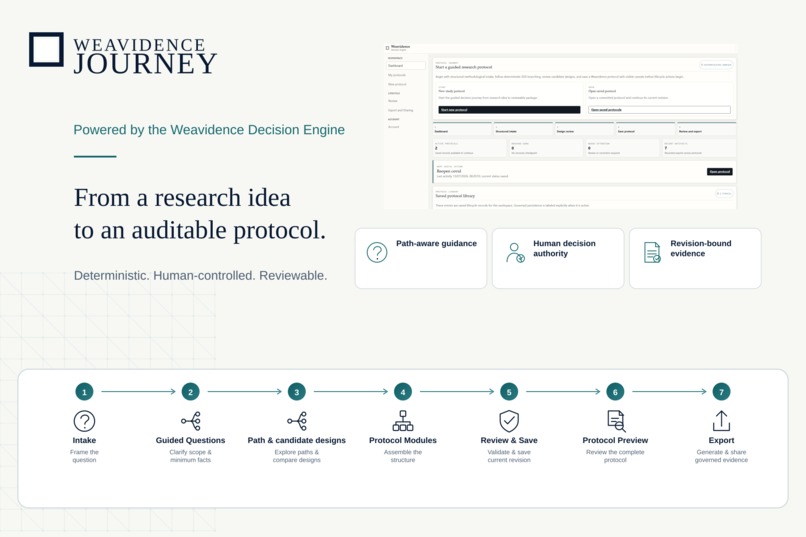
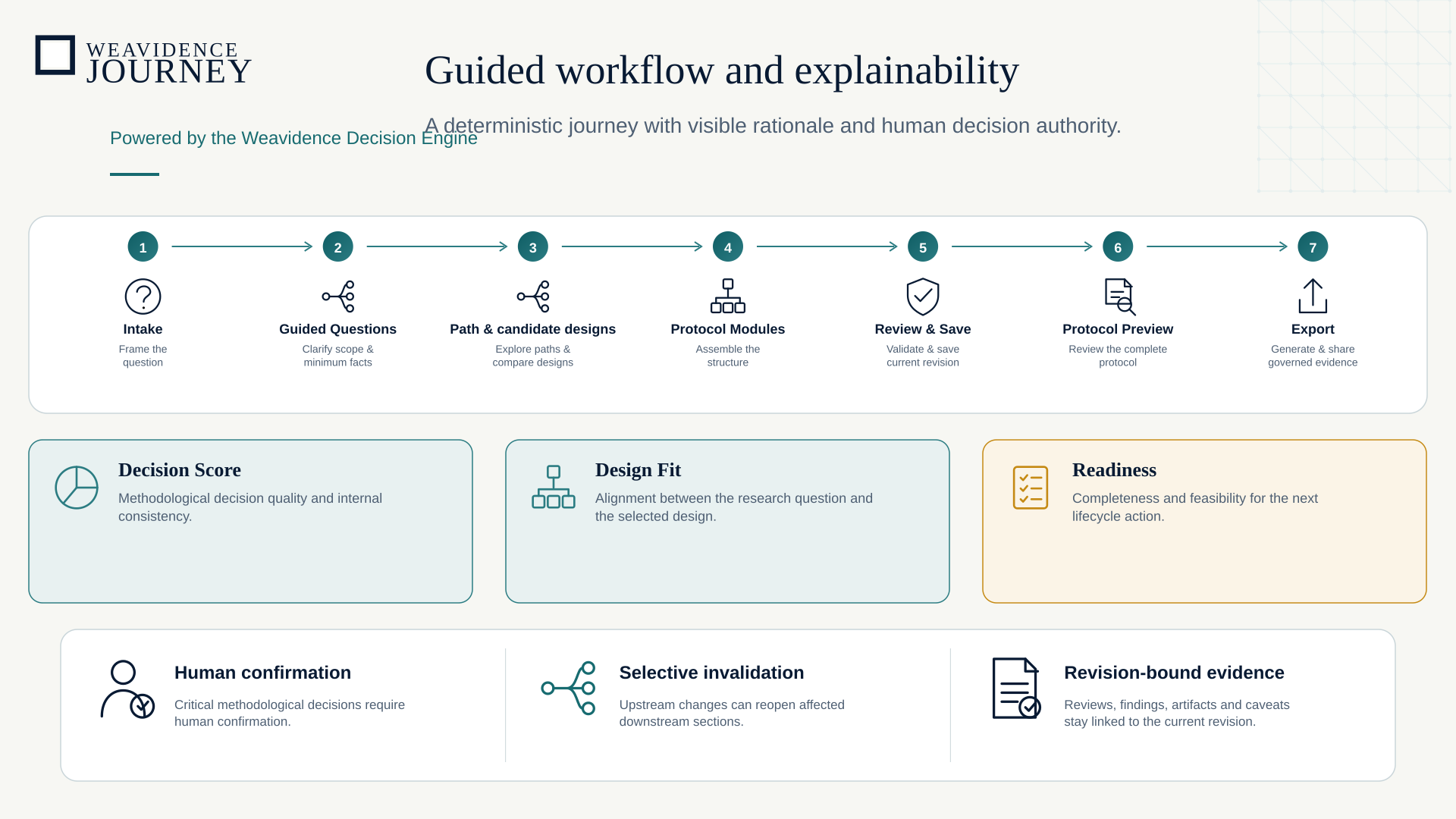
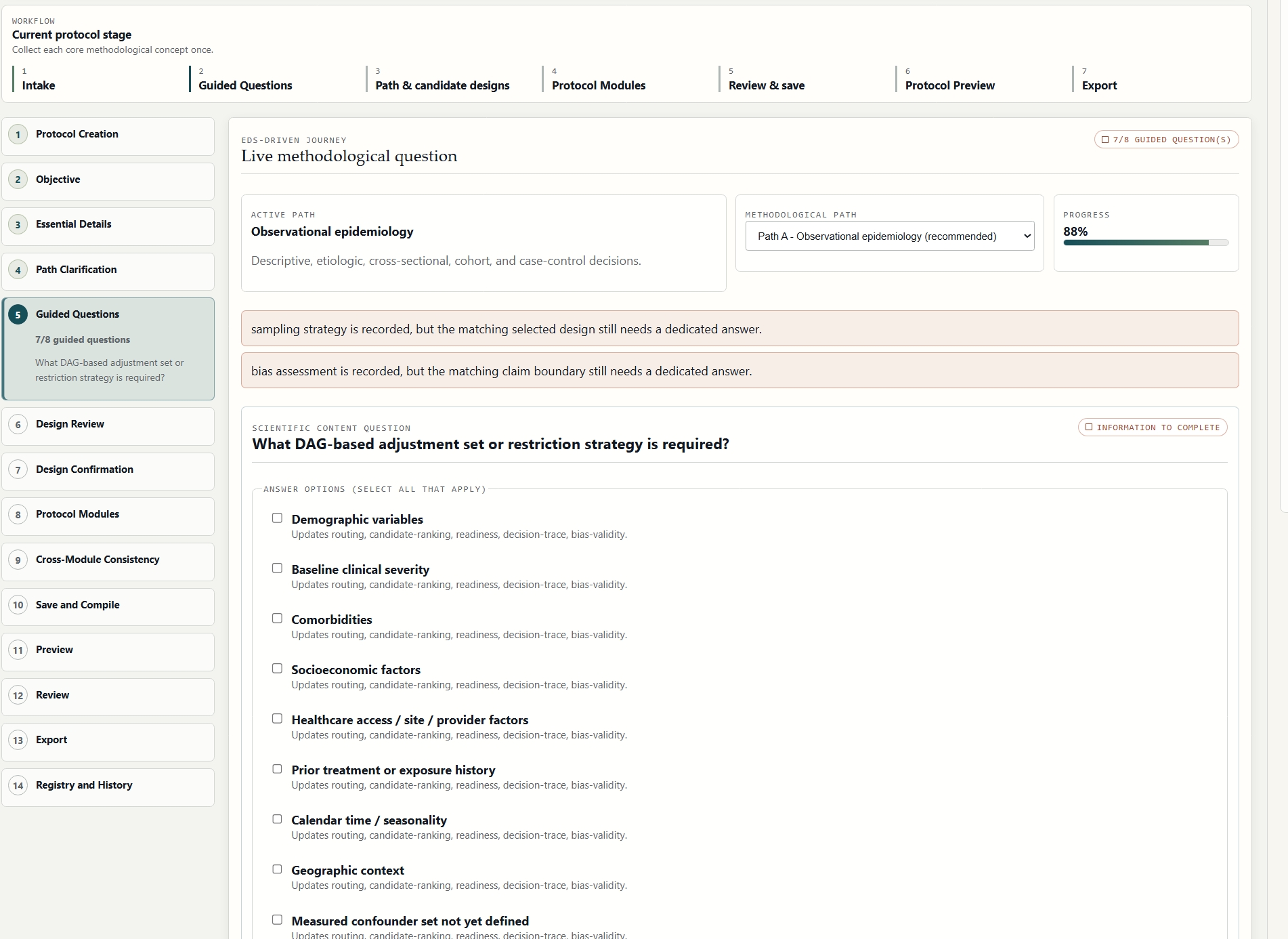
The journey is organized into seven lifecycle stages:
- Intake — frame the research question.
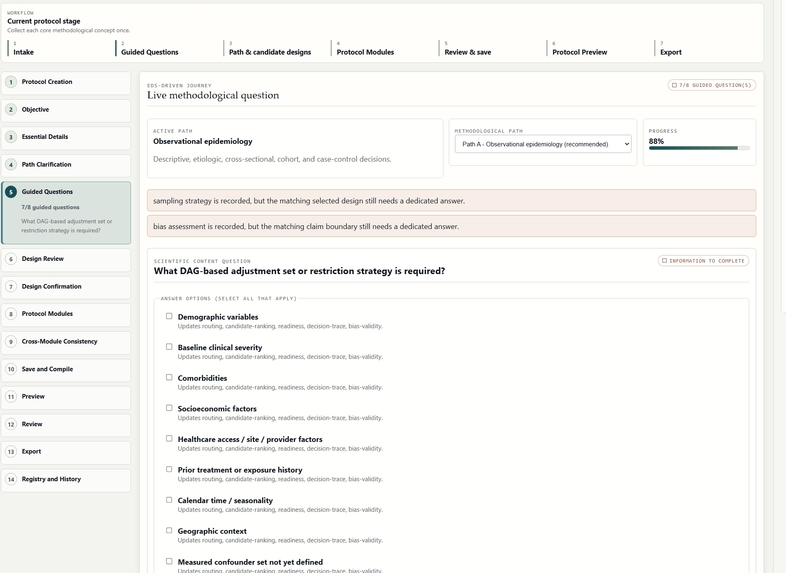
- Guided Questions — clarify scope and minimum required facts.
- Path & candidate designs — explore methodological paths and compare study designs.
- Protocol Modules — assemble the protocol structure.
- Review & Save — validate and save the current revision.
- Protocol Preview — review the complete protocol.
- Export — generate and share governed evidence.
The system supports multiple methodological paths and presents candidate study designs with visible rationale. The researcher can confirm the proposed direction or make a different choice, but important decisions remain explicit and traceable.
Three indicators are kept deliberately separate:
- Decision Score — methodological decision quality and internal consistency.
- Design Fit — alignment between the research question and the selected study design.
- Readiness — completeness and feasibility for the next lifecycle action.
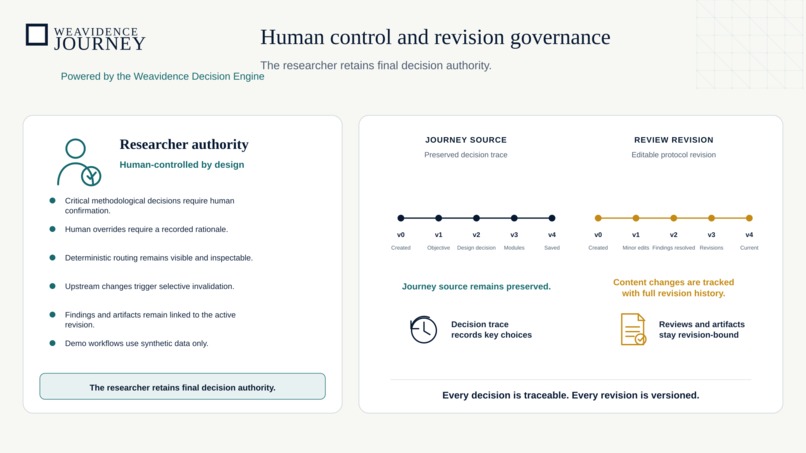
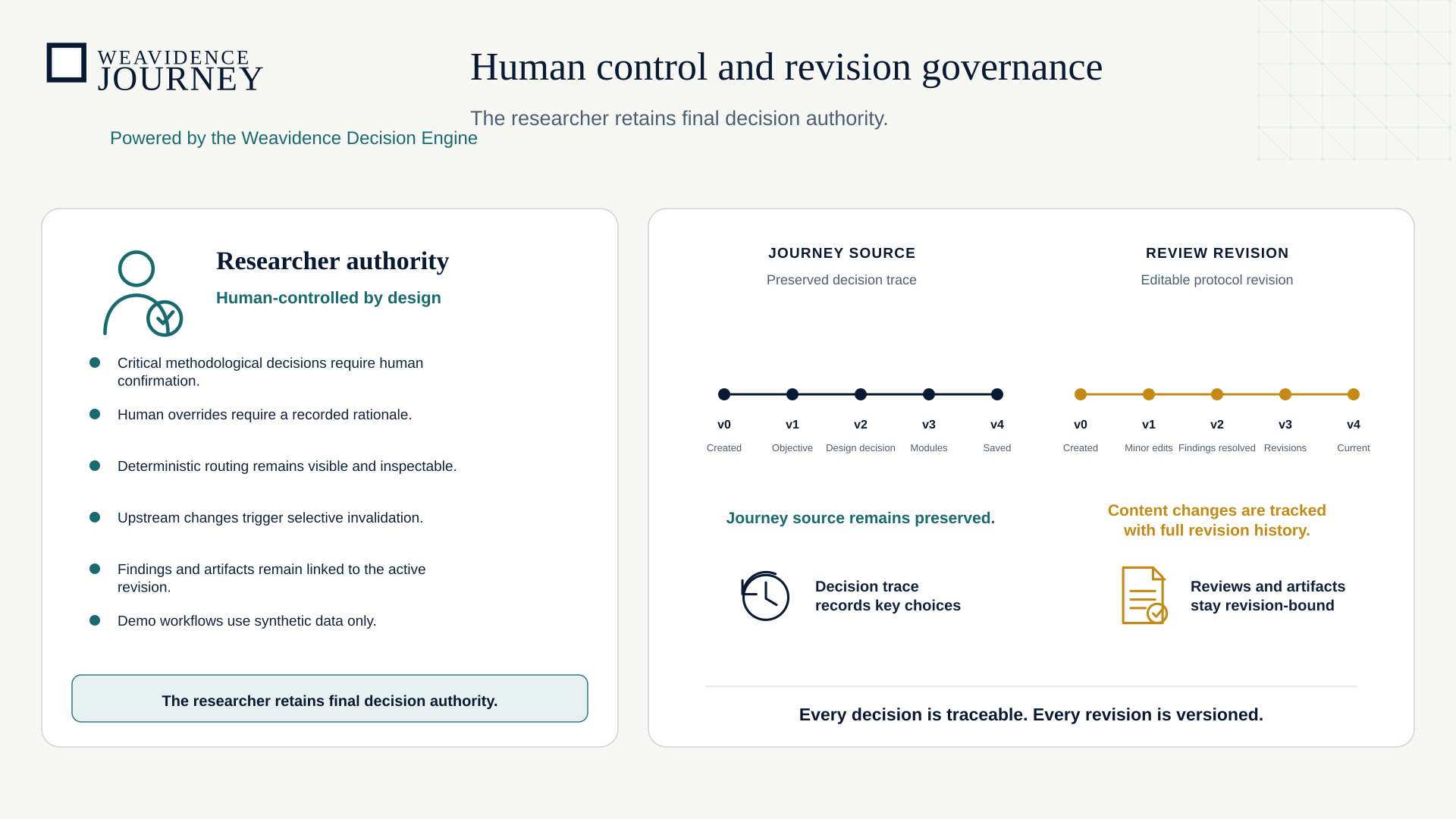
Upstream changes can selectively reopen affected downstream sections. Reviews, findings, caveats, artifacts, and exports remain linked to the active protocol revision.
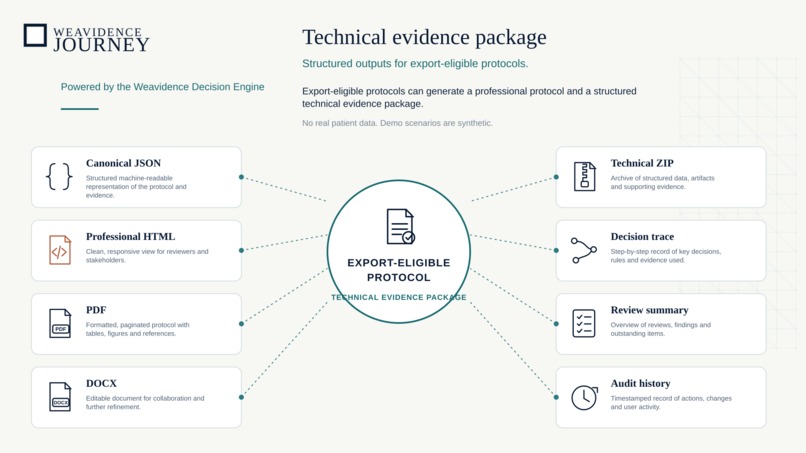
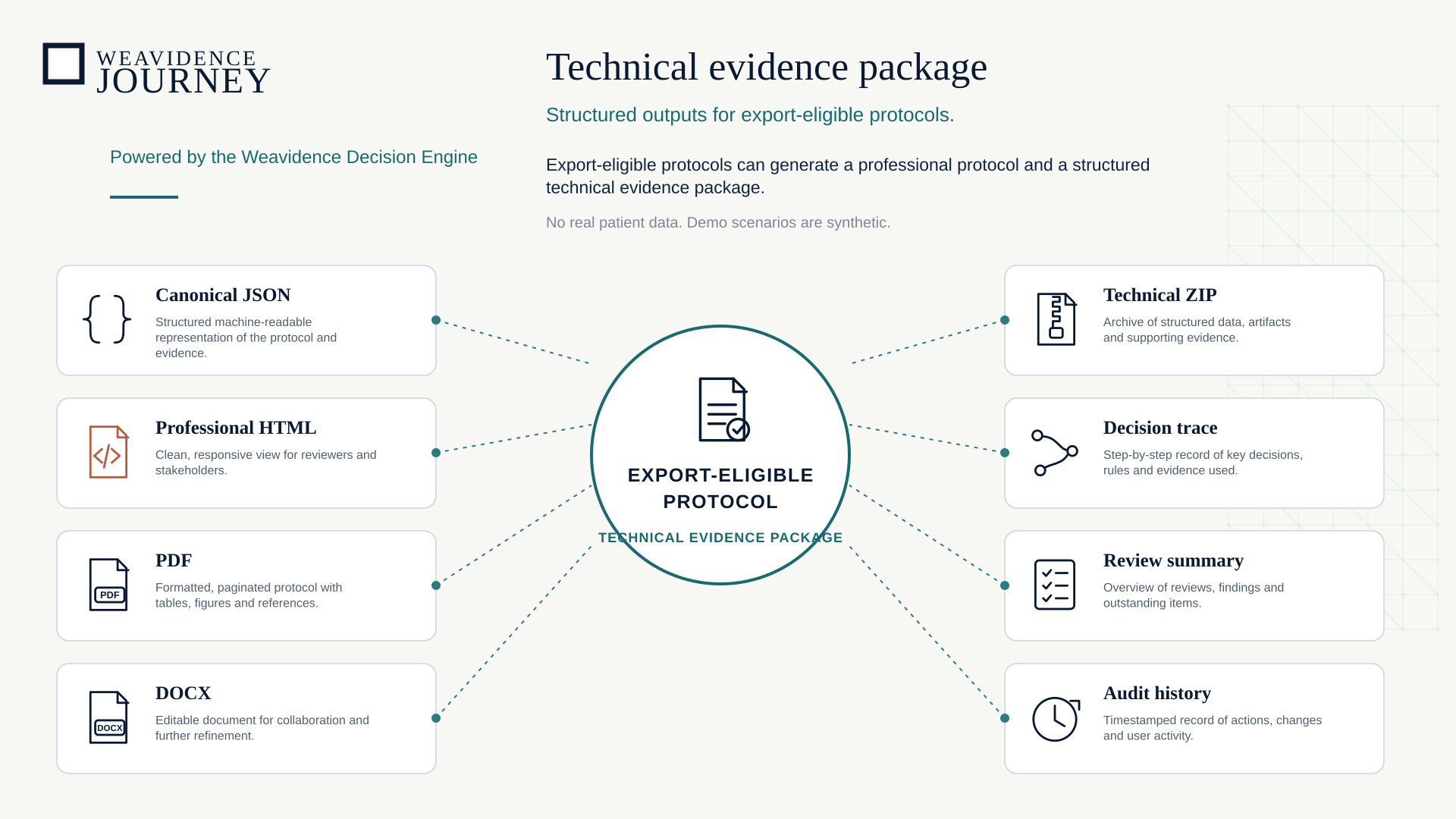
Export-eligible protocols can produce professional and technical outputs including structured JSON, HTML, PDF, DOCX, a technical archive, a decision trace, review information, and audit history.
The researcher always retains final decision authority.
How I built it
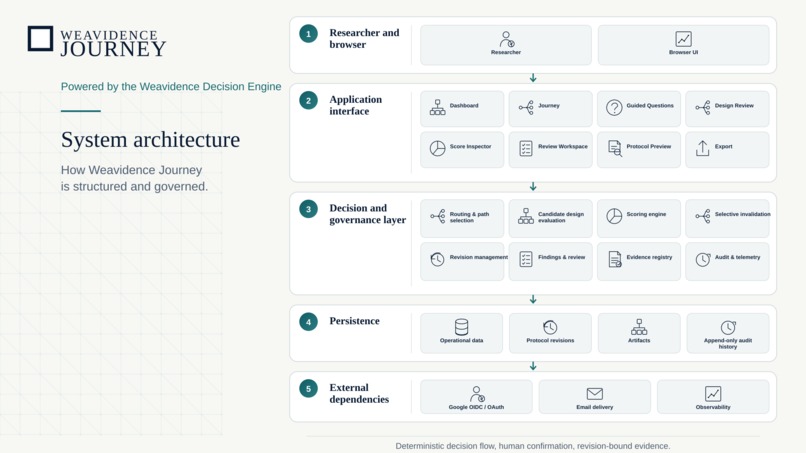
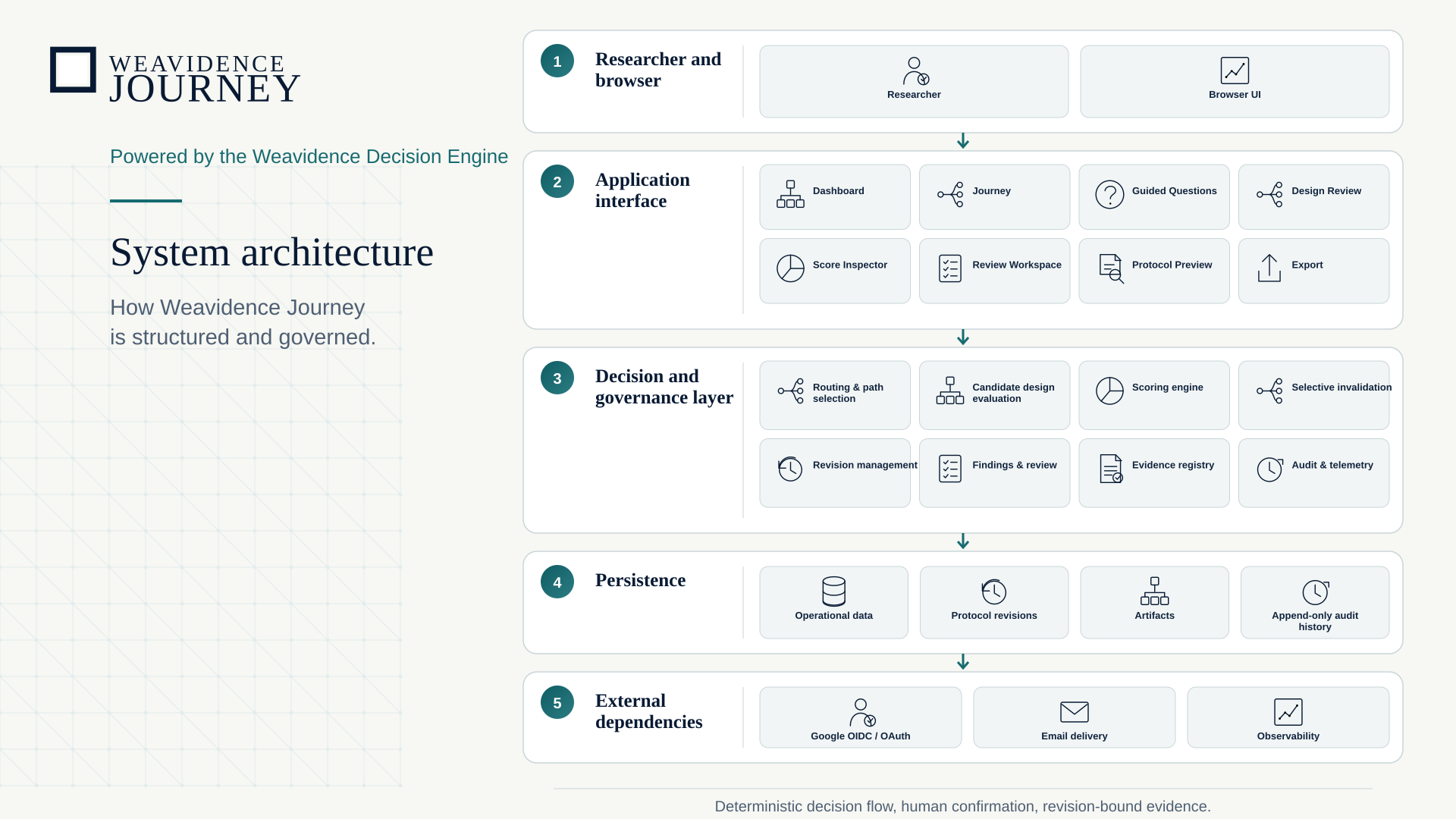
Weavidence Journey is a full-stack web application built around a deterministic decision engine rather than a generative-chat interface.
The implementation combines:
- a structured semantic registry for questions, concepts, answers, study designs, and methodological contracts;
- deterministic routing across methodological paths;
- candidate-design evaluation and transparent rationale;
- human confirmation and justified override workflows;
- selective invalidation when upstream answers change;
- revision-aware review and evidence binding;
- professional protocol generation and export;
- automated unit, integration, browser, semantic, and regression testing;
- authentication, persistent storage, auditability, and production deployment.
The product existed before the hackathon as a research-design application. During Build Week, I substantially refounded it into a governed decision system in which the journey, selected design, scoring, readiness, reviews, revisions, and generated artifacts are connected to the same evidence state.
This distinction is important: the project was not presented as if it had been created from nothing during the event. The Build Week contribution was a major architectural and methodological transformation of the existing system.
How I used GPT-5.6 and Codex
My development approach was human-led, AI-orchestrated, and adversarially verified.
GPT-5.6 supported strategic reasoning, specification, system architecture, orchestration, critique, and evidence preparation.
Codex inspected the repository, implemented and remediated features, executed tests, investigated failures, generated evidence, and preserved negative findings when acceptance conditions were not met.
AI did not become the runtime scientific authority. The product remains deterministic within its defined contracts, and the human researcher retains control over methodological decisions.
I used AI as an engineering and reasoning partner, while preserving ownership of the product vision, scientific framing, architectural decisions, acceptance criteria, and final judgment.
Challenges
Turning methodology into executable contracts
Scientific reasoning is often expressed in narrative guidance. Converting that knowledge into explicit questions, option banks, routing rules, design constraints, review requirements, and invalidation relationships was one of the hardest parts of the project.
Preventing false certainty
A research tool must not collapse uncertainty into one apparently definitive answer. The system therefore separates candidate designs, fit, methodological quality, readiness, caveats, and human confirmation instead of presenting one universal score.
Maintaining consistency across the whole lifecycle
A change made during Intake may affect design selection, protocol modules, review findings, generated outputs, and export eligibility. Keeping those components synchronized while preserving revision history required a strong semantic and evidence architecture.
Making tests prove meaning, not only clicks
A browser test can pass while selecting the wrong option or reaching the wrong state. I therefore strengthened the test architecture so that semantic tests verify path identity, option-bank compatibility, answer persistence, expected progression, and revision-bound behavior.
Preserving an institutional user experience
The interface had to feel sober, trustworthy, and suitable for professional research work. I deliberately avoided turning the product into a conversational assistant or a visually noisy AI demo.
What I learned
I learned that AI is most valuable in complex product development when it is placed inside a governed process.
AI accelerated repository inspection, implementation, testing, critique, and documentation. However, quality depended on explicit contracts, reproducible evidence, negative testing, independent review, and a human who remained responsible for every important decision.
I also learned that deterministic systems and generative AI are not opposites. They can complement each other: AI can help design and build the system, while the runtime product preserves explainability, repeatability, and human control.
Accomplishments
I am particularly proud that Weavidence Journey now brings together:
- structured methodological guidance;
- multiple research-design paths;
- transparent candidate-design evaluation;
- explicit human confirmation;
- separate Decision Score, Design Fit, and Readiness indicators;
- selective invalidation;
- revision-bound evidence;
- professional protocol outputs;
- decision traces and audit history;
- extensive automated and adversarial validation;
- a production-ready web architecture.
Most importantly, the product does not hide the reasoning process behind a polished generated document. It makes the journey itself visible.
What's next
The next stages are to expand expert review, deepen methodological content, improve accessibility and onboarding, validate the system with real research workflows, and progressively develop additional modules for statistical planning, bias assessment, causal reasoning, evidence synthesis, and specialized study designs.
The long-term goal is for Weavidence Journey to become a trustworthy methodological workspace in which researchers can design, review, revise, and communicate research protocols without losing control of the decisions that produced them.
From a research idea to an auditable protocol — through a deterministic, human-controlled decision journey.
Built With
- actions
- api
- codex
- css3
- docker
- git
- github
- gpt-5.6
- html5
- javascript
- json
- neon
- node.js
- oauth
- openai
- playwright
- postgresql
- prisma
- react
- render
- resend
- rest
- typescript
- vercel
- vitest

Log in or sign up for Devpost to join the conversation.