-
-
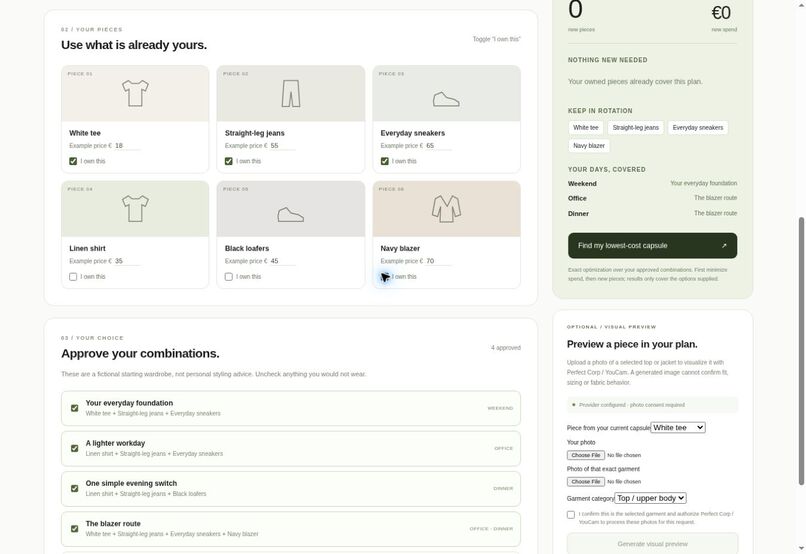
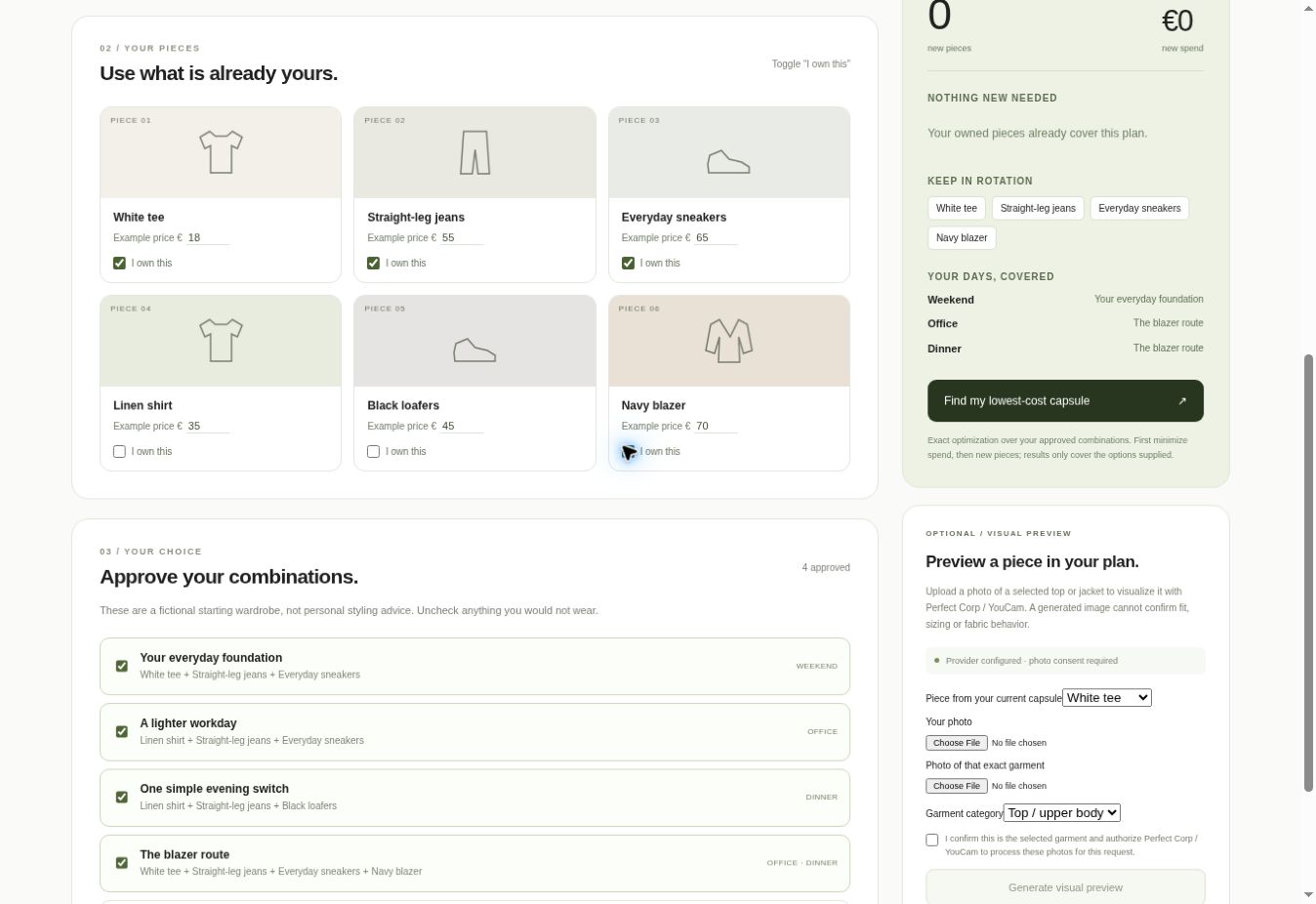
Marking the navy blazer as already owned reduces additional spend to €0 for the approved starter wardrobe.
-
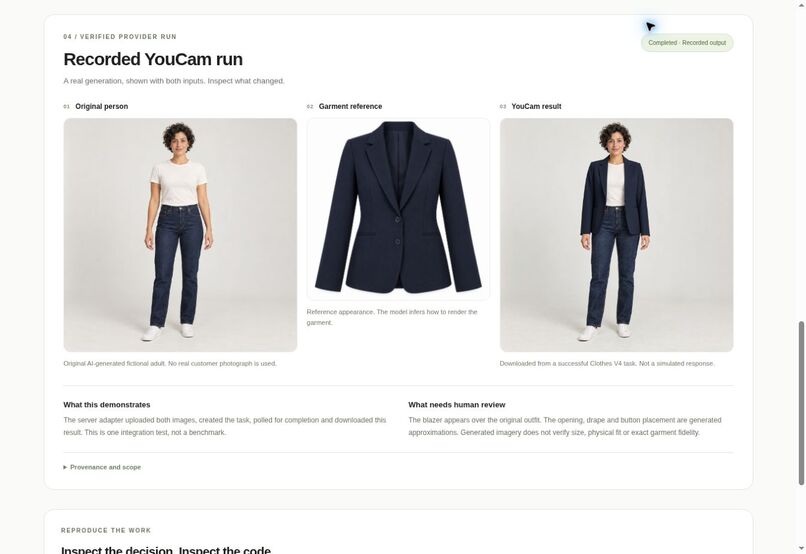
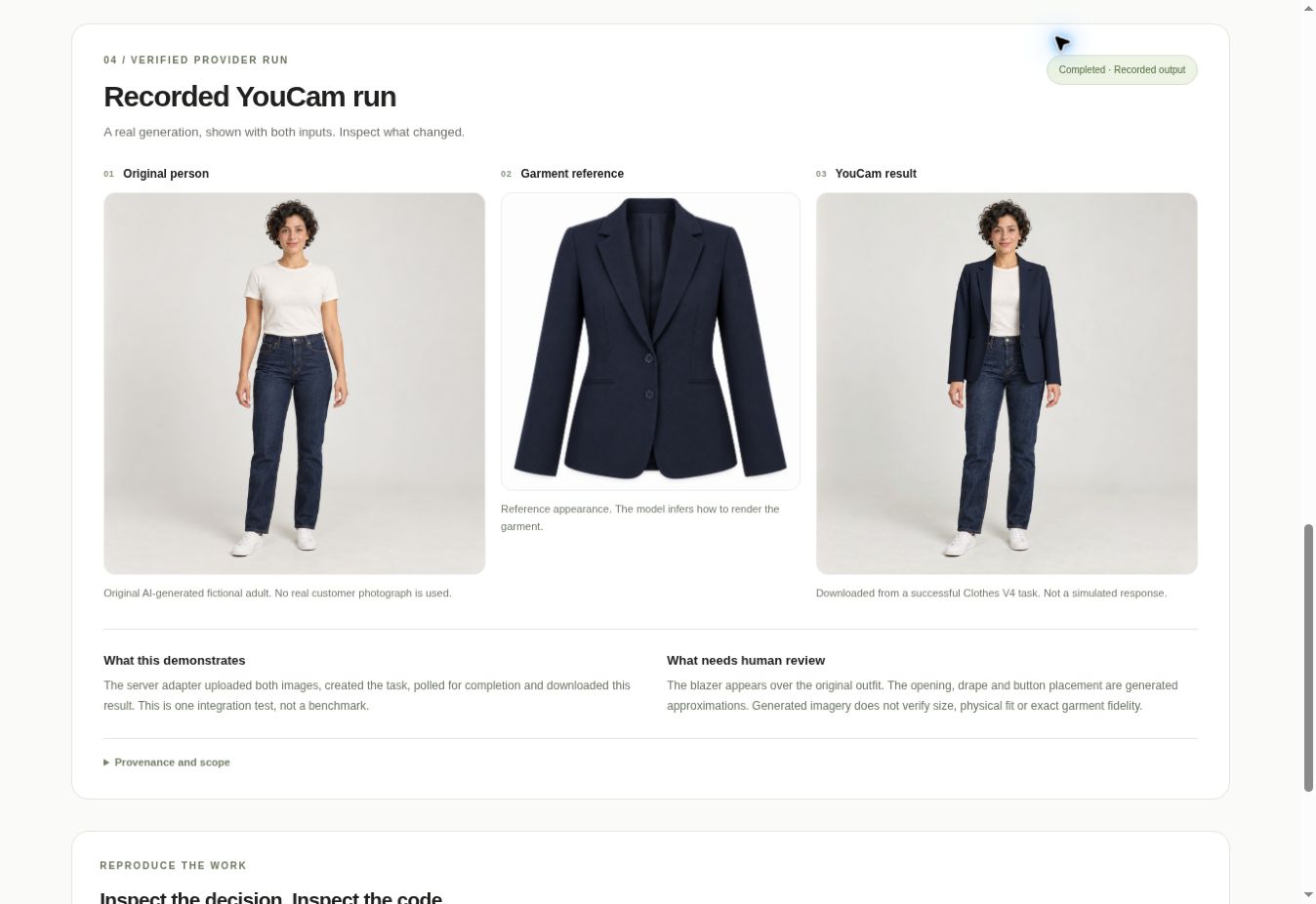
Real YouCam Clothes V4 result: original synthetic person, navy blazer input and recorded output. Visual preview, not a fit guarantee.
-
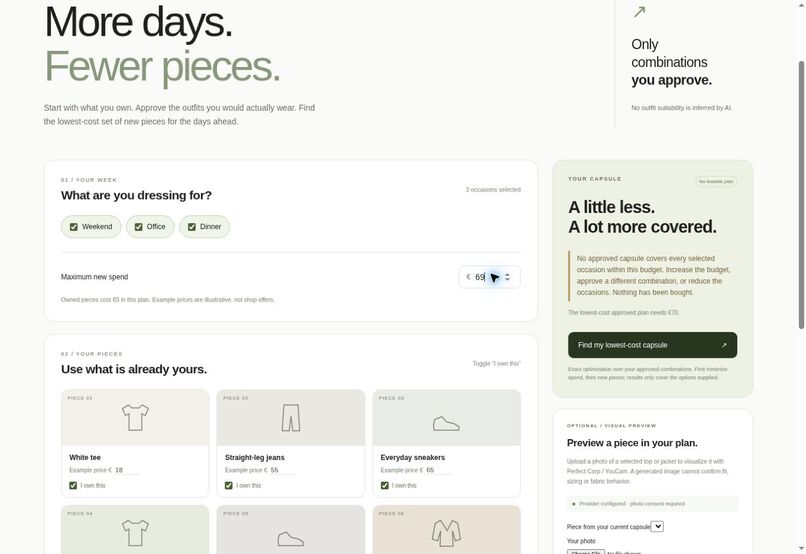
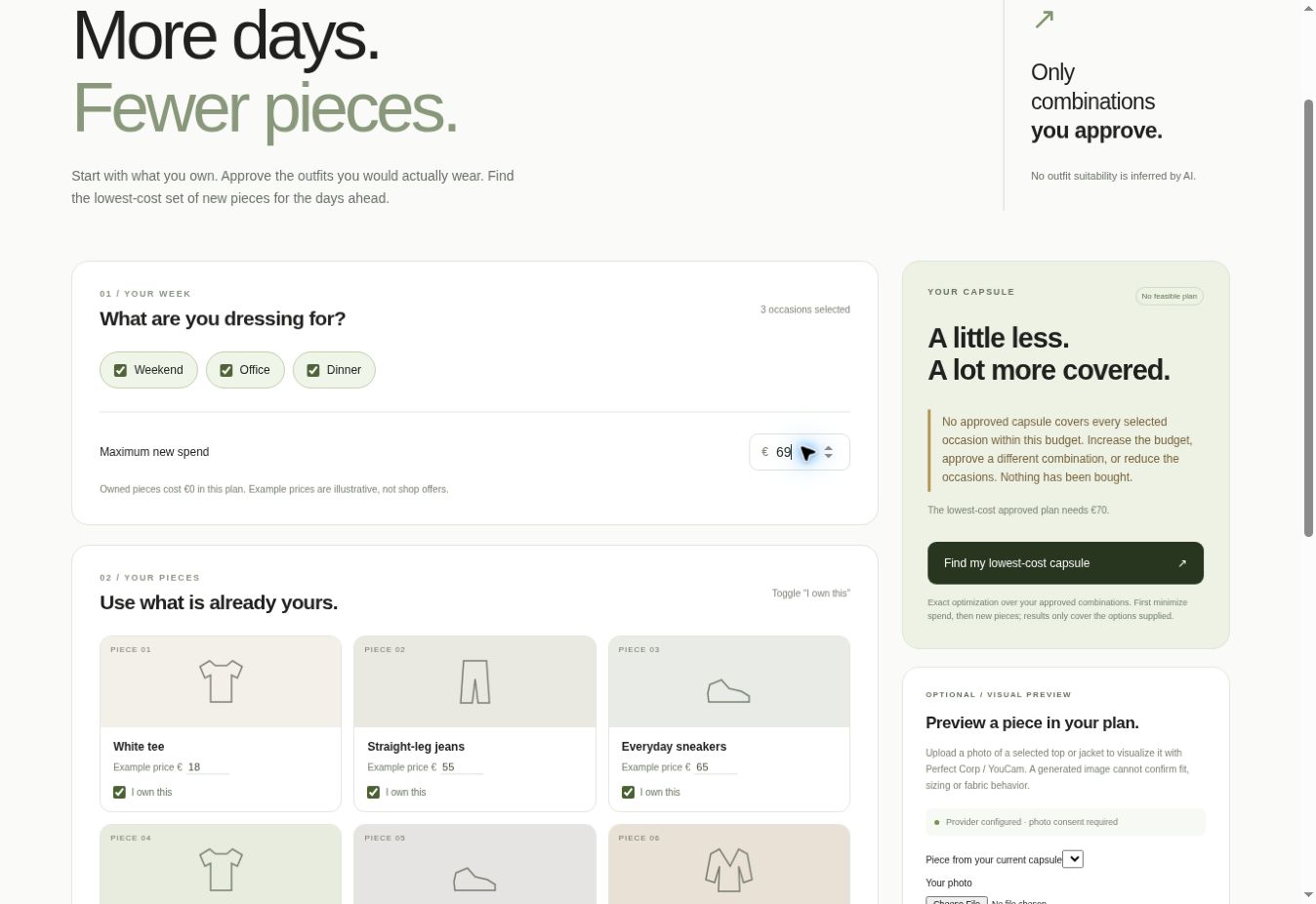
At a €69 budget the approved combinations cannot be covered. The exact planner identifies the €70 minimum.
Inspiration
Most virtual fitting rooms begin with a product. WearFewer begins with a question: what do I actually need to add to the clothes I already own?
We connect visual exploration to an inspectable purchase decision. Users approve outfit combinations themselves; the app does not infer which clothes are appropriate for a person or occasion.
What it does
Choose occasions, mark owned pieces, edit example prices and approve combinations. WearFewer finds the lowest-cost additions that cover those occasions, then minimizes purchase count among equal-cost solutions. It shows alternatives and explains when the budget cannot cover the approved combinations.
In our fictional starter wardrobe:
- A €70 navy blazer completes the approved week.
- At €69, the app reports that the budget is insufficient.
- Mark the blazer as already owned, and additional spend becomes €0.
The curated web demo connects that decision to a real, recorded YouCam Clothes V4 result. The original inputs are a synthetic adult model and an unbranded navy blazer. The capsule preview is relevant only while the blazer belongs to the current plan. Changing prices or approvals does not regenerate the image.
This makes the distinction visible: the optimizer answers which approved purchases cover the plan; YouCam helps the user inspect one garment's appearance. Neither determines physical fit or size.
How we built it
The planner uses dependency-free JavaScript and exact subset enumeration for up to 18 purchasable items. Prices use safe integer cents. An independent Set-based oracle checks the optimization result across 120 randomized cases.
The source includes a local live-upload interface and a Node.js server adapter for YouCam. A real HTTP request to our backend uploaded both images, created a Clothes V4 outerwear task, polled completion and downloaded the displayed result. Credentials stay server-side. A durable ledger reserves generation attempts before the task POST, counts uncertain outcomes and blocks duplicate inputs across process restarts or key changes.
The browser planner and backend were tested separately. The controlled browser preview environment could not reach the provider; we do not claim a completed browser-to-provider end-to-end test. The public website therefore offers a clearly labeled recorded result, while the source includes the live integration for local execution with an authorized private key and credits.
Challenges we ran into
Editable prices initially risked leaving an outdated plan. The UI now reads displayed values before calculation and clears stale results. We also hardened credential handling, rotated the initial development credential and replaced provider sample images with original synthetic assets for the public demonstration.
The generated blazer has approximate opening, drape and button placement. Showing the actual result and its limitations is part of the product, rather than treating a rendering as proof of fit.
Accomplishments
- 34 automated tests pass, covering the exact solver, provider adapter, HTTP boundary and UI state.
- A separate review passed five curated-preview state checks.
- Two real YouCam tasks completed during development; the public demo uses only the original-asset blazer case.
- The public demo needs no account, photo upload or visitor credits. Source, setup instructions, test instructions and asset provenance are available in the repository.
These are bounded engineering results. We have not yet measured savings, reduced returns, environmental impact or sizing accuracy.
What we learned
A useful fitting room can help someone decide not to buy. That requires explicit user choices and transparent arithmetic alongside visual generation. Keeping those responsibilities separate makes both easier to inspect.
What's next
Run a pre-specified user study to test whether the workflow improves purchase decisions. Add product-data provenance and additional permitted garment categories after validating their integrations.
Try it and review the evidence
Public demo: https://wearfewer-carlosjv.zrm7tv2zmj.chatgpt.site
Source: https://github.com/carlosjunquerovila-afk/wearfewer — download and unzip WearFewer_Source.zip for the full runnable project, assets, instructions and tests.
Suggested walkthrough: calculate with the default €100 budget; change it to €69; restore €100; mark the navy blazer owned; inspect approved combinations, alternatives and the recorded comparison.
The public demo provides free, unlimited replay of the recorded YouCam case and interactive local planning. It does not provide unrestricted fresh YouCam generation. The included live adapter requires your own authorized server-side credentials and credits; no private owner key is shared.
AI assistance and provenance
Created during October 2026 with AI assistance for code, reviews, documentation and original synthetic assets. The public package contains no real customer photographs, testimonials or third-party sample images. Software is MIT licensed; asset permissions and provenance are documented separately. Carlosjv is the human entrant; AI assistants are not additional team members.
Built With
- javascript
- node.js
- youcam-api
