WearCheck — Know Before You Wear
Inspiration
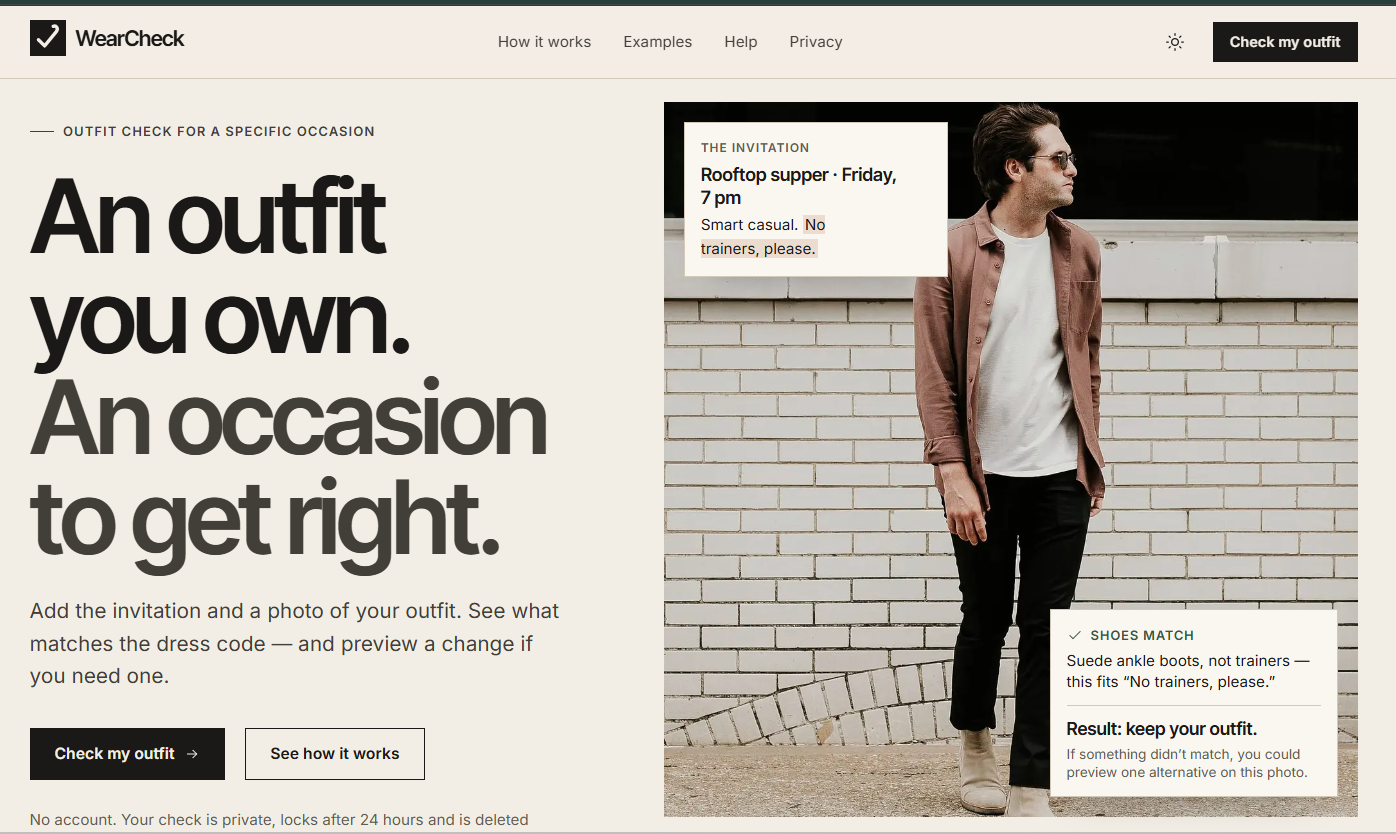
Getting dressed for an important event shouldn't feel like guessing.
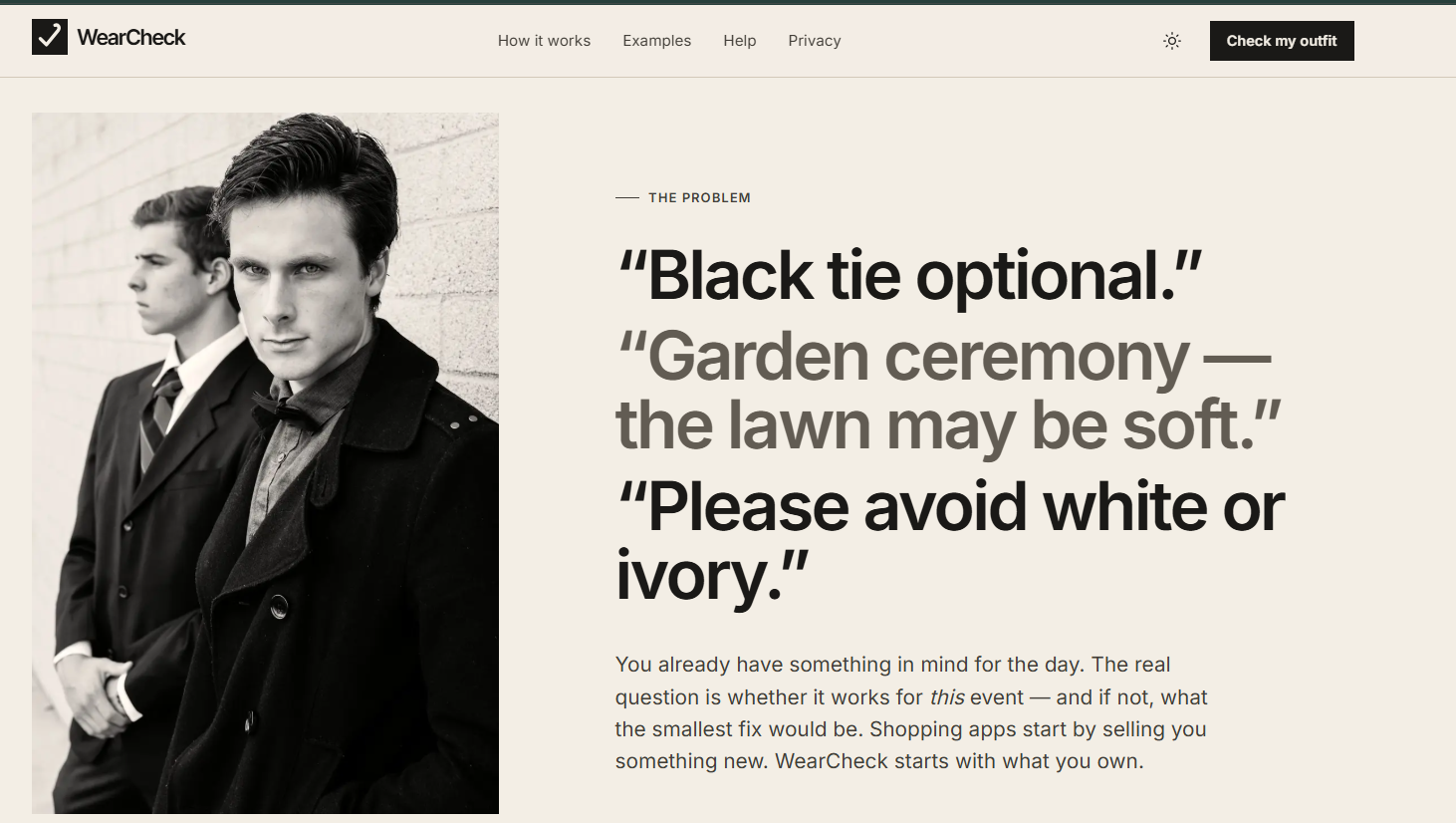
A wedding invitation says "formal attire, no white." A corporate event requires business formal. A celebration has specific colours or footwear expectations. You already own an outfit, but you're unsure whether it fits the occasion.
Searching for dress-code advice gives generic answers. Online shopping shows clothes on models, not on you. And discovering that your outfit is inappropriate after arriving at an event is too late.
That inspired WearCheck: an AI-powered dress-code companion that helps people understand what an occasion requires, check their existing outfit, and virtually try on suitable alternatives before getting dressed or buying something new.
We wanted to move beyond virtual try-on as entertainment and make it part of a practical decision.
What it does
WearCheck turns an event invitation into an actionable outfit decision.
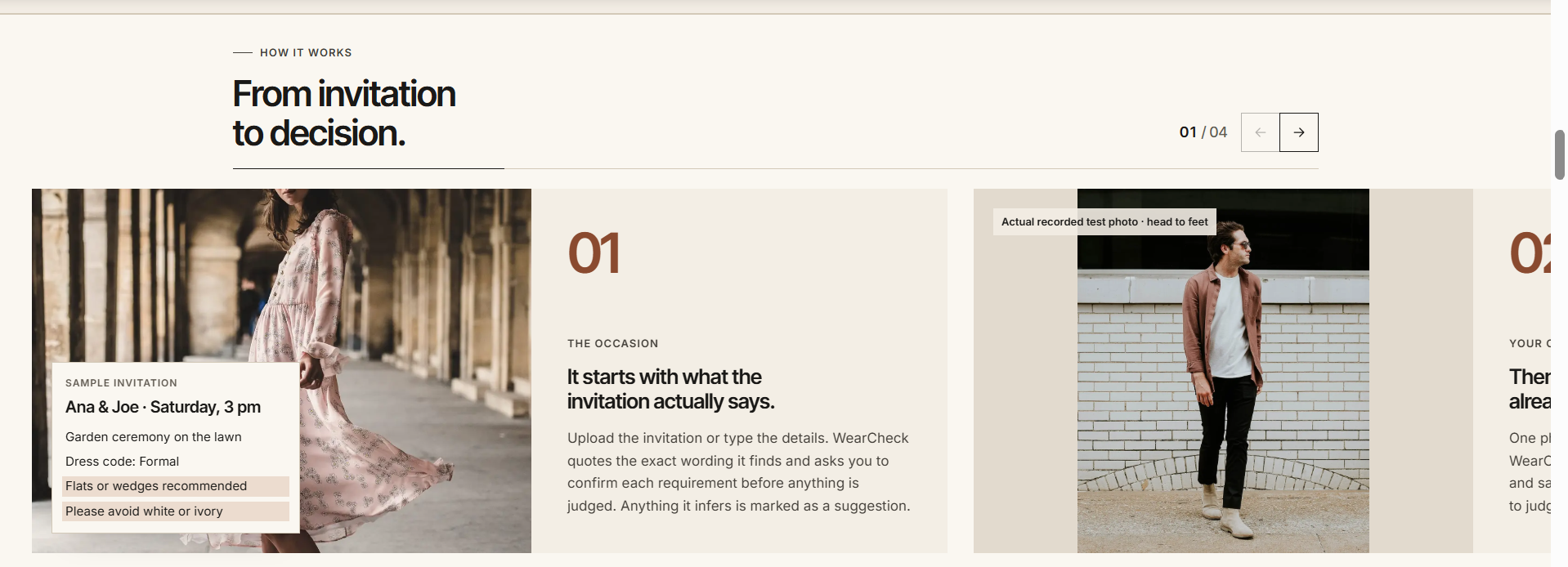
- Understand the occasion. Upload an invitation or describe the event. WearCheck uses Gemini to interpret dress-code requirements, including clothing categories, colours, formality and restrictions.
- Check your outfit. Upload a full-length photograph. WearCheck evaluates visible clothing against the requirements and identifies potential conflicts, missing evidence and areas of uncertainty.
- Explore suitable alternatives. Review garment references filtered against the event's requirements, or upload your own clothing reference.
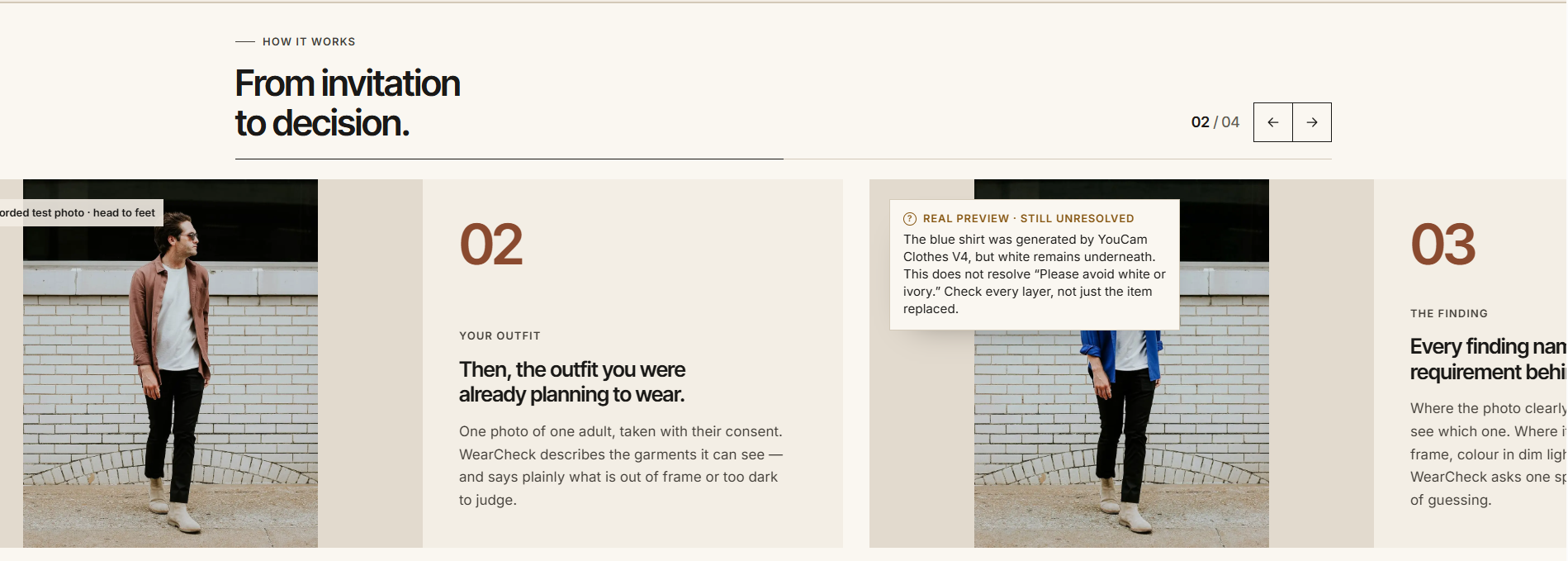
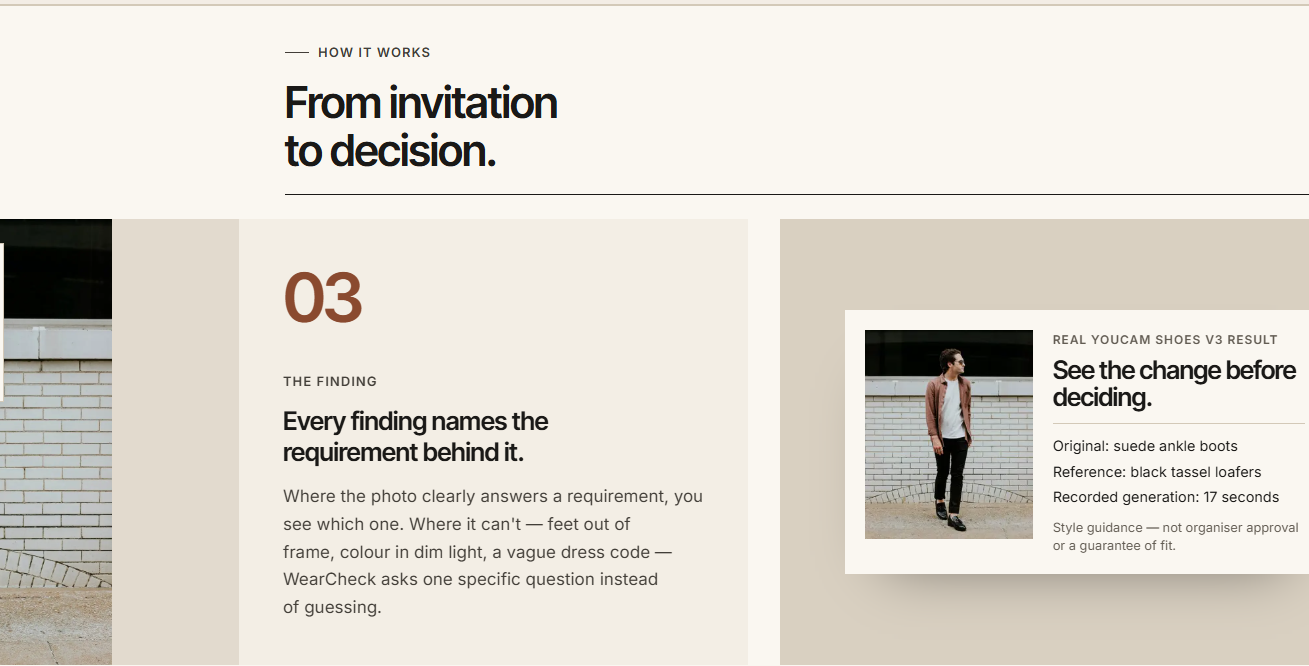
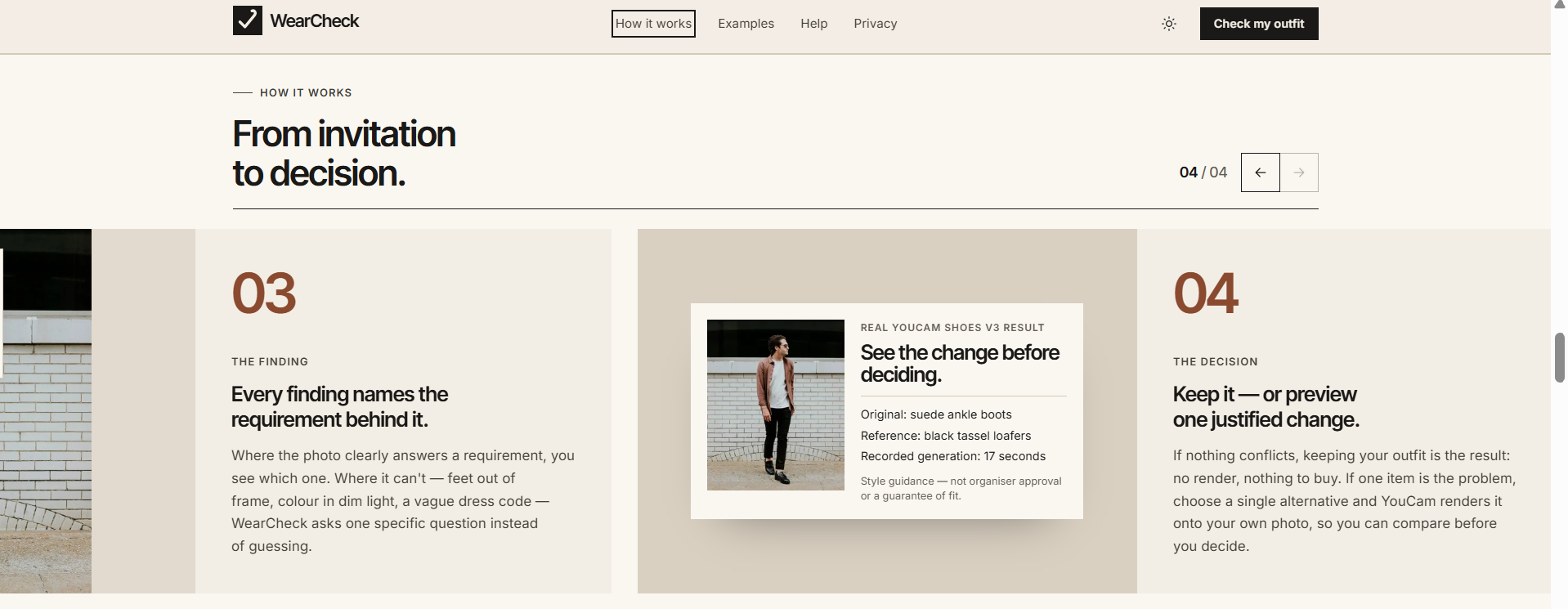
- Try the change on yourself. WearCheck integrates YouCam Clothes V4 to generate clothing transformations and YouCam Shoes V3 to preview replacement footwear.
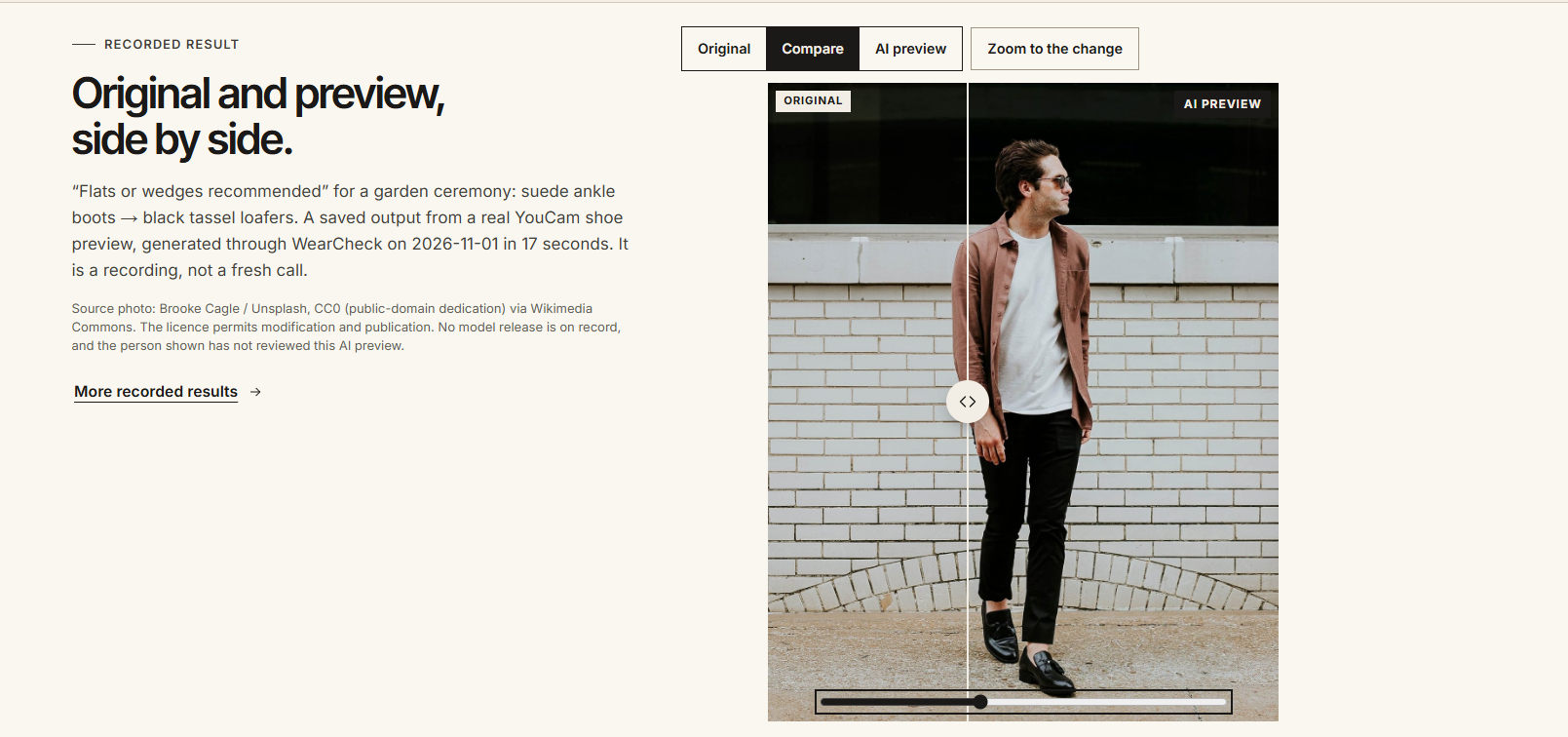
- Review the result. Compare the original photograph with the generated preview, inspect the changes and reassess the result against the original requirements.
- Make a decision. See what appears compatible, what still conflicts and what cannot be verified from the image.
The goal isn't to tell people what is fashionable. It's to help them make a more informed, occasion-specific clothing decision.
How we built it
WearCheck is a responsive web application built with Next.js, React and TypeScript, deployed on Vercel.
The application combines three distinct capabilities:
Gemini — Understanding the dress code
Gemini helps interpret event instructions and assess visible clothing. WearCheck separates observed evidence from uncertainty rather than assuming every requirement can be verified.
WearCheck — Applying the decision logic
The application manages event requirements, evaluates conflicts, filters clothing references, tracks decisions and coordinates the workflow. Rules help prevent explicitly prohibited garments or colours from being treated as suitable recommendations.
YouCam — Making the correction visible
This is where the experience moves beyond a conventional dress-code checker.
Instead of simply suggesting "wear a different shirt" or "change your shoes," WearCheck sends the selected reference and user photograph through the appropriate YouCam virtual try-on API.
- YouCam Clothes V4: Generates a preview of replacement clothing on the user's photograph.
- YouCam Shoes V3: Generates a preview of alternative footwear.
The resulting image can then be compared with the original and reassessed against the event requirements.
The application also includes image handling, asynchronous generation tracking, private media access, deletion controls and responsive comparison interfaces.
Challenges we faced
Turning vague dress codes into usable requirements
Event instructions aren't always precise. "Smart casual" and "formal" can mean different things depending on the occasion.
We had to distinguish explicit restrictions from subjective interpretations and avoid presenting uncertain conclusions as facts.
Preventing misleading recommendations
A garment might satisfy one requirement while violating another. A blue shirt could resolve a prohibited-white conflict but still fail a sleeve or formality requirement.
We developed requirement-aware filtering and assessment logic to evaluate multiple constraints rather than recommending garments based only on appearance.
Connecting AI analysis with actual virtual try-on
A text recommendation is not the same as a usable preview.
We needed to connect the selected garment reference, original photograph, correct YouCam operation, asynchronous generation result and subsequent assessment into a coherent workflow.
Handling imperfect images
Photos can hide shoes, crop garments or obscure colours. Virtual try-on can also change visual details beyond the intended replacement.
WearCheck therefore distinguishes visible conflicts from unverified requirements and encourages users to inspect generated previews rather than treating them as guaranteed accurate representations.
Building a reliable consumer experience
We worked on responsive layouts, generation recovery, request limits, privacy, session isolation and understandable failure states. These details matter because a consumer product needs to be usable beyond a successful API demonstration.
Accomplishments we're proud of
- Integrated two YouCam virtual try-on categories into an event-specific outfit workflow.
- Connected invitation interpretation, outfit assessment, reference selection, virtual try-on and post-generation review.
- Implemented before-and-after comparison tools so users can inspect generated changes.
- Added explicit uncertainty handling for cropped photographs, hidden garments and ambiguous requirements.
- Built a hosted application with private image handling and deletion controls.
- Developed automated tests and hosted browser checks covering core application behavior and real YouCam generation.
What we learned
The most important lesson was that generating a convincing image isn't the same as solving a user's problem.
A virtual try-on becomes more valuable when it answers a specific question: "Would this change help my outfit meet the requirements of the event?"
We also learned that AI-generated previews need careful interpretation. A realistic result can still contain unintended changes, and an outfit should not automatically be marked compatible just because generation succeeded.
Combining rule-based checks, AI interpretation and YouCam's visual generation capabilities creates a more useful experience than relying on any one component alone.
What's next
We want to take WearCheck from a working prototype toward a practical shopping and event-preparation companion.
Our priorities include:
- Expanding the range of suitable garment references and styles.
- Integrating real retailer catalogues so users can preview items they can actually purchase.
- Improving multi-garment assessment and alternative ranking.
- Adding stronger verification of user-uploaded clothing references.
- Supporting more event types, dress-code conventions and personal preferences.
- Improving the reliability and explainability of AI-generated outfit decisions.
Longer term, WearCheck could help fashion retailers answer a more useful question than "How would this look on me?"
"Would this work for the occasion I'm shopping for?"
Try WearCheck
Live application: https://wearcheck.vercel.app
Source code: https://github.com/TheWeirdDee/wearcheck/tree/feat/wearcheck-implementation
WearCheck is a prototype decision-support tool. Generated previews are simulations, not guarantees of fit, appearance or dress-code compliance.
Built With
- gemini
- javascript
- next.js
- react
- supabase
- typescript
- vercel
- youcam
