-
-
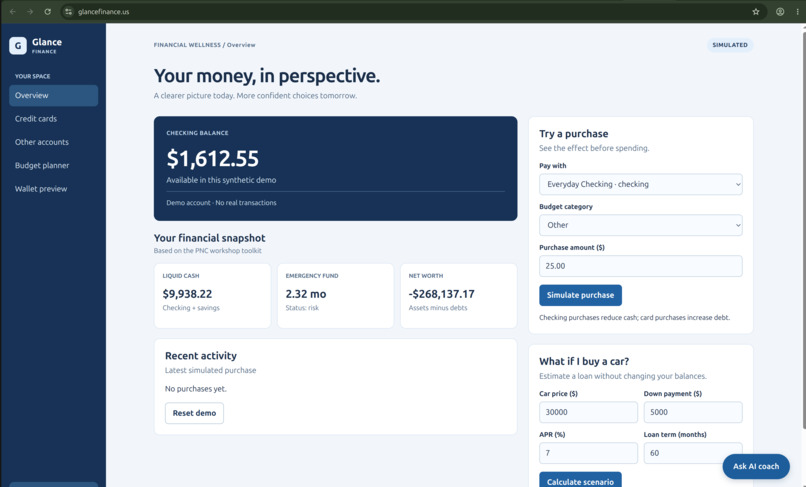
Main Overview
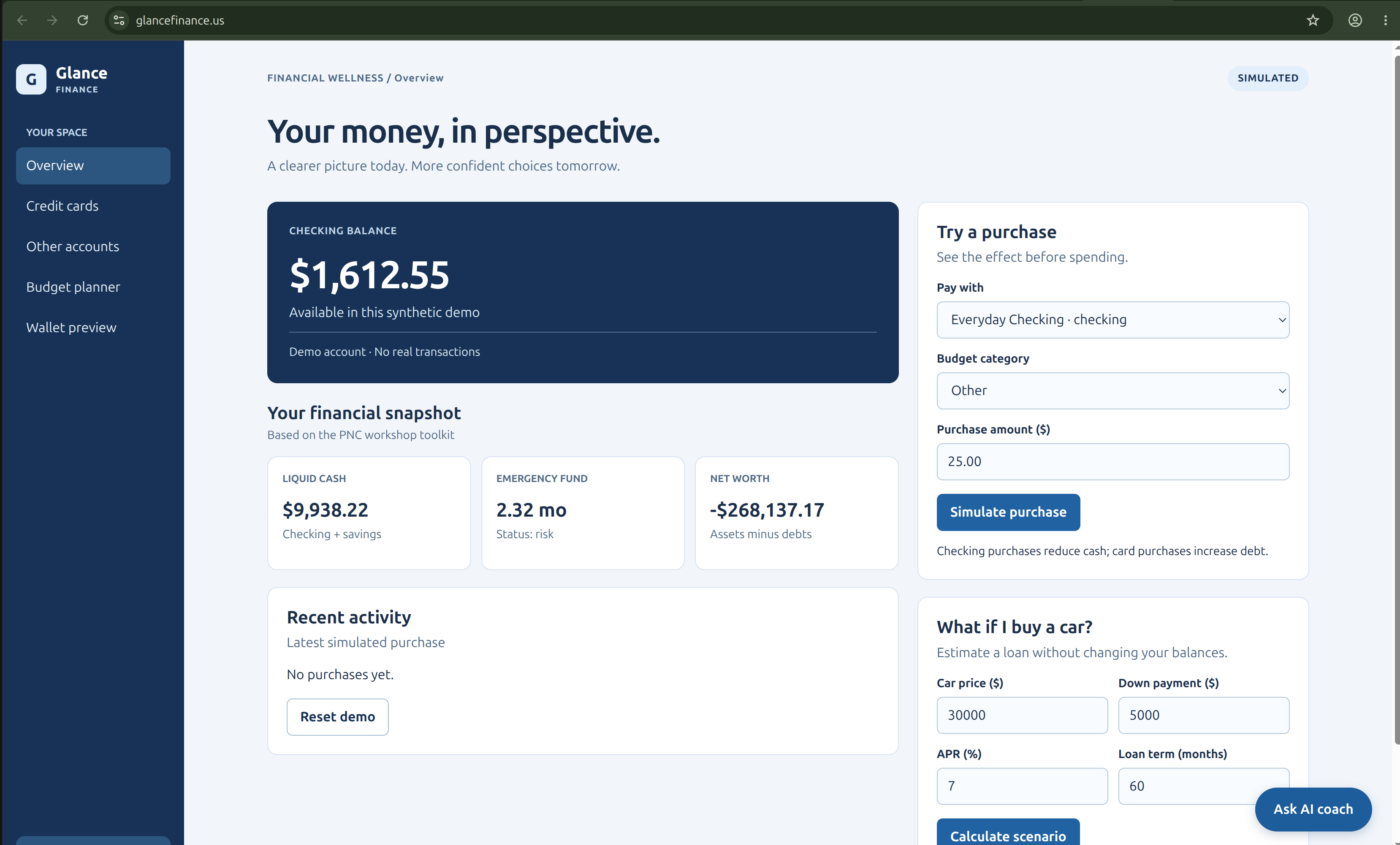
Inspiration
Financial information can be scattered across checking accounts, credit cards, savings, investments, and loans. A balance alone doesn’t show what we owe, how much we have available, or how a choice might affect our ability to handle an emergency. We wanted to make that bigger picture easier to understand and to explore a wallet-sized display that could make important information visible when decisions happen.
What it does
Glance Finance is a financial wellness prototype built for PNC’s 360° Financial Health Navigator challenge. It brings a fictional customer’s accounts and financial-health metrics into one dashboard, with clear distinctions between assets, debt, and available credit.
Users can simulate a purchase from checking or a credit card and see the appropriate balance change. A car what-if calculator estimates a monthly payment and its potential impact on the emergency fund. The budget planner supports a quick monthly estimate or individually listed recurring expenses, converts them into monthly amounts, and offers editable category soft limits. A floating AI coach can discuss the demo’s financial picture. A compact browser-based wallet preview displays an overview and individual account cards.
The app uses synthetic data only: it does not connect to a bank, detect actual purchases, move money, or provide financial advice. Budget suggestions use fixed example weights, not learned habits. AI answers can be inaccurate and should be checked against the app’s calculations.
How we built it
We used PNC’s workshop toolkit for synthetic customer data and financial calculations, then built a Python web application around the profile, account views, purchase simulations, car scenario, and budgeting workflow. We integrated Ollama with the llama3.2 model for the AI coach, keeping numerical calculations separate from generated explanations.
We designed and iterated the web and compact-display layouts in Figma, moving from an initial teal concept to a blue-and-white interface and rebranding the project as Glance Finance. We deployed a public demo on a Vultr Ubuntu server, with Nginx, HTTPS, per-visitor in-memory sessions, same-origin checks, and request limits. The domain is managed through Porkbun.
For a future physical display, we prepared separate ESP32/LVGL firmware and a Python connector. The firmware compiled, and the connector was tested locally and with simulated serial data; the physical display has not yet been programmed or tested with Glance Finance.
Challenges we ran into
Making a complex financial picture understandable required separating available cash from credit and debt, and fitting a broader account view into a small screen without overcrowding it. We addressed this with grouped account views and a wallet deck that shows one account at a time.
We also worked through Python environment and AI model setup, public deployment, and privacy-minded demo design. The first tested hosted AI response took about 99 seconds, so latency remains a limitation. Finally, the available display belongs to a teammate and already contains another project; we chose to prepare firmware separately rather than risk overwriting their work without permission and a restore plan.
Accomplishments that we're proud of
We turned a starter toolkit into a cohesive, publicly accessible prototype with an interactive dashboard, purchase and car simulations, a flexible budget planner, and a hosted AI coach. We tested the public demo’s purchase flow, reset, session isolation, budget suggestions, wallet navigation, and an actual AI response. We also evolved the design into a consistent Glance Finance identity and prepared a separate display prototype while protecting existing hardware work.
What we learned
We learned to pair financial calculations with clear language, distinguish AI explanations from deterministic numbers, and design for both a detailed dashboard and a compact screen. We practiced visual iteration, Python integration, cloud hosting, HTTPS configuration, testing, and careful hardware planning. We also learned that a convincing demo requires acknowledging its limitations as clearly as its possibilities.
What's next for Glance Finance
With the device owner’s permission and a verified backup and restore plan, we would validate the board model and test the firmware, touch navigation, and data updates on the physical screen. We would improve AI response time and reliability, explore accessible savings projections, and research secure, permissioned real-data integration. These are future goals, not capabilities of the current demo.
