-
Logo
-
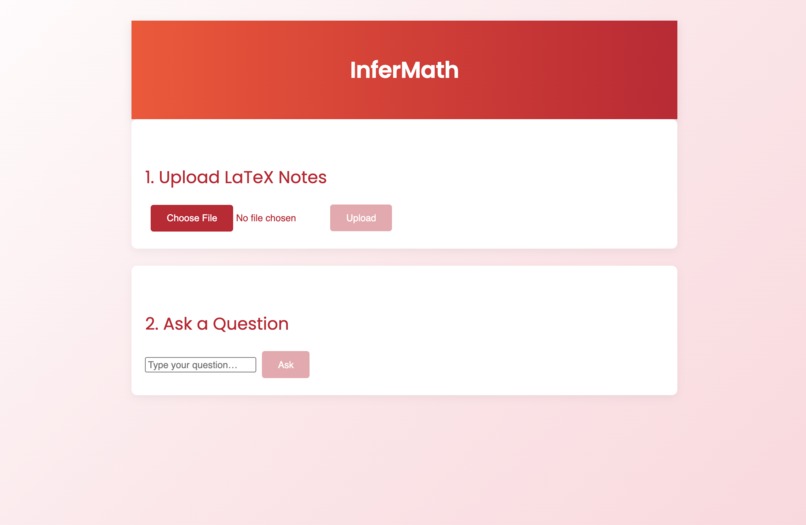
User UI
Inspiration
We’ve always been fascinated by how mathematical reasoning can be encoded into systems—but felt that most tools stop short of actual understanding. Reading long technical documents or equations often requires deep context and symbolic reasoning. That sparked our curiosity: What if we could build something that bridges the gap between raw math notation and intelligent understanding, without compromising on rigor or precision?
What it does
The project takes in mathematical content written in a markup language and intelligently processes it. It understands structure, extracts key components, and generates meaningful outputs that go beyond simple parsing. It helps users interact with technical documents in a much more human and intuitive way—whether that’s to simplify, analyze, or explore.
How I built it
We combined ideas from language models, information retrieval, symbolic reasoning, and a few lesser-known research techniques. The system follows a multi-stage pipeline where input is parsed, enhanced with external context, and then refined through structured analysis. We leaned on both open-source tools and custom-built components, aiming for modularity and flexibility.
Challenges I ran into
One of the biggest challenges was balancing flexibility with precision. Mathematical language is full of edge cases, and many traditional approaches either overfit or oversimplify. Ensuring the system could handle messy real-world input while still generating meaningful and reliable output took a lot of experimentation and iteration.
Accomplishments that I'm proud of
We’re proud of designing a system that feels intelligent—something that doesn’t just process symbols, but understands their purpose. Watching the system reason through complex content and generate useful insights was incredibly rewarding. It’s a step toward something much more powerful.
What I learned
This project pushed us to think deeply about how understanding works, both for humans and machines. We learned how to blend different techniques in a cohesive pipeline, and how to abstract away from specific tools to focus on capability. It was also a great lesson in edge-case handling and user-centered design.
What's next
We’ve just scratched the surface of what’s possible. Next, we plan to expand the system’s reasoning depth, broaden the scope of input it can handle, and refine the interface to make it even more intuitive. Long term, we see it evolving into a general-purpose reasoning assistant for technical content, not just math.

Log in or sign up for Devpost to join the conversation.