-
-
Our Agents
-
-
Wealth Council
Wealth Council is a tool that turns an investment portfolio into one clear report.
The idea came from a simple problem: investing information is scattered everywhere. You might check your holdings in one place, stock news in another, charts somewhere else, and then try to piece it all together yourself. Professional investors have expensive tools for this, but most normal people do not.
We wanted to build something that could take a portfolio and automatically pull together the important parts into one place. Since Wealth Council supports CSV portfolio uploads, it can already work with Wealthsimple, Robinhood, and many other brokerages that let users export their holdings.
Why this matters
Economic pressure is making financial decisions more important than ever. Many young investors are influenced by social media advice, and many people are worried about whether their savings will last in the long term.
We built Wealth Council to help make investing decisions less fragmented and more informed by turning portfolio data, risk metrics, and market context into one clear report.
What it does
Wealth Council analyzes a portfolio from a few different angles:
- portfolio composition and sector exposure
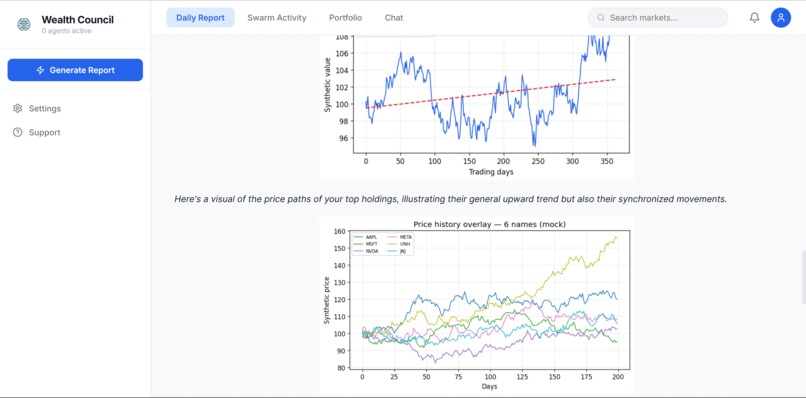
- risk metrics like volatility, Sharpe ratio, and beta
- correlations between holdings
- relevant financial news and sentiment
- alternative asset context like crypto and commodities
Then it combines all of that into a single report written in plain language.
The goal was not just to show raw numbers, but to help people actually understand what is going on in their portfolio.
How it works
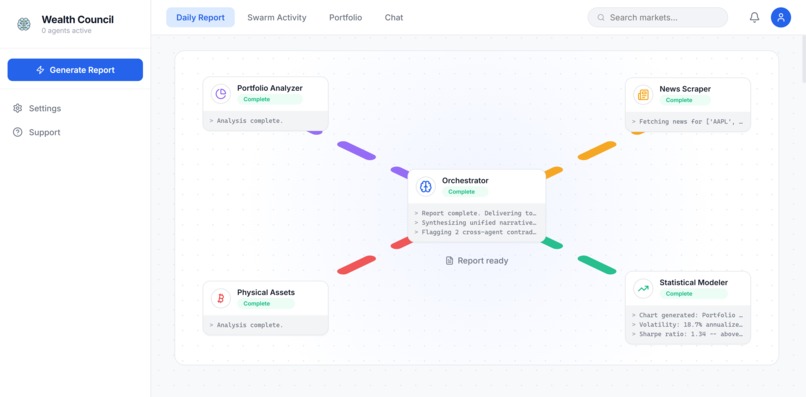
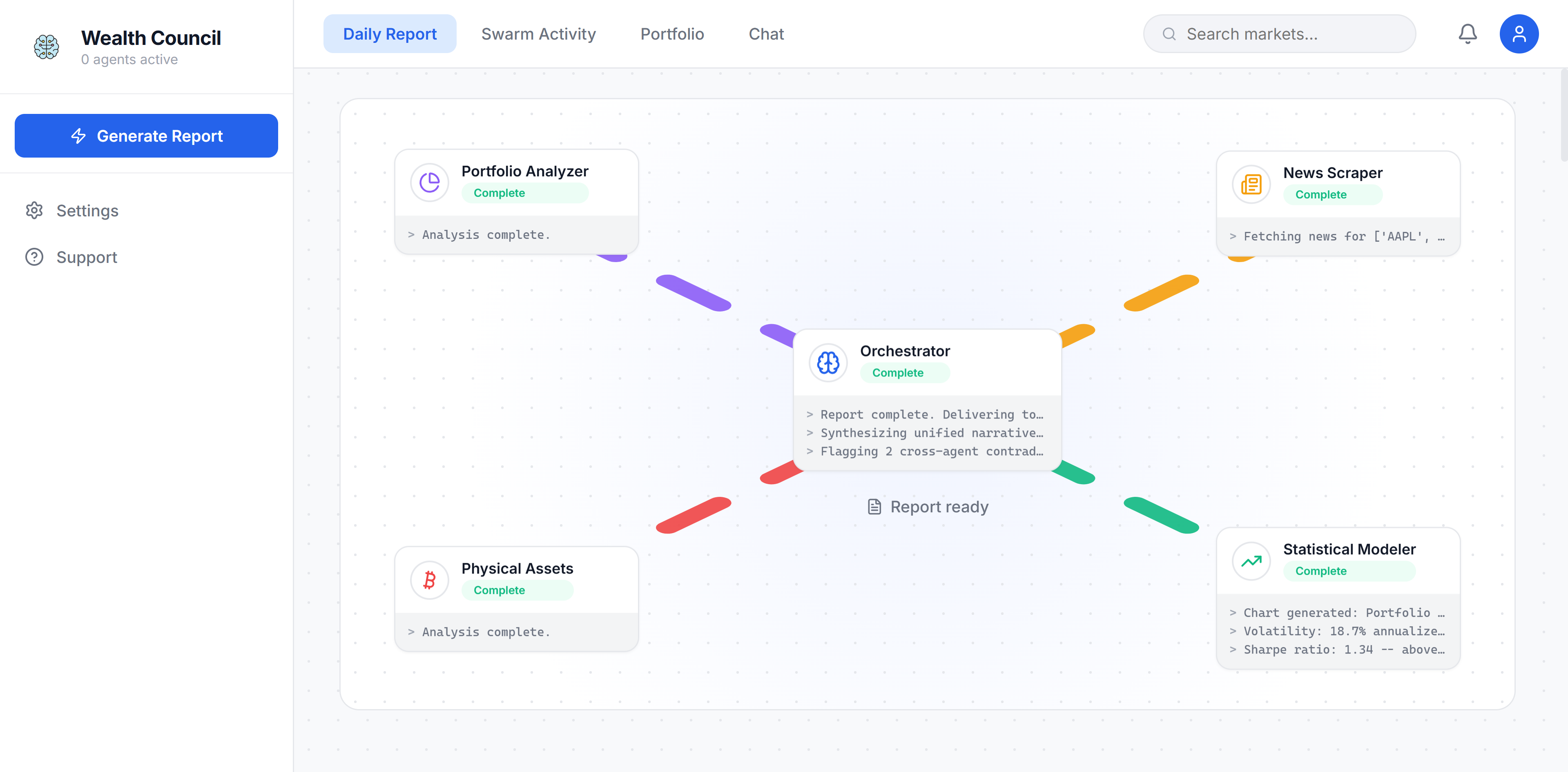
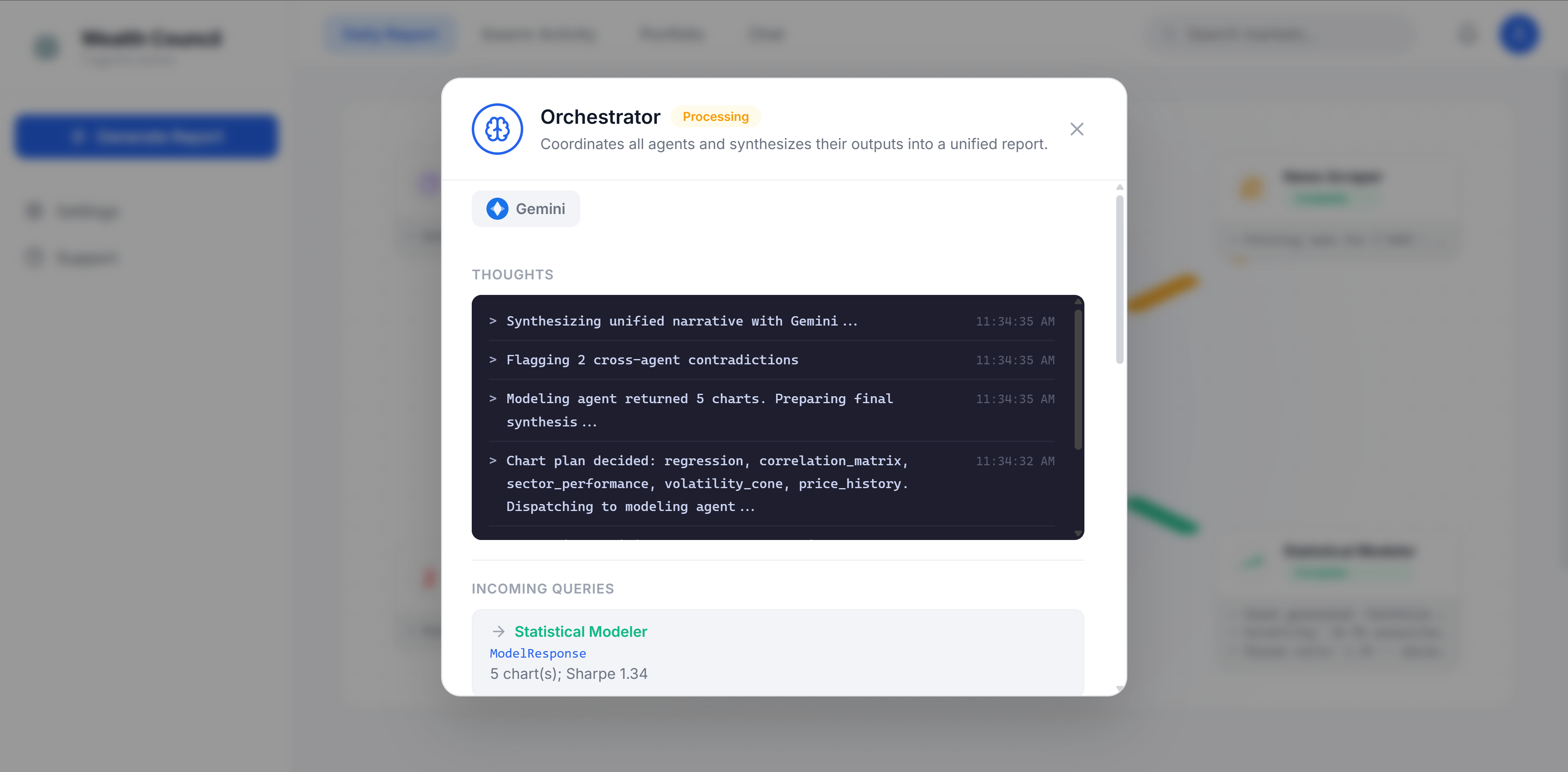
The project uses a multi-agent pipeline where specialized agents handle domain-specific analysis.
One looks at portfolio structure and risk.
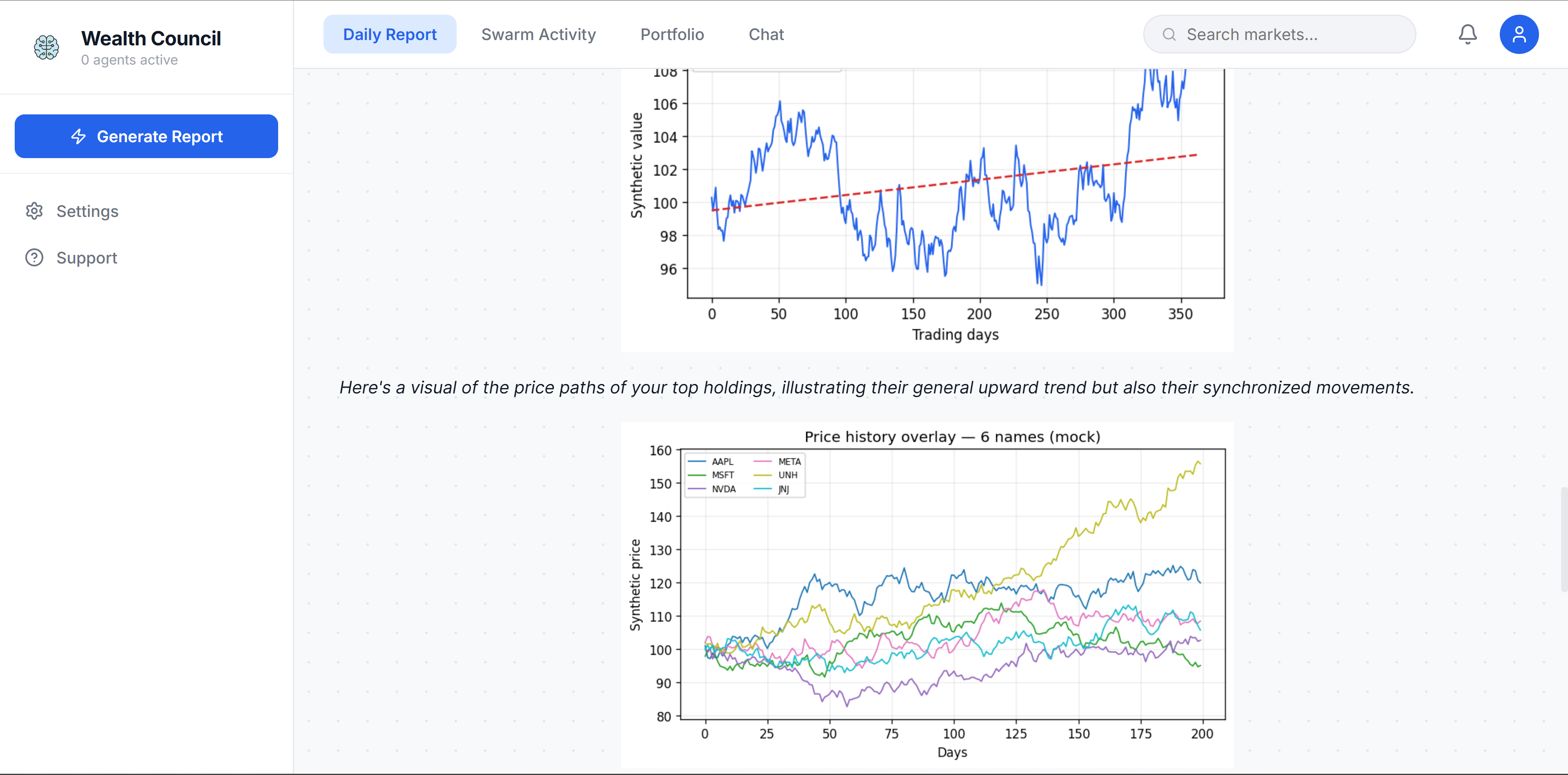
One handles quantitative modelling and charts.
One looks at news and sentiment using FinBERT.
One pulls in alternative asset data.
Then an orchestrator combines everything into one final report.
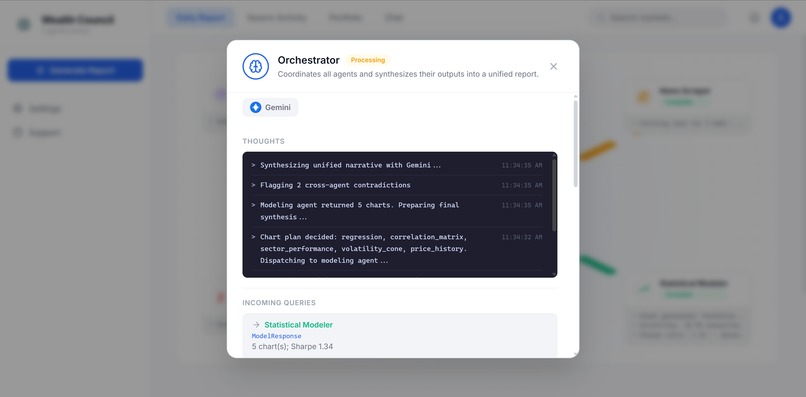
The Gemini Orchestrator: We used the Google Gemini API as the "brain" of the system. While the other agents return raw structured data and statistics (like the Herfindahl index and Sharpe ratio), the Gemini-powered orchestrator synthesizes these disconnected signals into a unified narrative.
On the frontend, users can press Generate Report and watch the agents run in real time as results stream back and the report gets assembled.
We also wanted the system to be practical, not tied to one platform. By supporting CSV portfolio imports, the tool can already analyze portfolios from Wealthsimple, Robinhood, and many other brokerages without requiring a custom integration for each one.
Why we built it
Many investing tools are either too basic or too expensive.
We wanted to build something in the middle: a tool that gives real analysis, but is still understandable to someone who is not a finance professional.
Tech stack
- Fetch.ai uAgents
- React + TypeScript + Vite
- FastAPI
- Google Gemini API
- HuggingFace Transformers / FinBERT
- NumPy, pandas, yfinance, matplotlib
- Server-Sent Events for streaming updates
Challenges
One challenge was combining a lot of different kinds of data into one output that still felt coherent.
It is easy to build a dashboard with separate sections, but it is much harder to make the final result feel like one useful report instead of a bunch of disconnected information.
Another challenge was making development fast. We solved that by supporting mock data, so the whole system could run offline without needing live API calls during development.
Accomplishments
We built a full end-to-end prototype that:
- runs a multi-agent analysis pipeline
- streams updates to the frontend in real time
- uses real financial and news data
- generates a final unified report
- works with exported portfolio CSVs from Wealthsimple and other brokerages
What we learned
We learned that agent-based systems are actually a strong fit for this kind of problem, because portfolio analysis naturally breaks into different types of reasoning.
We also learned that presentation matters a lot. Even strong analysis is much more useful when it is brought together into one clear story.
What’s next
Next steps would be:
- better report personalization
- portfolio history and comparisons over time
- more interactive tools for exploring risk, diversification, and market sentiment
- smoother onboarding and portfolio import flows


Log in or sign up for Devpost to join the conversation.