-
-
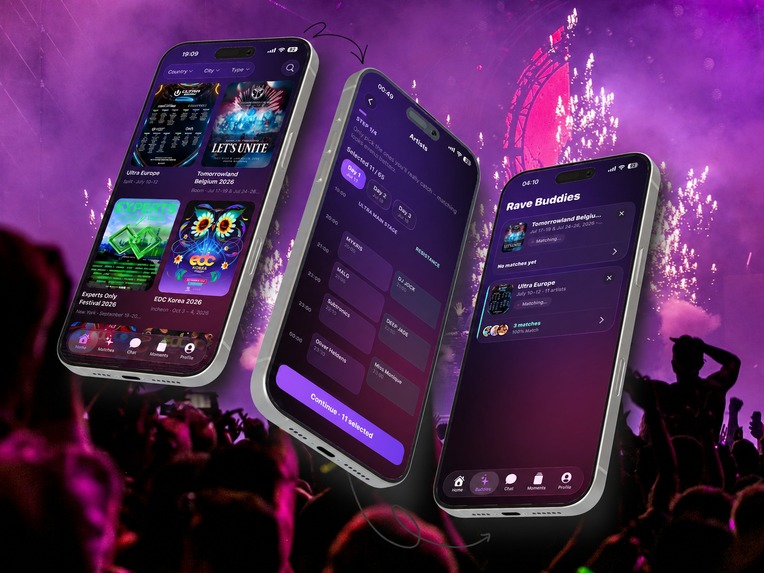
Find your people before the drop.
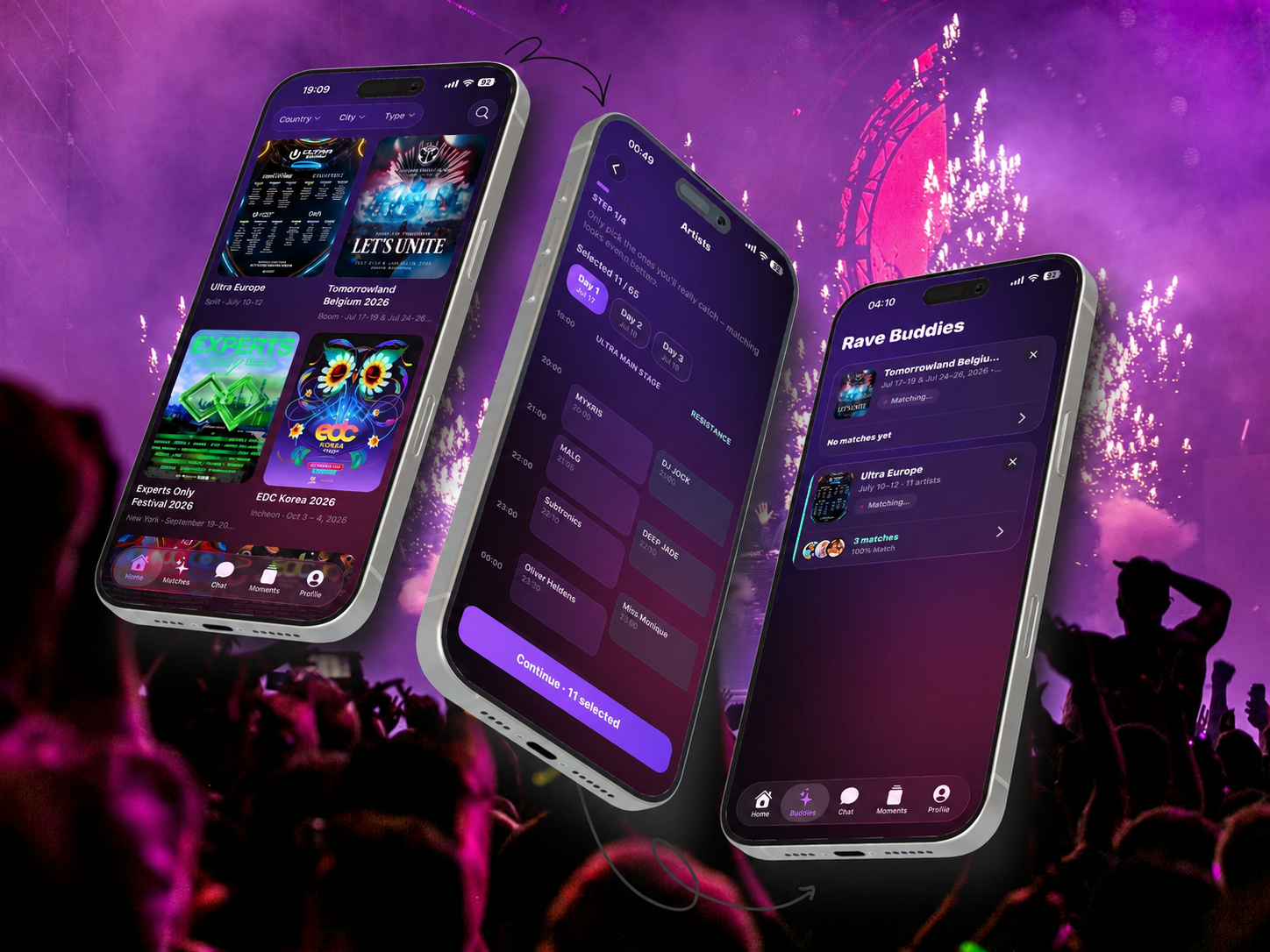
Inspiration
Music festivals and live music events are highly social experiences, but finding the right people to attend with is still surprisingly difficult.
Most people currently search for festival buddies through large group chats, comment sections, Reddit, or social media posts. These spaces may contain hundreds of people, yet very few of them actually meet in person.
Even when two people are attending the same festival, they may want completely different experiences: different artists, stages, arrival times, energy levels, and social expectations.
I created We The Ravers to help people find others who are not only going to the same event, but who genuinely match the way they want to experience it.
What it does
We The Ravers is a social platform for music festivals, electronic music events, club nights, and live shows.
Users can:
- Discover upcoming music events
- Build their personal artist lineup
- Mark events they want to attend or have attended
- Find people with similar music taste and event plans
- Match based on shared artists, timing, preferences, and overall vibe
- Chat before an event and make a real meeting plan
- Share posts, photos, videos, and memories afterward
- Build a personal archive of their live music experiences
Instead of placing everyone into one large event group, We The Ravers focuses on smaller, more relevant connections.
The goal is simple: help users find the right people before the drop, meet in real life, and create memories together.
The project also includes an AI event discovery workflow. An autonomous agent checks public music-event sources on a recurring schedule, identifies potentially important new festivals, shows, lineup announcements, ticket releases, and event updates, and sends me a daily report only when meaningful new information is found.
This allows the platform to prioritize major promoters, ticketing platforms, venues, and high-interest events without relying entirely on manual discovery.
How I built it
I designed and developed We The Ravers as an independent founder.
The mobile application is built with React Native and Expo, with Supabase and PostgreSQL powering authentication, user profiles, event data, matching, messaging, social feeds, notifications, and media-related features.
The product includes:
- Event discovery and unified event pages
- Artist and lineup preferences
- User profiles and music-taste data
- A personalized matching candidate pool
- One-to-one and group messaging
- Social posts, images, and video content
- Notifications and unread states
- Blocking, reporting, privacy, and moderation tools
- Internationalization for a global music community
I used ChatGPT and OpenAI Codex as hands-on engineering agents across the live product stack.
Through connected developer tools, ChatGPT could inspect the real Supabase backend instead of relying only on screenshots, copied SQL, or isolated code snippets. It reviewed the PostgreSQL schema, Row Level Security policies, RPC functions, indexes, query patterns, and frontend-to-backend data flows.
This allowed me to use AI to:
- Audit the existing Supabase architecture
- Identify redundant requests and performance bottlenecks
- Review RLS and authorization behavior
- Trace bugs across the mobile app and backend
- Design optimized PostgreSQL functions and RPCs
- Compare proposed changes against the existing production system
- Turn product requirements into concrete engineering tasks
- Verify that new features remained compatible with the current architecture
For example, ChatGPT reviewed several slow-loading product flows and identified screens that were making multiple dependent database requests.
Based on that audit, I used Codex to consolidate profile, chat, and feed data paths into optimized PostgreSQL RPC functions. This reduced client-side round trips, simplified state management, and improved the responsiveness of important screens.
Codex worked directly inside the repository to inspect existing code, implement features, refactor data-loading paths, debug cross-platform issues, run checks, and validate changes.
Rather than using AI only to generate isolated code snippets, I built a workflow in which:
- ChatGPT reasons about the product, backend, and system architecture.
- ChatGPT inspects the connected Supabase project and identifies risks or opportunities.
- Product requirements are converted into structured engineering tasks.
- Codex implements and validates changes in the real codebase.
- The updated system is reviewed against the existing app architecture.
I also built an automated music-event research agent.
On a recurring schedule, the agent checks selected public sources for:
- Newly announced festivals and concerts
- Lineup additions and artist announcements
- Ticket-sale and sold-out updates
- Date or venue changes
- Major promoter announcements
- Important events missing from the existing database
The agent filters repetitive or low-value information and produces a concise daily report only when it finds meaningful changes.
I can then review the recommendations before approved events are added or updated in the platform. This creates a human-in-the-loop workflow that combines automated discovery with editorial control.
Challenges
One of the biggest challenges was defining what a “good match” actually means.
Attending the same festival is not enough. Two users may like different artists, arrive at different times, prefer different stages, or have very different expectations about how social the experience should be.
The matching system therefore has to consider multiple signals, including:
- Shared artists and sets
- Event attendance
- Music taste
- Timing and availability
- Social preferences
- Existing connections
- Safety and blocking rules
Another major challenge was building a fast and reliable experience across profiles, feeds, matching, and real-time messaging.
As the product grew, some screens began making too many separate database requests. This increased latency and made loading behavior harder to manage.
By auditing the real Supabase architecture with ChatGPT and implementing optimized RPC-based data paths with Codex, I was able to reduce unnecessary network round trips and simplify the client architecture.
Event data presented a different challenge.
Many existing music-event platforms contain large numbers of niche listings while still missing important mainstream festivals, major venue shows, or promoter announcements. Collecting everything is not the same as collecting the events users care about most.
The event discovery agent therefore has to evaluate relevance, source quality, duplication, event scale, and whether an update is actually meaningful before generating a report.
Trust and safety was also a core challenge. Because the platform is intended to help strangers meet offline, privacy, moderation, blocking, reporting, and user control cannot be treated as secondary features.
What I learned
Building We The Ravers taught me that the hardest part of a social product is not adding more social features. It is creating the right context for meaningful interaction.
Large communities may generate more messages, but they do not necessarily create better connections. A smaller number of highly relevant recommendations can be much more valuable than an endless list of people.
I also learned that AI-assisted development becomes much more useful when the AI can understand the real system rather than working from disconnected prompts.
Giving ChatGPT access to inspect the actual backend made it possible to reason about database structure, security policies, product behavior, and performance as one connected system.
Codex was most valuable when it could work inside the full repository, preserve existing behavior, and implement changes that matched the current architecture.
The automated event agent also taught me that complete automation is not always the best goal. For a curated event platform, the strongest workflow is often AI discovery combined with human review.
The agent handles repetitive research and change detection, while I make the final editorial decision about what belongs in the product.
What's next
The next stage of We The Ravers is to make event planning, matching, and event discovery more intelligent.
Future features include:
- AI-assisted festival schedule planning
- Personalized artist and event discovery
- Better explanations for why two users are compatible
- Conflict detection between overlapping artist sets
- Smarter meeting-place and timing suggestions
- Automated event deduplication and source verification
- Agent-assisted creation of structured event records
- More detailed post-event memories and annual music recaps
- Expansion into additional cities, countries, venues, and music communities
The event discovery workflow will also evolve from a daily research report into a structured editorial pipeline.
The agent will discover and compare event information, identify missing or changed data, prepare suggested updates, and send them for human approval before anything is published.
The long-term vision is for We The Ravers to become the social layer for live music: a place where people discover events, find the right companions, experience the night together, and preserve the memories afterward.
Find your people before the drop.
Built With
- api
- chatgpt
- cloudflare
- codex
- edge
- expo.io
- functions
- javascript
- level
- mcp
- openai
- postgresql
- react-native
- realtime
- router
- row
- rpc
- security
- supabase
- swiftui
- typescript
- vercel
- web

Log in or sign up for Devpost to join the conversation.