Inspiration
Ever wondered if Michael Bradley is the best American midfielder of his generation? Ever felt that Germany and Argentina's defensive midfielders and the defenders were to blame for their downfall? People will be rooting for Luka Modric to run the show once again today, but can he do that in the Final?
We finally have a data-driven tool to answer these questions. Moving from the usual practice of celebrating attackers and goalscorers, we now present a tool to quantify the players' defensive contributions. Our tool goes beyond this by providing coaches with an estimate of the optimal time to substitute a player during a game.
Our models are based on play-by-play data from US players of the US Men's National Team making it a complete and comprehensive study.
What it does
First, we have developed a new rating system for defenders and defensive midfielders. This rating system takes 20 variables into account and considers a convex combination of them to provide ratings for five different types of player attributes (snatching, holding, duel, possession, passing) that we deem most useful in judging a player's defensive contributions to the game. This system is built using quadratic programming and gives us the most appropriate weighting scheme to find out the ratings.
Second, we employ the above rating system to compute the ratings for every player in every minute of a game. The application of this is two-fold: on the one hand, it helps us understand how a player's performance changes in each game while on the other hand, we can find out the trend of the players' contributions with respect to time. He have implemented this tool in a ShinyApp-based prototype which can be used to go over the players' ratings in and across matches.
Finally, we show one of the many important applications of this new rating system. Since it gives us the minute-wise ratings for every player, we can find out under what circumstances, a player's performance declines significantly. That would in turn help the coach figure out the perfect time to make a substitution during a game. We demonstrate this using several examples.
How we built it
In order to build the rating system, we first selected data from players who have competed in at least five matches. Then, we minimize the variance of the ratings using quadratic programming techniques. For each of the five attribute classes mentioned above, we assigned the most appropriate variables from the US Men's National Team data set to each of the classes and then, we computed the most appropriate weighting scheme for those classes for each player. It was interesting to note that unsuccessful challenges or player errors were highly punished while clearances or successful tackles were awarded appropriately. We present these values in the submission (variables.csv)
Once we combined the rating system with the observed values of the different variables, we could calculate the ratings for different players in different moments. Our protoype displays these values across time for any selected player and game combination.
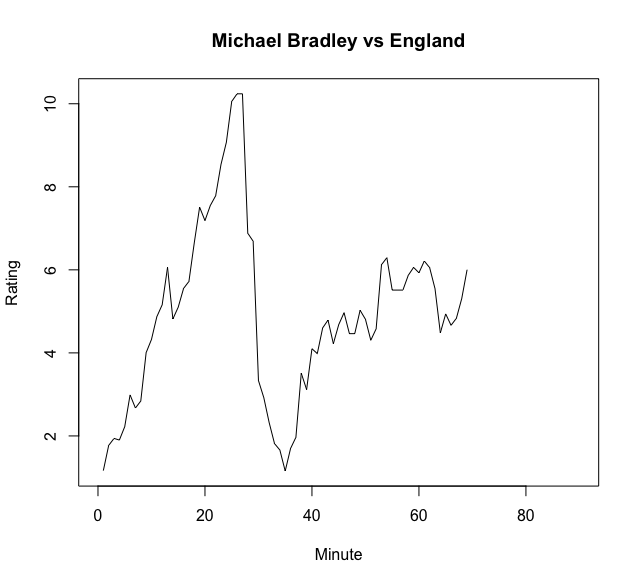
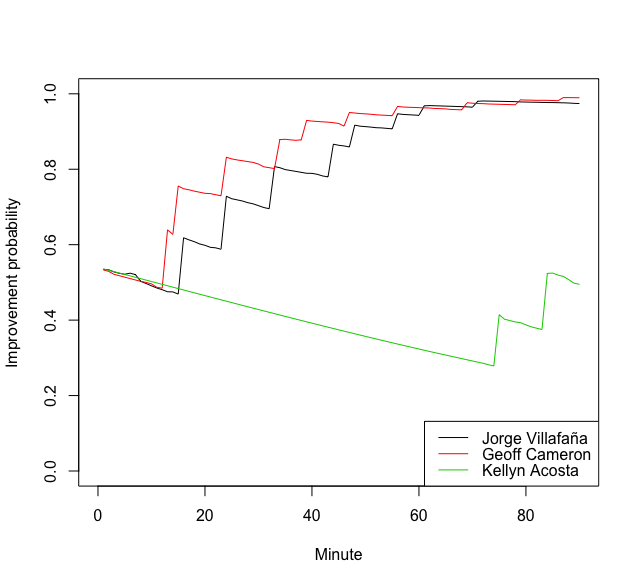
We then developed a generalized linear model to analyze the effects of actual substitution time, along with different in-game ratings on possible improvement in gameplay for a team. Here, we used change-point analysis techniques to find out the most appropriate moment when a substitution should be made. We found that the more delay a team does to make a substitution the less its chance is to improve the goal-differential (and vice-versa). Hence, this technique can be employed in real life to find out the most perfect time for a substitution. We would like to mention one particular case in this regard. Going back to our first comment, we wanted to check if Michael Bradley is actually the best American defensive midfielder all the time and whether there were some matches where it would have made more sense to substitute him earlier. In the image attached herewith (corresponds to USA vs England match from 2010 World Cup), we can see that Bradley's performance suffered from around the halftime mark and it would have been better to bring fresh legs. However, the coach continued with him and USA eventually lost the match 1-2. Interesting, isn't it?
Challenges we ran into
It was challenging to find the most appropriate method to choose the weighting scheme and we had to brainstorm for quite a bit. Also, the most difficult part was to develop the ShinyApp, and we strongly believe it would have been much better looking and would have had more applications, if we had more time. Still, we wanted to show that it can be done and that is why we have submitted this prototype.
Accomplishments that we're proud of
In just 24 hours we have managed to create a working prototype of what promises to be a extremely valuable tool for soccer coaches, and anyone involved in player trading. We feel our product takes us a step further in the direction of the moneyball moment for soccer.
What we learned
Working with a detailed soccer dataset is always fun, and it was challenging yet satisfying for us to do something meaningful. At the same time, we realized that there remains a lot to do, and we hope to continue our passion to work on such problems in the near future.
What's next for 'We Know how to Defend' by DropBall
With more time, we hope to expand the tool to estimate a rating system for attacking abilities as well. This would further optimize our predicted substitution times. Our rating system can also be used to predict match results, which will be dependent on various situational covariates and the time series for the ratings for all players. And last but not the least, this method and its applications are easy to comprehend and therefore can be applied to any dataset of this sort.
Built With
- r
- rmd

Log in or sign up for Devpost to join the conversation.