-
-
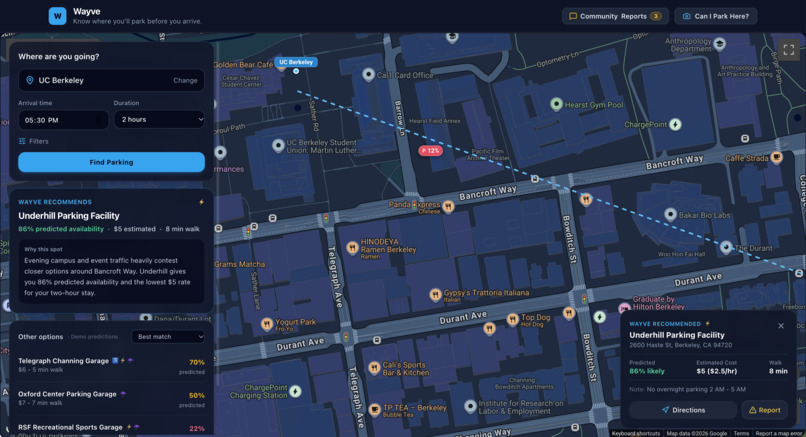
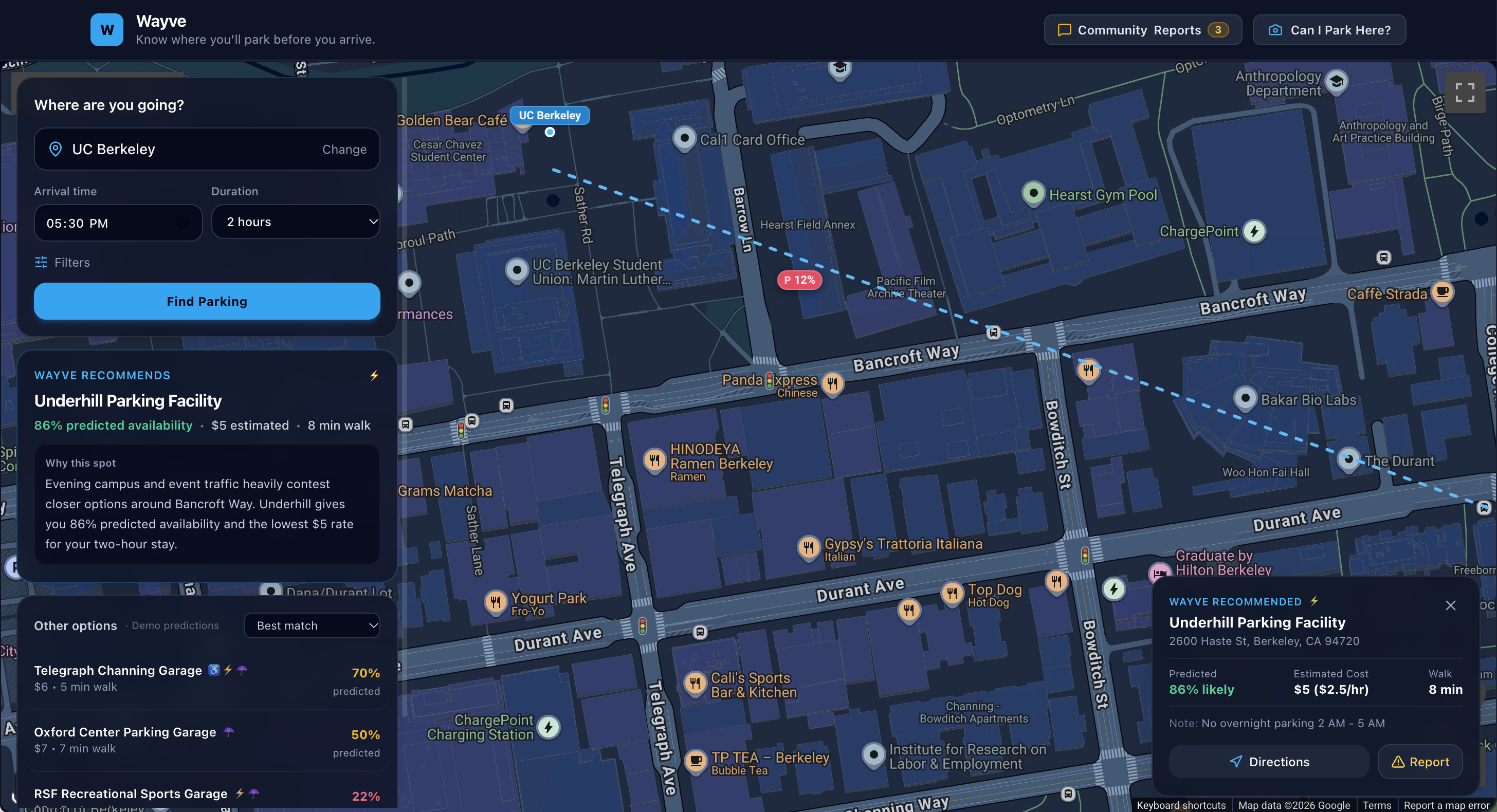
home page + map
-
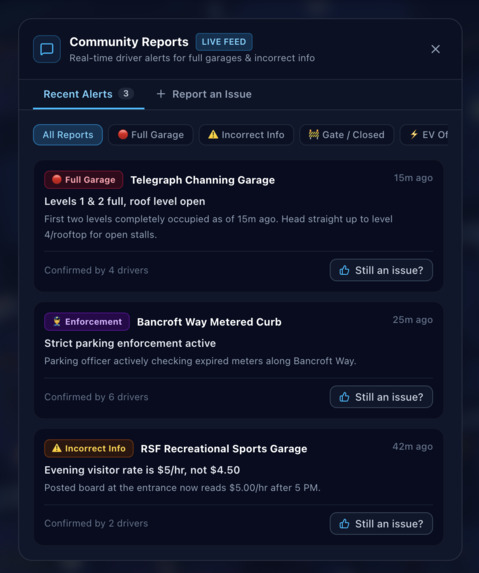
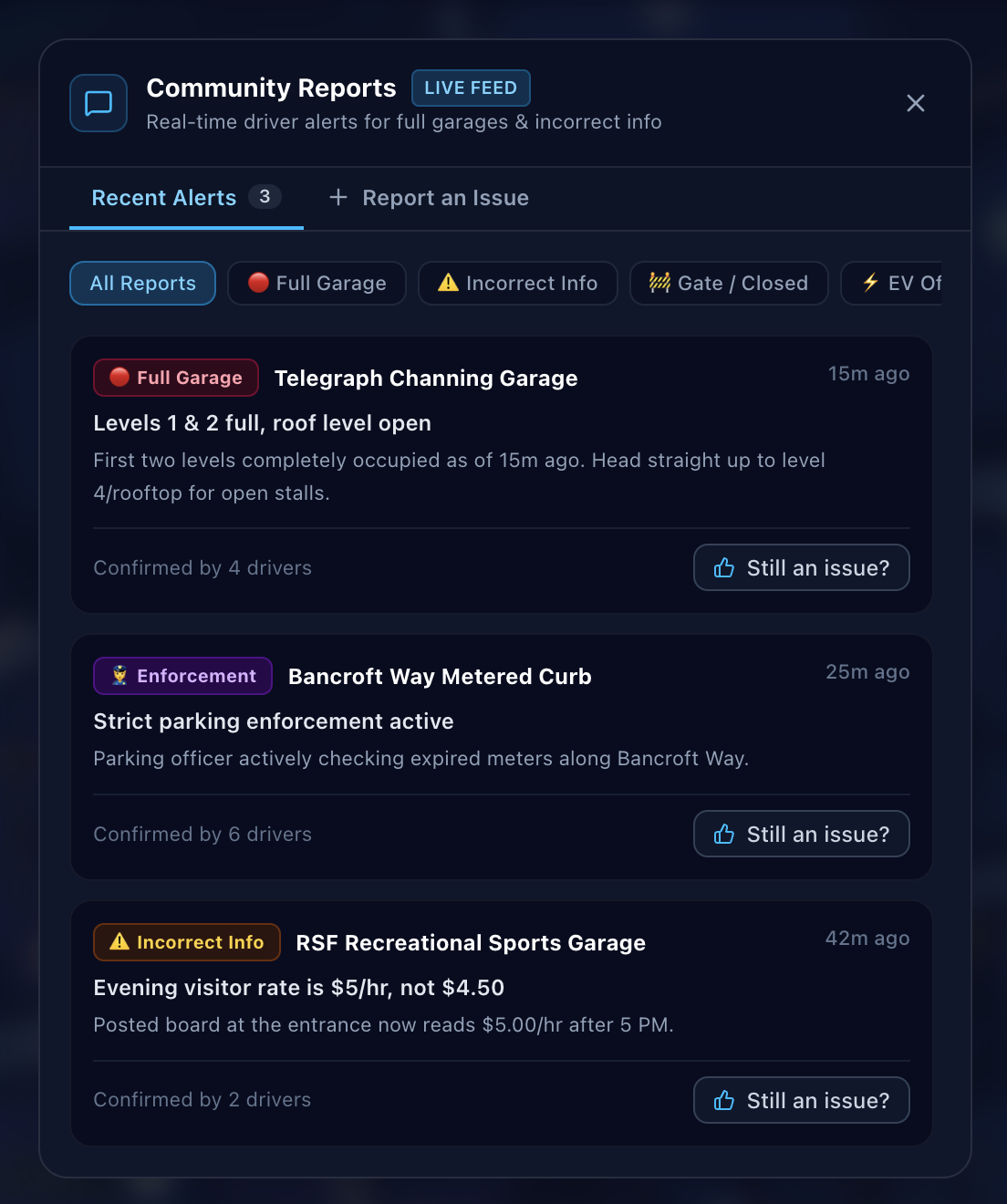
community report page
-
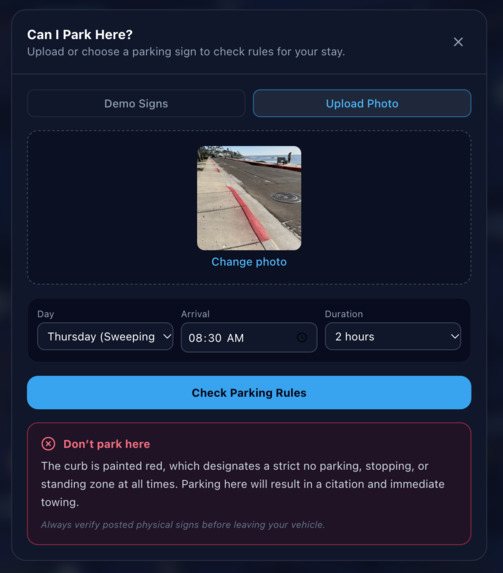
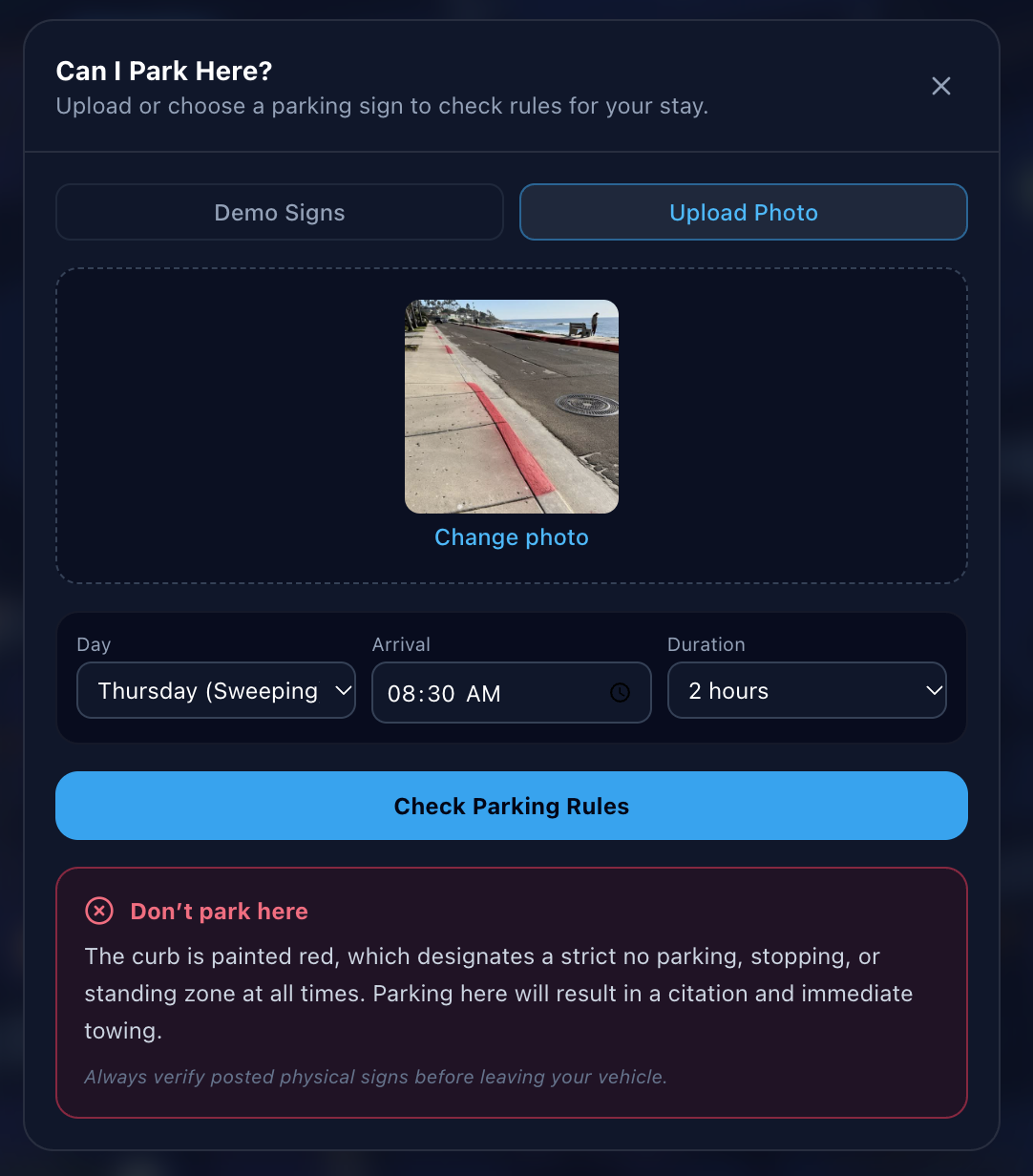
can I park here?
-
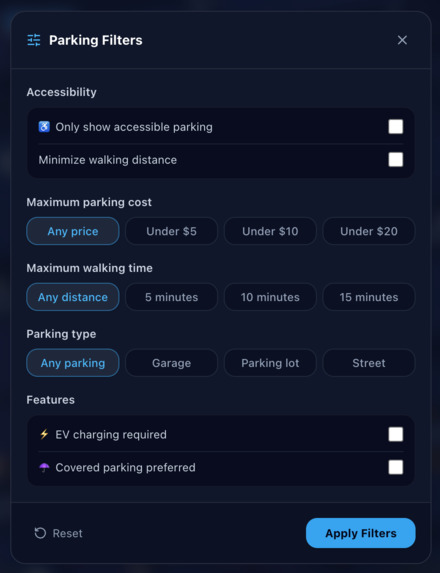
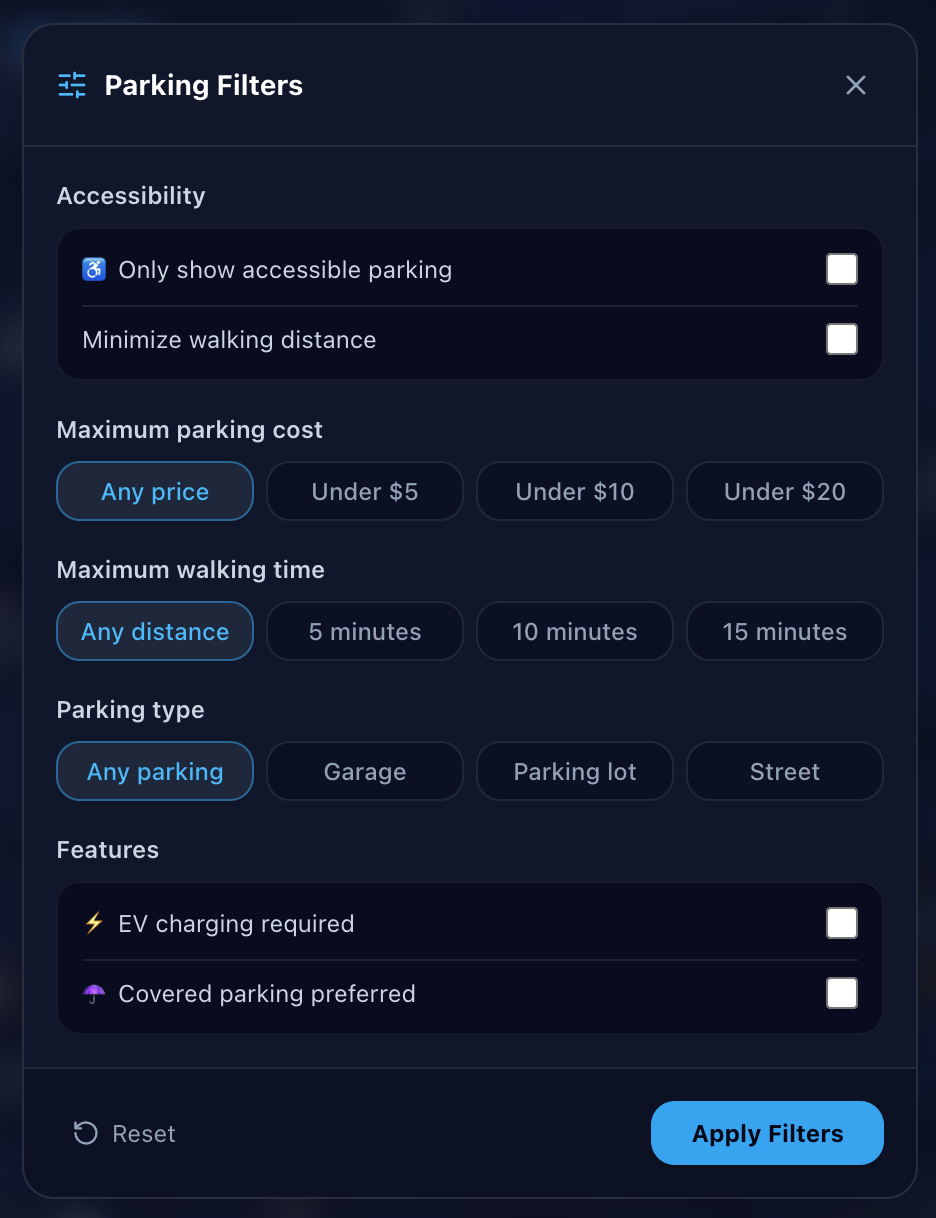
parking filters
-
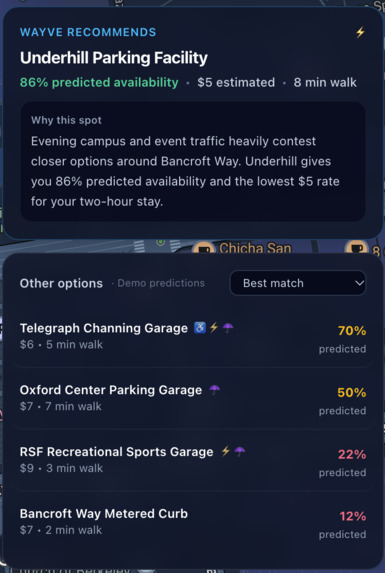
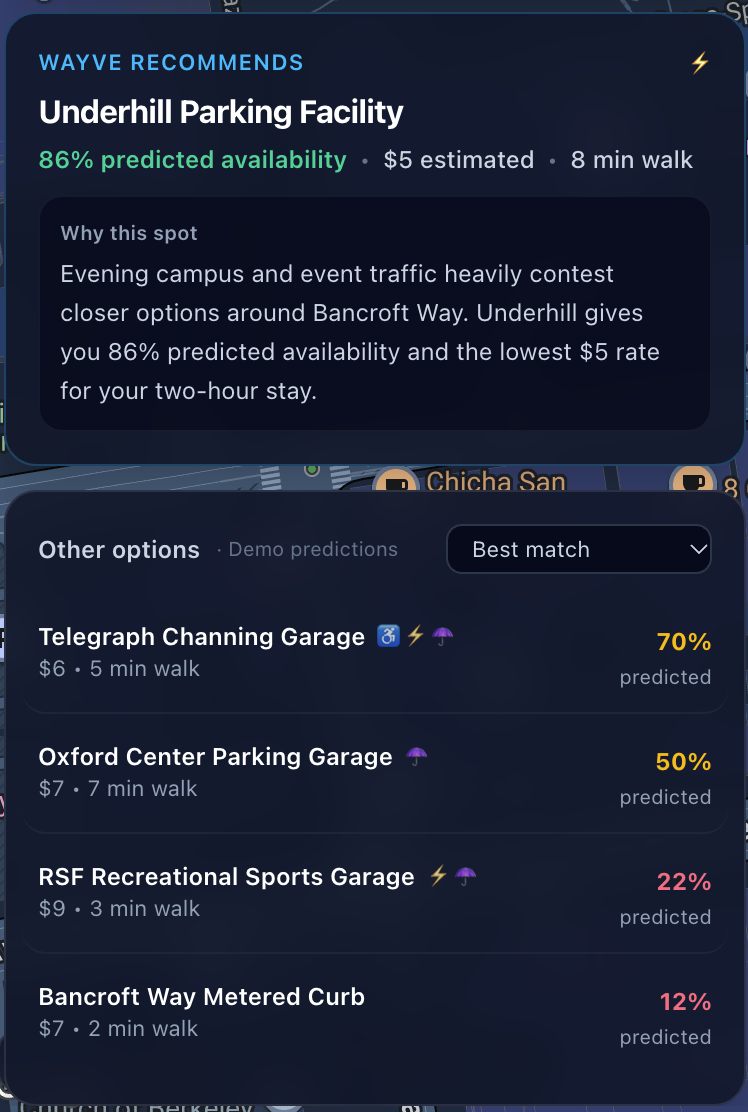
parking recommendations
Inspiration
We’ve all experienced the frustration of driving around looking for parking, especially when we’re already running late. Even with navigation apps like Google Maps, finding a destination is easy, but figuring out where to park once you arrive is a completely different challenge. I wanted to build something that goes beyond simply showing nearby garages. Parking decisions depend on personal preferences, timing, accessibility, and restrictions that aren’t always obvious. That’s what inspired Wayve: making parking smarter, more personalized, and less stressful.
What it does
Wayve is an AI-powered parking assistant that helps drivers find the best parking options before they arrive at their destination.
Users enter their destination, arrival time, and expected parking duration. Wayve then recommends nearby parking options based on predicted availability, estimated costs, and walking distance. Users can personalize their search with filters for accessibility, EV charging, covered parking, parking type, and budget.
One of Wayve’s main features is “Can I Park Here?”, which uses AI-powered image recognition to analyze parking signs and curb restrictions. Users can upload a photo, and Wayve helps determine whether parking is permitted. For example, uploading an image of a red curb returns a warning that parking is prohibited.
I also built a Community Reports feature because parking information changes constantly. Users can report full garages, inaccurate information, or other parking-related issues. This creates a system where AI provides recommendations while real people contribute valuable on-the-ground information.
Once users find a suitable parking location, they can open directions directly in Google Maps.
How I built it
I developed Wayve using React, TypeScript, Vite, and Tailwind CSS for the frontend, with an Express backend.
I incorporated Google Maps APIs for interactive mapping and navigation, with SpotHero as the primary parking data source for the parking experience. I also integrated Gemini AI to power Wayve’s parking sign and curb analysis feature.
Wayve’s recommendation system considers factors such as parking availability, cost, walking distance, and individual preferences to help users make more informed decisions. The current prototype also uses demo parking predictions to demonstrate how availability-based recommendations can work.
I designed the interface around simplicity, making it easy for someone to enter their destination, customize their preferences, and find parking without navigating through multiple applications.
While AI helped accelerate the development process, I made the decisions about which features to prioritize, how they should work together, and how to make the overall experience intuitive for everyday drivers.
Challenges I ran into
One of my biggest challenges was combining different sources of parking information into a single, user-friendly experience. Parking availability is constantly changing, and even existing parking databases cannot always reflect real-world conditions.
Another challenge was making AI useful in situations where mistakes have real consequences. Parking restrictions can be complicated, and an incorrect recommendation could result in a ticket or towing. I had to think carefully about how to present AI-generated guidance without making users overly reliant on it.
I also wanted Wayve to feel like a complete experience rather than a collection of disconnected features. Connecting parking recommendations, image analysis, navigation, and community reporting into one intuitive interface required thoughtful design decisions.
A major consideration was figuring out where AI could genuinely add value and where human input was still necessary. Rather than relying entirely on automated predictions, I decided to incorporate community reporting so that users could contribute information that AI and existing databases might miss.
Accomplishments that I'm proud of
I’m especially proud of building a platform that addresses multiple parts of the parking experience rather than just helping users locate garages.
Wayve’s “Can I Park Here?” feature demonstrates how AI can help solve everyday problems through visual understanding, while the personalized recommendation system makes parking searches more relevant to individual drivers.
I’m also proud of the Community Reports feature because it reflects the central theme of this hackathon: AI cannot do everything alone. AI can analyze information and generate predictions, but people provide the real-world observations and judgment needed to make those predictions more useful.
Another accomplishment I’m proud of is bringing these features together into one cohesive platform. Instead of building separate tools for finding parking, interpreting restrictions, and reporting issues, I wanted Wayve to address the entire parking experience.
Ultimately, I’m proud that I was able to turn an everyday frustration into a functional prototype that demonstrates how AI and human contributions can work together to solve a practical problem.
What I learned
Building Wayve reinforced that developing with AI isn’t just about integrating the most advanced technology. It’s about identifying problems worth solving and understanding where technology can genuinely improve people’s experiences.
I learned how to combine mapping services, parking data, AI-powered image analysis, and user-generated feedback into a cohesive product.
More importantly, I learned that the most useful AI products don’t replace human judgment. They support it.
While AI helped me move faster during development, the most important decisions still required human creativity and judgment. I had to decide which problems were worth addressing, what features would actually benefit drivers, and how to make the experience simple enough for someone to use in a stressful situation.
Parking is a great example because real-world conditions are constantly changing. AI can help drivers make better decisions, but community participation is what allows the system to adapt to situations that existing data might miss.
This project taught me that building something meaningful with AI is less about how much technology you can incorporate and more about how thoughtfully you use it.
What's next for Wayve
My next major goal is to integrate Wayve directly into Google Maps through a browser extension, allowing users to access intelligent parking recommendations without leaving their existing navigation experience.
Instead of switching between Google Maps and Wayve, users could search for a destination and immediately see nearby parking recommendations, predicted availability, pricing, and personalized filters alongside their route.
I also want to expand Wayve’s AI capabilities to better interpret complicated parking signs, including time-based restrictions, permit requirements, and street-cleaning schedules.
Another priority is improving the accuracy of parking availability predictions by incorporating more real-time information from parking providers and expanding the community reporting system. As more people contribute reports, Wayve could become increasingly responsive to changing parking conditions.
Eventually, I’d like to introduce smarter predictive models that account for factors such as time of day, local events, traffic patterns, and historical parking trends to provide more accurate recommendations before drivers even begin their trips.
Long term, I envision Wayve becoming an intelligent parking layer that works alongside the navigation tools people already use, making parking a seamless part of every journey.
Built With
- css
- express.js
- gemini-api
- github
- google-maps
- html
- javascript
- node.js
- react
- spot-hero-api
- tailwind-css
- typescript
- vite

Log in or sign up for Devpost to join the conversation.