-
-
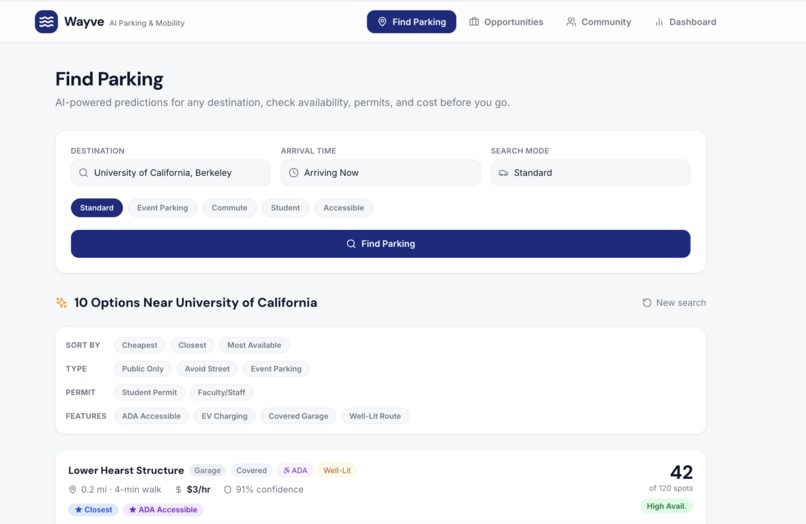
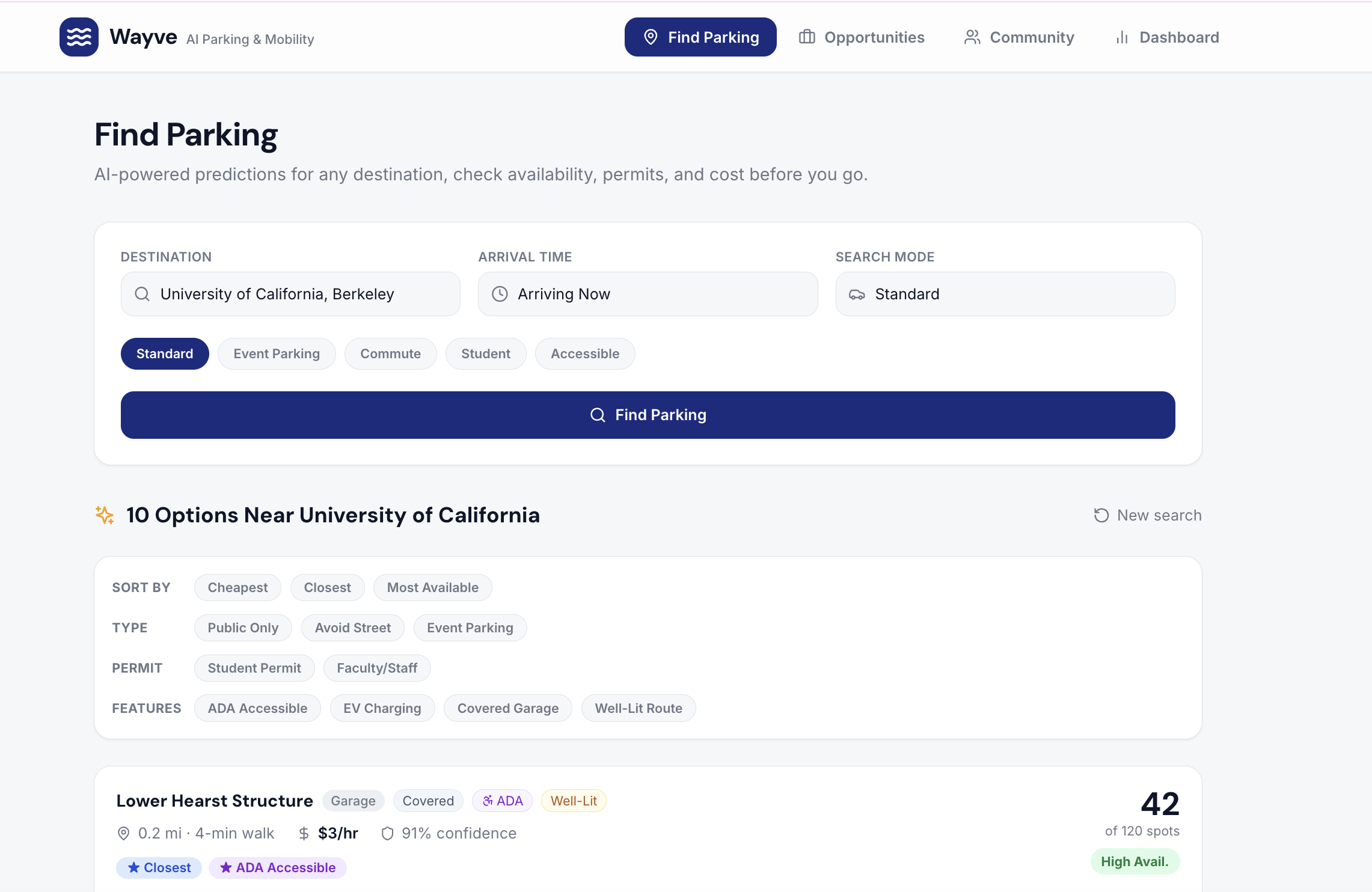
UC Berkeley demo search
-
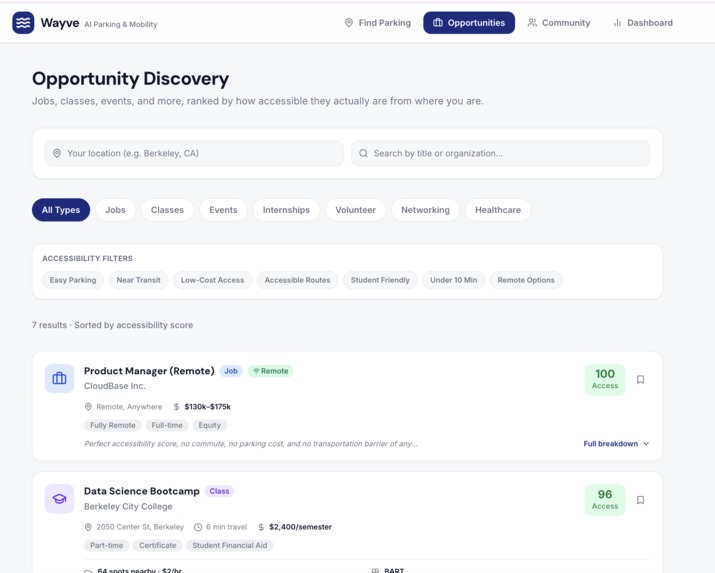
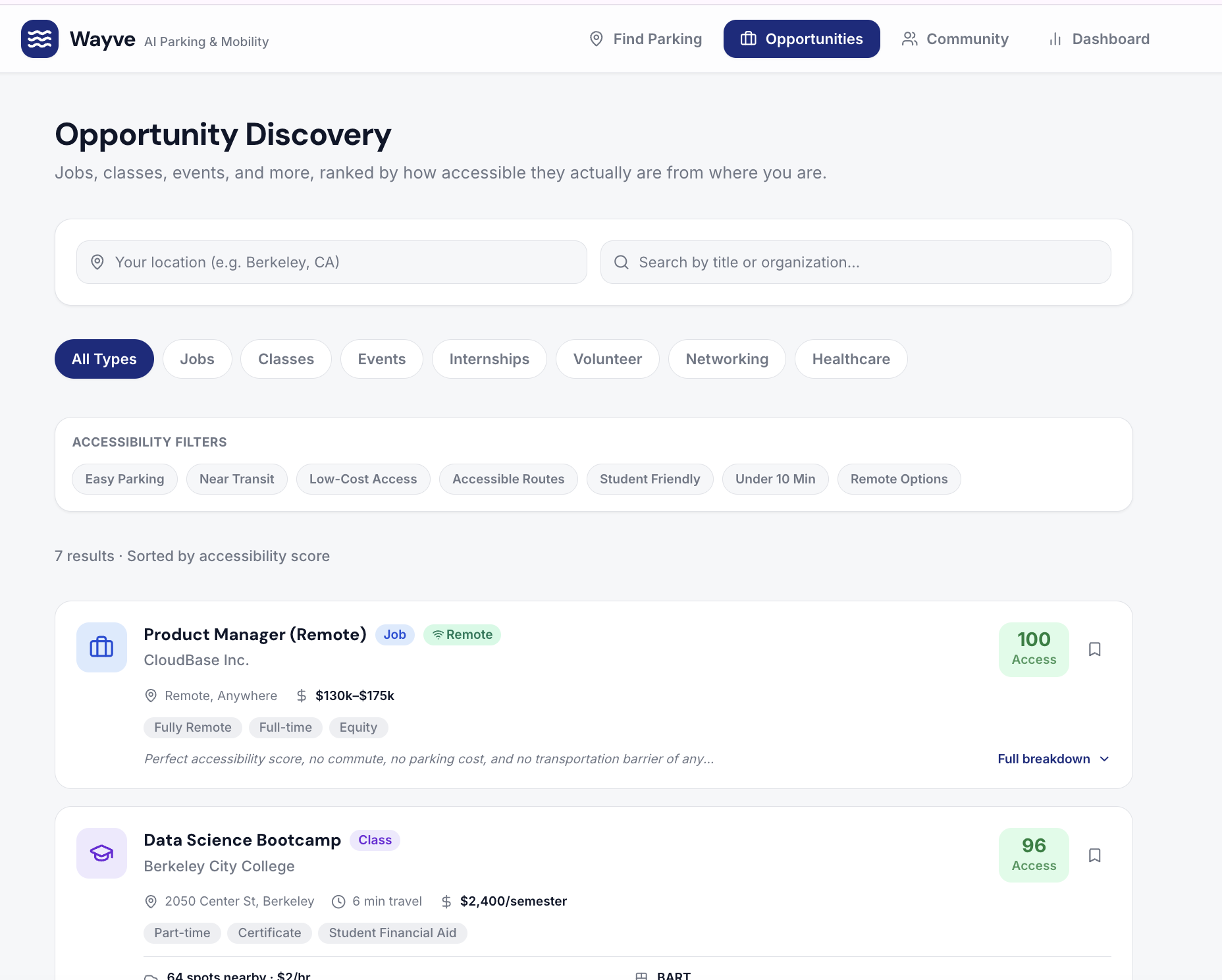
Wayve opportunities page
-
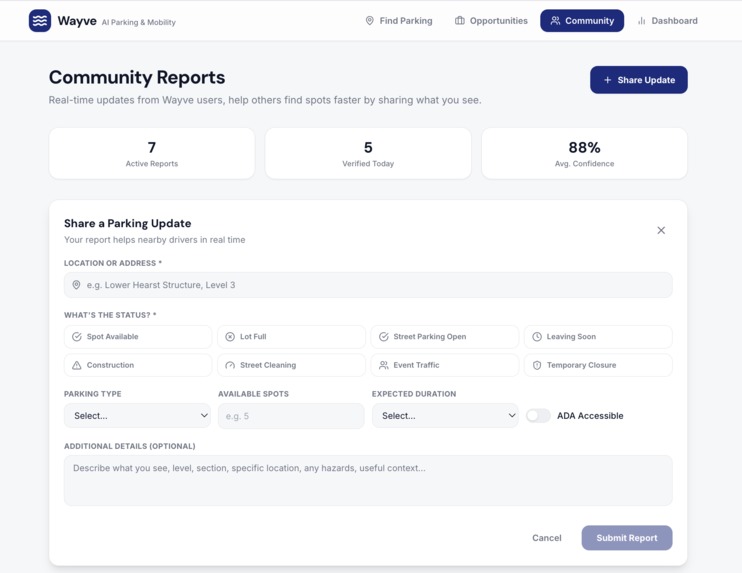
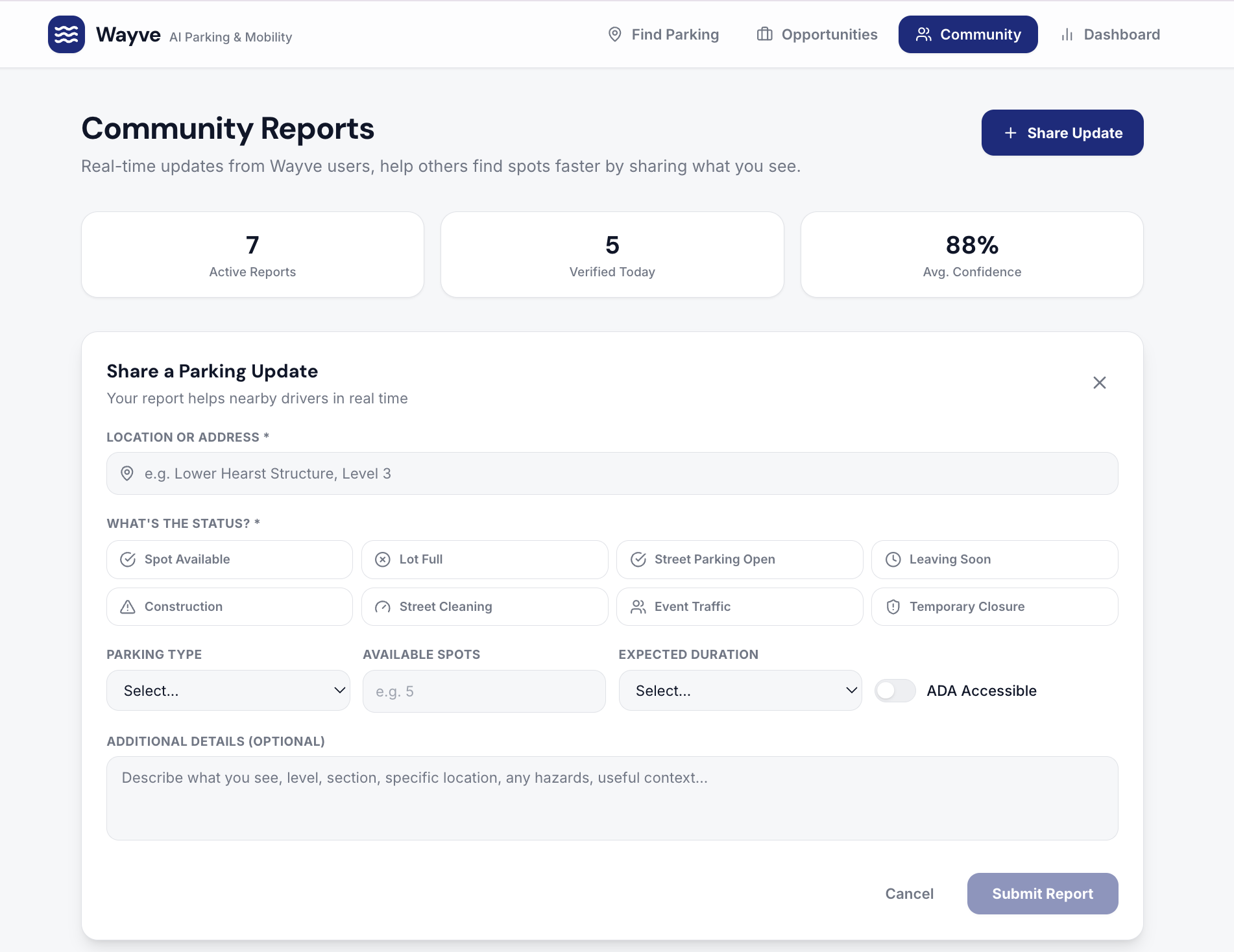
Report inaccuracies or changes as part of our community!
-
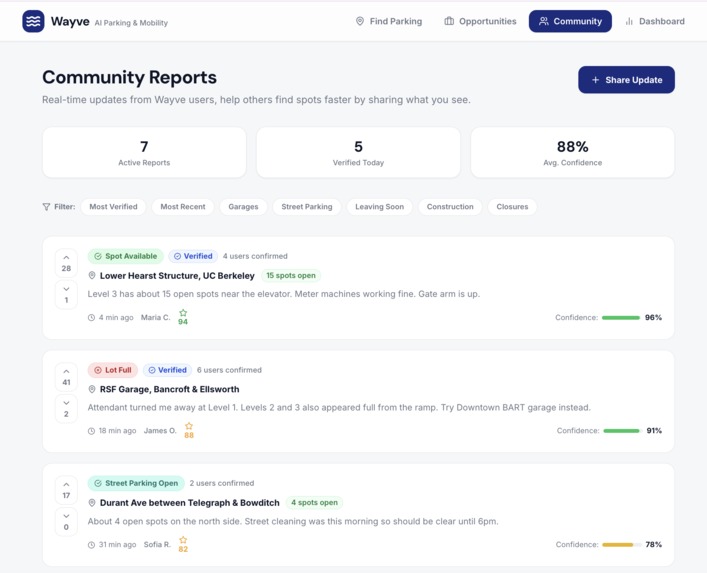
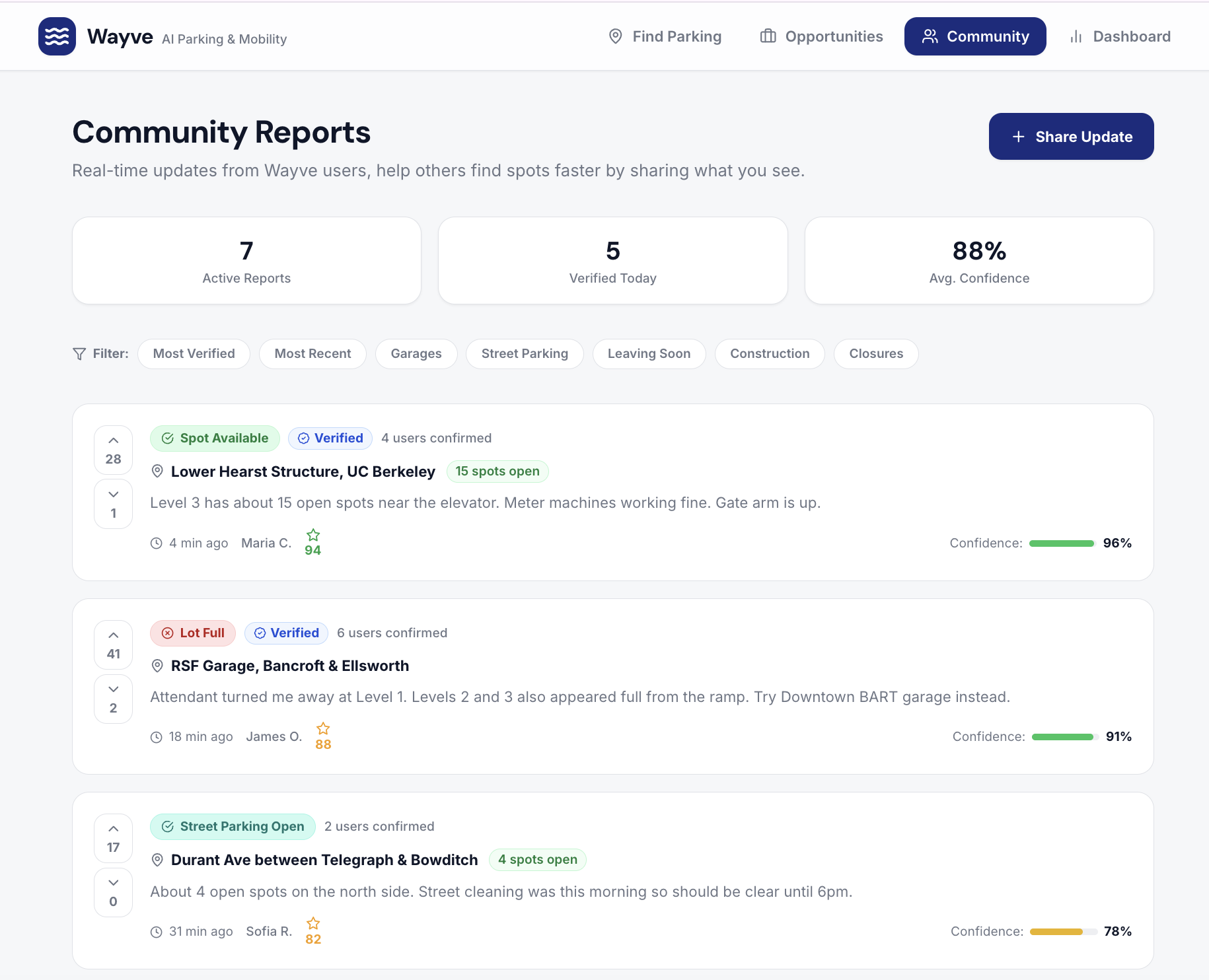
Community Reports with upvoting and downvoting chance
-
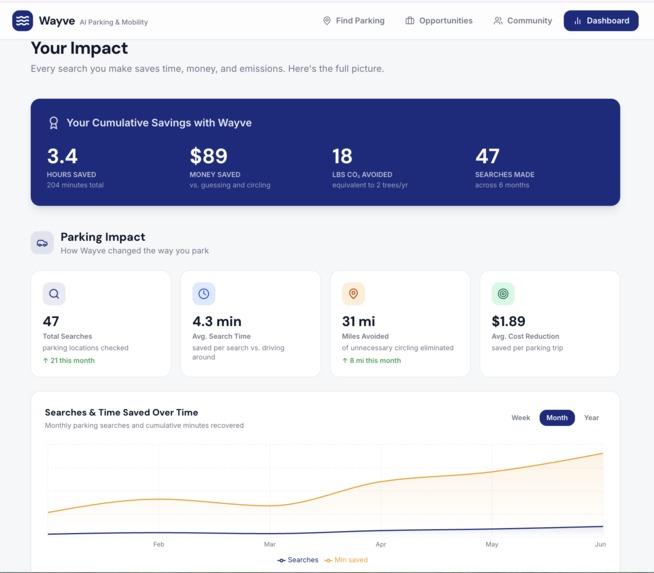
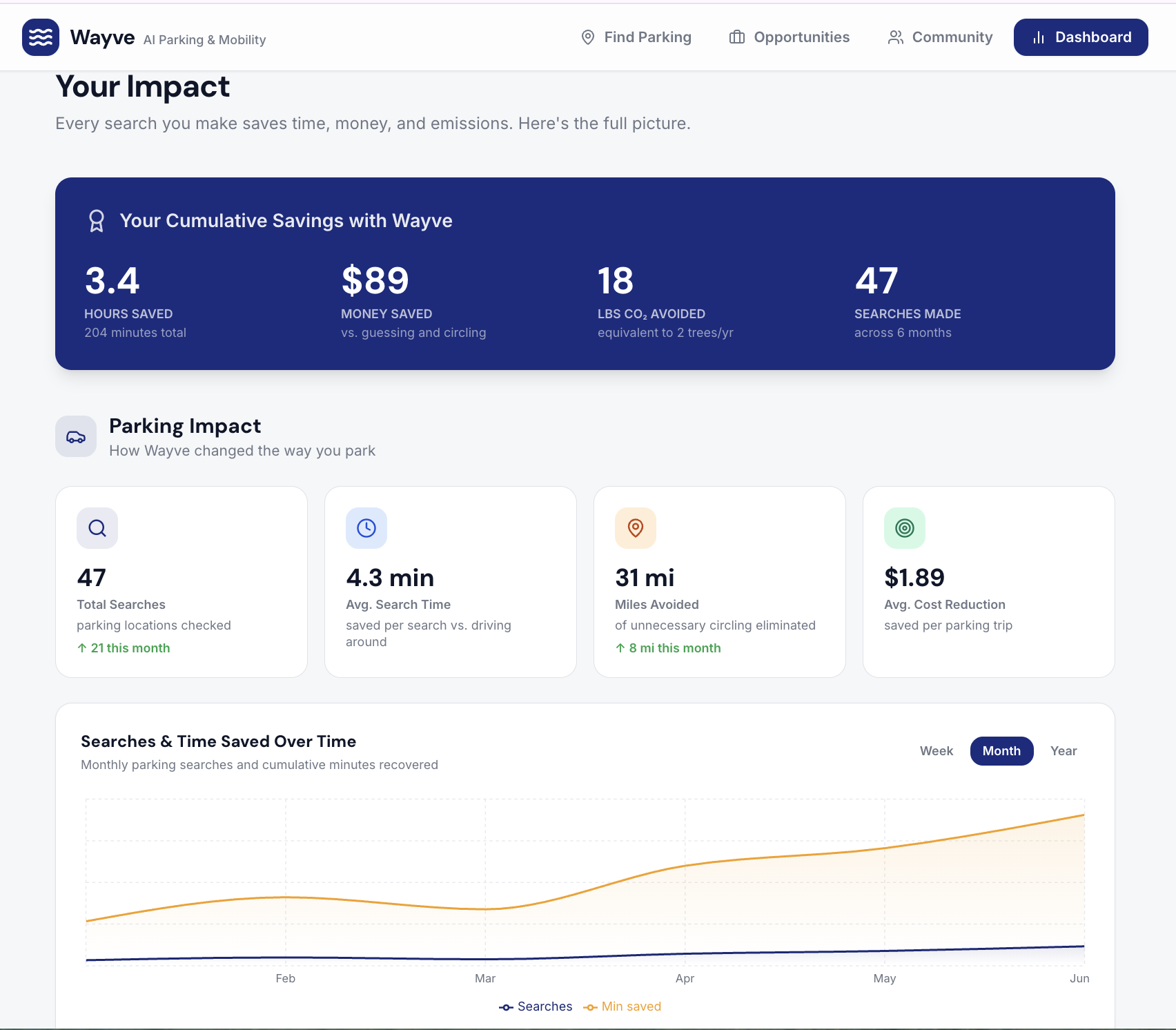
Dashboard summary
-
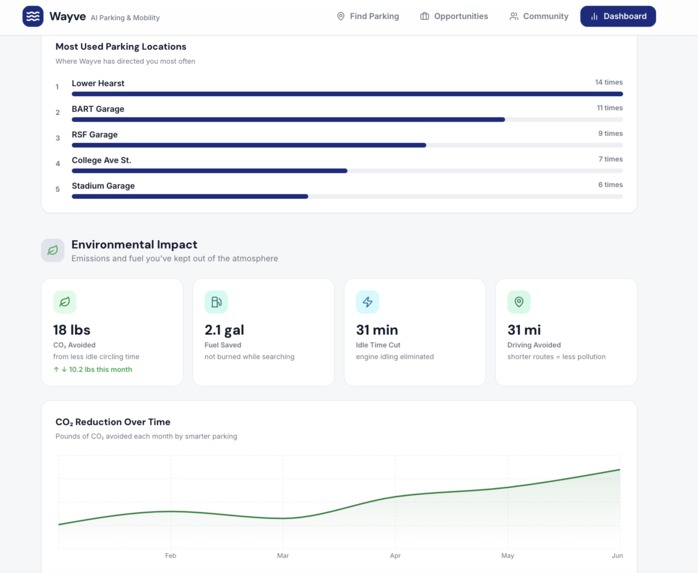
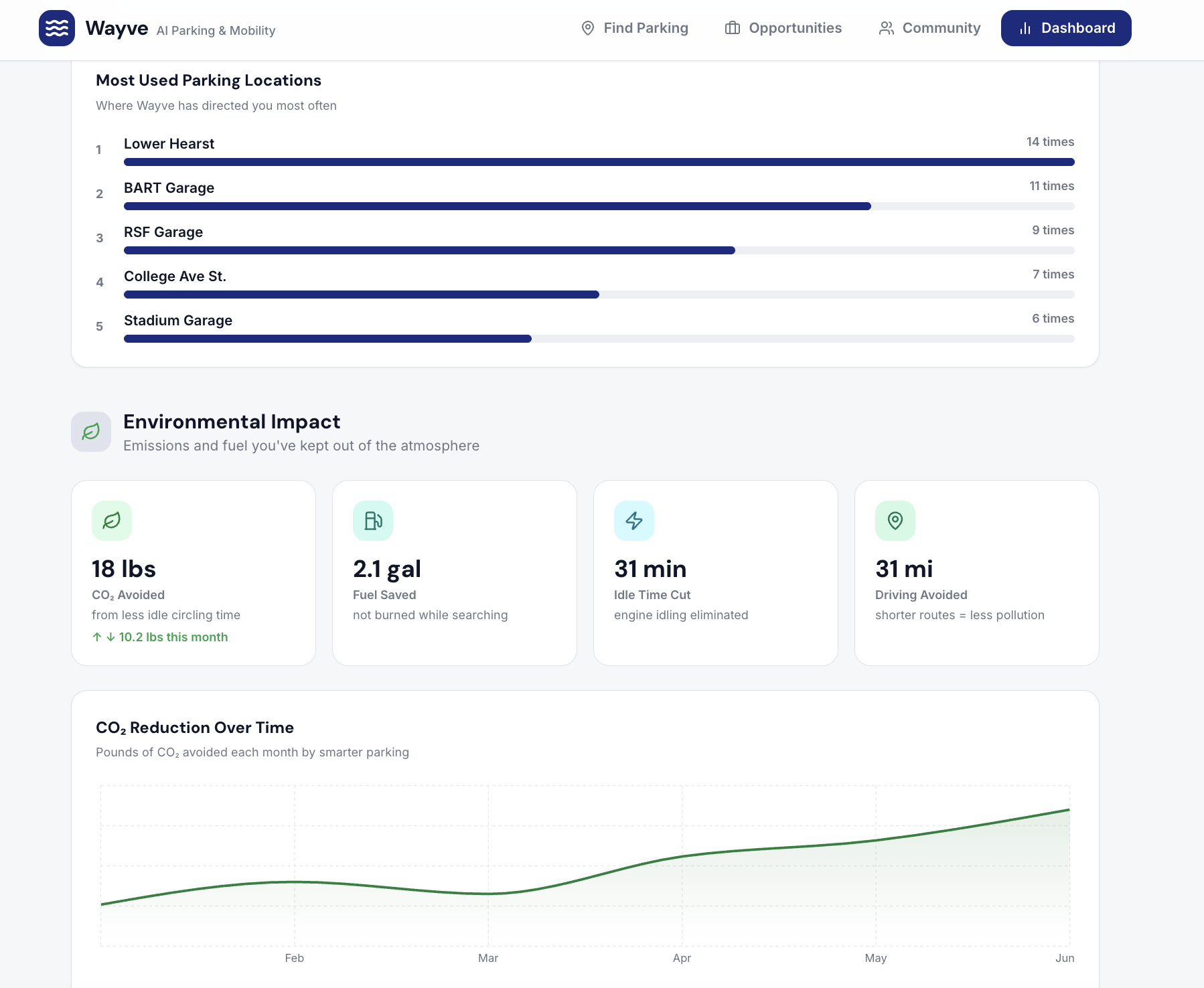
More dashboard data (environmental+parking habits)
-
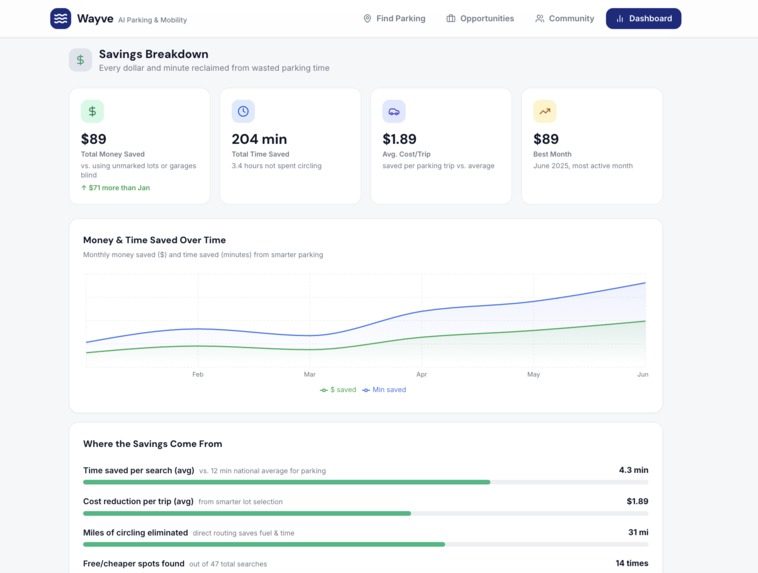
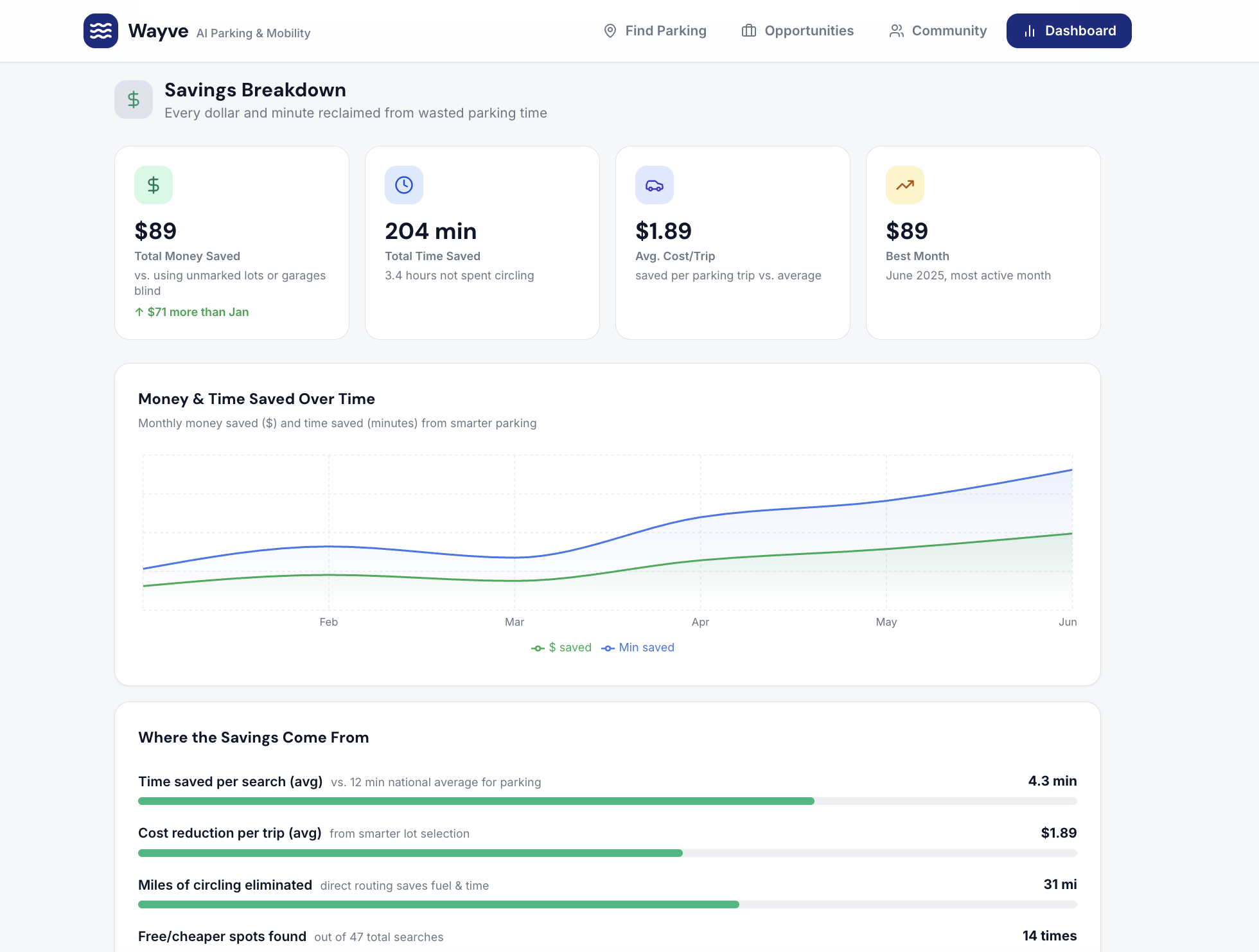
Dashboard Savings breakdown
-
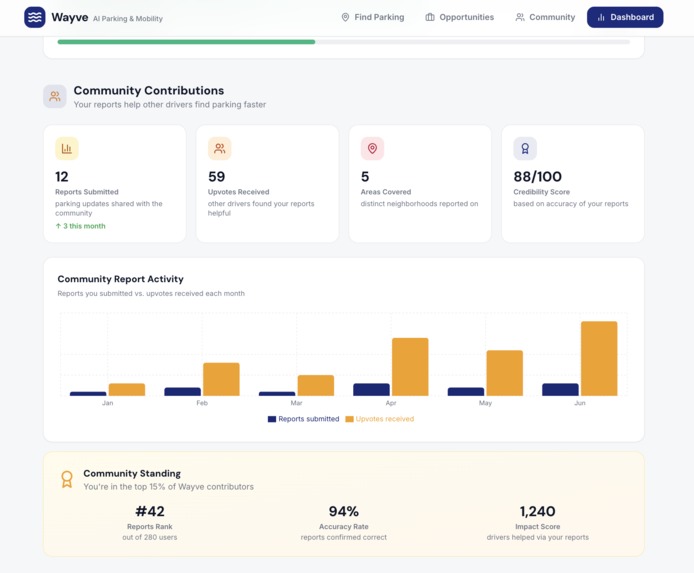
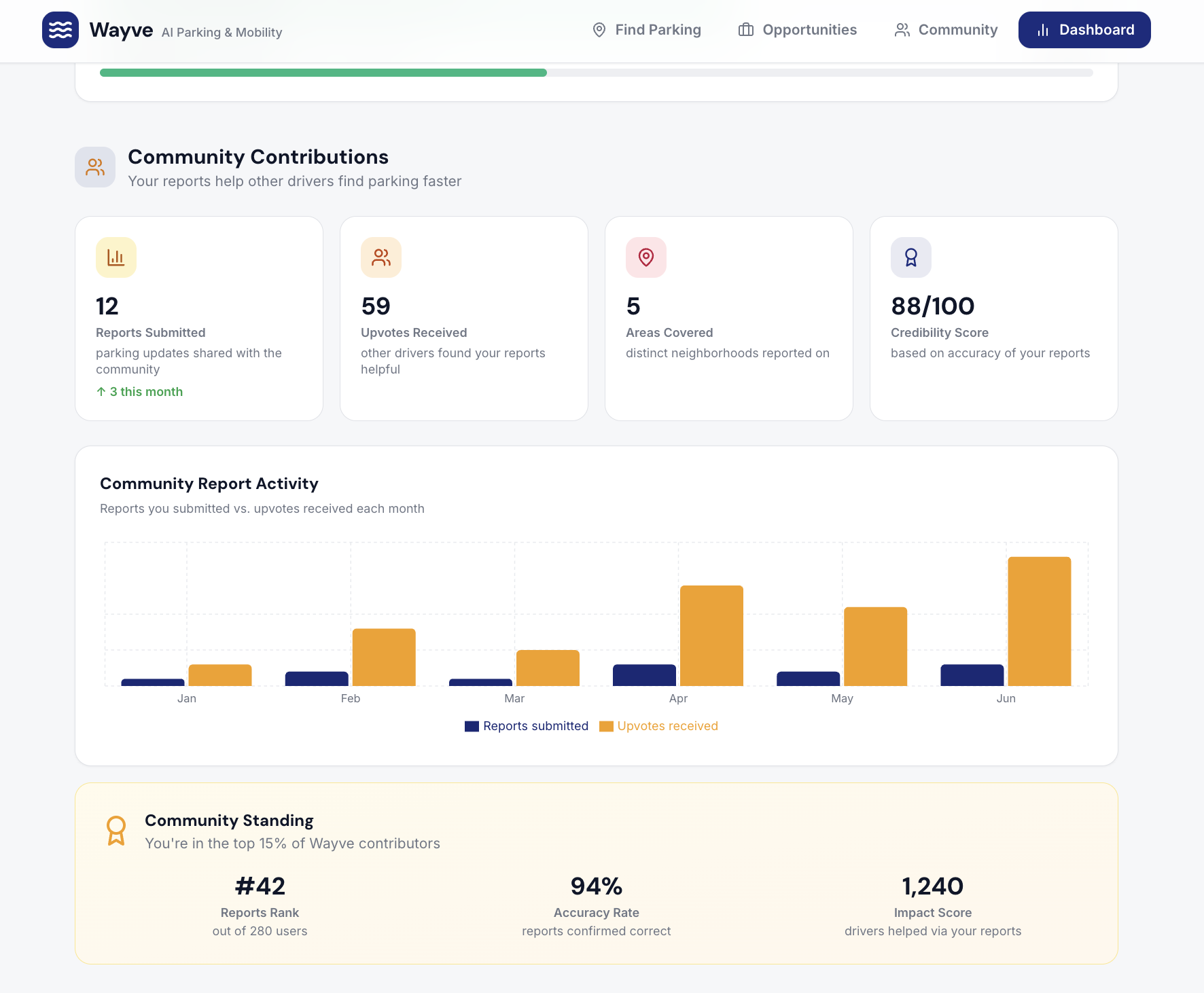
Dashboard outlining community impact contributed
Inspiration
Parking is something millions of people experience every day, yet it remains one of the most frustrating parts of transportation. Students arrive late to class, commuters miss appointments, and drivers spend valuable time searching for available spaces. At universities such as UC Berkeley, thousands of students, faculty, staff, and visitors travel to campus every day, and finding parking can often take longer than the drive itself. Beyond the inconvenience, these extra minutes contribute to traffic congestion, fuel consumption, and unnecessary carbon emissions.
The inspiration for Wayve came from a simple question: navigation applications can tell us how to reach a destination, but why can they not tell us where we can actually park when we arrive? We wanted to build a system that addresses the final part of the journey and helps people make smarter transportation decisions before they even reach their destination.
What it does
Wayve is an AI-powered parking platform that predicts parking availability before a user arrives. Rather than displaying every parking option equally, the system analyzes arrival time, historical demand, nearby events, parking costs, walking distance, accessibility needs, and community reports to recommend the most practical options for each individual user.
The platform also recognizes that transportation affects much more than parking. Access to internships, volunteer opportunities, campus events, and community activities often depends on whether people can realistically reach those destinations. Wayve therefore connects transportation decisions with access to opportunity. The community reporting system also allows users to report full garages, construction, or temporary closures, helping improve future recommendations and train the AI.
How we built it
Wayve was developed as a web application using React, TypeScript, and modern frontend development tools. The prototype was designed to demonstrate how multiple transportation data sources can work together to estimate parking availability.
The prediction system is based on factors such as historical parking demand, arrival times, nearby events, user preferences, and community reports. We designed the system around a gradient boosting model because it performs well on structured transportation data and can improve as more information becomes available.
The prediction process can be represented as:
$$Availability = f(time,\ location,\ events,\ demand,\ reports)$$
The goal of the AI system is not simply to display parking locations but to provide personalized recommendations that adapt to changing conditions.
Challenges we ran into
One of the biggest challenges was the lack of universally available parking data. Many parking facilities do not provide real-time occupancy information, and installing sensors at scale can be expensive. Because of this, we had to design a system that could still make useful predictions using historical demand patterns, schedules, and community feedback.
Another challenge was balancing technical feasibility with realistic impact. Parking is often viewed as a small inconvenience, but we discovered that it affects accessibility, transportation equity, congestion, and environmental sustainability. Building a solution that addressed these larger issues while remaining practical required careful consideration of both the technology and the people using it.
Accomplishments that we're proud of
One accomplishment we are particularly proud of is turning an everyday frustration into a problem with meaningful social and environmental impact. Rather than building another navigation application, we created a platform that connects parking, accessibility, sustainability, and access to opportunity within a single experience.
We are also proud of developing a complete prototype that demonstrates the full user journey. Users can search for parking, receive personalized recommendations, report real-time conditions, discover opportunities, and track the environmental impact of their transportation decisions. The project goes beyond simply locating parking spaces and instead focuses on helping people reach important destinations more efficiently.
Another accomplishment was designing a system that can still provide useful recommendations even when real-time parking data is unavailable. By combining historical demand patterns, user preferences, event schedules, and community reports, Wayve demonstrates how AI can help solve transportation challenges without requiring expensive infrastructure.
Most importantly, we are proud that Wayve addresses a real problem experienced by students, commuters, faculty, and visitors every day. The project demonstrates how artificial intelligence can be used responsibly to improve accessibility, reduce unnecessary driving, and make transportation decisions more equitable and sustainable.
What we learned
Through building Wayve, we learned that transportation problems are rarely isolated. Parking affects how people access opportunities, how cities manage congestion, and how individuals experience their daily routines. We also learned the importance of designing around incomplete data and creating systems that improve over time through feedback.
Most importantly, we learned that solving problems requires more than technical knowledge alone. It requires understanding users, identifying meaningful challenges, and designing solutions that create measurable impact.
What's next for Wayve
Our next goal is to test Wayve within a real university environment and gather user feedback to improve prediction accuracy. Future development could include additional data partnerships, additional parking integrations, mobile applications, and pilot programs with universities and cities.
Success for Wayve would mean reducing parking search times, decreasing unnecessary driving, and helping people reach important destinations more efficiently. While Wayve began as a solution to parking frustration, its larger mission is to improve accessibility, reduce emissions, and make transportation decisions smarter for everyone.
Find the way. Solve the day. All with Wayve.
Built With
- css
- git
- github
- html
- javascript
- react
- tailwind
- typescript
- vite

Log in or sign up for Devpost to join the conversation.