Inspiration
Studios move video files with tools like IBM Aspera - costs thousands per year, and the file arrives exactly as dumb as it left. Meanwhile, delivering finished video to Studios still gets QC'd, summarized, and cataloged, by hand or by a second enterprise product (Interra BATON, Telestream Vidchecker, Venera Pulsar - all thousands per seat). The file spends minutes parked in cloud storage either way. Waystation uses that parking time: while your master sits in Backblaze B2, a reactive pipeline QCs it against a delivery spec, reviews it with multimodal AI, and locks the evidence under Object Lock - so what arrives is not a file, but a delivery.
What it does
- Verified transfer - browser-side BLAKE3 + parallel presigned multipart
straight to B2, crash-resumable via
ListParts; a bao outboard sidecar enables verified range downloads (every chunk checked against the content root before it's accepted). - Reactive pipeline - B2 Event Notifications (HMAC-signed webhook) fire the QC worker the moment the object lands. No polling, no compute babysitting.
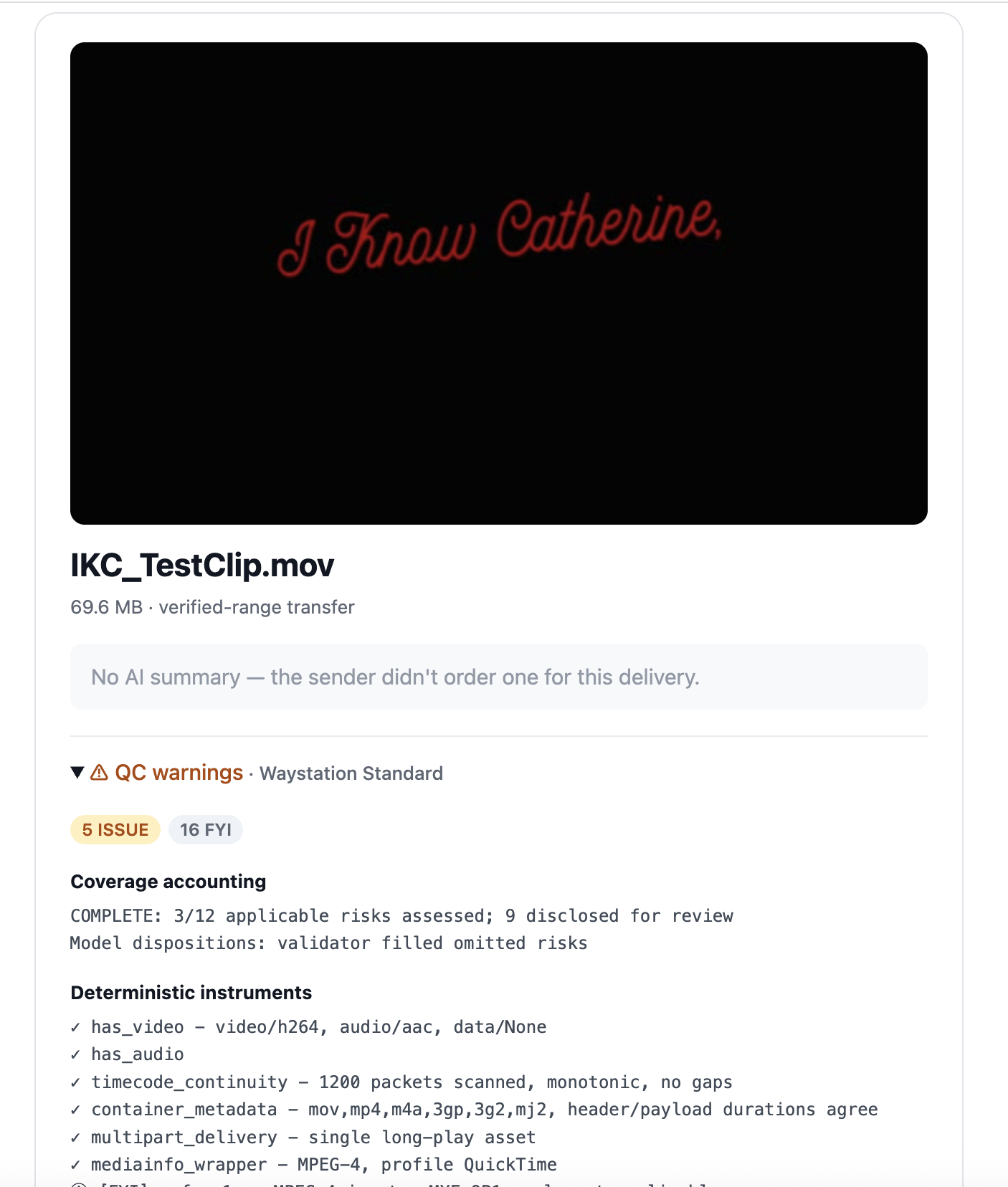
- Broadcast-grade QC - structural (timecode continuity, container integrity, multipart detection), signal (full-decode pass, black/freeze/ silence, EBU R103 legal range with a real amplitude+area policy, ITU-R BS.1770-4 loudness/true-peak/LRA, phase, clipping, hum, mattes, advisory PSE flash-risk screening), captions (timing, collisions, CPS/WPM, encoding, speech-sync drift), and reference SSIM/PSNR/VMAF scored as a 1–5 MOS against an optional source mezzanine.
- Hosted deterministic worker - The deterministic layer runs headlessly in a dedicated Docker worker on an Ubuntu 24.04.4 LTS x86_64 Vultr VPS. Its image includes FFmpeg/FFprobe, MediaInfo, QCTools qcli, MediaConch, Java, and Netflix Photon. QC reports retain tool, policy, evidence, and time-range provenance.
- AI QC lane (GMI Cloud) - Gemini vision reviews sampled frames for what filters can't name (slates, watermarks, burned-in timecode, censorship artifacts); Gemini's audio modality transcribes a sample window and the transcript is word-error-rate diffed against the captions - automated caption accuracy. Plus a caption-grounded one-line summary for the recipient.
- Netflix strict profile - one toggle swaps thresholds for a zero-tolerance delivery spec (−24 LKFS ±1, −2 dBTP, native frame rates only, no pulldown, PSE hard-fail). Findings tier into BLOCKER / ISSUE / FYI.
- Provable provenance - every run emits a real Genblaze manifest
(
genblaze-core, schema v1.5): Run → Steps with provider/model attribution → SHA-256 Assets, canonical-hashed and verified with the SDK's own verifier, then written to B2 under Object Lock COMPLIANCE - in our live run the bucket owner's own key, holdingdeleteFiles+bypassGovernance, was refused deletion. - Billing-ready metering - every billable act (transfer GB, QC minutes, AI frames, ASR seconds, heal runs) is a ledger entry traceable to the manifest; maps 1:1 onto Stripe/Lago usage meters.
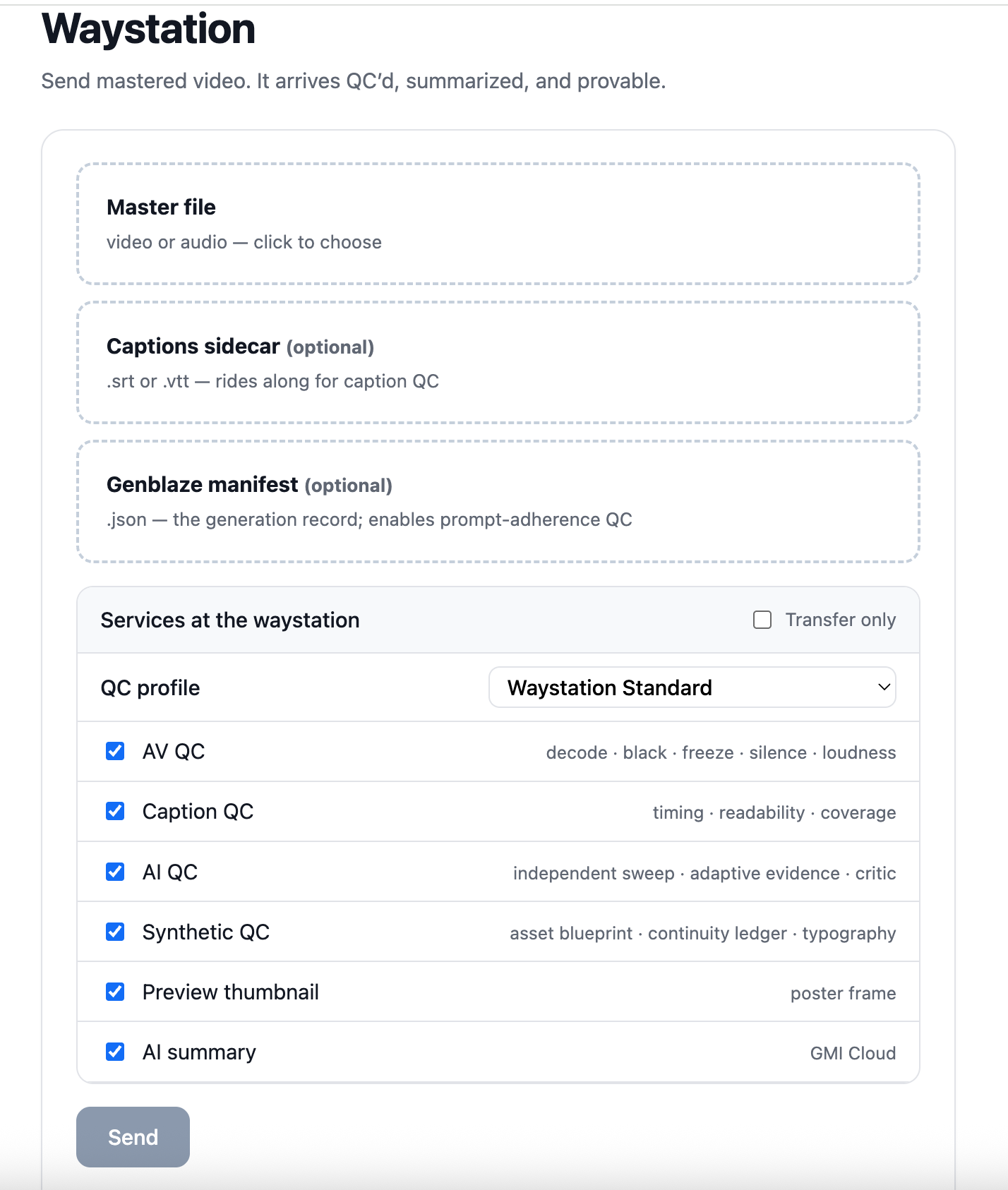
- Transfer-only mode - turn everything off and it's a plain verified file-transfer tool. Every service is a sender-side toggle.
How we built it
Browser (Vite/TS + Rust→wasm BLAKE3/bao) → Hono/Node gateway (control plane
only - presigned URLs, event webhook, SSE progress, metering; it never
touches file bytes) → Python/FastAPI worker (ffmpeg/ffprobe deterministic
lanes + GMI Cloud multimodal lane) → everything back into B2 under
derivatives/. Backblaze B2 is used deeply: S3-compatible multipart with
server-side ListParts assembly (no CORS ETag exposure needed), Event
Notifications over a cloudflared tunnel, Object Lock COMPLIANCE for the
manifest, presigned delivery. AI runs on GMI Cloud's OpenAI-compatible API
(google/gemini-3.5-flash) - one discovery we're proud of: GMI serves no
dedicated ASR model, but Gemini accepts input_audio content parts, so
Gemini is the ASR for caption-accuracy checking.
Challenges we ran into
- Absolute-min/max legal-range checking flags every lossy encode (codec
ringing), so we implemented the industry policy: out-of-range pixel
fraction vs a picture-area threshold, measured exactly with a lut
violation-mask (and discovered ffmpeg's
lutyuvmin/max values are color-range dependent the hard way). - Browser multipart on B2/MinIO without CORS
ExposeHeaders- solved by assembling fromListPartsserver-side, so the browser never reads ETags. - A caption file that alphabetically sorted before the master exposed a sidecar-detection bug on the delivery page - caught because we demo on the real UI, not just scripts.
Accomplishments we're proud of
- The same violating master gets 4 BLOCKERs under Netflix strict and zero under Standard - profiles are real policy, not labels.
- Live Gemini vision caught the burned-in timecode in our test master unprompted; ASR caption accuracy scored 21/21 words.
- A QC report nobody - including us - can alter for 24 hours.
- Six one-command proof scripts; every feature claim in this page is executable.
What we learned
Deterministic instruments and AI judges are complements, not substitutes: ffmpeg measures LUFS, Gemini recognizes a slate - a QC system needs both lanes, and the provenance layer must anchor both kinds of verdicts.
What's next
AI-targeted escalation (vision review at the exact timecodes the deterministic lane flags), Ai prompt inovations. Dolby Vision canvas verification via dovi_tool, IMF/Photon execution in a JVM container. Per-customer billing on the metering ledger. Auto fix QC issues!
Built With
- backblaze-b2
- bao
- blake3
- boto3
- claude
- cloudflare-workers
- cloudflared
- fastapi
- ffmpeg
- gemini
- gmi-cloud
- hono
- libx264
- minio
- node.js
- object-lock
- python
- rust
- s3-api
- server-sent-events
- typescript
- vite
- vmaf
- webassembly
- websockets

Log in or sign up for Devpost to join the conversation.