About the Project
WaySense AI was inspired by a simple but important question: how can artificial intelligence help visually impaired people better understand and interact with the world around them? Everyday activities such as walking in an unfamiliar environment, identifying obstacles, reading signs, recognizing objects, or understanding a particular situation can be challenging for people with visual impairments. We wanted to develop an intelligent assistant capable of transforming visual information into useful and understandable feedback, helping users become more independent and confident in their daily lives.
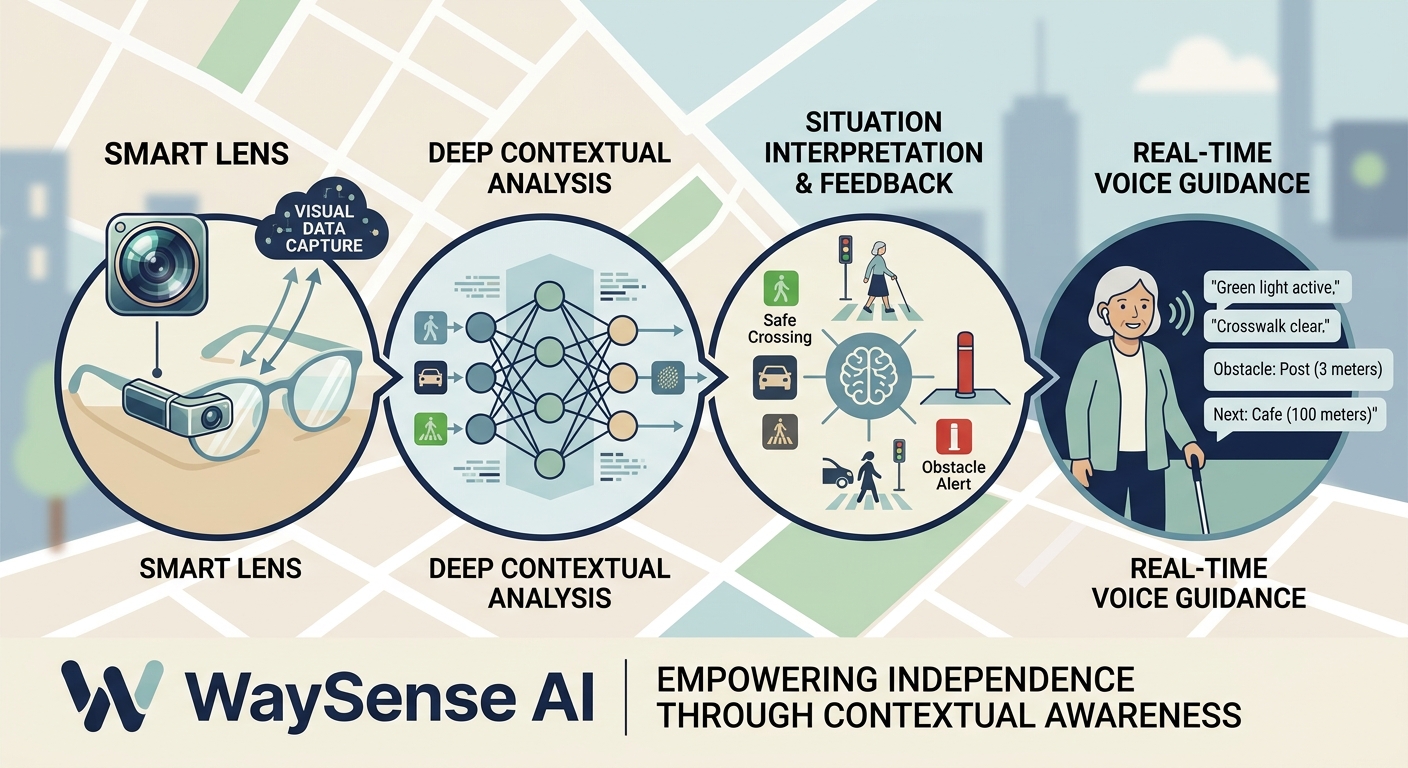
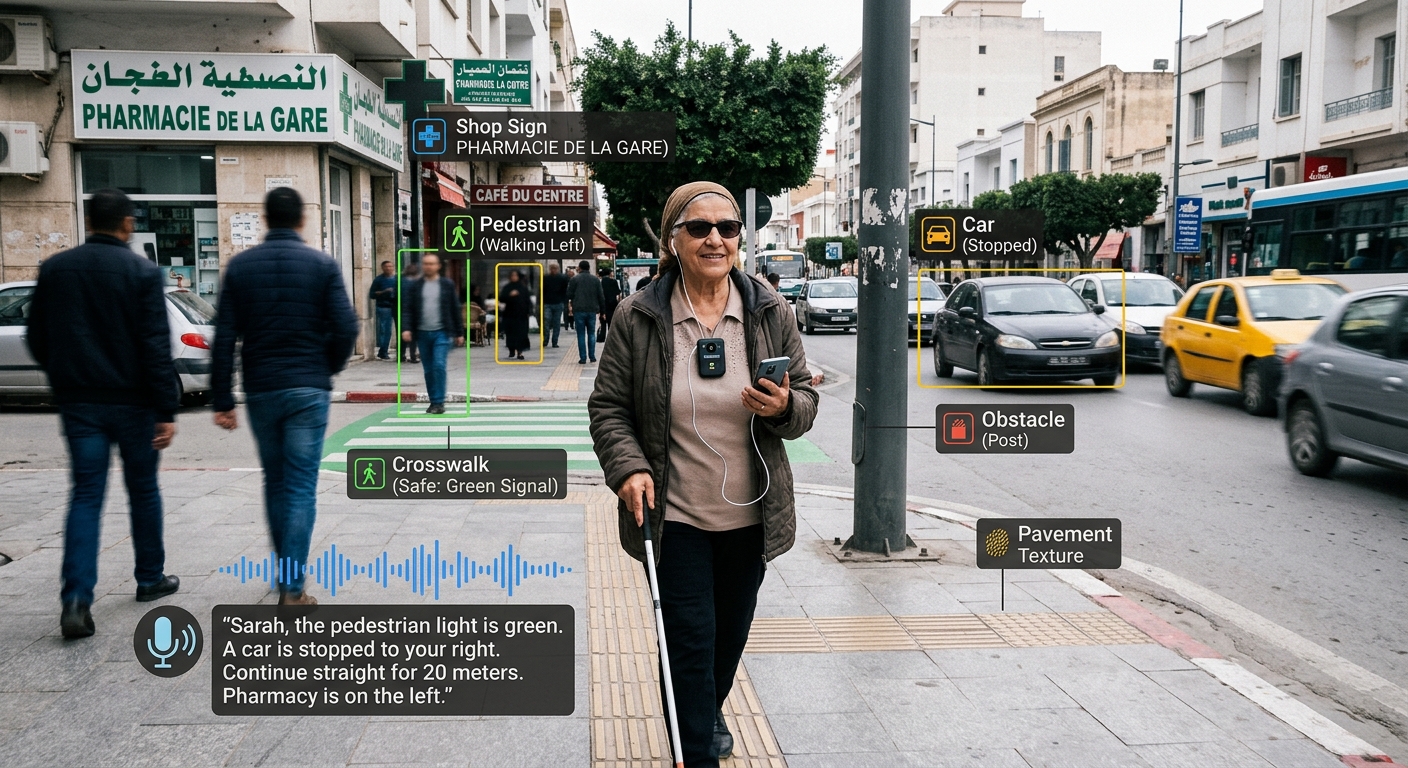
WaySense AI is an AI-powered assistive solution designed to help visually impaired people perceive and understand their surroundings. Using a camera and artificial intelligence, the system analyzes the user's environment and generates contextual information about what is happening around them. Instead of simply detecting individual objects, WaySense AI aims to understand the overall scene and provide relevant information through an accessible interface. The system can identify objects and obstacles, interpret visual scenes, read textual information, and describe relevant elements of the environment. The information can then be communicated to the user through natural language and voice interaction.
The main idea behind WaySense AI is to transform complex visual information into simple and actionable feedback. For example, instead of simply detecting a person, a vehicle, and a crosswalk independently, the system can analyze their relationships and provide a contextual description of the situation. This approach allows the user to receive information that is more meaningful than a simple list of detected objects. The objective is to provide the right information at the right moment while avoiding unnecessary or overwhelming feedback.
The system was built by combining computer vision, artificial intelligence, natural language processing, and voice-based interaction. The general workflow starts with visual information captured through the user's device. This information is processed by AI models to detect relevant elements and understand the surrounding scene. The resulting information is then interpreted and converted into natural language before being delivered to the user in an accessible form. The architecture was designed to remain modular so that additional AI models, recognition capabilities, navigation services, and assistive technologies can be integrated in future versions.
One of the main challenges we faced was moving beyond simple object detection toward contextual understanding. Recognizing individual objects is not enough for an assistive application. The system must understand the relationships between objects and determine which information is actually relevant to the user. For example, detecting a vehicle and a pedestrian independently does not necessarily indicate whether there is a potential danger. The AI needs to analyze the complete situation and provide information that can support the user's decision-making.
Another important challenge was accessibility. The system must provide information in a way that is concise, understandable, and fast enough for real-world use. Too much information can be overwhelming, while insufficient information can make the system less useful. We therefore focused on designing an interaction model where the AI communicates the most relevant information rather than simply describing everything it detects.
Through the development of WaySense AI, we learned that building an effective AI solution is not only about selecting powerful models. It is also about understanding the users, their environment, and the decisions they need to make. We learned the importance of combining computer vision with contextual reasoning and natural language generation to create a more useful assistive experience. We also learned that accessibility should be considered as a fundamental part of the system architecture rather than as an additional feature added at the end of development.
One of the achievements we are most proud of is turning a simple idea about AI-powered visual assistance into a functional prototype focused on a real-world accessibility problem. WaySense AI demonstrates how modern AI technologies can be combined to transform visual information into meaningful assistance for people with visual impairments.
Our next objective is to make WaySense AI more accurate, faster, and reliable in real-world environments. Future developments could include integration with smart glasses and wearable devices, real-time navigation assistance, indoor and outdoor navigation, improved obstacle detection, traffic and pedestrian awareness, multilingual voice interaction, and personalized assistance based on individual user needs.
Our long-term vision is to develop WaySense AI into a personal AI companion for visually impaired people. Rather than replacing human independence, the system is designed to strengthen it by providing users with additional information about their surroundings and helping them make more informed decisions. We believe that artificial intelligence can play an important role in creating a more accessible and inclusive world.
Built With
- ai
- artificial
- computer
- detection
- fastapi
- generative
- image
- intelligence
- javascript
- language
- llm
- models
- natural
- object
- ocr
- processing
- python
- react
- recognition
- rest
- speech
- text-to-speech
- vision

Log in or sign up for Devpost to join the conversation.