-
-
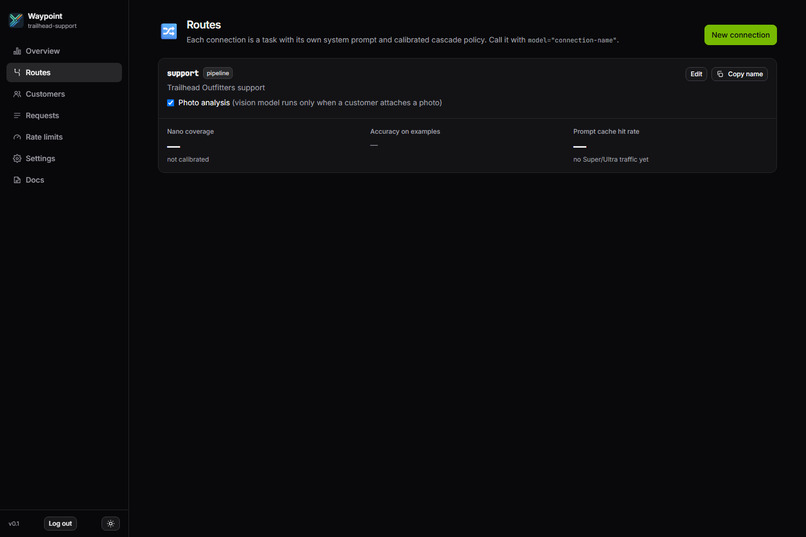
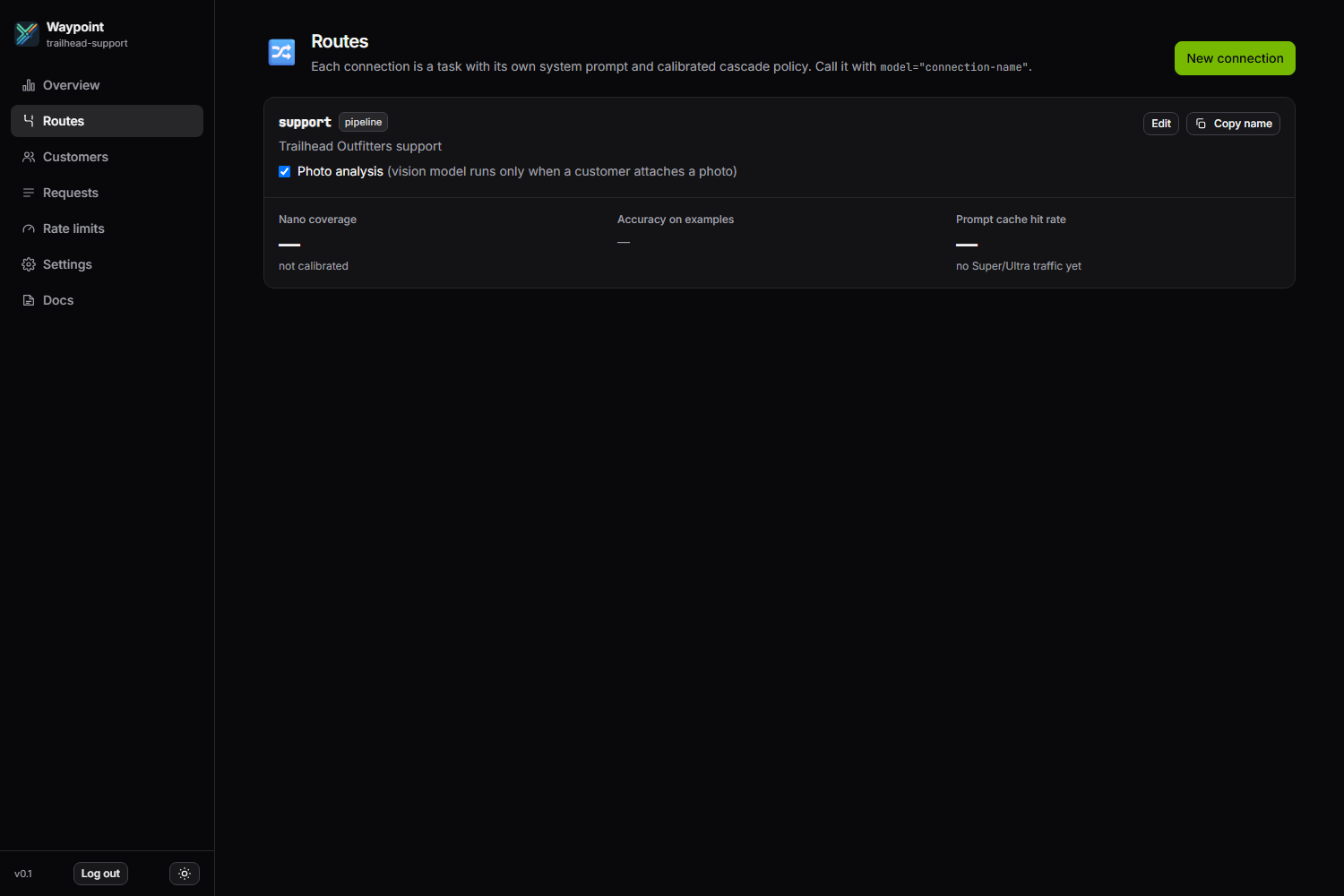
Connections dashboard
-
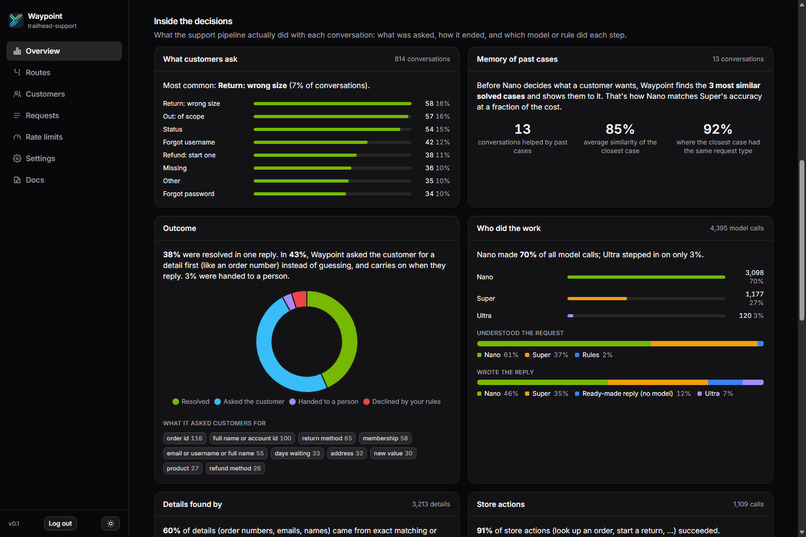
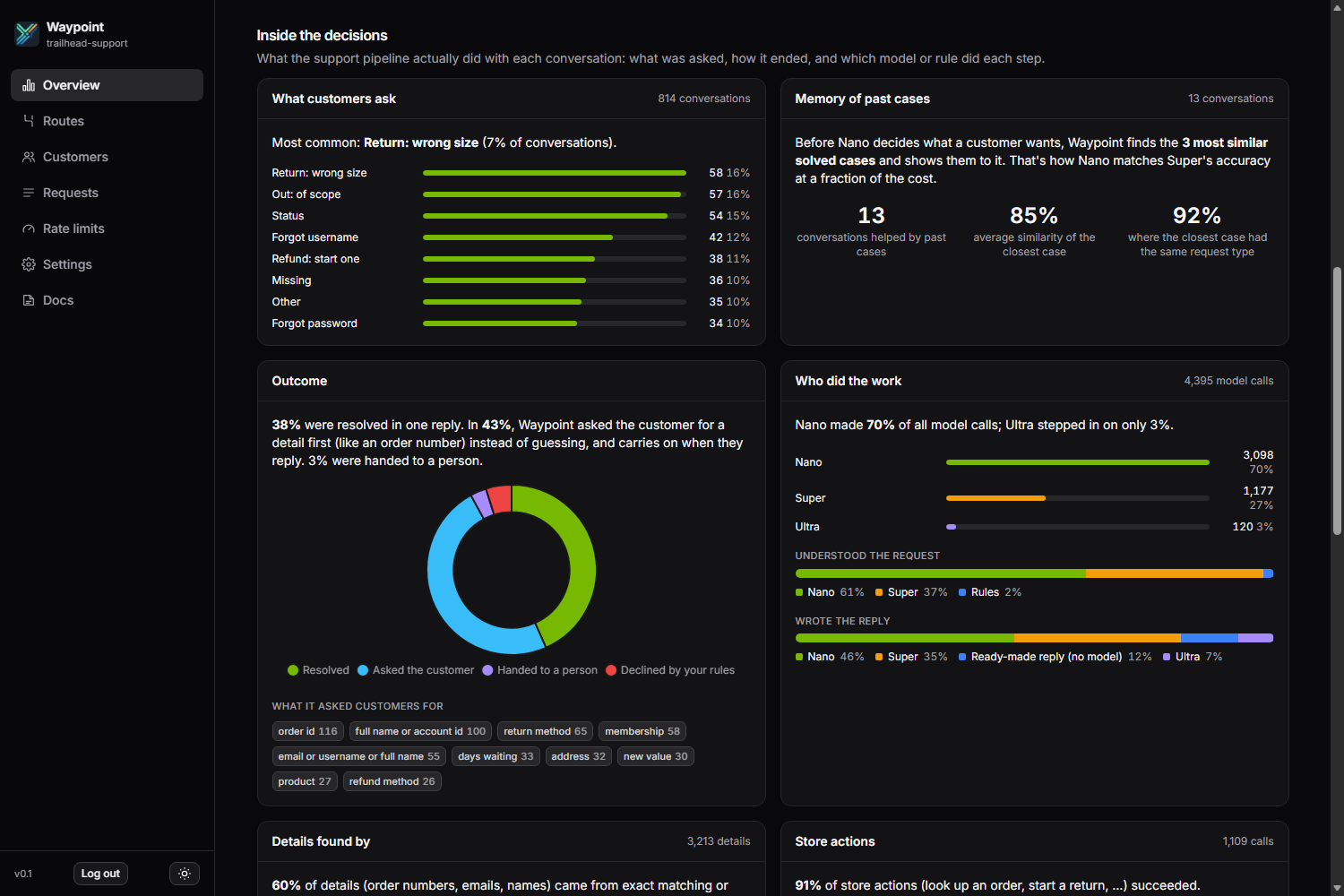
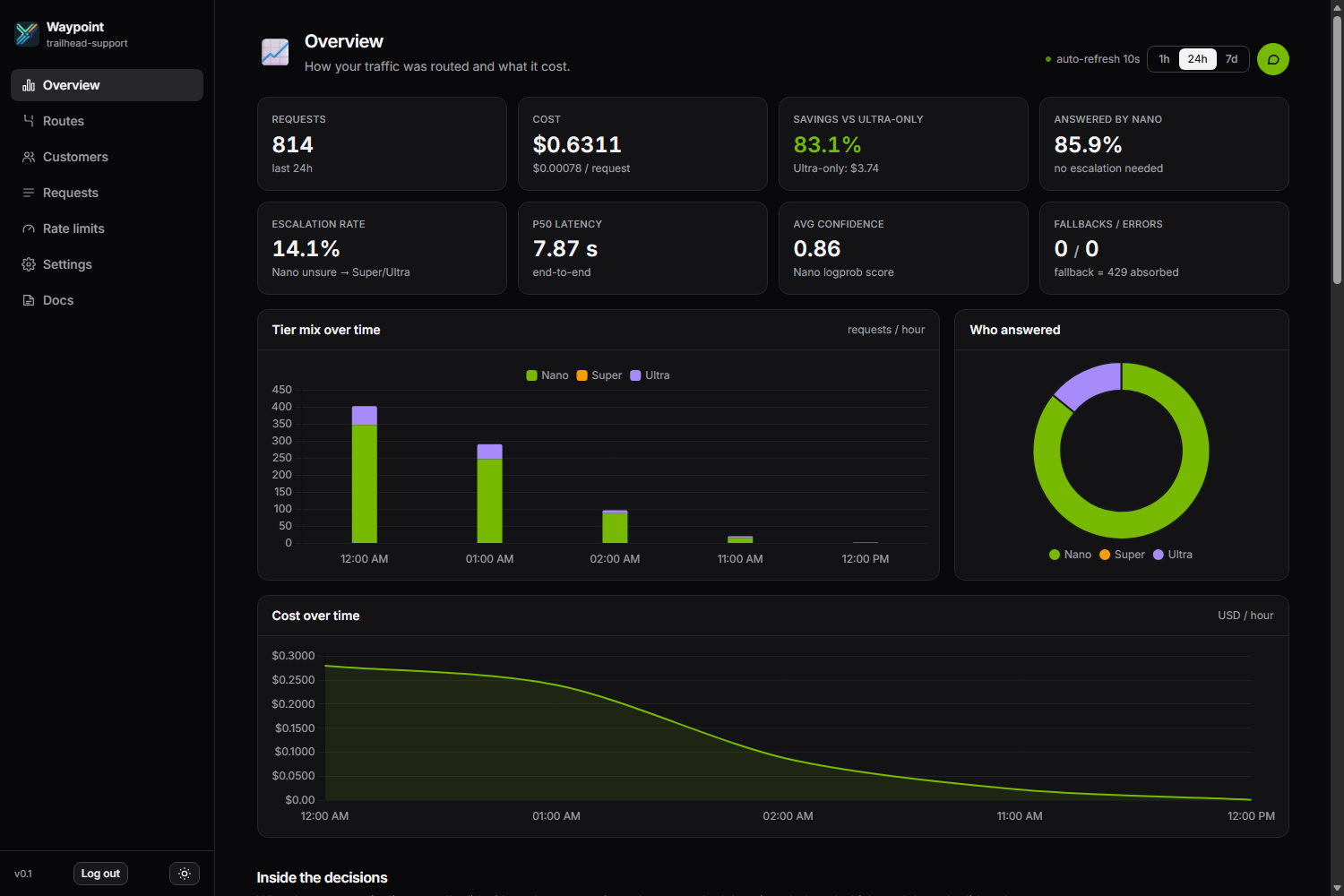
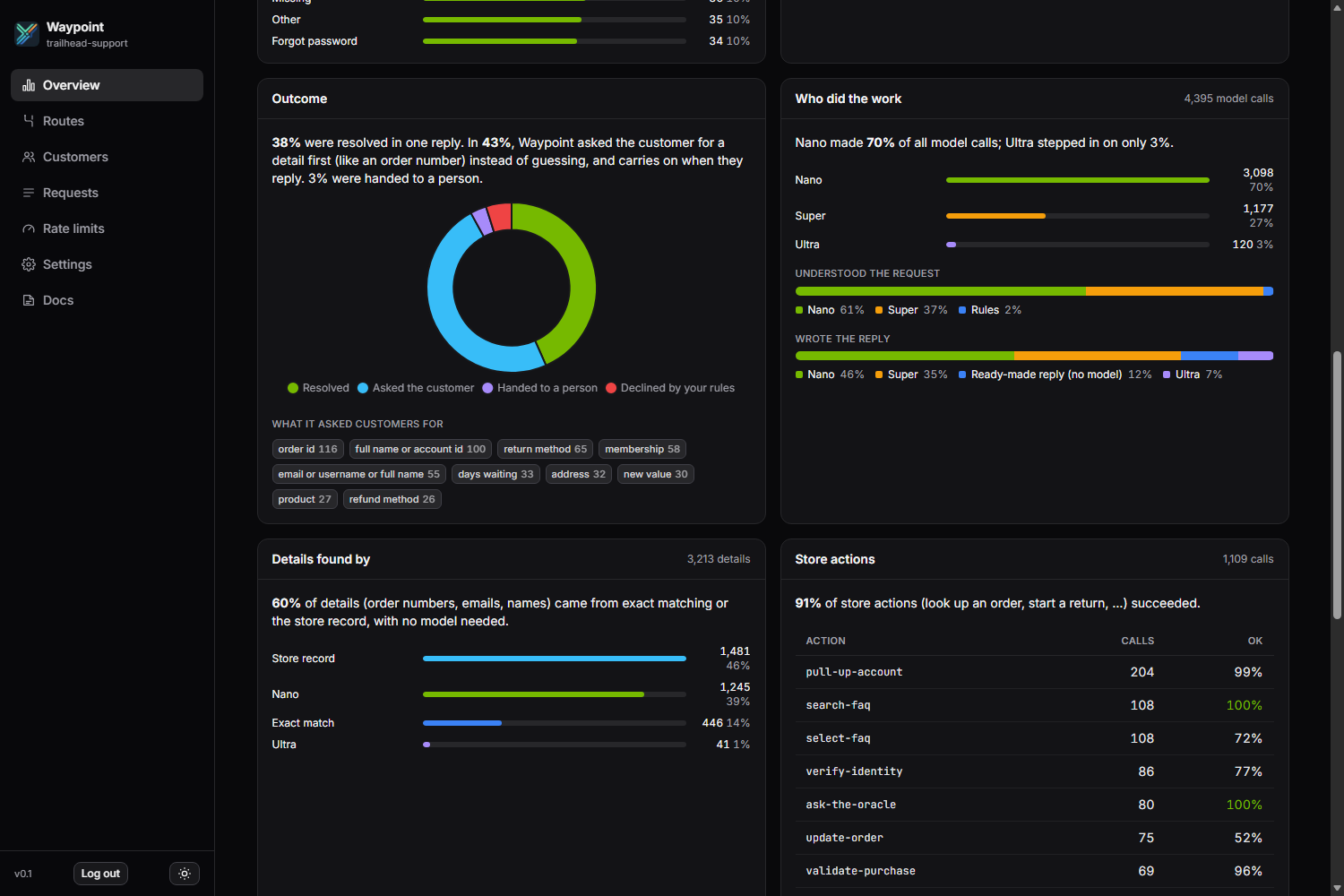
Analytics dashboard
-
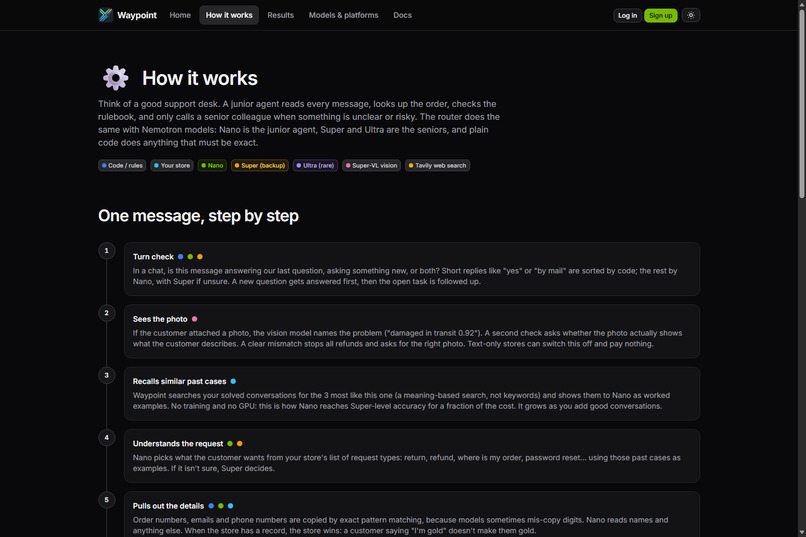
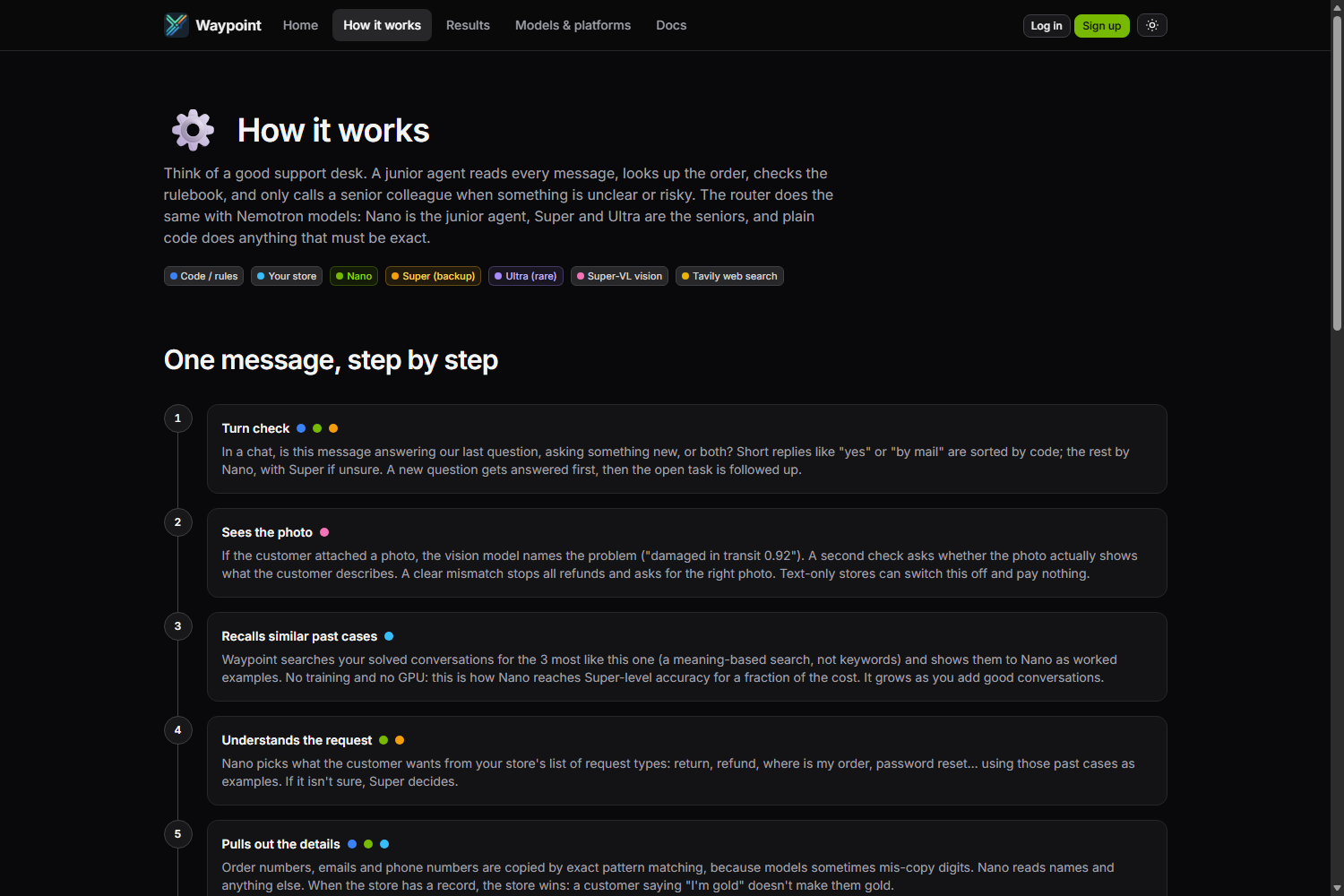
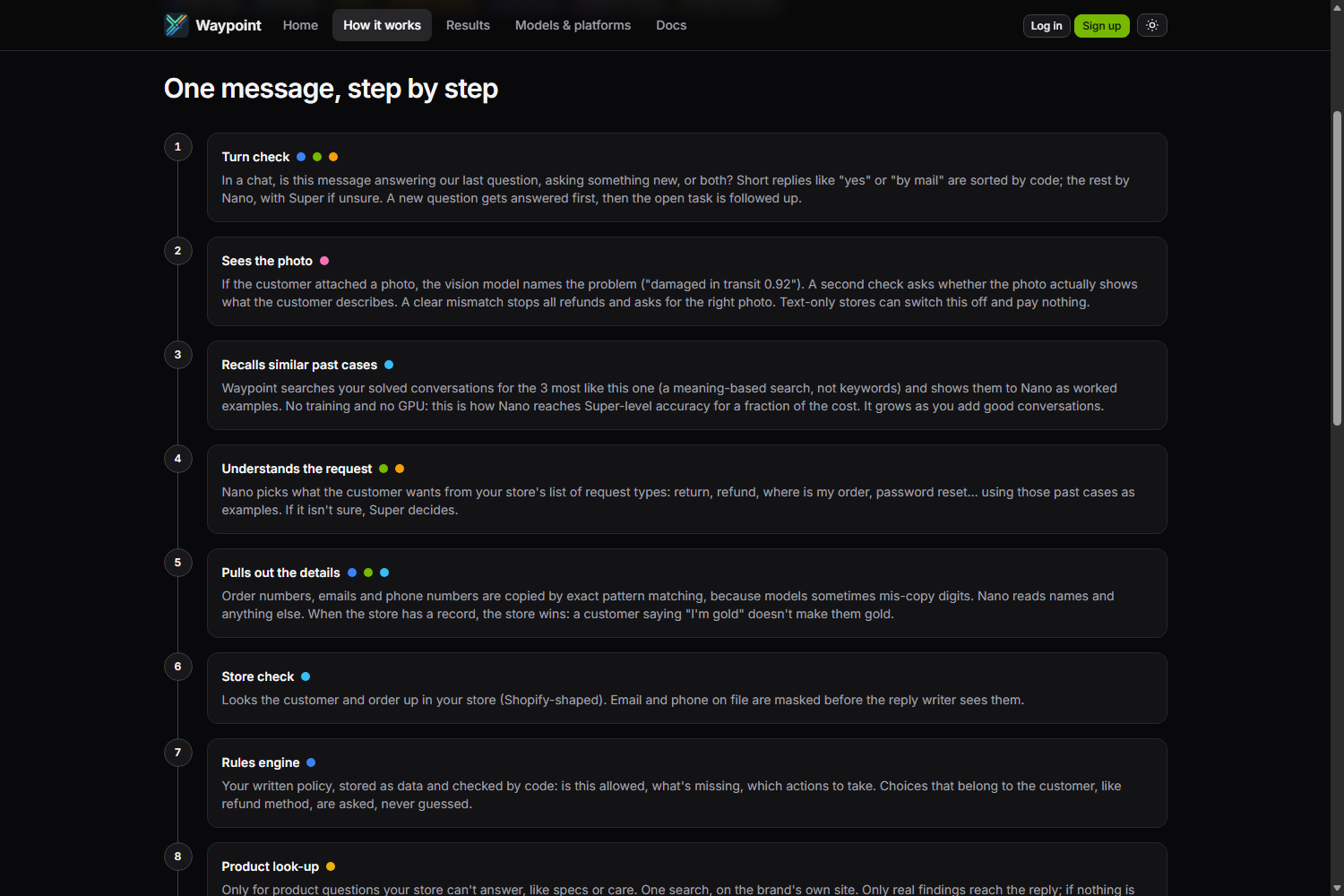
How it works
-
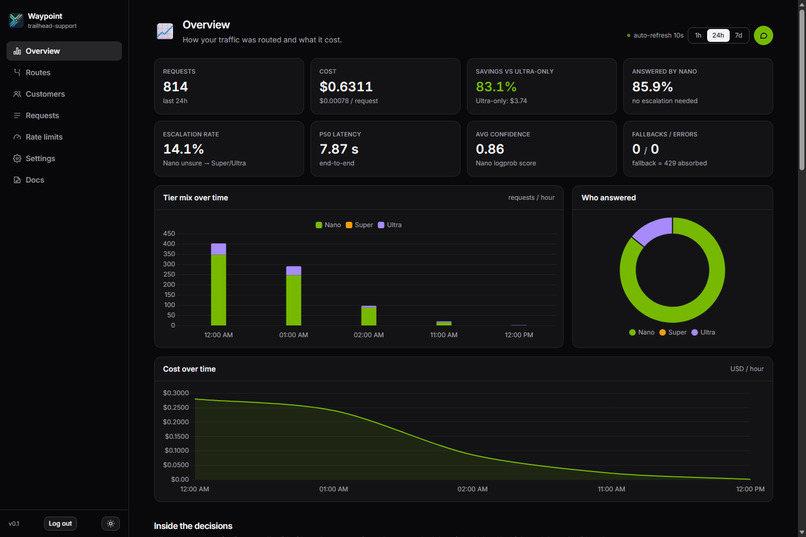
Analytics dashboard
-
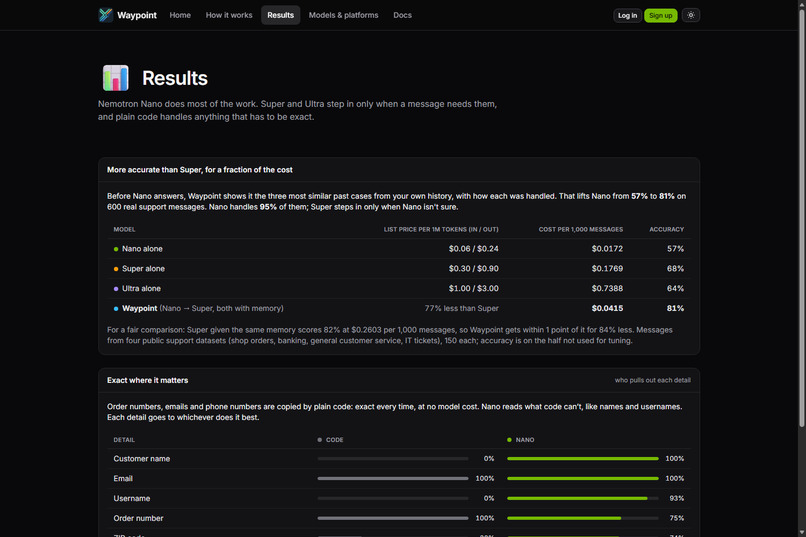
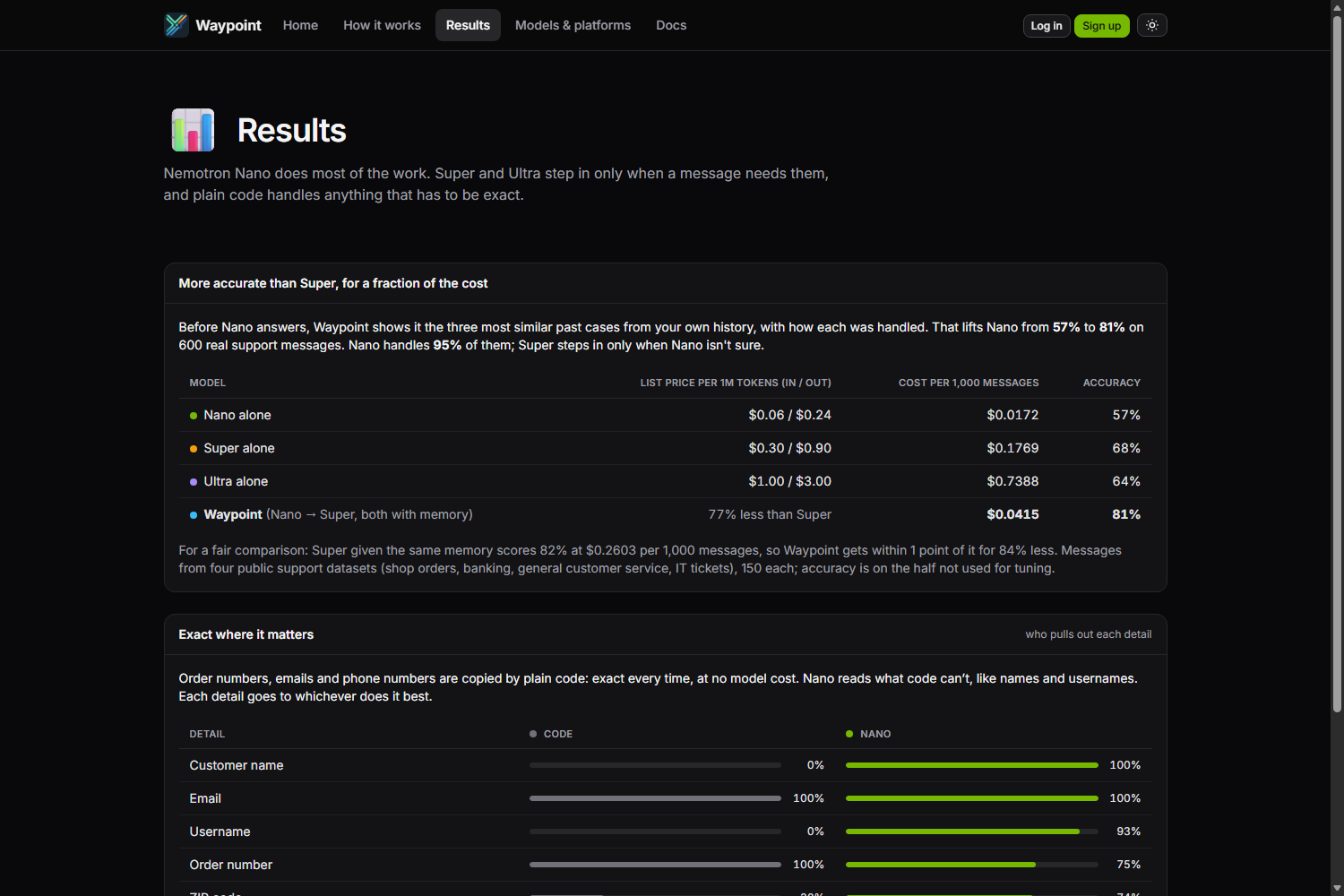
Results table (81% vs 68% vs 64%)
-
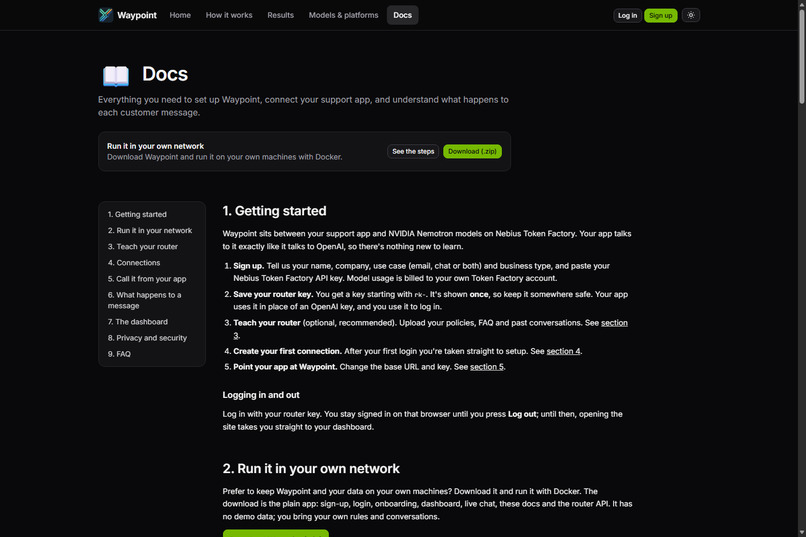
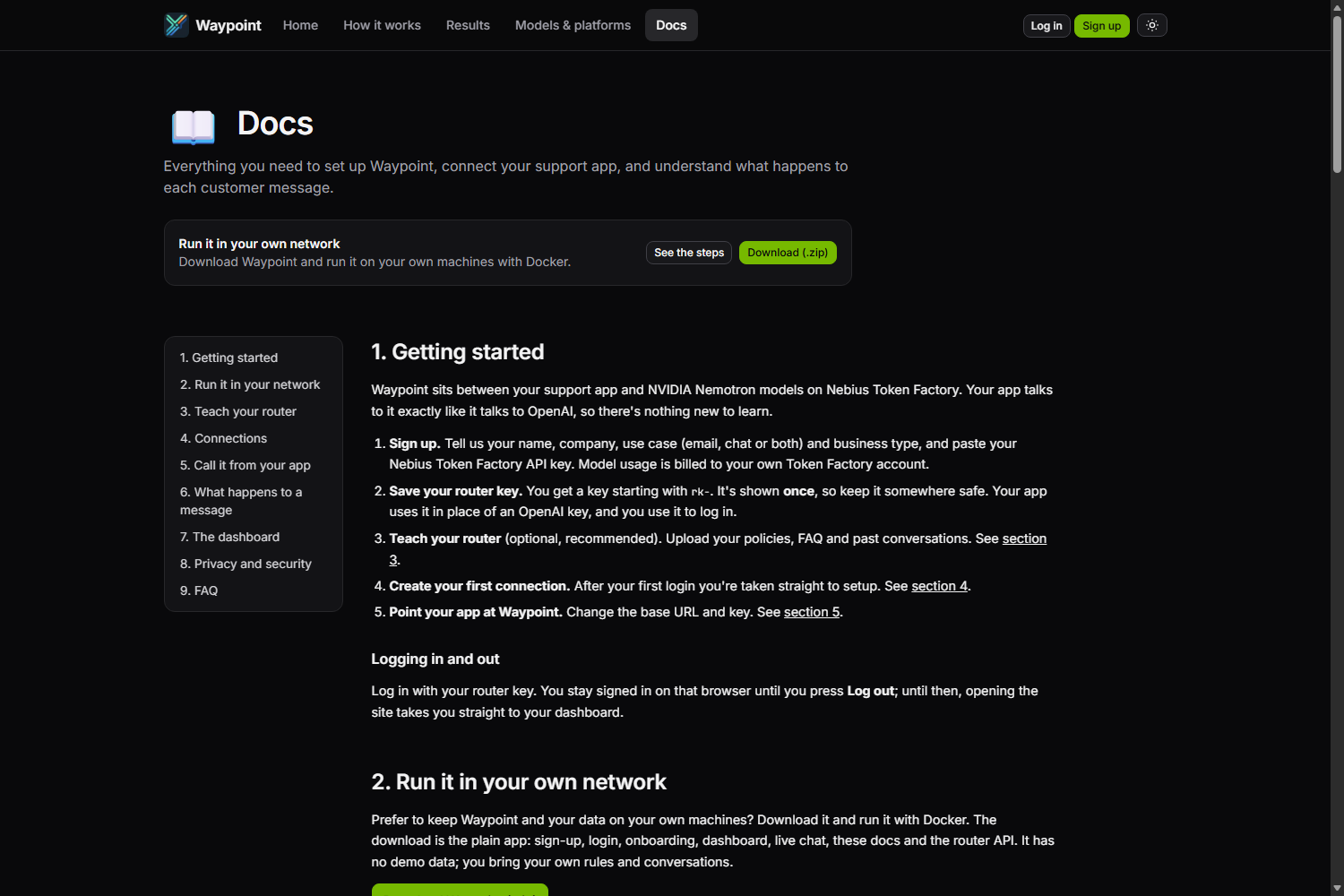
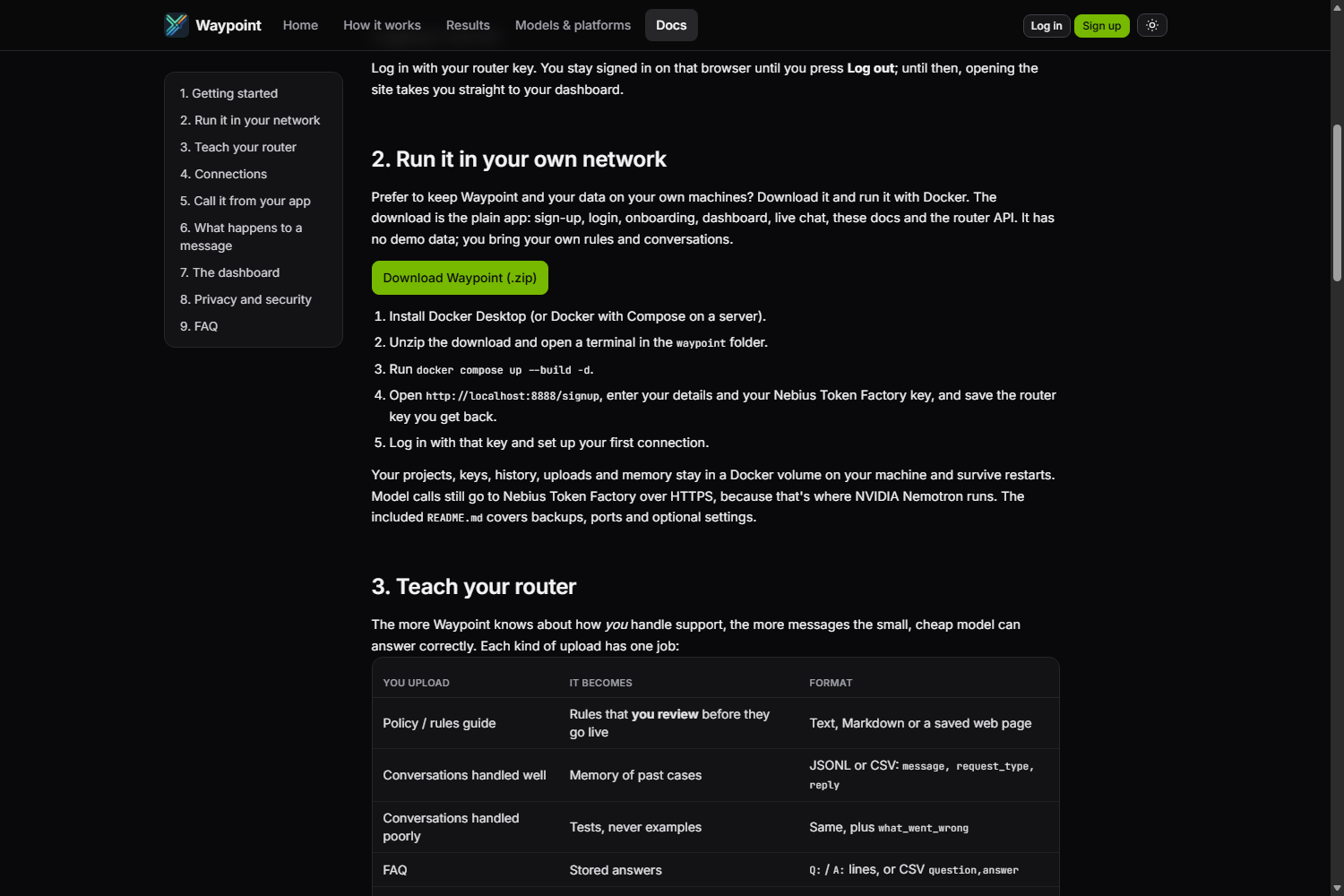
Docs
-
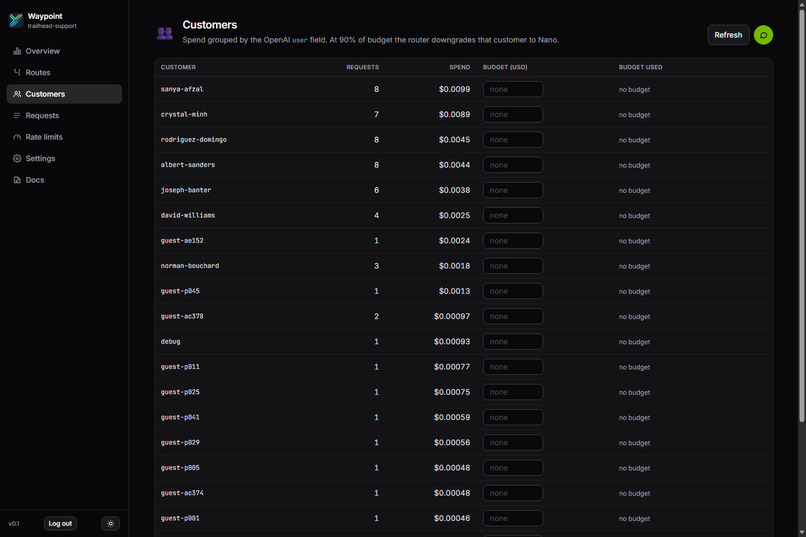
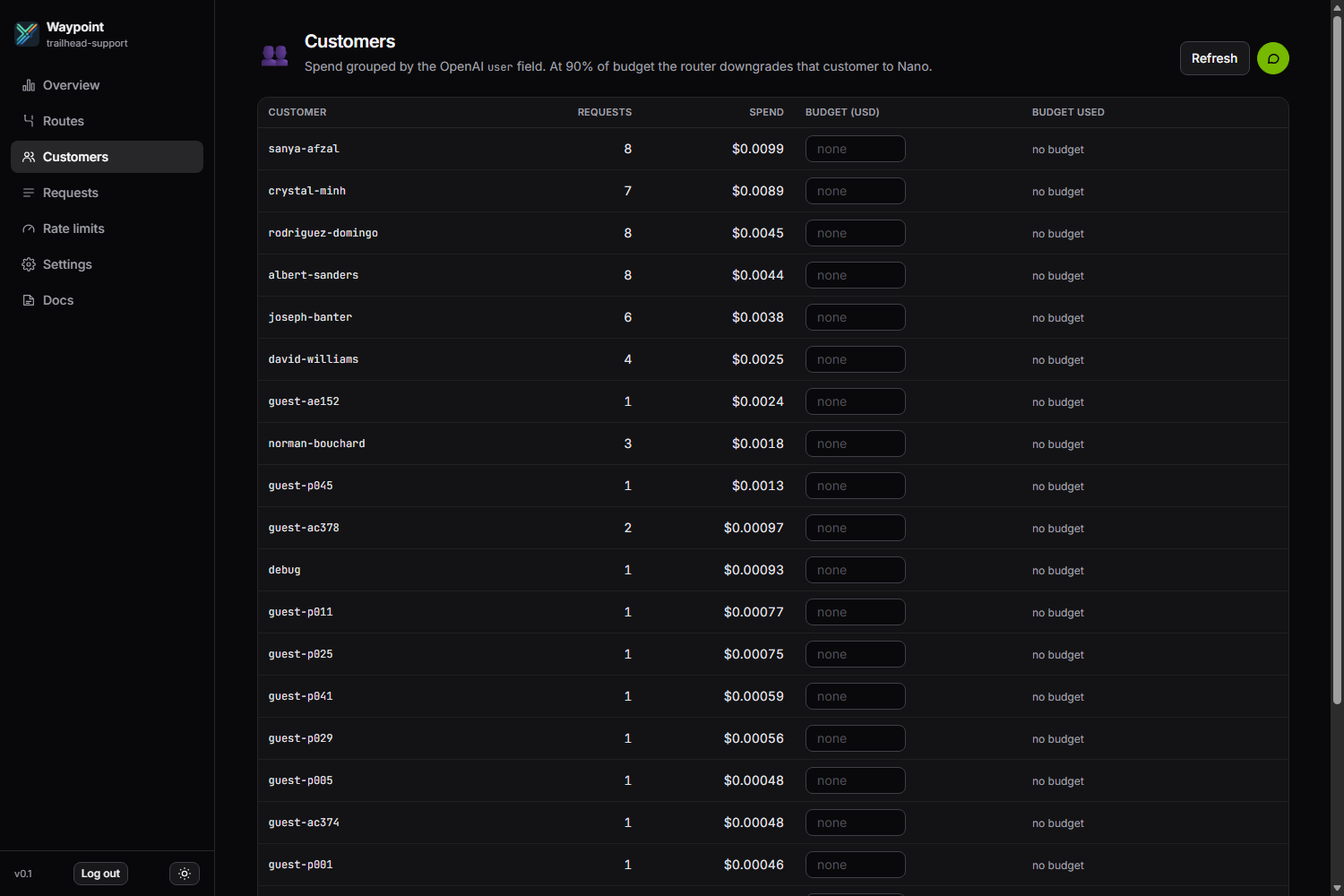
List of customers and spends
-
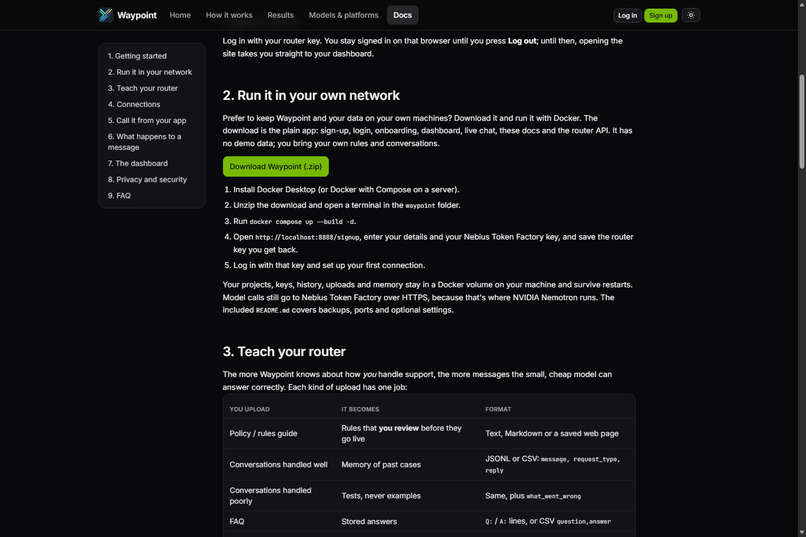
Self hosted download
-
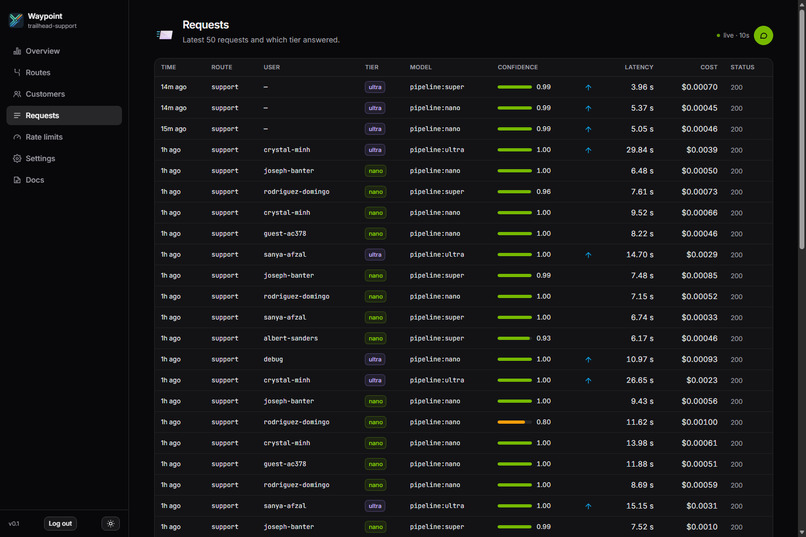
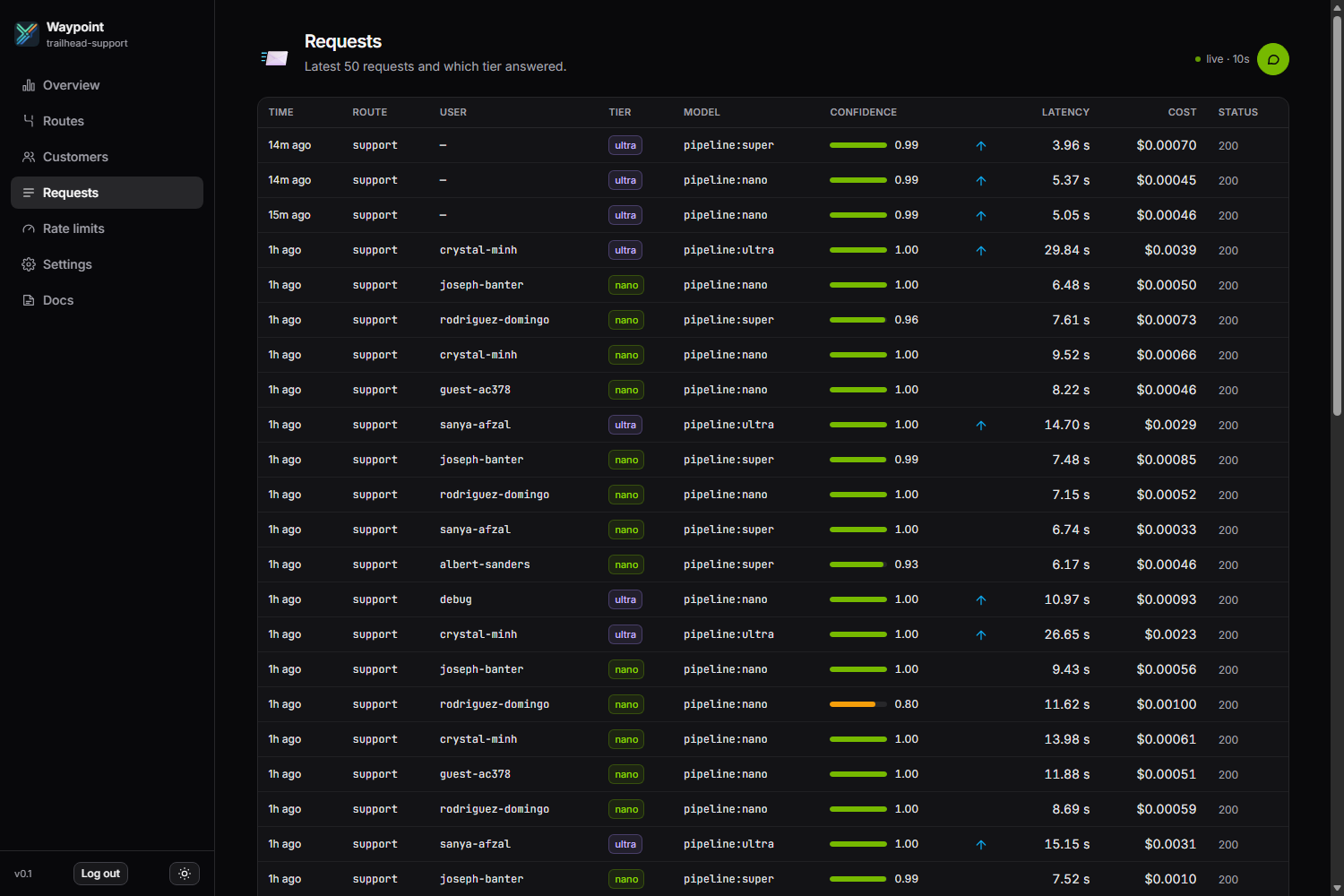
List of requests made
-
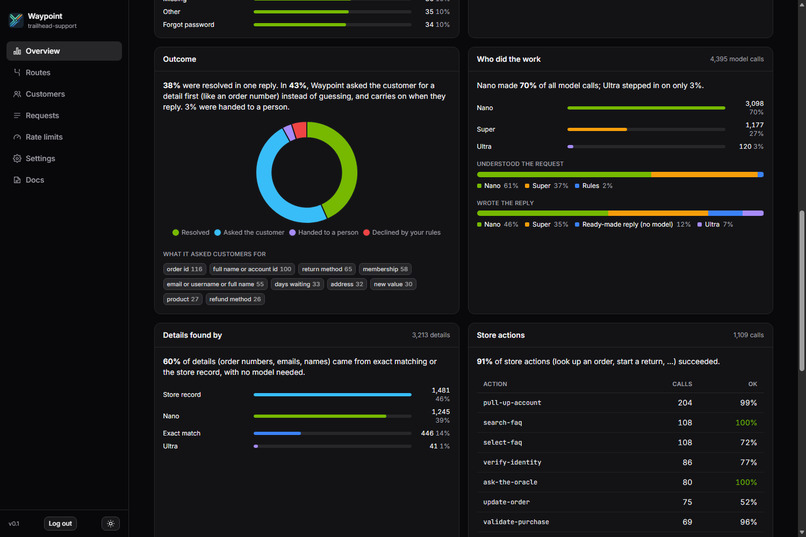
Analytics dashboard
-
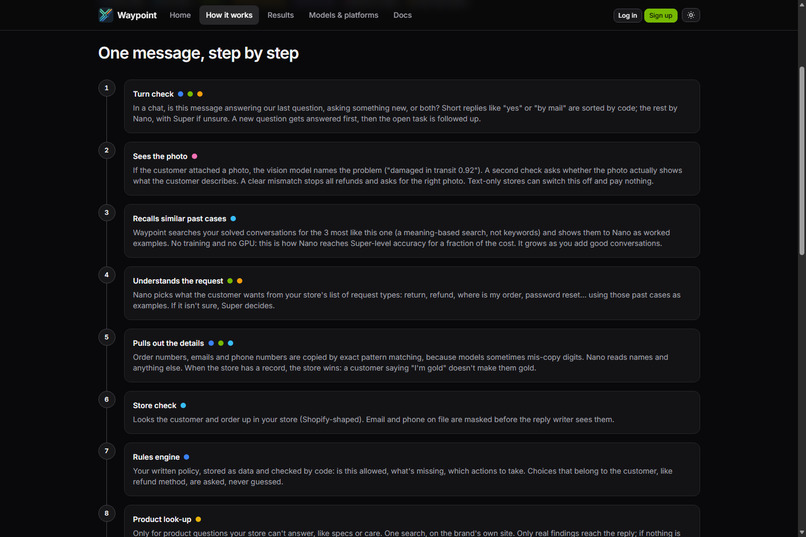
the step-by-step flow, including "Recalls similar past cases"
-
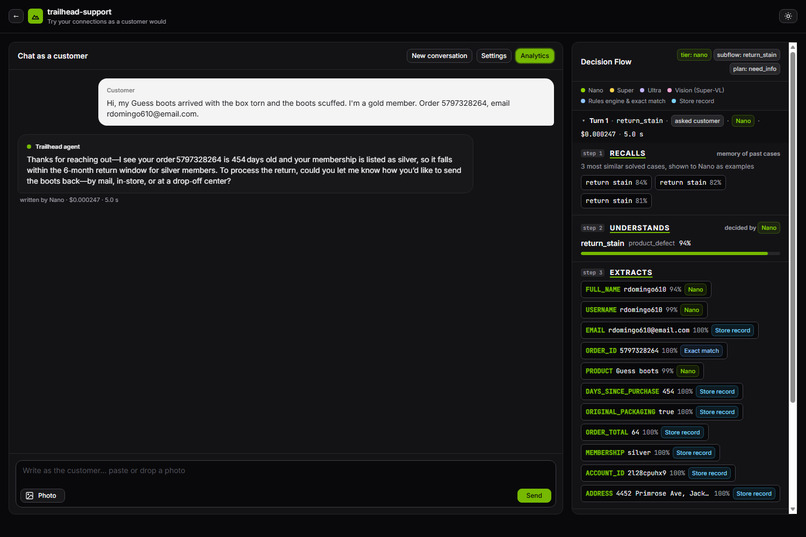
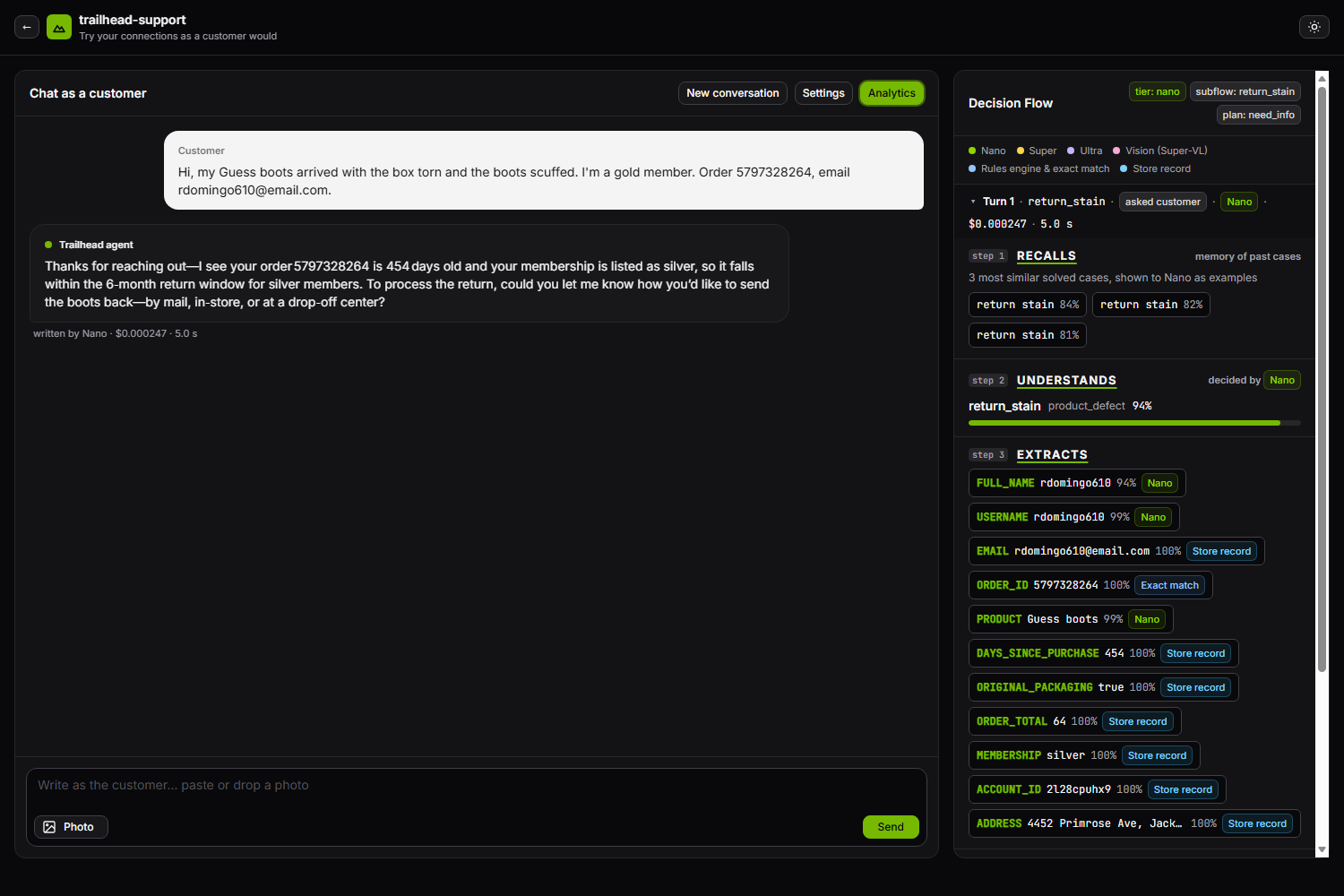
Live chat demo
-
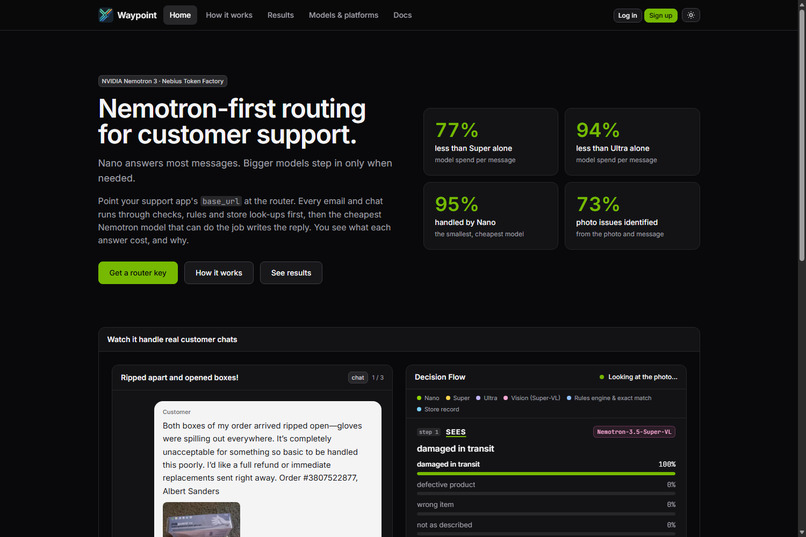
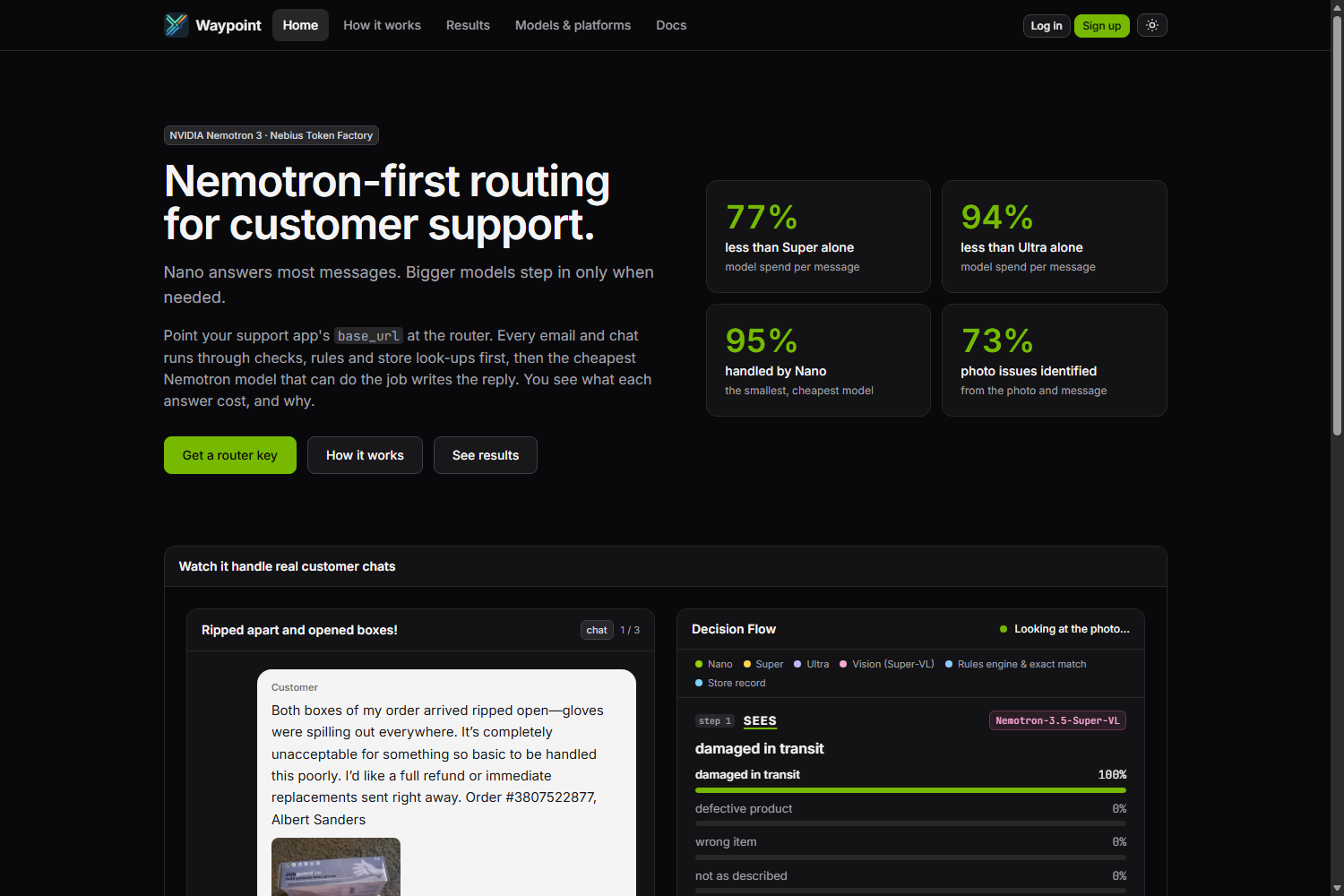
Home page
-
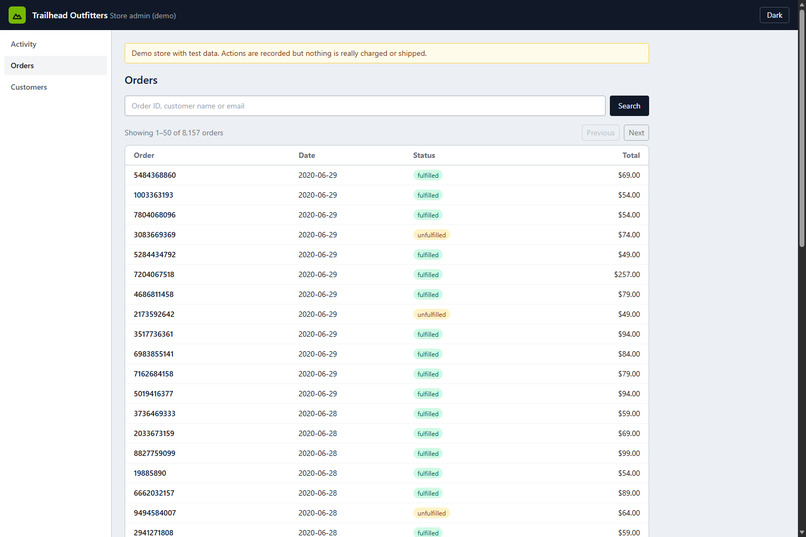
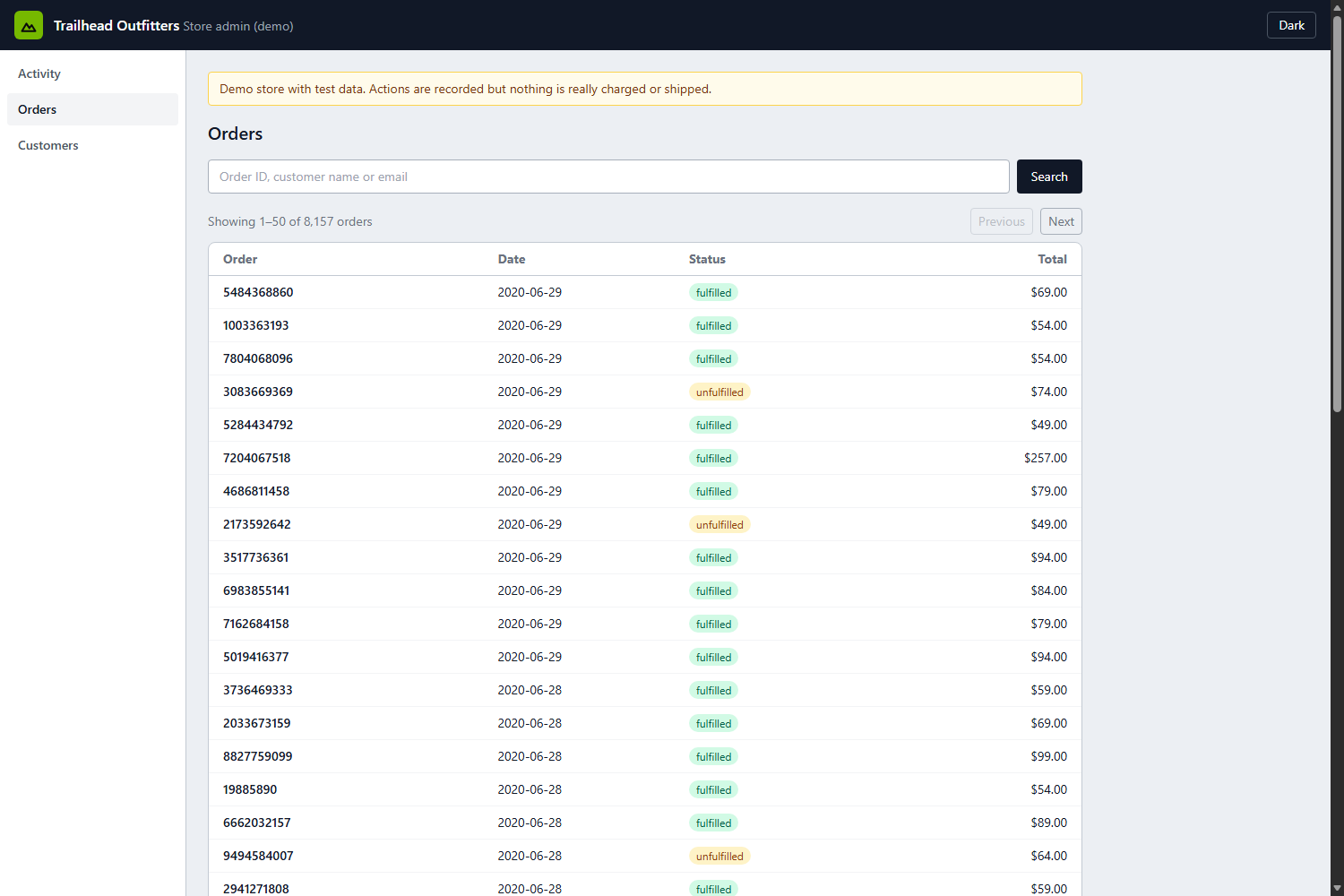
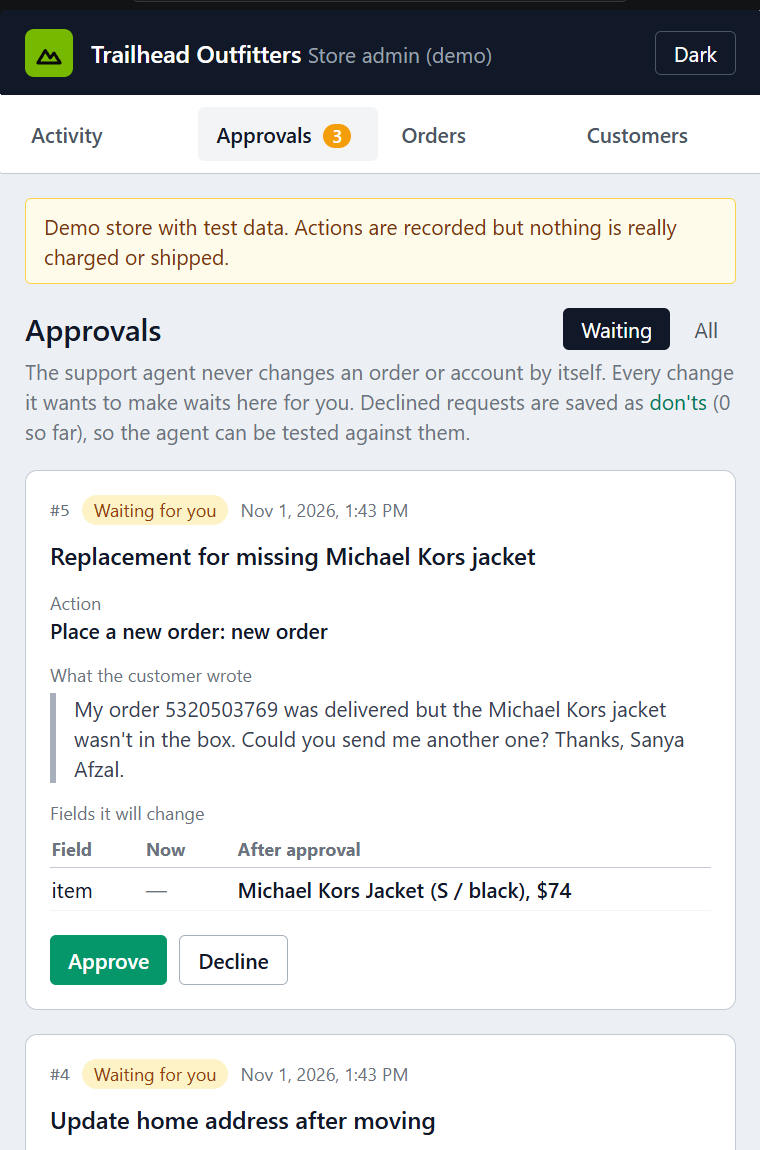
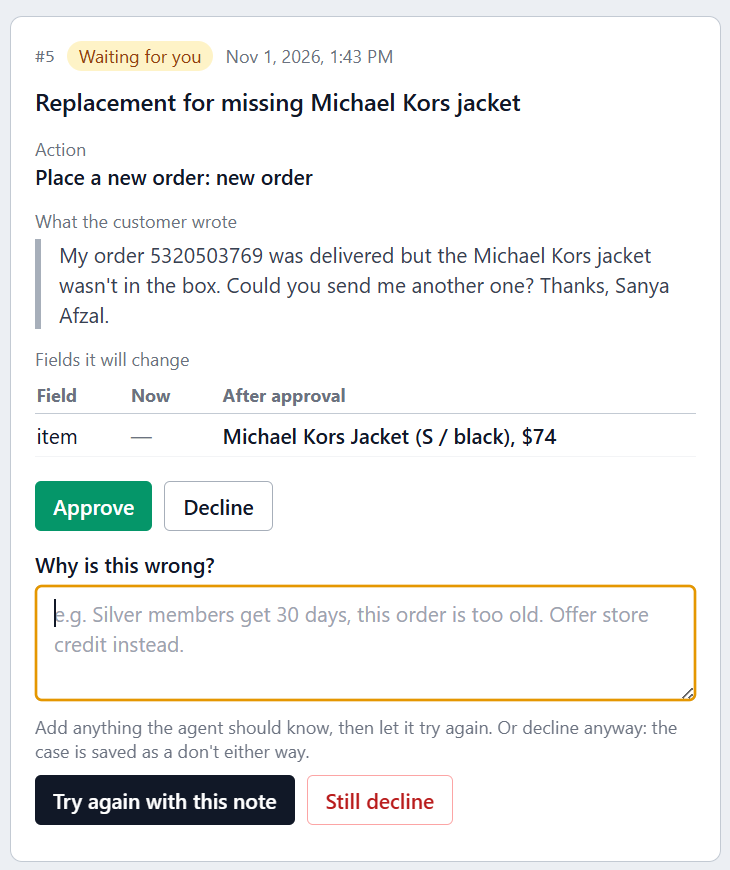
Store admin page
-
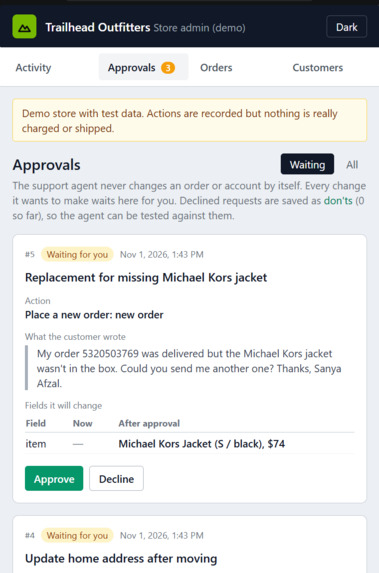
-
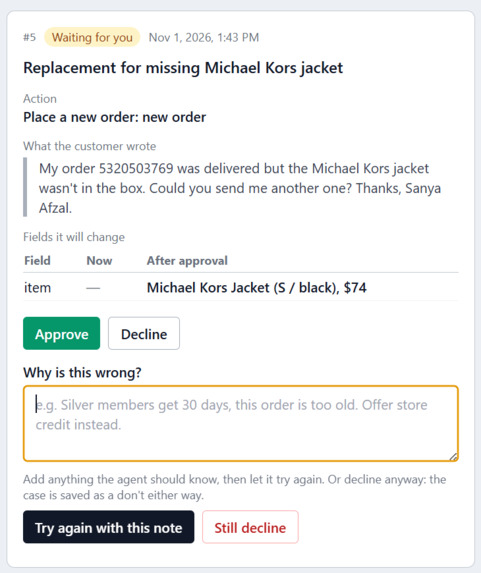
Inspiration
Every support team trying AI hits the same wall. The big models give good answers, but you pay big-model prices on every "where's my order?". Small models are cheap, but in support a confident mistake means a wrong refund or an angry customer. We kept thinking about how a real support desk works: a junior agent handles most tickets and only pulls in a senior when they're stuck. We wanted an AI system that works the same way, and that can show its working.
What it does
Waypoint is an OpenAI-compatible router for customer support, running NVIDIA Nemotron on Nebius Token Factory. You change the base_url in your app, and every email or chat goes through a pipeline:
- Recalls similar past cases: finds the 3 most similar solved conversations and shows them to Nemotron Nano as worked examples.
- Understands the request: Nano classifies it; if its confidence is low, Nemotron Super takes over.
- Pulls out details exactly: order numbers and emails are matched by plain code, not a model, then checked against the store's records. If a customer says "I'm gold" and the store says silver, the store wins.
- Checks photos: Nemotron Super-VL confirms the photo matches the customer's story before anything is approved.
- Applies your rules: refunds and returns follow the store's rulebook, written as plain code, and the reply can only promise actions that actually happened.
- Writes and checks the reply: the smallest model that writes well enough, followed by a safety check, with sensitive topics handed to a person.
Every reply keeps a decision record: what was understood, where each detail came from, which rule applied and which model did the work. The product includes sign-up with your own Token Factory key, onboarding that tunes each connection on your examples, a dashboard, live chat with a step-by-step Decision Flow, a Shopify-style demo store, docs, and a Docker download for running it in your own network.
Results on 600 real support messages from 4 public datasets (scored on a held-out half):
| Setup | Accuracy | Cost per 1,000 messages |
|---|---|---|
| Nemotron Super alone | 68% | $0.177 |
| Nemotron Ultra alone | 64% | $0.739 |
| Waypoint (Nano with memory, Super when unsure) | 81% | $0.042 |
That's 77% cheaper than Super and 94% cheaper than Ultra, with 95% of messages handled by Nano. To be fair: Super given the same memory scores 82%, so Waypoint is one point behind it at about a sixth of the cost.
How we built it
- Backend: Python, FastAPI and httpx, with SQLite for projects, requests and decision records, and Fernet encryption for each user's Token Factory key.
- Models, all through Token Factory's OpenAI-compatible API:
- Nemotron 3 Nano is the first responder, with thinking switched off so its token log-probabilities measure confidence in the answer itself.
- Nemotron 3 Super is the backup and the default writer for complex replies.
- Nemotron 3 Ultra handles high-stakes replies and grades answers during tuning.
- Nemotron 3.5 Super-VL checks photos.
- Qwen3-Embedding-8B powers the memory of past cases.
- Confidence cascade: the threshold is tuned per connection on the customer's own examples, holding Nano to the quality bar of the model it would hand off to.
- Forced choices: structured outputs restrict classification to the valid labels, so there are no invented categories.
- Gateway features: pacing based on Token Factory's rate-limit headers (live traffic goes before background jobs), fallback to a similar model on overload, cost tracking per customer with budgets, prompt-cache hints, and LangSmith tracing of every model call.
- Frontend: static HTML with Tailwind and Chart.js; no build step.
Challenges we ran into
- Confidence was meaningless at first. Nemotron 3 thinks by default, so the log-probabilities scored the reasoning, not the answer. Turning thinking off for the scoring call fixed it.
- Bigger wasn't better. Ultra scored below Super on short classification. And without memory, our cascade traded 3 points of accuracy for a 61% saving, which isn't worth it in support. Adding memory of past cases turned that trade-off into a win on both accuracy and cost.
- Noisy benchmarks. We found wrong answer keys in public datasets and reviewed them by hand before trusting any score.
- Dropping fine-tuning. We first planned to distil Ultra into a smaller model, but that would need hourly dedicated GPUs, which can't compete with Nano's per-token price. Retrieval gave us the gains without any training.
- Trust. Customers state things that aren't true. We had to make the store record the source of truth for account facts and stop replies from promising anything that hadn't happened.
- Messy conversations. On 348 deliberately difficult conversations, we raised the pass rate from 49% to 69%. Two requests in one message is still an open problem.
Accomplishments that we're proud of
- Beating Nemotron Ultra's accuracy at 6% of its cost, measured on held-out data.
- A system that shows its working: every decision is visible, from the past cases it recalled to the rule that fired.
- A complete product, not a notebook: sign-up, onboarding with automatic tuning, a dashboard, live chat, docs and a self-hosted Docker version.
What we learned
- Before switching to a bigger model, give the smaller one better context. Three good examples did more than 18 times the parameters.
- Measure, don't assume: on our tasks, the largest model was neither the most accurate nor worth its price.
- In support, exact things belong in code. Models should read and write; rules and records should decide.
What's next for Waypoint
- Link "Teach your router" uploads to a specific connection, so a company running two businesses keeps them separate, and feed each upload into memory, instructions and tests.
- Handle two requests in one message reliably.
- Connectors for real helpdesks and stores (Zendesk, Shopify), beyond our demo store.
- Grow each company's memory nightly from conversations it marks as good (opt-in), so accuracy keeps improving.

Log in or sign up for Devpost to join the conversation.