Inspiration
Learning something new is often harder than it should be.
The problem is not always a lack of information — there are thousands of courses, videos, articles, and tutorials available online. The real problem is understanding what to learn next, in what order, and whether you actually understand enough to move forward.
We created Waypoint as a personal AI learning navigator.
Instead of giving every learner the same static course, Waypoint aims to build an individual learning path based on the user's goal, current knowledge, progress, and mistakes.
The idea is simple: learning should not feel like following a fixed list of lessons. It should feel like having a route that continuously adapts to you.
What it does
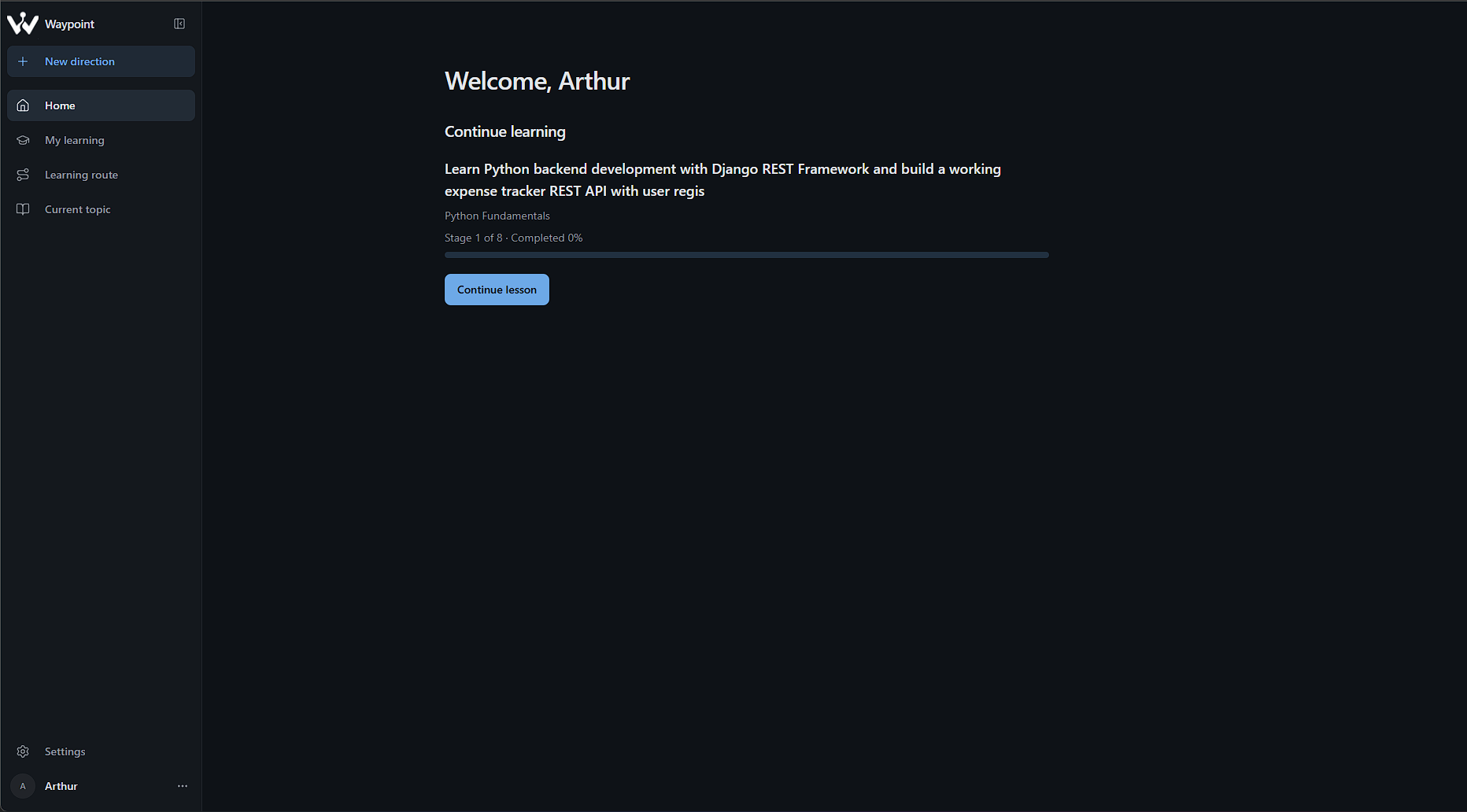
Waypoint turns a learning goal into a structured, personalized roadmap.
A typical learning flow looks like this:
- The learner chooses what they want to achieve.
- Waypoint conducts a short AI-powered assessment to understand their current level and goals.
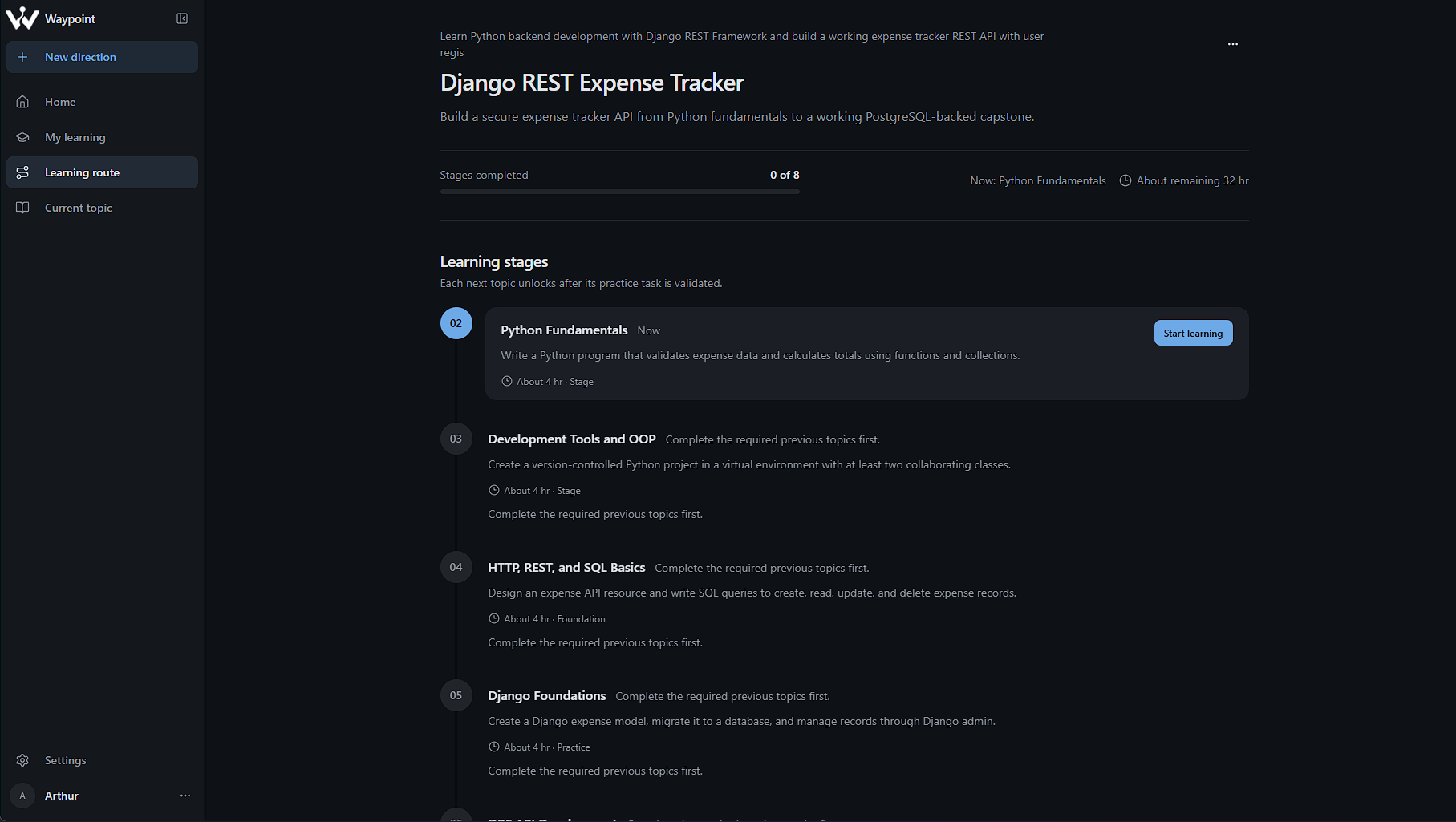
- The system generates a structured learning roadmap with connected topics and milestones.
- Each step contains guided learning material and practical tasks.
- The learner completes exercises, answers questions, or writes code.
- AI evaluates the result and identifies gaps in understanding.
- The roadmap can adapt based on the learner's performance.
For example, if someone is learning Django and struggles with database relationships, Waypoint should not simply mark the answer as incorrect and continue.
Instead, it can identify the missing prerequisite, add or recommend an intermediate step, and adjust the learning route before the learner moves forward.
The goal is to make education adaptive rather than static.
How we built it
Waypoint is built as a full-stack web application.
The frontend uses technologies including:
- React
- TypeScript
- Vite
- Tailwind CSS
The backend is built with:
- Python
- Django
- Django REST Framework
- PostgreSQL-compatible data architecture
The platform is designed around structured learning data: projects, roadmaps, topics, progress, lessons, practice results, and learner interactions.
AI is not intended to be just a chatbot placed on top of the interface.
Instead, it acts as part of the learning engine — helping with learner assessment, roadmap generation, educational guidance, evaluation, and adaptive decisions.
How we use OpenAI
OpenAI models are used to power the intelligent parts of Waypoint's adaptive learning experience.
The AI can help:
- understand a learner's goal and current knowledge;
- generate structured personalized learning paths;
- explain concepts in the context of the learner's roadmap;
- generate relevant practice;
- evaluate answers and reasoning;
- detect knowledge gaps;
- recommend how the learning path should change.
One of the most important design principles behind Waypoint is that AI should not simply generate random lessons.
The system combines structured application logic with AI reasoning so that the learning experience remains consistent, understandable, and goal-oriented.
We also use Codex throughout the development process to help implement, improve, debug, and iterate on the product.
Challenges we faced
One of the biggest challenges was designing AI as a reliable part of an educational system rather than simply creating another AI chat interface.
A useful learning platform needs structure.
We had to think about questions such as:
- How should an AI-generated roadmap remain consistent over time?
- How can the system distinguish between a simple mistake and a real knowledge gap?
- When should a learner continue, and when should the route adapt?
- How do we combine deterministic application logic with flexible AI reasoning?
- How do we keep the experience simple while the underlying learning system becomes increasingly complex?
Another challenge was designing the product so that personalization does not overwhelm the learner.
Waypoint should always make one thing clear:
Where am I now, and what should I do next?
What we learned
Building Waypoint changed the way we think about AI in education.
We learned that the most useful role for AI may not be replacing teachers, courses, or educational content.
Instead, AI can act as an intelligent layer between the learner and all available knowledge — helping organize the journey, understand progress, identify gaps, and decide what comes next.
We also learned that good AI products need more than a powerful model.
They need strong product logic, structured data, thoughtful UX, validation, and clear boundaries between what should be deterministic and what should be decided by AI.
What's next for Waypoint
Our long-term vision is for Waypoint to become a universal learning navigation layer.
A learner could enter almost any meaningful goal — from learning a programming framework to mastering a school subject — and Waypoint would help transform that goal into a clear, adaptive journey.
Future development includes:
- deeper adaptive roadmap logic;
- richer practical exercises and coding environments;
- improved knowledge-gap detection;
- long-term learner memory and personalization;
- progress analytics;
- better AI evaluation;
- support for more learning domains.
Waypoint is built around one core idea: Everyone has a destination. Learning becomes easier when you know the next waypoint.
Built With
- api
- codex
- css
- django
- framework
- github
- gpt-5.6
- openai
- postgresql
- python
- react
- rest
- shadcn/ui
- tailwind
- typescript
- vite


Log in or sign up for Devpost to join the conversation.