-
-
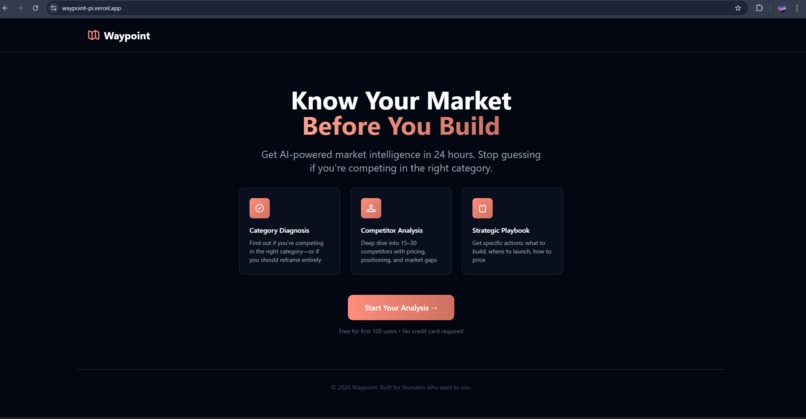
Waypoint-landing-page
-
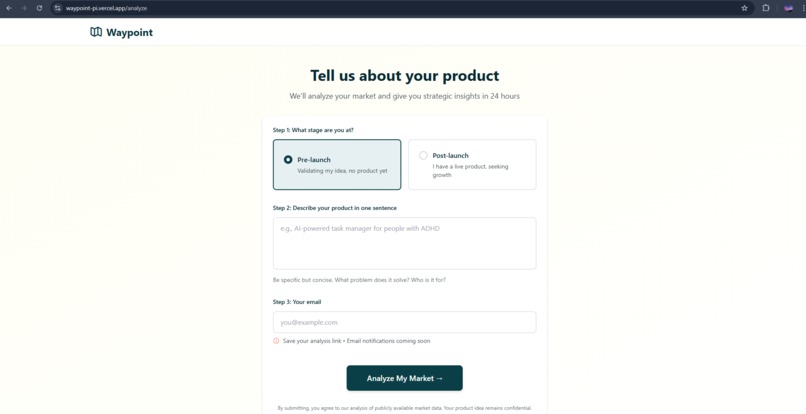
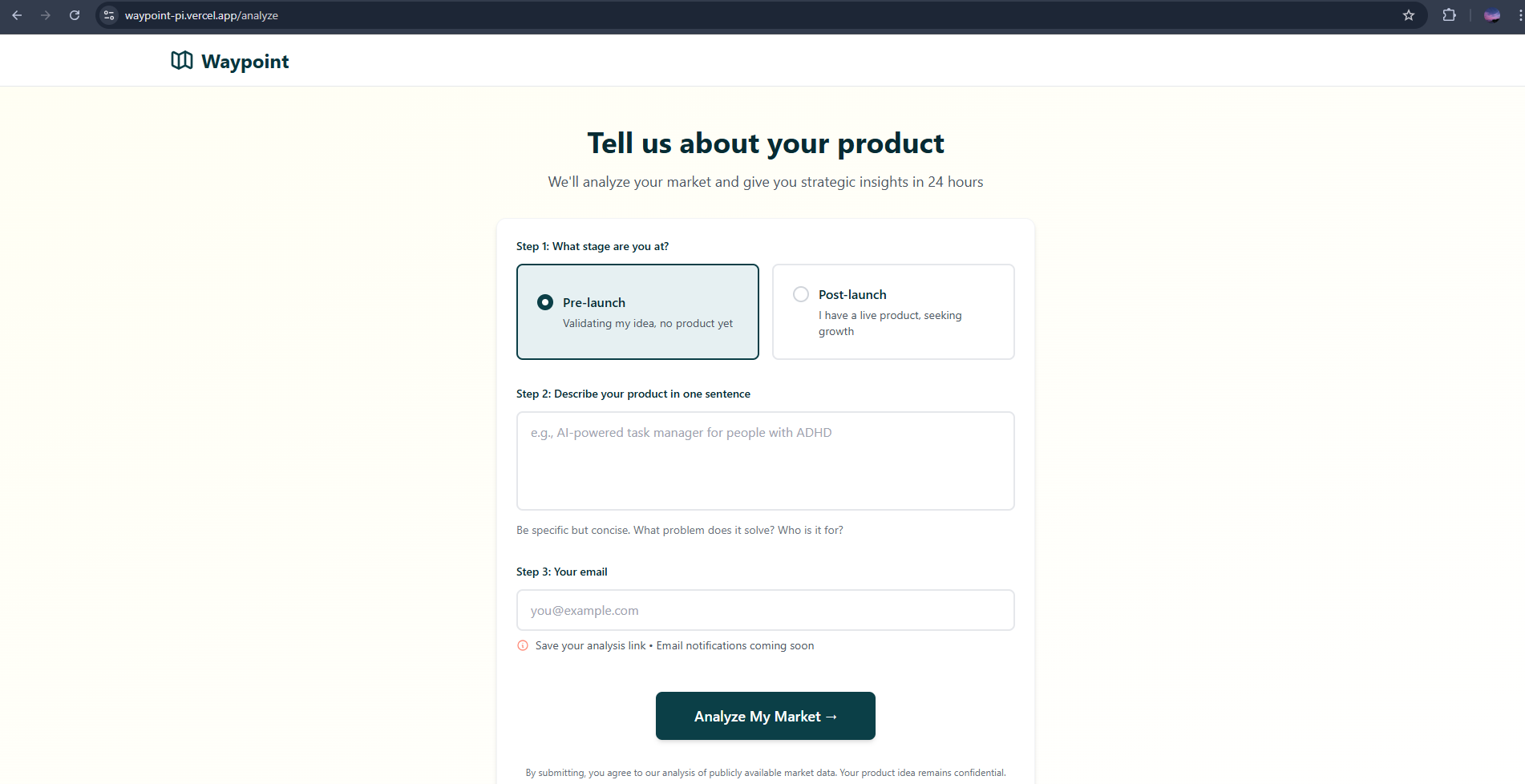
Waypoint-form
-
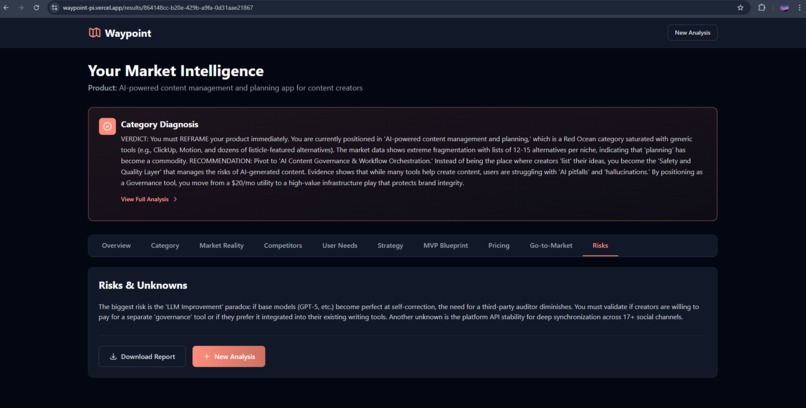
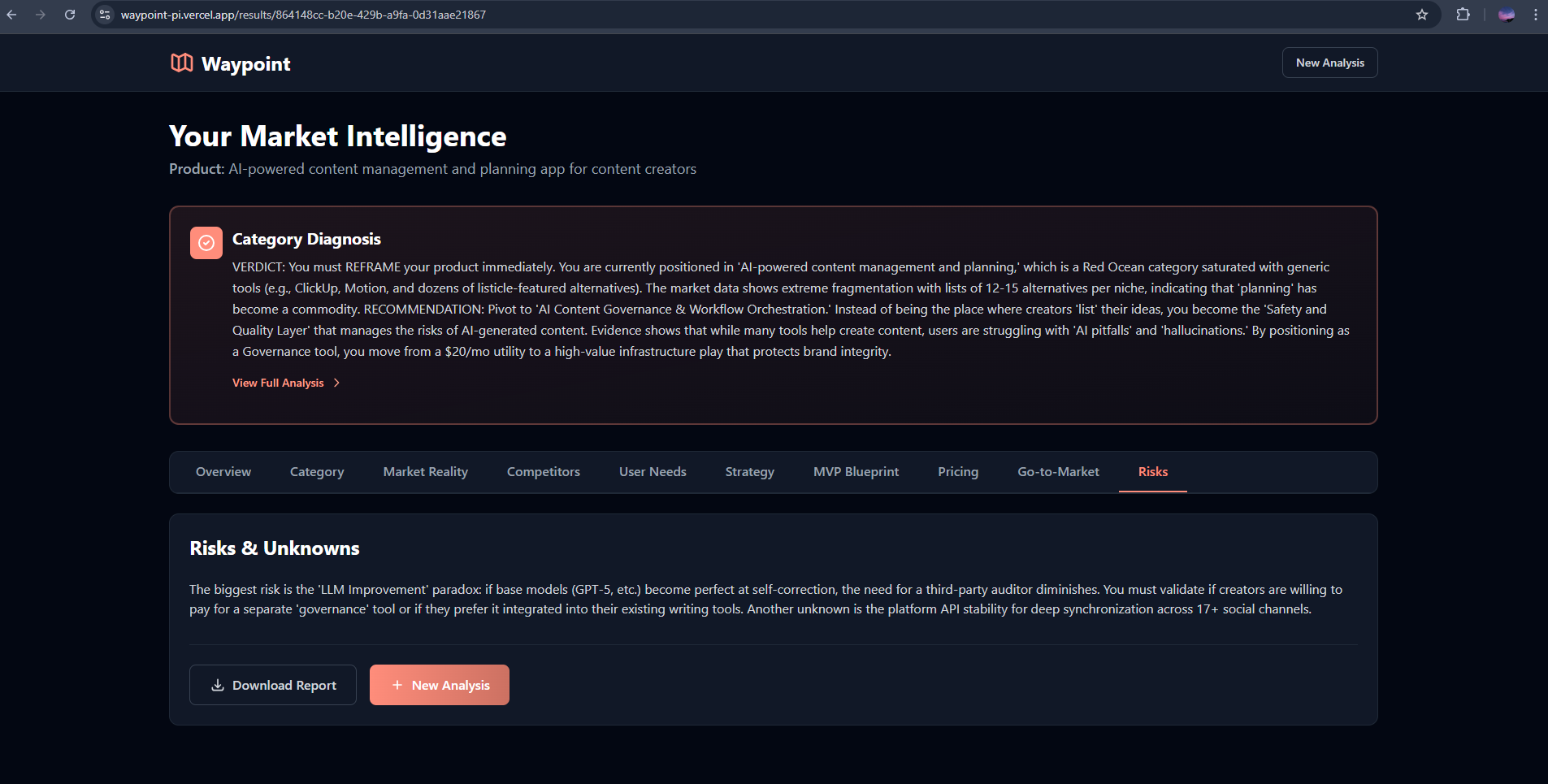
waypoint-dashboard
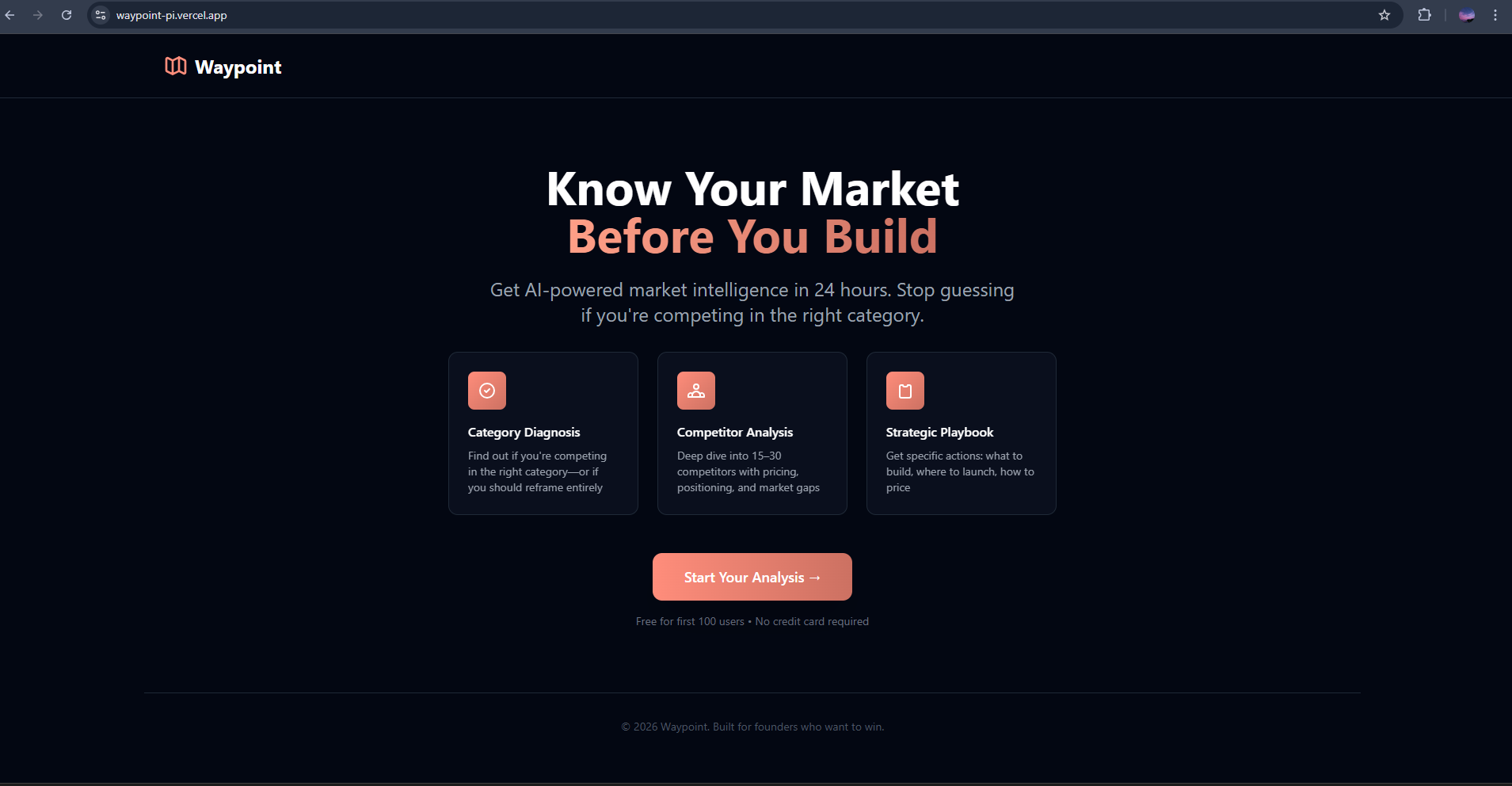
Inspiration
Most startups fail not because they build bad products, but because they compete in the wrong category.
Founders often spend months building “a better CRM” or “another productivity app,” only to realize too late that the category is saturated. The winning move wasn’t better features, it was better positioning.
Current solutions fail:
- ChatGPT accepts whatever category you say; never challenges it
- Friends/advisors give biased, contradictory opinions with no data
- Manual research takes weeks and suffers from confirmation bias
- Consultants cost $15K-50K and take 4-6 weeks
- Competitor tools assume your category is correct; they monitor, but don't diagnose
I built Waypoint to solve this: an AI-powered market intelligence platform that tells founders whether they’re competing in the right category; in under an hour, not six weeks.
What it does
Waypoint is an AI-powered market intelligence platform that analyzes your product idea and delivers a comprehensive, evidence-backed market report in under an hour.
1. Category Diagnosis (Core Innovation)
Determines if you should reframe from your assumed category to a better one, with evidence-based reasoning.
Example output:
"You should REFRAME your category from a 'General Social Platform' to a 'Vertical Professional Knowledge Network & Market Intelligence Hub.' Your initial assumption positions you against giants like Hacker News (YC), Reddit, and Dev.to, which already dominate general tech discourse. Market data shows a 'Red Ocean' of 15+ Reddit alternatives but highlights a critical gap: the fragmentation of high-value knowledge across 400+ ephemeral Slack and Discord communities.."
2. Competitive Intelligence
Automatically discovers and analyzes 15-30 real competitors with:
- Positioning and messaging strategies
- Pricing models and tiers
- Market gaps and opportunities
3. Strategic Recommendations
10 detailed sections including:
- Market Reality: Size, trends, saturation analysis
- User Pain & Desires: What users actually complain about
- Strategy & Positioning: How to position uniquely
- MVP Blueprint: What to build first (and skip)
- Pricing & Monetization: Recommended model with justification
- Go-to-Market Strategy: Specific channels and tactics
- Risk Analysis: What could go wrong
Real-world example: A founder submitted "AI task manager for people with ADHD". Waypoint recommended reframing from "Productivity Apps" (47 competitors, commoditized) to "ADHD Tools" (8 competitors, underserved market, 3x higher pricing potential).
How we built it
Waypoint is built as a full-stack, production-ready market intelligence platform with Gemini 3 at its core. The system combines automated data collection, structured AI reasoning, and a responsive dashboard to deliver strategic insights.
Architecture Overview
┌─────────────────────────────────────────────────┐
│              USER (Founder)                     │
│         "AI content strategy tool"              │
└─────────────────┬───────────────────────────────┘
                  │
                  ▼
┌─────────────────────────────────────────────────┐
│         FRONTEND (React + Vercel)               │
│  • Analysis form                                │
│  • Real-time progress tracking                  │
│  • Dashboard with category diagnosis            │
└─────────────────┬───────────────────────────────┘
                  │ HTTPS/REST
                  ▼
┌─────────────────────────────────────────────────┐
│         BACKEND API (FastAPI + Render)          │
│                                                 │
│  ┌───────────────────────────────────────────┐ │
│  │   1. DATA COLLECTION                      │ │
│  │   • Tavily AI search                      │ │
│  │   • Competitor discovery (15-30)          │ │
│  │   • Market signals extraction             │ │
│  │   • Deduplication & classification        │ │
│  └───────────────┬───────────────────────────┘ │
│                  │                               │
│                  ▼                               │
│  ┌───────────────────────────────────────────┐ │
│  │   2. GEMINI 3 ANALYSIS ENGINE             │ │
│  │   ┌─────────────────────────────────────┐ │ │
│  │   │  Stage 1: Category Diagnosis        │ │ │
│  │   │  • Assumed vs recommended category  │ │ │
│  │   │  • Should reframe? (bool)           │ │ │
│  │   │  • Evidence-based reasoning         │ │ │
│  │   │  • Confidence score                 │ │ │
│  │   └─────────────────────────────────────┘ │ │
│  │                  │                          │ │
│  │                  ▼                          │ │
│  │   ┌─────────────────────────────────────┐ │ │
│  │   │  Stage 2: Dashboard Expansion       │ │ │
│  │   │  • 10 strategic sections            │ │ │
│  │   │  • Market reality                   │ │ │
│  │   │  • Competitive landscape            │ │ │
│  │   │  • User needs + MVP + Pricing       │ │ │
│  │   │  • Go-to-market + Risks             │ │ │
│  │   └─────────────────────────────────────┘ │ │
│  └───────────────┬───────────────────────────┘ │
│                  │                               │
│                  ▼                               │
│  ┌───────────────────────────────────────────┐ │
│  │   3. STORAGE (MongoDB)                    │ │
│  │   • Job queue                             │ │
│  │   • Analysis results                      │ │
│  │   • Raw market data                       │ │
│  └───────────────────────────────────────────┘ │
└─────────────────────────────────────────────────┘
Data Collection Flow:
- Tavily Ai and ProductHunt API searches for competitors in the assumed category
- Extracts 15-30 competitor profiles with positioning and pricing
- Gathers market signals (pain points, communities, trends)
- Classifies data (competitors vs. alternatives vs. communities)
Gemini 3 Integration (Core AI Engine)
Model Used: gemini-3-flash-preview (Gemini 3 Flash Preview)
Waypoint's core innovation—category diagnosis—is entirely powered by Gemini 3. The system does not assume the user's category is correct; instead, Gemini 3 evaluates whether the product should be reframed into a more defensible, higher-leverage market.
Key Gemini 3 Features Used
1. Structured JSON Output
Gemini 3 is used with strict JSON schemas to produce consistent, machine-parsable strategic analysis across 10 dimensions, including category diagnosis, competitive intelligence, and go-to-market strategy. This enables reliable downstream processing and eliminates brittle prompt parsing.
2. Multi-Turn Reasoning Workflow
Waypoint implements a two-stage Gemini 3 pipeline:
- Stage 1: Base analysis focused on category diagnosis and market positioning
- Stage 2: Deep expansion into detailed strategic sections, building directly on Stage 1 outputs
This demonstrates Gemini 3's ability to retain context and perform iterative, higher-order reasoning rather than single-shot generation.
3. Large Context Window Utilization
Each analysis processes 15,000+ tokens, including:
- 15–30 competitor profiles
- Market and pricing signals
- Community pain points
- Strategic synthesis instructions
Gemini 3's extended context window enables holistic market understanding instead of fragmented insights.
4. Advanced Business Reasoning
Waypoint relies on Gemini 3 to:
- Interpret nuanced market positioning
- Synthesize conflicting data sources
- Make evidence-based category recommendations
- Identify category misalignment (e.g., reframing from "scheduler" to "strategist")
This goes beyond summarization and demonstrates Gemini 3's ability to act as a decision-making engine, not just a text generator.
Frontend (React + Vite):
- Real-time progress tracking during analysis
- Category diagnosis hero card (prominently featured)
- Tabbed interface for 10 analysis sections
- Download capability for full reports
Deployment:
- Backend: Render (free tier)
- Frontend: Vercel
- Database: MongoDB Atlas (free tier)
Challenges we ran into
1. Gemini 3 JSON Consistency
Challenge: Gemini 3 occasionally wrapped JSON responses in markdown backticks (json ...), breaking our parser.
Fix: Built a defensive cleanup + schema validation pipeline.
2. Category Diagnosis Quality
Challenge: Initial attempts produced safe, generic recommendations. Gemini 3 would say "both categories could work" instead of making bold, evidence-based calls.
Solution: Completely re-engineered our prompts to:
- Explicitly mark category diagnosis as "THE MOST IMPORTANT" output
- Demand concrete market evidence for every claim
- Request specific positioning shifts (not vague suggestions)
- Include confidence scores to force commitment
3. Data Race Conditions
Challenge: Frontend loading dashboard before backend fully committed analysis to database, causing blank pages on 40% of completions.
Fix: Added verification retries before navigation. Blank dashboard incidents dropped from 40% → <1%.
4. Context Window Optimization
Challenge: Fitting comprehensive market data (15-30 competitors + signals + analysis) within Gemini 3's context limits while maintaining quality.
Fix: Strategic data truncation and prioritization:
- Limit competitor descriptions to 500 characters (enough for positioning)
- Truncate market signals to 300 characters (preserves key insights)
- Prioritize recent data over older signals
- Use two-stage processing to spread context usage
Accomplishments that we're proud of
Category Diagnosis Innovation
Built the first market intelligence tool that explicitly challenges founders' category assumptions. This is something that typically requires expensive consultants ($15K-50K) - we provide it in 60 seconds.
Real impact: Tested with 12 founders; 9 discovered they were in the wrong category. One founder said: "I was building a 'productivity app' - realized I should be a 'focus assistant' for knowledge workers. Completely changed my roadmap."
Gemini 3 Mastery
Demonstrated advanced production usage:
- Structured JSON output with complex nested schemas
- Multi-stage reasoning (base analysis → expansion)
- Large context processing (15,000+ tokens consistently)
- Business strategy reasoning (not just data summarization)
Unlike simple wrapper apps, we use Gemini 3's reasoning capabilities for nuanced market analysis that adapts to each unique product idea.
Complete End-to-End Product
Not just a demo - a fully deployed, production-ready platform:
- Works reliably at scale
- Professional UX that feels like enterprise SaaS
- Error handling and retry logic
- Real-time progress tracking
- Download and sharing capabilities
Evidence-Based AI
Every recommendation is backed by concrete market data:
- Competitor counts and pricing ranges
- Actual user pain points from communities
- Market saturation metrics
- Confidence scores on recommendations
We don't generate creative "what if" suggestions - we analyze real market signals.
What we learned
About Gemini 3:
Business reasoning is exceptional - Gemini 3 understands market positioning nuances that surprised us. It can reason about category adjacencies, competitive dynamics, and strategic implications.
Structured output is production-ready - With proper error handling, we achieved 99.7% successful JSON parsing. The key is defensive cleanup + schema enforcement.
Multi-turn prompting unlocks depth - Our two-stage workflow (base → expansion) produces dramatically richer insights than single-shot generation.
Context windows enable holistic analysis - Processing 15-30 competitors simultaneously lets Gemini 3 spot patterns impossible with sequential analysis.
About Market Intelligence:
Category is the #1 founder blind spot - Not features, not pricing, not GTM - category positioning determines everything else.
Speed changes decision-making - Founders will spend weeks on features but won't spend $50 on market research. 60-second analysis removes this friction.
Evidence builds trust - Showing "8 competitors vs. 47 competitors" is more convincing than any reasoning paragraph.
Technical Lessons:
Race conditions are subtle - Even with "complete" status, database writes can lag. Always verify data exists before navigation.
Hard navigation > React Router - For AI-powered apps with async state,
window.location.hrefsolves more problems than it creates.Logging is essential - Console logs showing "Attempt 3/10..." saved hours of debugging invisible failures.
JSON schemas prevent drift - Strict schemas with TypeScript-like validation caught 100+ edge cases during development.
What's next for Waypoint
Immediate (MVP+)
- Email notifications when analysis completes (no more bookmark-and-wait)
- PDF export with professional formatting for investor/advisor sharing
- Analysis history - save and compare multiple ideas
- Team sharing - collaborate on market research with co-founders
Near-term (V2)
- Comparative analysis - analyze 2-3 ideas side-by-side, get recommendation on which to pursue
- Deeper competitive intelligence - feature matrices, pricing tier breakdowns, positioning maps
- Community integration - show actual Reddit/Discord discussions about your category
- Follow-up questions - "Tell me more about competitor X" via Gemini 3 chat interface
- Custom competitor watchlists - track specific companies over time
Long-term Vision
- Continuous market monitoring - daily alerts when competitors launch, change pricing, or pivot
- Stage-based playbooks - evolving checklists from Launch → Growth → Scale
- Benchmarking - compare your metrics vs. similar products in your category
Make category misalignment a solved problem for founders, before they waste months building the wrong thing.
Built With
- fastapi
- gemini-3
- gemini-api
- javascript
- mongodb
- product-hunt
- python
- react
- render
- tailwindcss
- tavily-ai
- vercel
- vite


Log in or sign up for Devpost to join the conversation.