-
-
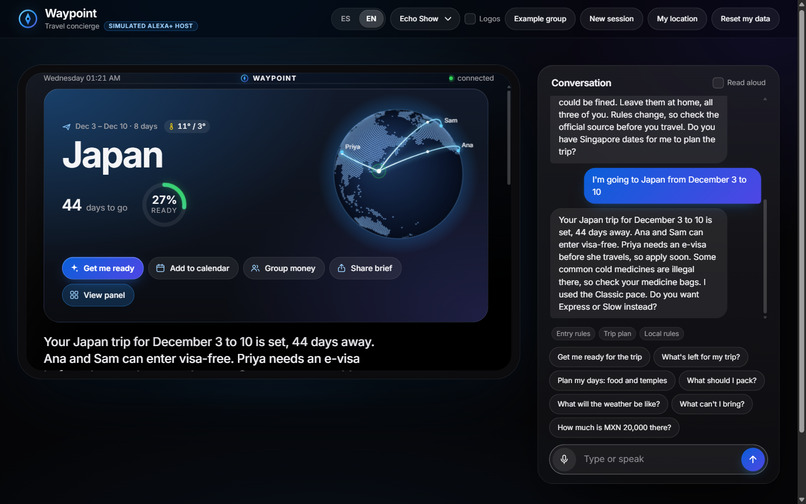
landpage
-
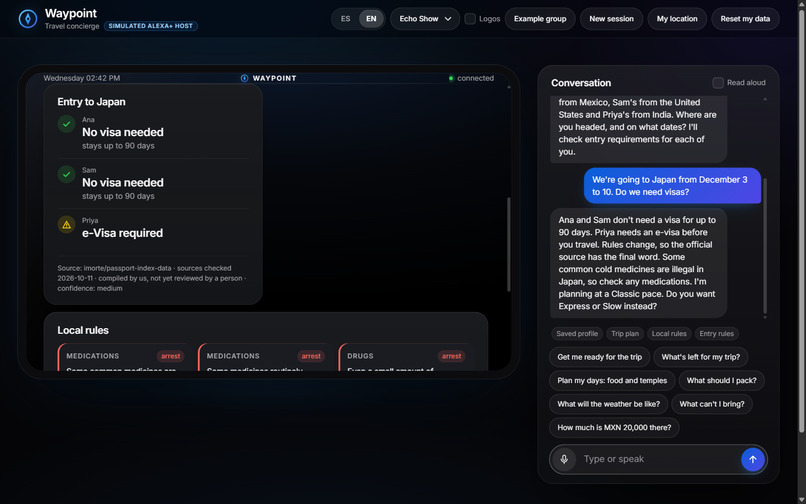
in action
-
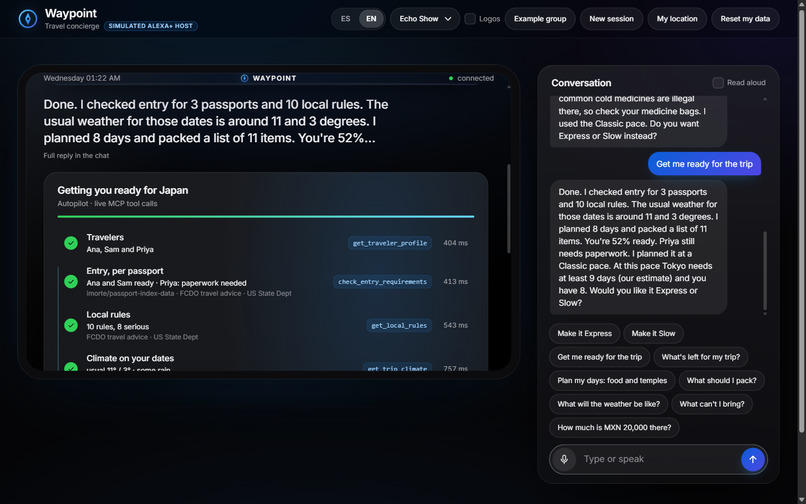
results
-

Real World implementation!
-
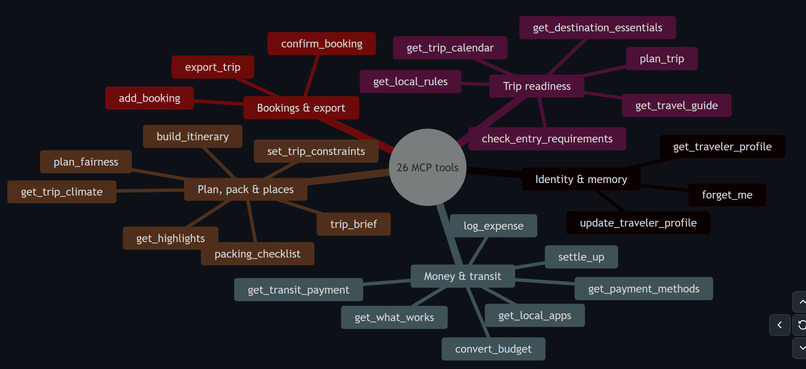
Architecture

WAYPOINT
Your AI Travel Concierge for Alexa+
One journey. Different travelers. Hundreds of questions. One assistant.
Try Waypoint Live | Explore the Open-Source Code
Travel shouldn't be this complicated.
Traveling somewhere new should be about discovering places, cultures, and experiences.
Instead, we spend countless hours preparing.
Can we enter the country with our passport? What medications can we bring? Which payment methods work? How much money will we need? What should we pack? And once we arrive, where should we actually go?
Language barriers make everything harder. Information is scattered across government websites, travel blogs, currency converters, maps, and local applications, often with conflicting recommendations.
We've experienced these challenges firsthand while traveling internationally.
The problem isn't a lack of travel information. It's that nobody brings it together around the traveler.
So we built Waypoint.

Meet Waypoint — An AI concierge for your entire journey
Waypoint is an AI-powered travel assistant designed for Alexa+, built to help people prepare for international travel and explore destinations through natural conversation.
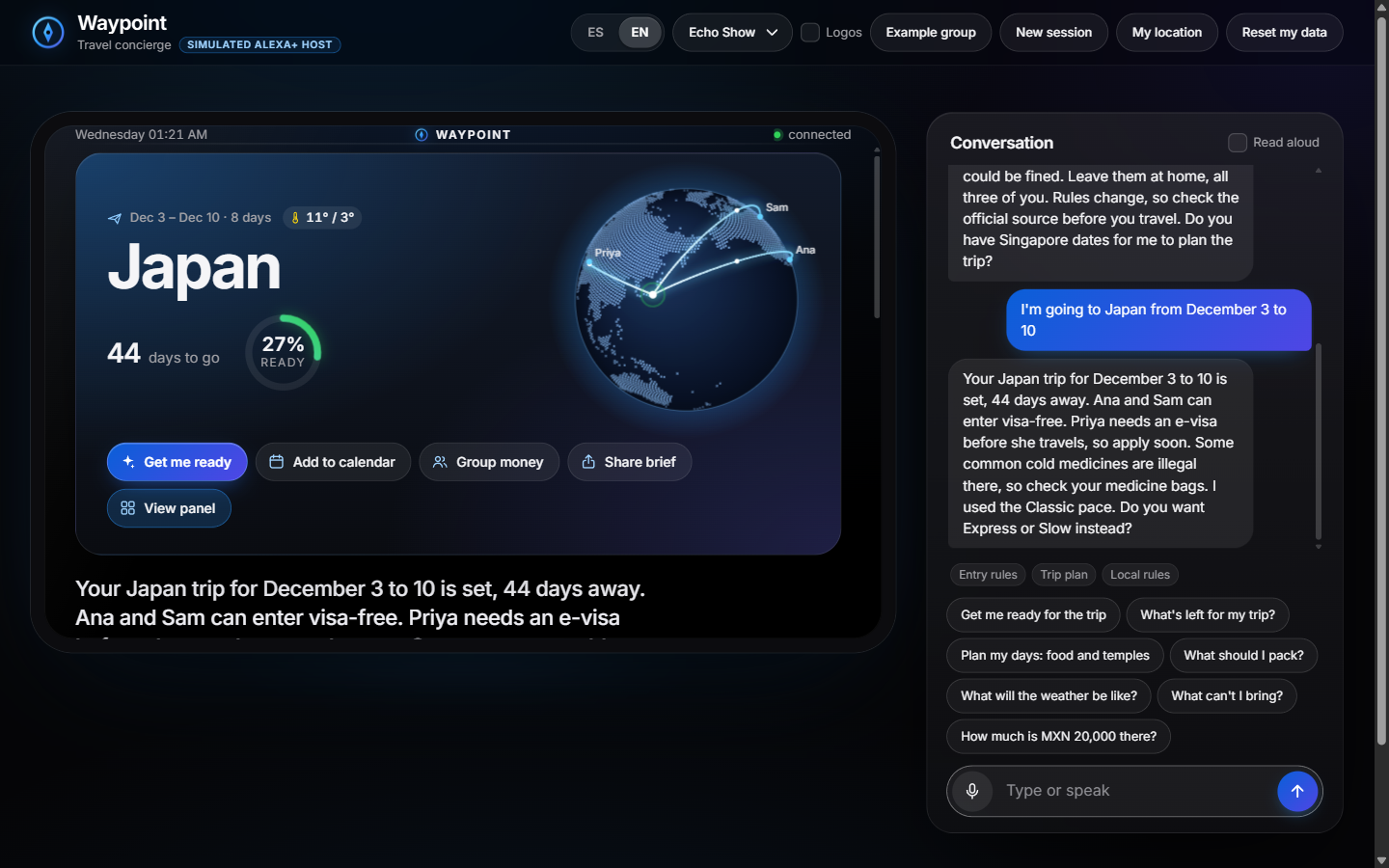
Tell Waypoint where you're going, when, and who's traveling.
It understands the context, remembers your trip, coordinates specialized tools, and helps you understand what needs to happen next.
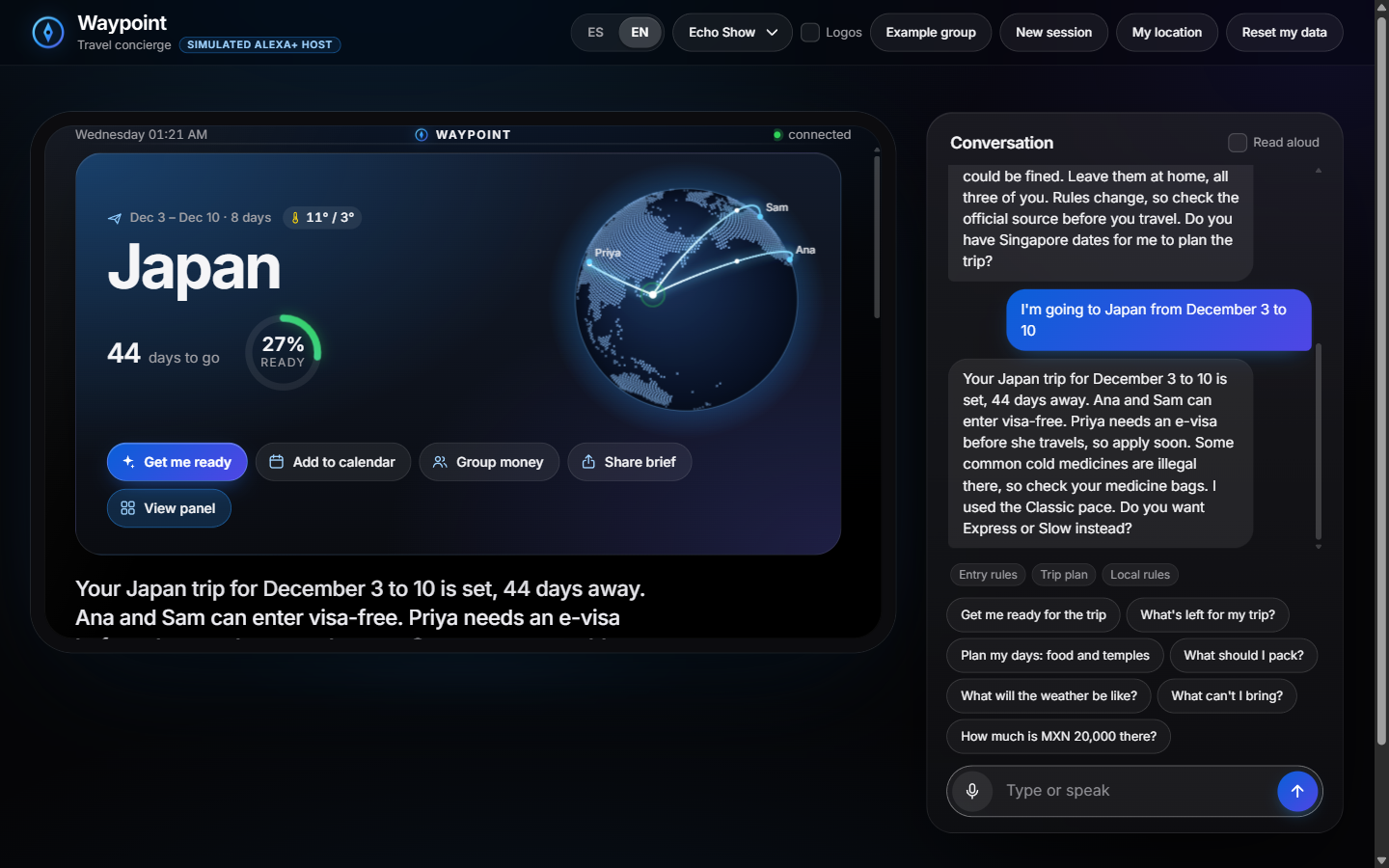
Rather than becoming another application travelers must learn, Waypoint is designed around conversations.
And unlike an ordinary chatbot, Waypoint doesn't simply generate plausible answers. It retrieves structured information, provides source references, tracks what remains unresolved, and maintains context across sessions.
One trip. Three passports. Three different answers.
Imagine three friends traveling to Japan together.
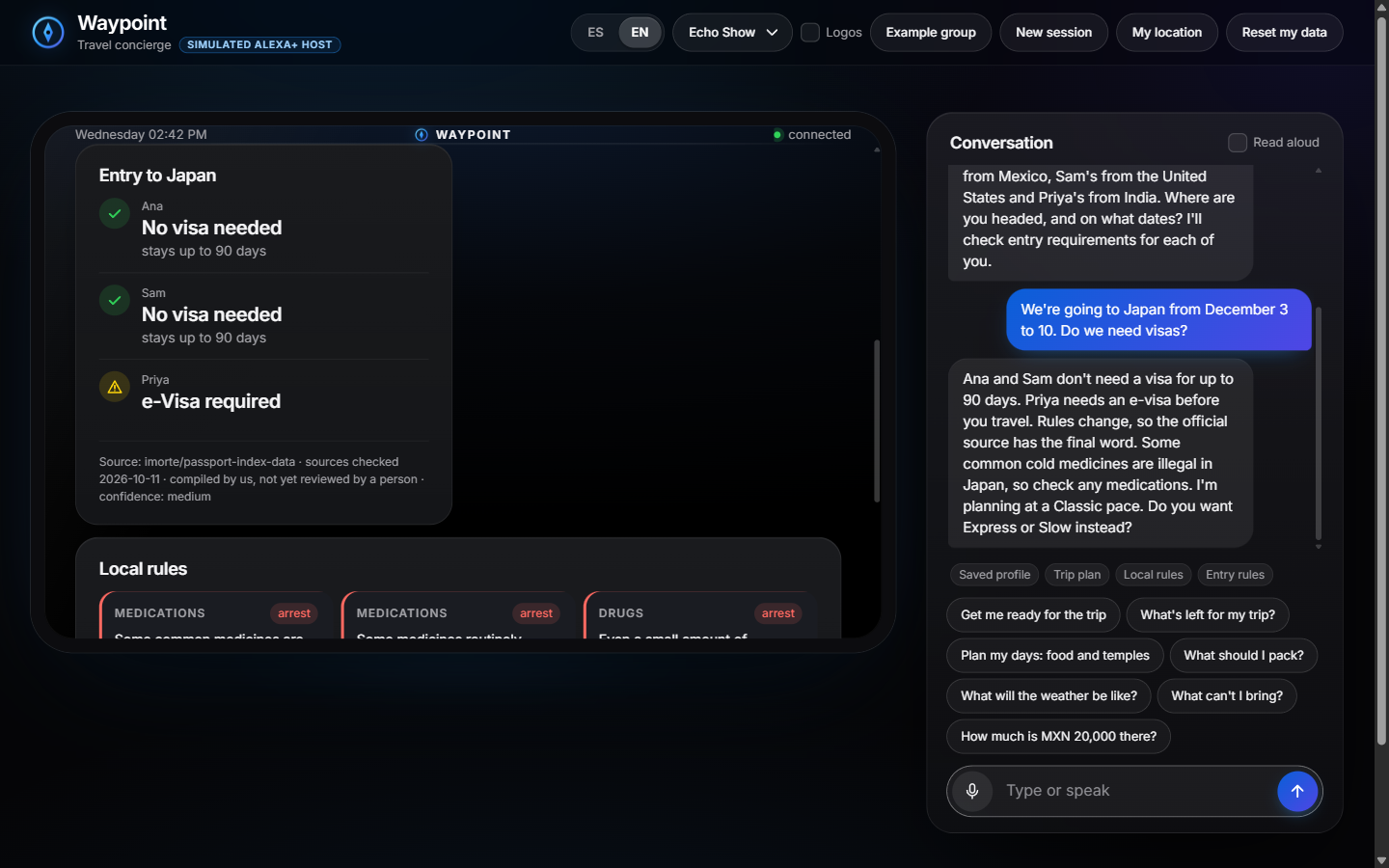
Ana has a Mexican passport. Sam has an American passport. Priya has an Indian passport.
They're going to the same destination, but their documentation requirements aren't necessarily the same.
A generic travel assistant might answer the question once. Waypoint treats each traveler individually.
With one natural-language instruction, the travelers can register their profiles and begin preparing their shared trip.
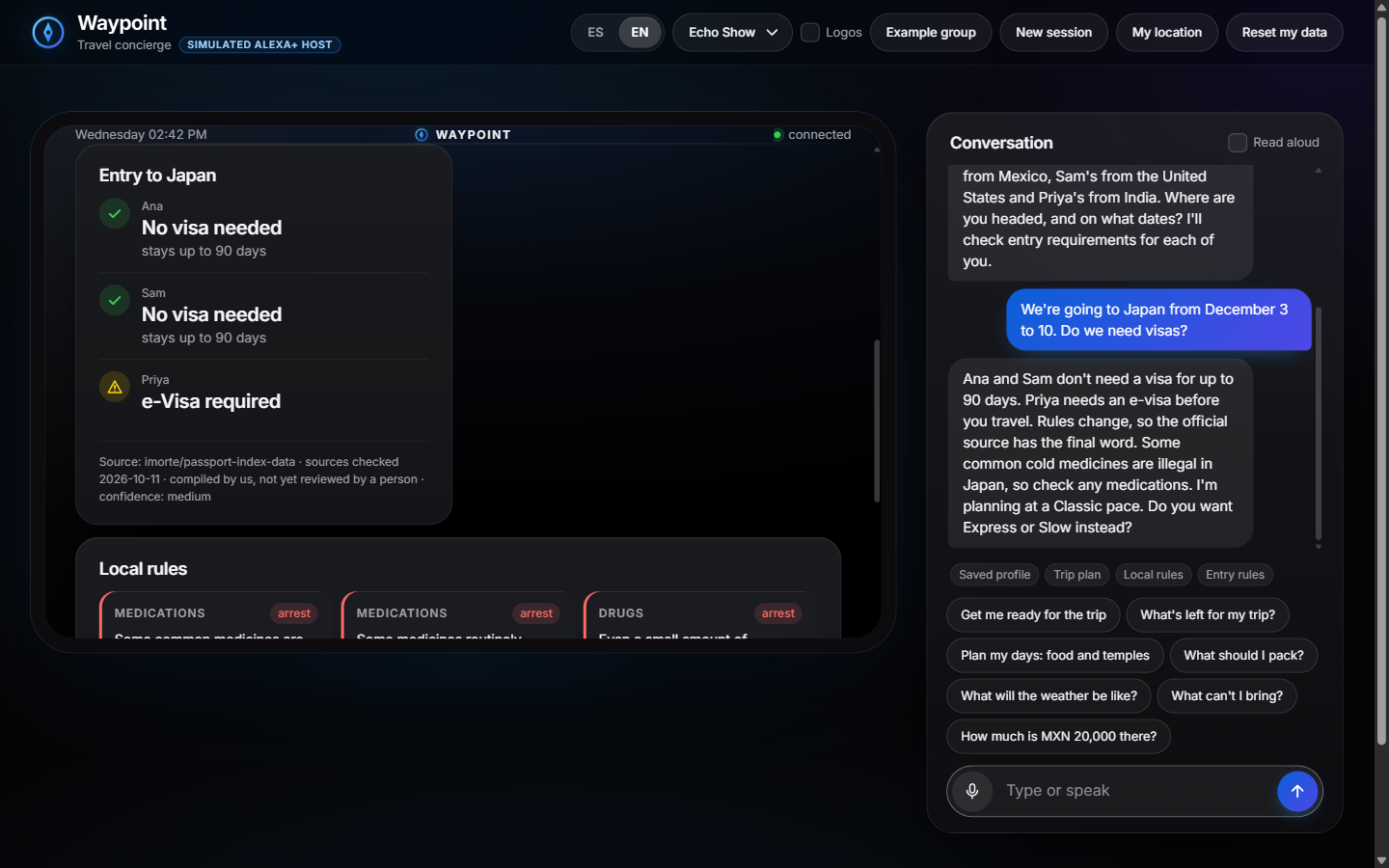
Waypoint uses the relevant passport and destination data to generate traveler-specific entry guidance, flags outstanding requirements, and keeps the trip information available for future conversations.
It also identifies relevant local restrictions and provides source references, verification dates, and confidence indicators.
Travel information changes. That's why Waypoint distinguishes historical data and machine-compiled guidance from human-reviewed information, and directs travelers to official authorities for final confirmation.
The goal isn't to sound certain. It's to help travelers understand what they know, what they don't, and what they need to verify.
From asking questions to actually getting ready
Travel planning involves more than answering isolated questions.
A traveler may need entry documentation, a packing list, budget estimates, local regulations, transportation information, and an itinerary that respects their preferences.
Waypoint brings these tasks together through Autopilot.
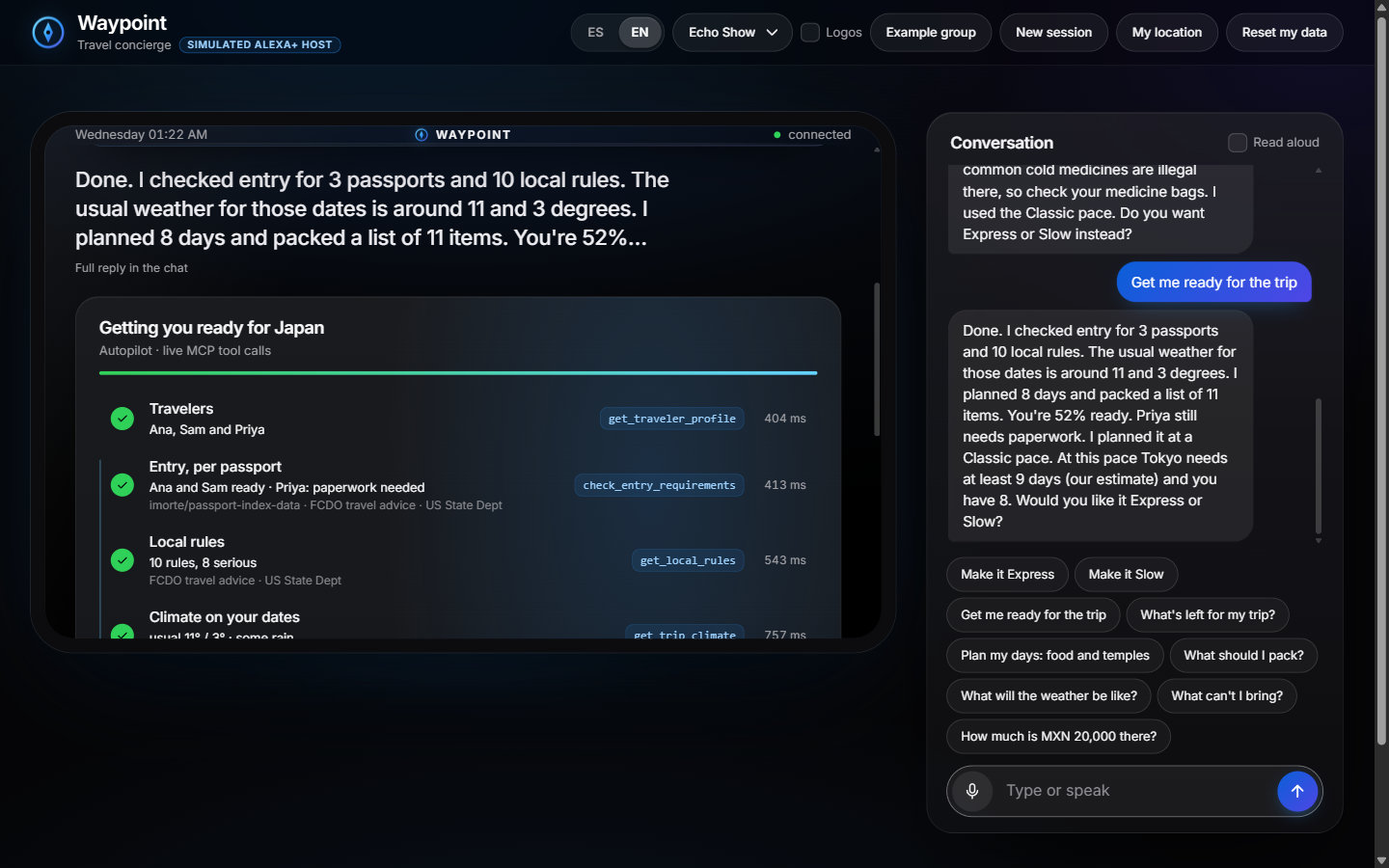
With one request — "Get me ready for my trip" — Waypoint executes a coordinated workflow of nine real MCP tool calls.
It checks traveler profiles, entry requirements, destination rules, climate, local essentials, and attractions. It then prepares an itinerary and packing list before producing an updated travel-readiness overview.
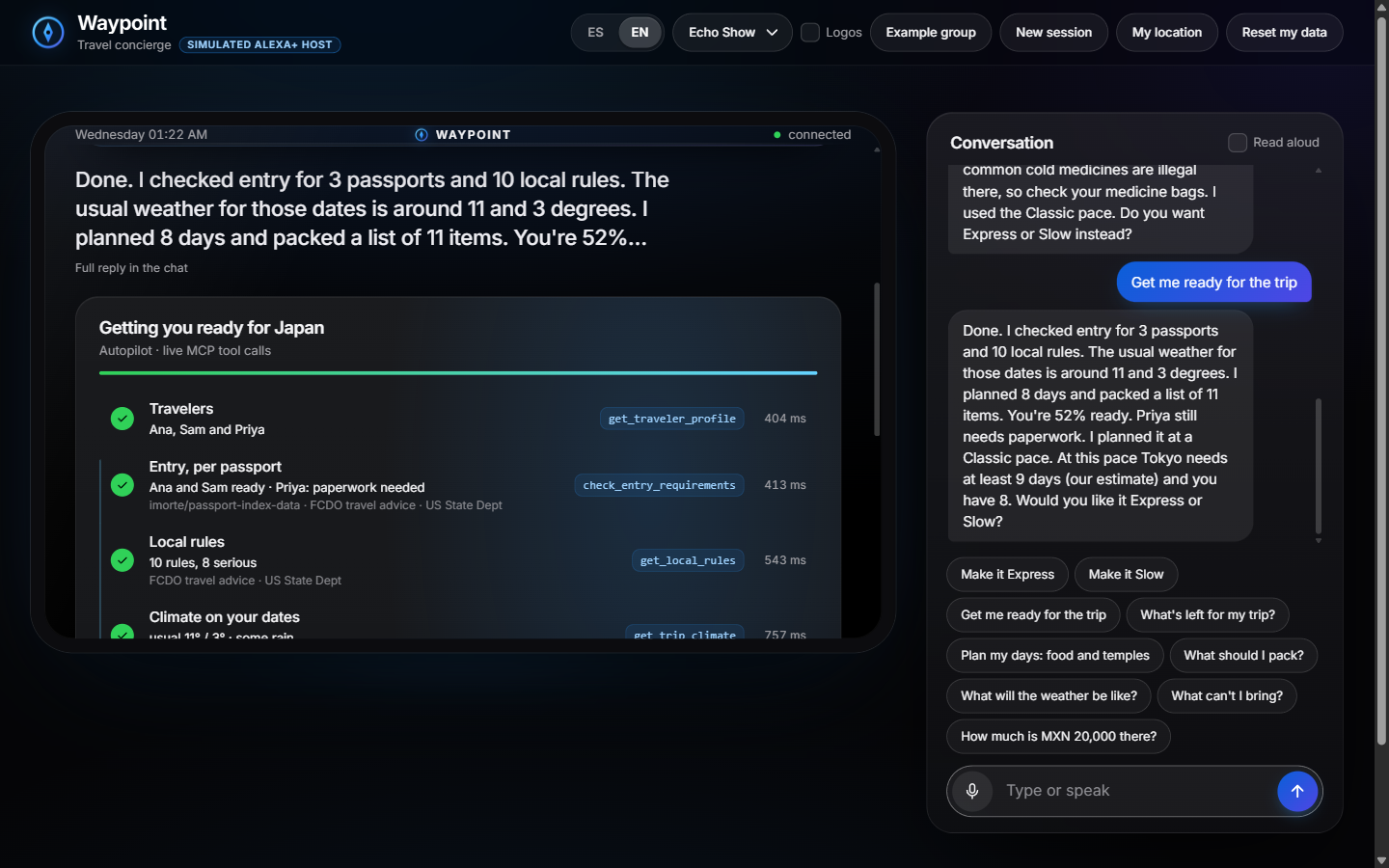
The workflow isn't a scripted animation. Judges can inspect each executed call, including the tool, source information, execution status, and timing.
Waypoint also validates proposed itineraries before saving them. Plans that violate constraints such as available time, travel pace, or incompatible destinations can be rejected and corrected.
The result is not simply a travel recommendation.
It's a coordinated plan that knows what has been done and what still needs attention.
Built for the real world, not just the demonstration
An assistant shouldn't stop being useful when the traveler leaves home.
During our time in Vũng Tàu, Vietnam, we took Waypoint outside and tested it on a phone.
We asked for interesting places nearby.
Waypoint used location-aware discovery to suggest attractions, presenting distances, descriptions, photos, and map links.
One of the landmarks it recommended was right in front of us.

This is where the idea becomes tangible: the same assistant that helps you prepare for Japan can also help you discover what's around you in Vietnam.
From navigating unfamiliar cities to understanding local customs, currencies, and transportation, Waypoint aims to make new environments easier to experience.
From preparation to exploration, the context travels with you.
What makes Waypoint more than another AI chatbot?
We designed Waypoint around three principles.
1. Agentic execution, not just conversation.
Waypoint combines natural-language reasoning with specialized MCP tools, structured responses, persistent state, and deterministic validation. Its workflows connect questions to concrete actions inside the application.
2. Information with provenance.
Travel requirements and local regulations can have real consequences. Our tools preserve source information, verification dates, confidence levels, and review-status labels rather than treating generated answers as authoritative.
3. One continuous journey.
Waypoint remembers traveler profiles, trip details, preferences, bookings, checklists, and expenses, allowing users to continue where they left off instead of repeatedly explaining their situation.
These principles shape both the user experience and the underlying architecture.
Under the hood: MCP meets AWS
Waypoint is built on the official Model Context Protocol SDK, using TypeScript and MCP specification version 2025-11-25.
Its architecture includes:
| Technology | Role |
|---|---|
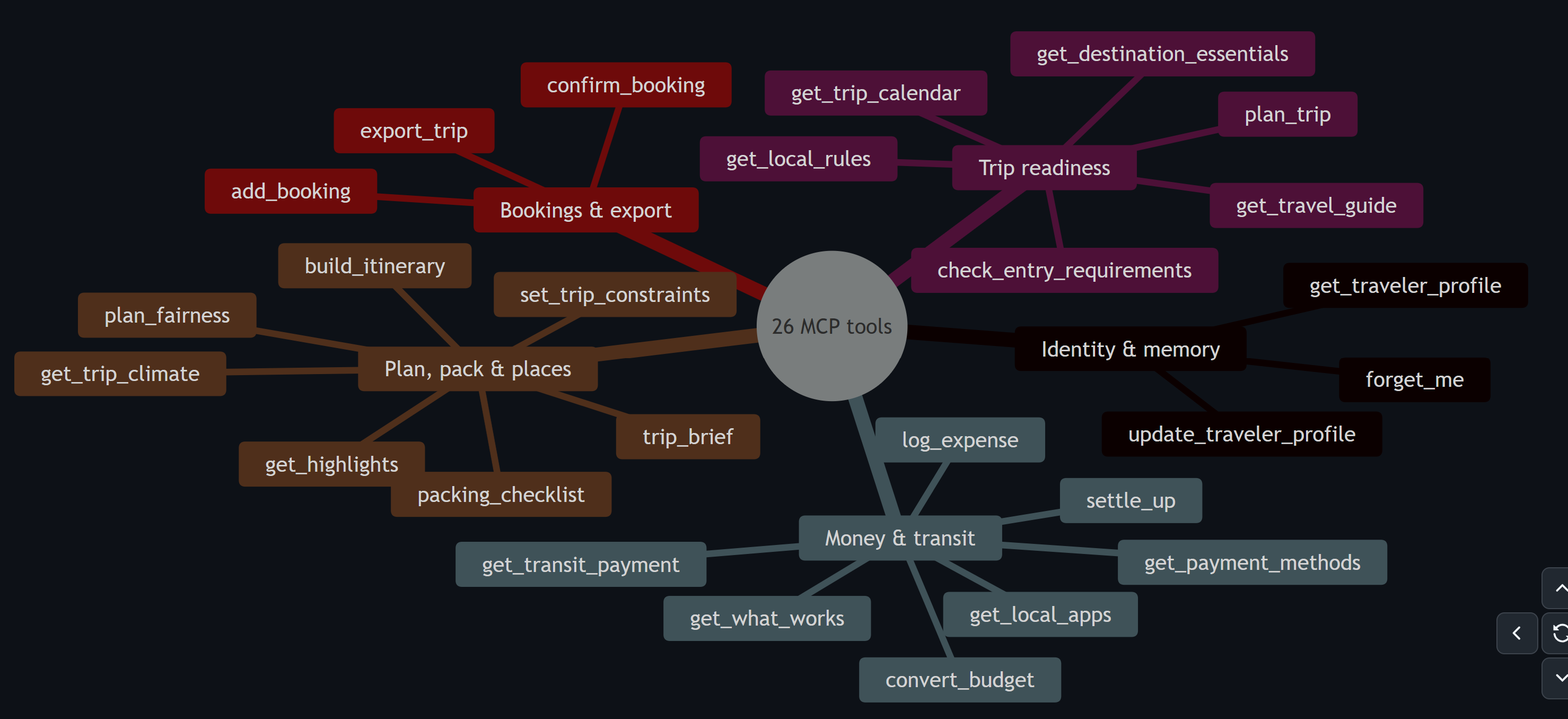
| 26 MCP tools | Structured travel intelligence and actions |
| Amazon Bedrock + Strands | Natural-language agent reasoning and tool selection |
| AWS Lambda | Publicly deployed application and MCP server |
| Amazon DynamoDB | Persistent traveler and trip context |
| Amazon Polly | Neural voice responses |
| MCP Apps | Interactive trip-readiness dashboards |
| AWS CDK + GitHub Actions | Infrastructure and automated deployment |
The web experience is explicitly a simulated Alexa+ host, implemented as a real MCP client communicating with our self-hosted server. It supports MCP initialization, tool discovery, tool execution, and interactive responses.
Amazon's partner-only Alexa+ tooling was not publicly available for the hackathon, so we built and documented the simulation approach rather than claiming native Alexa+ integration.
Our conversational Bedrock/Strands agent and the browser-based Autopilot provide complementary capabilities: model-directed tool selection and a deterministic multi-step preparation workflow.
See the actual execution
Waypoint includes a visible MCP protocol log exposing the underlying JSON-RPC interactions, including initialize, tools/list, and tools/call.
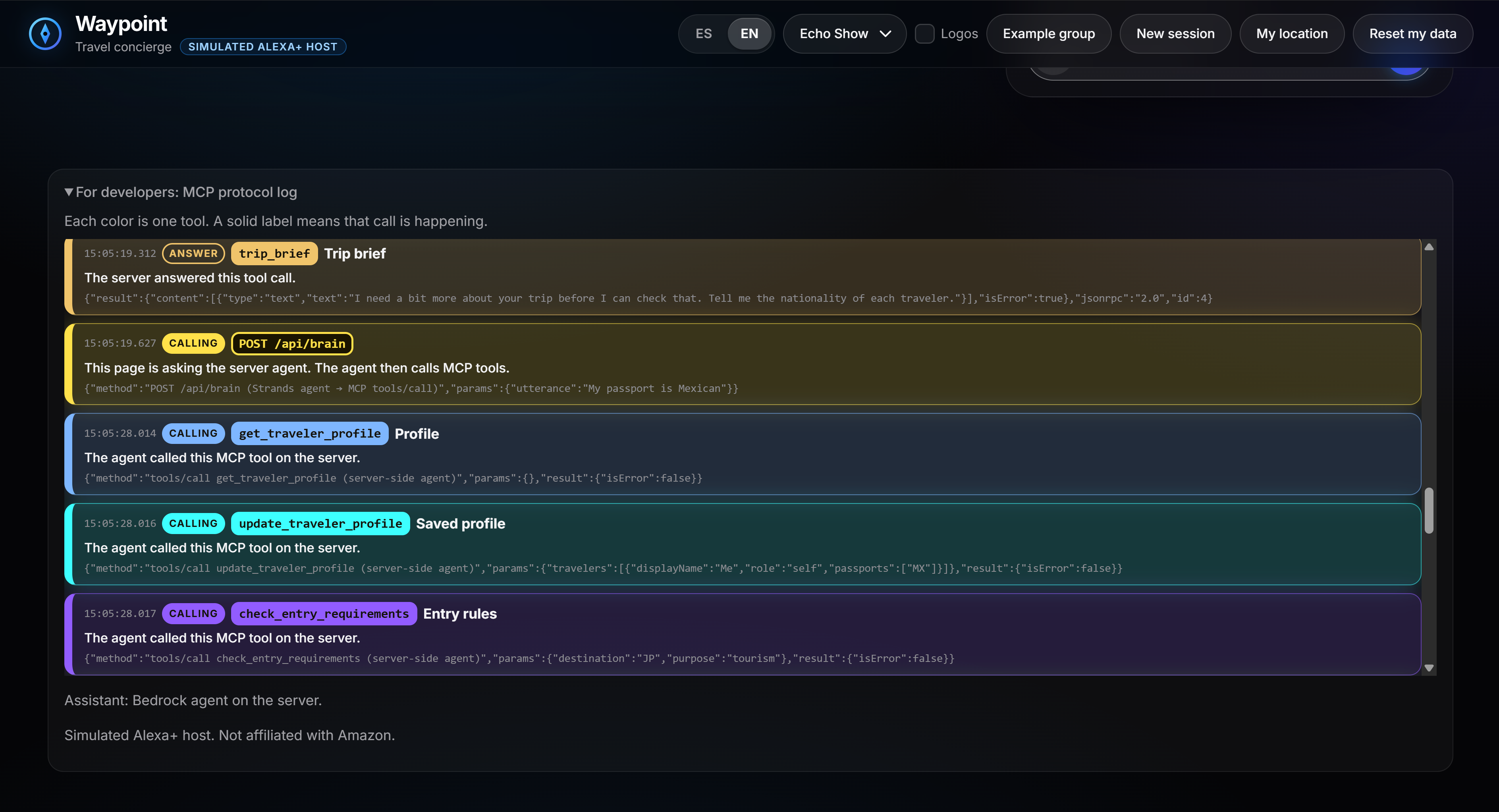
Developers and judges can explore the complete implementation, including source code, infrastructure, validation logic, and automated tests.
Building agents we can actually trust
One of our biggest technical challenges was ensuring that travel guidance remained traceable to its source.
A convincing AI response isn't necessarily a correct one, particularly when discussing laws, entry requirements, or restrictions.
We developed a data pipeline that combines public information with deterministic checks. Where source quotations are available, our validators verify that they appear in the corresponding recorded source text. Data without human review is identified as such.
We also encountered challenges integrating MCP with serverless infrastructure, handling structured tool outputs, preserving sessions, and building a convincing voice-and-screen experience without access to native Alexa+ developer tools.
These challenges became an opportunity to contribute to the ecosystem.
We released travel-entry-packs, an independent MIT-licensed open-source toolkit for building and validating source-backed travel datasets.
We also documented our development friction, workarounds, and recommendations for improving the developer experience.
Explore the Development Friction Log
Where we go from here
Waypoint already demonstrates how conversational AI can coordinate information and tools across a real travel journey.
But the larger opportunity goes further.
We envision a travel concierge that accompanies people from their first preparations to the moment they arrive, helping them navigate unfamiliar destinations, coordinate groups, and make informed decisions.
Our next priorities include expanded human-reviewed guidance, stronger identity management, deeper travel-service integrations, and richer multilingual experiences.
As the Alexa+ development ecosystem opens more broadly, we want to bring these capabilities into native voice-first experiences.
The future of travel assistance shouldn't be another search bar. It should be an assistant that understands your journey and helps you move through it.
Experience Waypoint yourself
Judges can open the application directly on a phone or computer, load the example group of travelers, create a trip to Japan, and press Get me ready to inspect the nine-call MCP workflow.
No installation or AWS account is required.
GitHub · Open Source Contribution · Technical Documentation
Waypoint — From getting ready to getting there, and discovering everything in between.
Built With
- amazon-bedrock
- amazon-dynamodb
- amazon-polly
- aws-cdk
- aws-lambda
- css
- express.js
- github-actions
- html
- javascript
- mcp
- node.js
- strands-agents
- typescript
- wikidata


Log in or sign up for Devpost to join the conversation.