-
-
home page
-

home page
-
building simulation
-
prediction time
Inspiration
During an emergency, a building's design can significantly influence how quickly people reach safety. Narrow corridors, overcrowded stairwells, and poorly distributed exits can create bottlenecks that delay evacuation. Yet, evaluating these scenarios across multiple floors and comparing alternative layouts can be difficult without simulation tools.
We built WAYOUT around one question: What if building designers could simulate an evacuation, identify congestion hotspots, and test design improvements before making real-world changes?
Our vision is to combine artificial intelligence, pedestrian simulation, and building design optimization to make evacuation analysis more interactive, data-driven, and accessible.
What it does
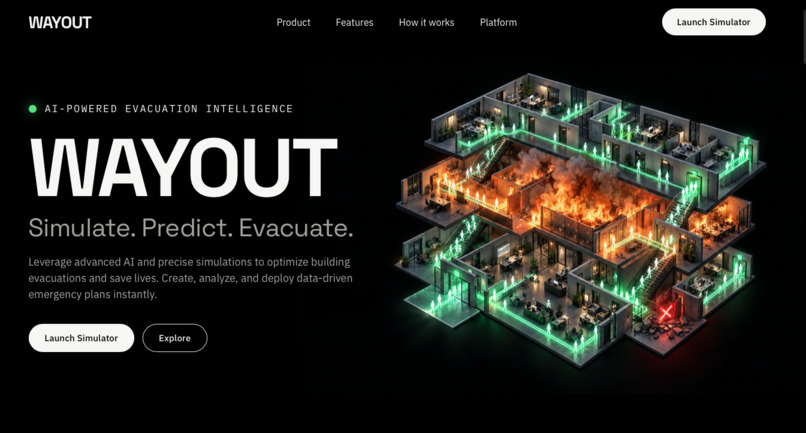
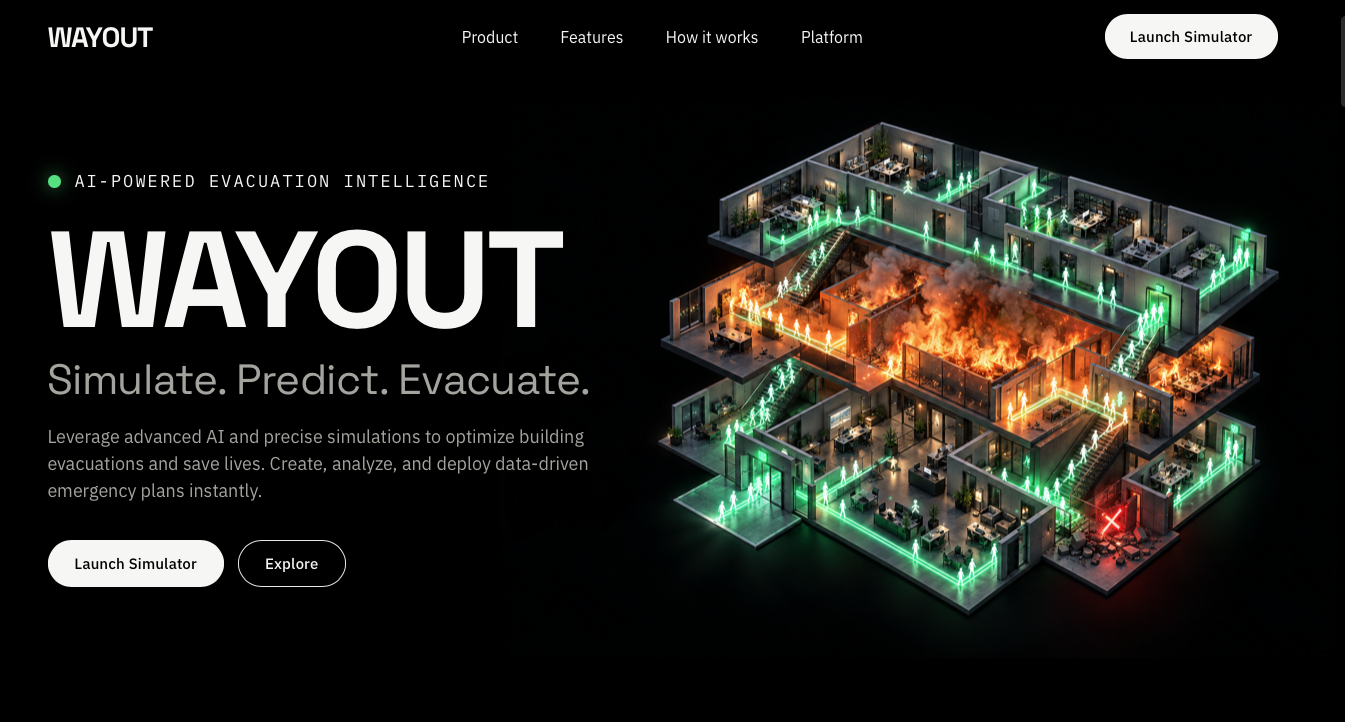
WAYOUT is an AI-assisted building evacuation analysis platform that simulates crowd movement through multi-floor buildings, identifies bottlenecks, and evaluates potential layout improvements.
Its key capabilities include:
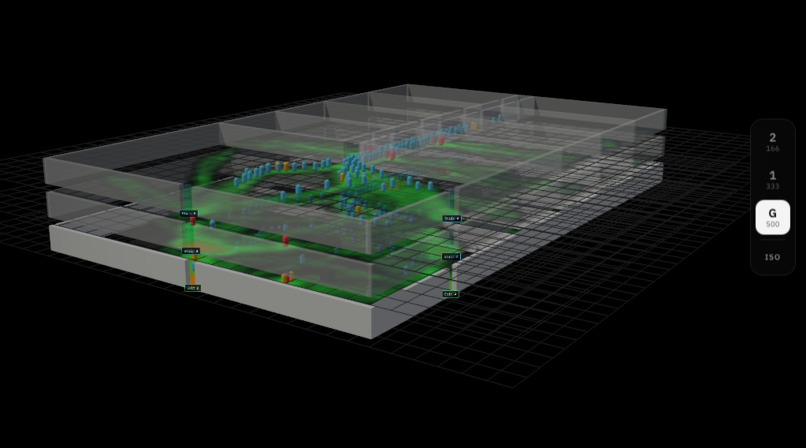
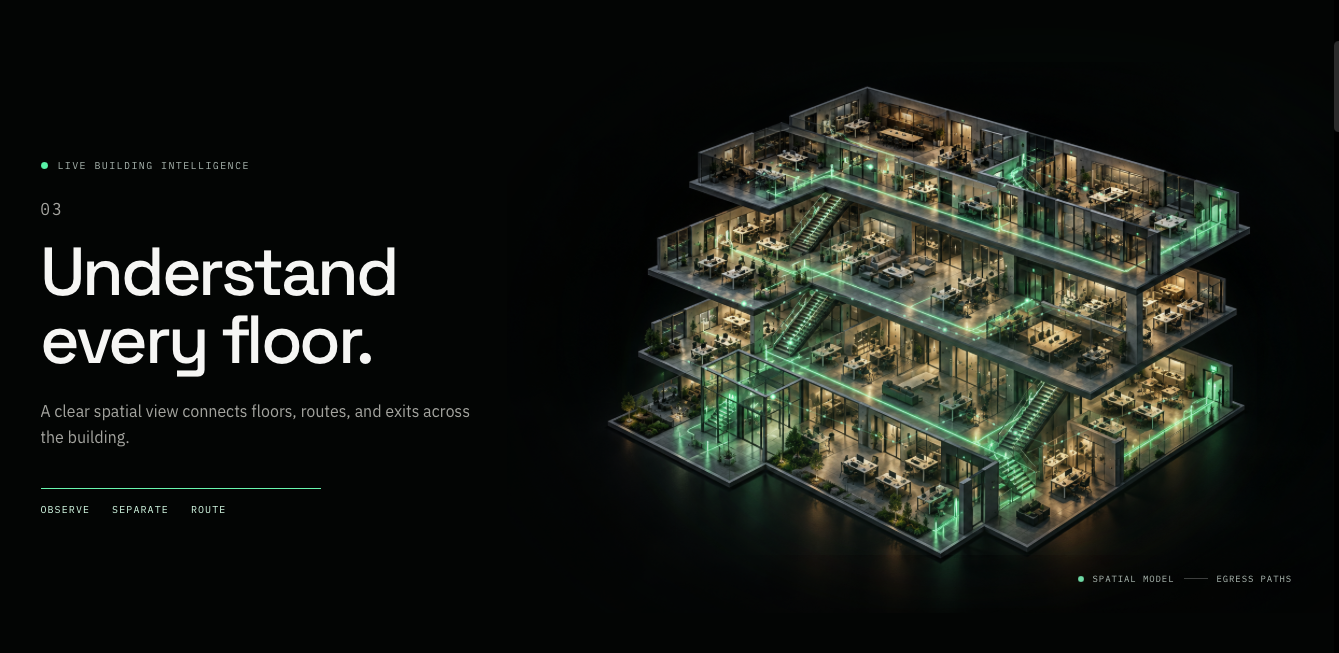
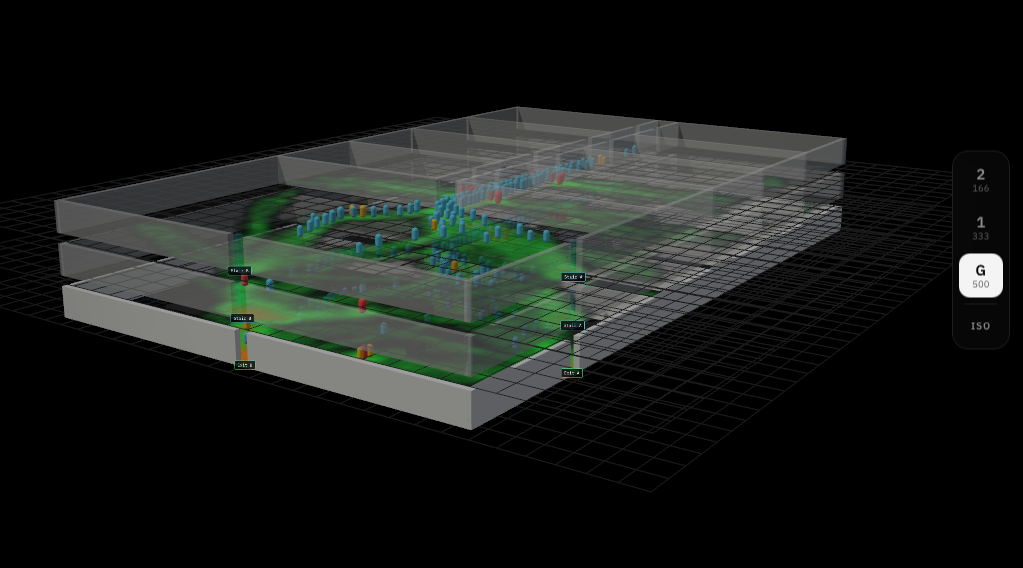
- Interactive 3D visualization of building layouts, animated pedestrian movement, and crowd-density heatmaps.
- Multi-floor evacuation simulation that models pedestrian movement through corridors, stairwells, and exits across connected floors.
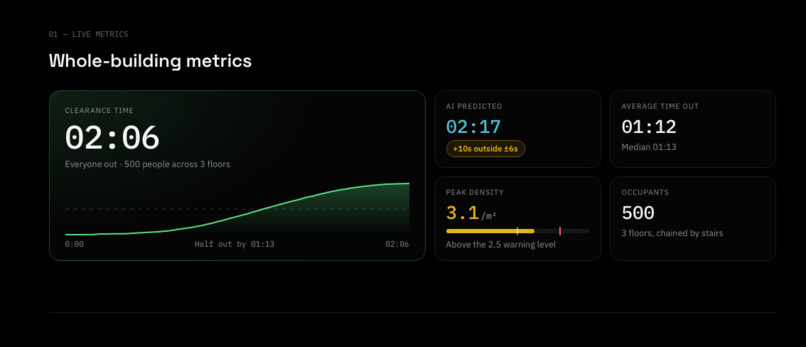
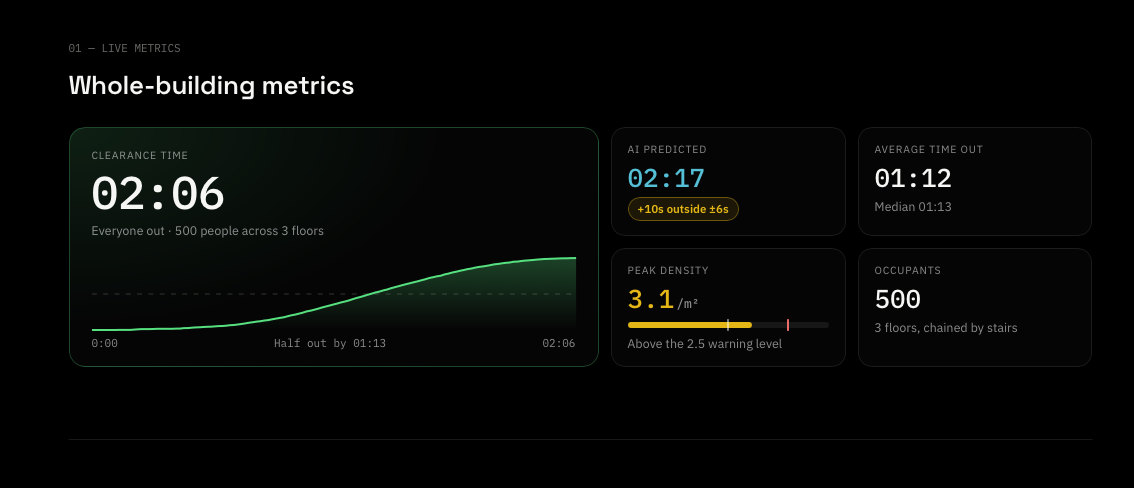
- Bottleneck detection to identify congestion hotspots and measure simulated evacuation clearance times.
- Machine learning predictions using a multilayer perceptron (MLP) model to estimate single-floor simulation outcomes.
- Layout optimization to evaluate potential changes to corridor widths, exits, and stairwells, validating proposed changes through full simulation.
- Scenario comparison to compare baseline and modified building layouts and understand the effect of different design choices.
- Floor-plan import to generate initial geometry drafts from floor-plan images and PDFs.
Rather than only visualizing an evacuation, WAYOUT connects simulation, prediction, and optimization in one workflow.
How we built it
We developed WAYOUT using a full-stack architecture that connects an interactive web interface to a Python-based simulation and optimization backend.
The frontend uses React, TypeScript, Vite, Three.js, and React Three Fiber to power the interface, interactive 3D building scenes, pedestrian animations, and density heatmaps.
The backend uses Python and FastAPI to manage building geometry, simulation requests, prediction endpoints, and optimization workflows.
The pedestrian simulation uses a social-force-inspired movement model that accounts for pedestrian interactions, wall avoidance, navigation, and exit selection. Dijkstra-based potential fields help agents navigate toward available exits.
For machine learning, we developed a scikit-learn MLP surrogate model trained on simulation-generated data to estimate single-floor evacuation outcomes more quickly than running every candidate through the full simulator.
The optimization system proposes changes to building parameters, including corridor widths, exits, and stairwells. Candidate layouts are evaluated through simulation so their clearance times can be compared with the baseline.
The frontend renders simulation results computed by the backend, keeping the 2D analysis and 3D visualization consistent.
We have also designed an optional NVIDIA Nemotron integration for converting uploaded floor plans into initial geometry drafts. This feature requires configuration and credentials and is separate from the locally running CPU-based simulation engine.
Challenges we ran into
One of our biggest challenges was integrating pedestrian simulation, machine learning, layout optimization, and interactive visualization into a coherent system.
Multi-floor coordination required us to model how occupants move between floors through stairwells while accounting for arrival times and the overall building evacuation timeline.
Simulation performance was another challenge. Running detailed pedestrian simulations for every design alternative can be computationally expensive. We addressed this by introducing a machine learning surrogate model for faster single-floor estimates while retaining full simulation for validation.
We also needed to ensure that the 2D floor plan, 3D building, animated agents, and congestion heatmaps represented the same underlying simulation results.
Another challenge was making optimization reliable. A recommended design change should not automatically be considered an improvement. We built a workflow that evaluates candidate layouts and compares their simulated clearance times.
Finally, real evacuations involve factors such as smoke, fire, visibility, human behavior, and building-specific conditions. Our current model does not capture all these factors and has not been calibrated against real evacuation data. Understanding and communicating these limitations is essential to responsible use.
Accomplishments that we're proud of
We are proud to have built a working research prototype that brings several complex engineering components together in one application.
We developed an interactive 3D environment for visualizing building layouts and pedestrian movement, implemented a multi-floor evacuation simulation with stairwell-based movement between floors, and built congestion analysis, bottleneck identification, and evacuation clearance-time reporting.
We integrated a machine learning surrogate model for faster single-floor predictions and developed a layout optimization workflow that evaluates candidate changes using simulation results.
We also connected the frontend, backend, simulation engine, prediction model, and optimization logic through a unified application architecture.
Our biggest accomplishment is moving beyond a static visualization to a system where users can explore building layouts, run simulations, and investigate how design changes affect simulated evacuation outcomes.
What we learned
WAYOUT taught us that applying AI to engineering problems requires more than training a model or building an attractive interface. The quality of the underlying simulation, the reliability of the data, and the validation of the results are equally important.
We learned how to combine numerical simulation with machine learning, use surrogate models to reduce computation, formulate layout improvements as an optimization problem, and integrate these components into a full-stack application.
We also learned the importance of distinguishing predictions from validated outcomes, particularly when working on safety-related applications. A technically convincing result must still be transparent about its assumptions and limitations.
What's next for WAYOUT
Our next goal is to make WAYOUT more realistic, computationally efficient, and useful for building-design workflows.
We plan to investigate GPU-accelerated simulation and NVIDIA computing technologies to improve performance for larger buildings and more complex crowd scenarios.
We aim to develop and validate the optional NVIDIA Nemotron-based floor-plan extraction workflow to reduce the manual effort required to create building geometry.
We also plan to incorporate additional evacuation factors, including hazard scenarios and more realistic pedestrian behavior, and evaluate simulation outputs against suitable real-world or published evacuation datasets before making stronger claims about predictive accuracy.
Future development will explore more sophisticated optimization methods for balancing evacuation time, corridor capacity, exit placement, and building-design constraints. We also want to investigate how WAYOUT could fit into existing architectural and building-planning workflows.
Our long-term vision is to develop WAYOUT into an AI-assisted evacuation design platform that helps architects, engineers, and researchers compare scenarios and identify potential design improvements earlier in the building lifecycle.
WAYOUT is currently a research prototype for relative scenario comparison and design exploration, not a certified life-safety or building-code compliance system.
Built With
- 3d-visualization
- ai-for-good
- artificial-intelligence
- computational-modeling
- computer-simulation
- computer-vision
- crowd-simulation
- data-visualization
- dijkstra's-algorithm
- emergency-response
- fastapi
- full-stack
- gradient-descent
- machine-learning
- neural-networks
- numpy
- nvidia-nemotron
- optimization-algorithms
- python
- react
- react-three-fiber
- scikit-learn
- three.js
- typescript
- vite


