-
-
Why it matters?
-
Statistics
-
Getting the help
-
Chat transcript
-
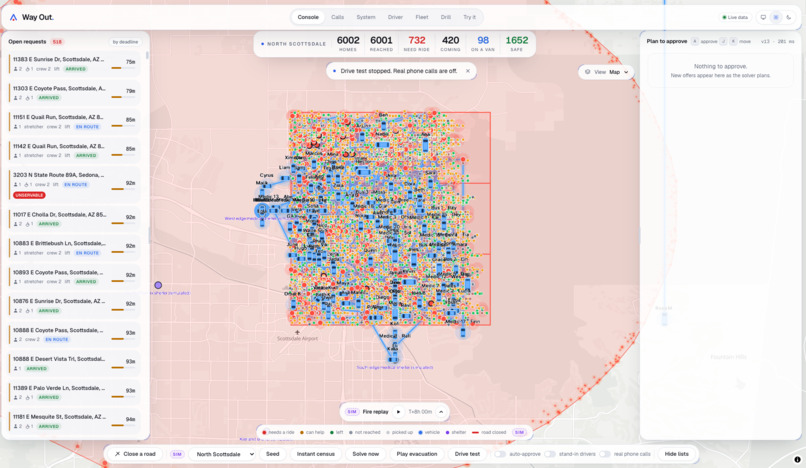
Live Console
-
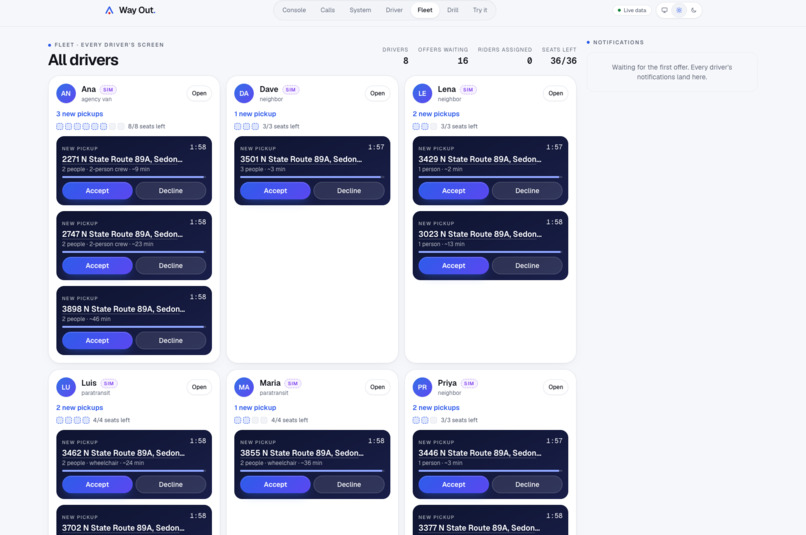
Driver Rider Assignment view
-
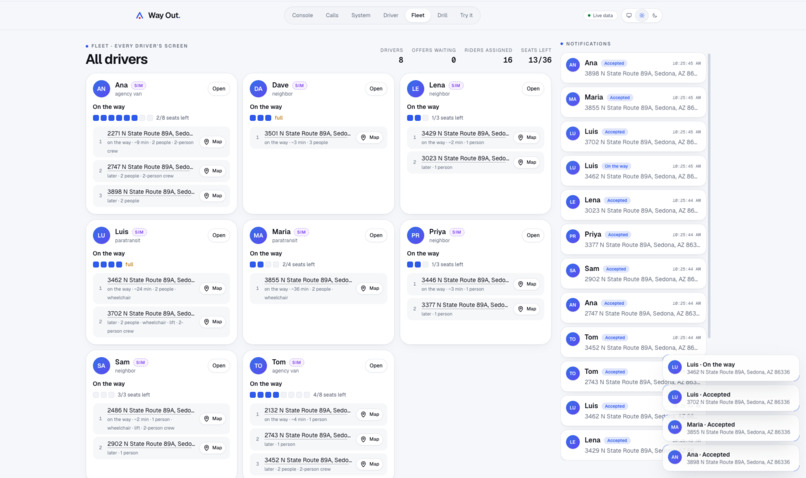
Driver Fleet view
-
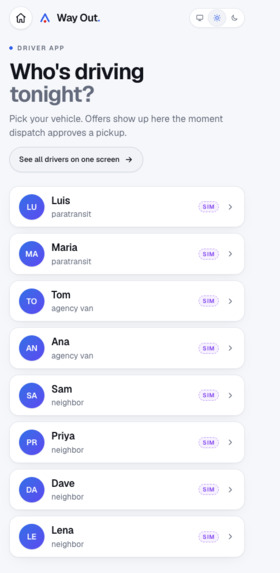
Driver view
-
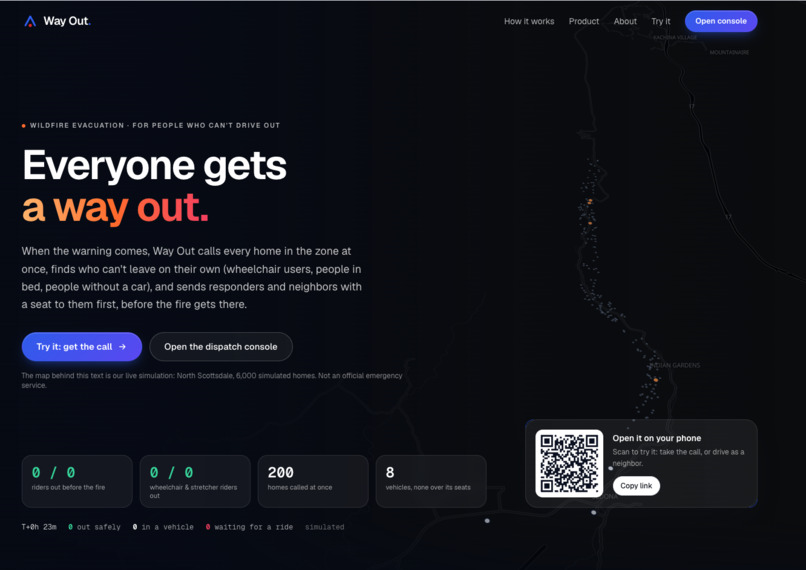
Landing Page
Inspiration
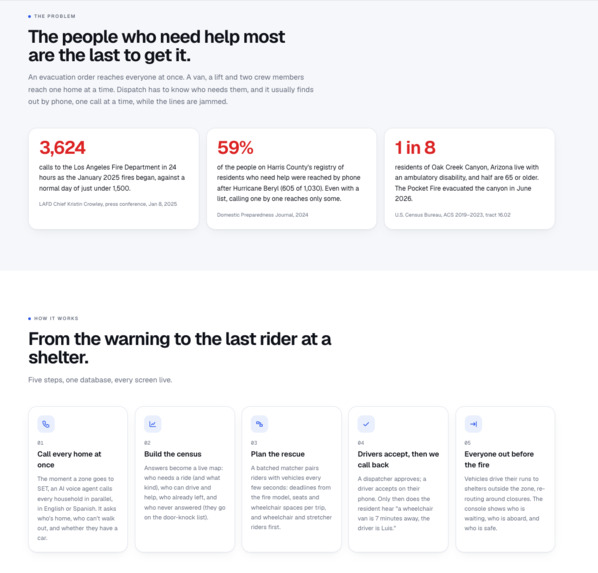
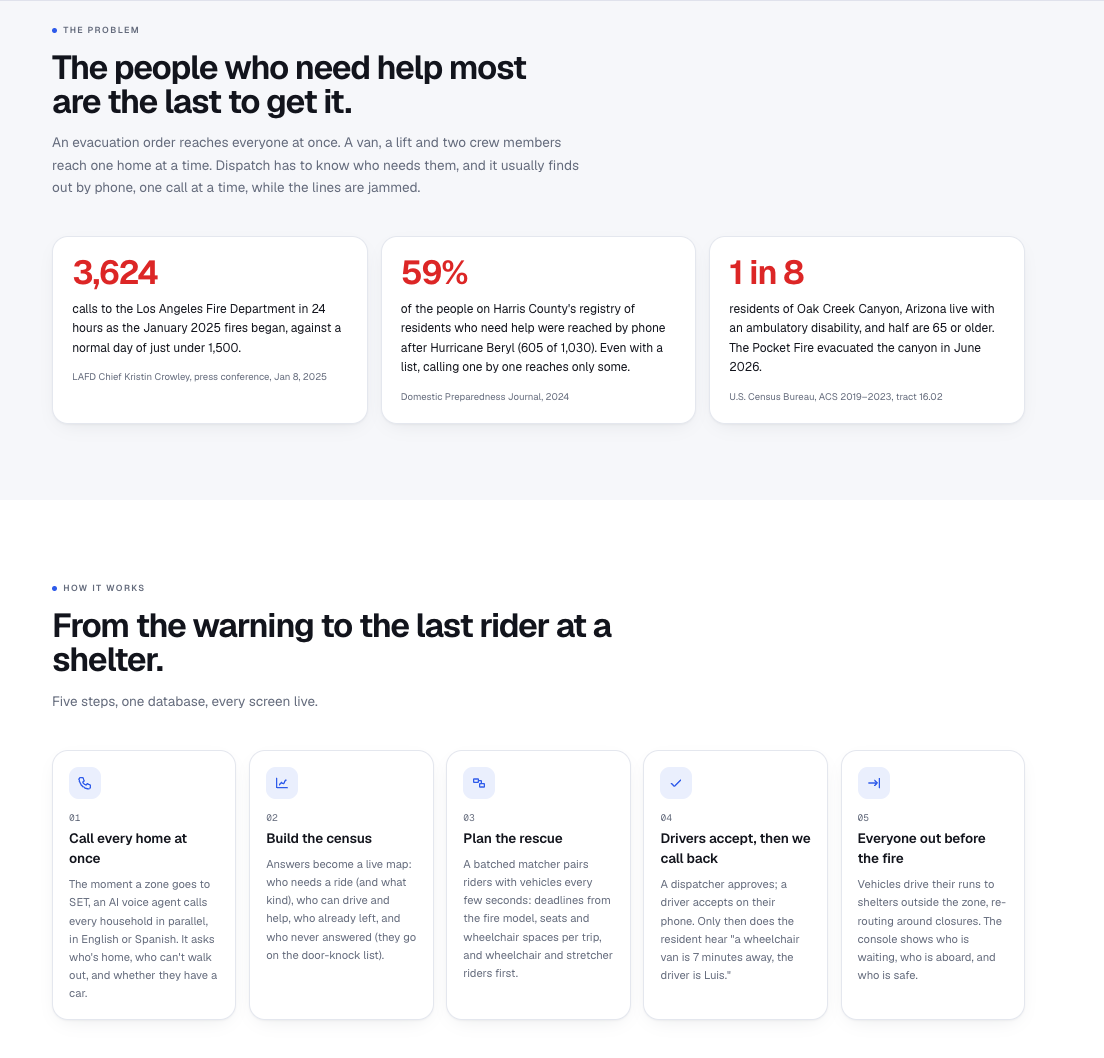
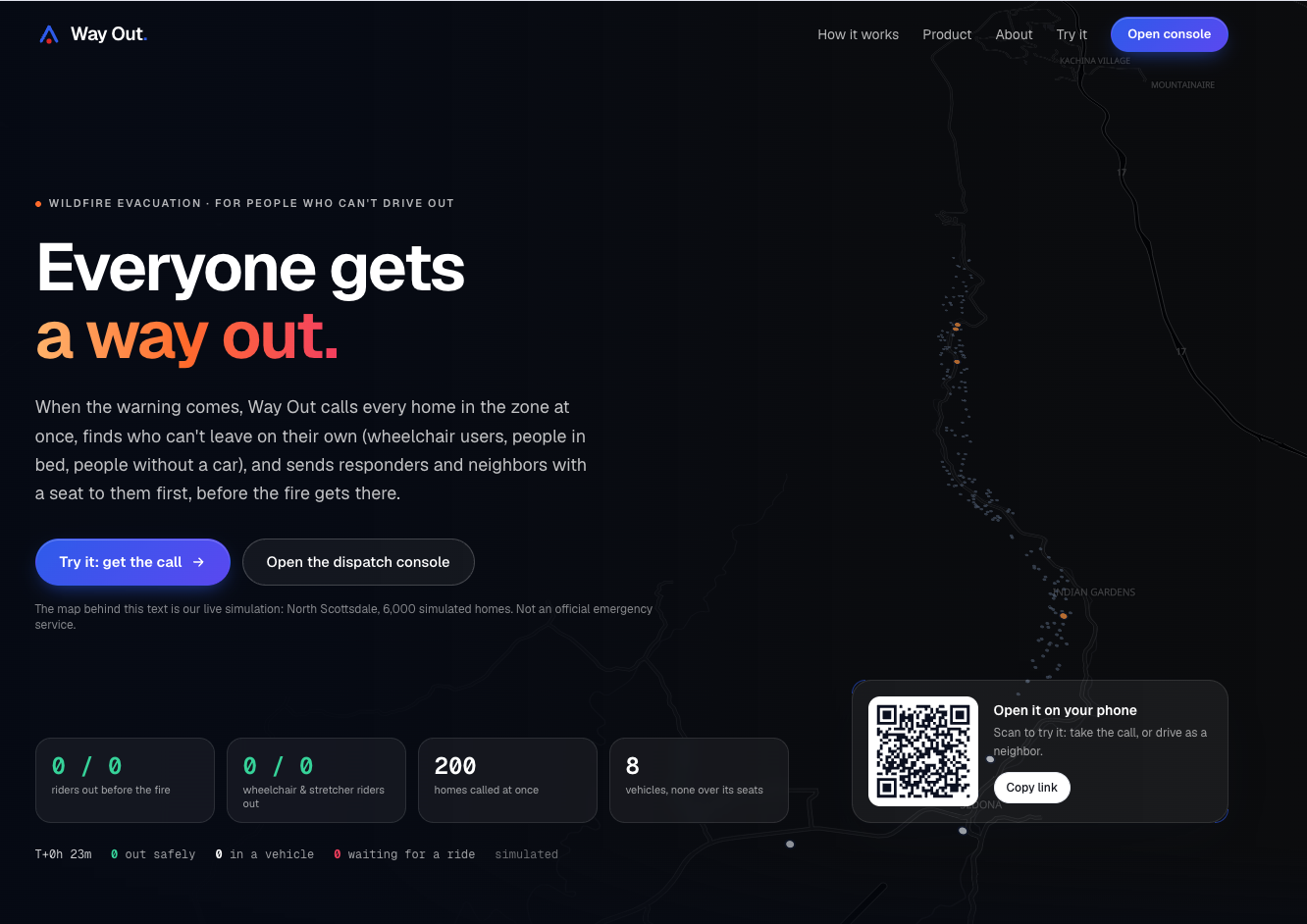
In wildfires, the people who die are mostly the ones who can't leave on their own: in the 2018 Camp Fire, 53 of the first 69 identified victims were over 65. This June, the Pocket Fire forced the evacuation of Oak Creek Canyon near Sedona, where about half the residents are 65 or older. Counties often know who needs help; they just can't call everyone before the fire arrives. We built Way Out for that canyon.
What it does
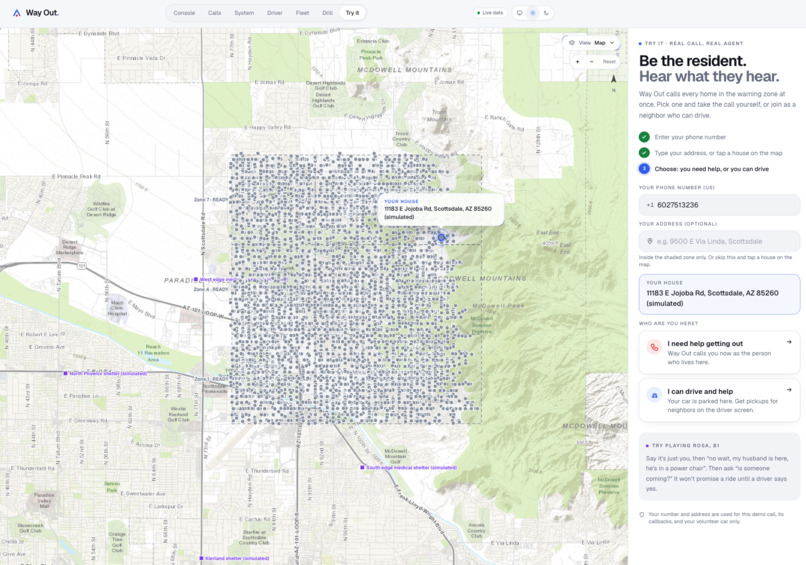
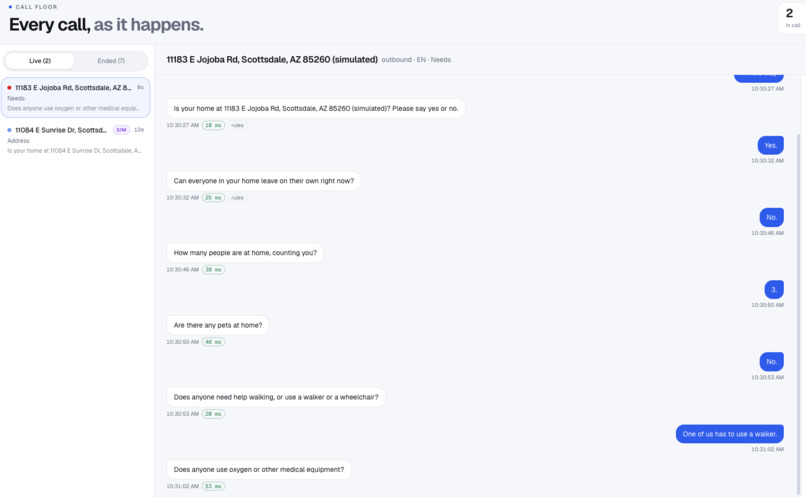
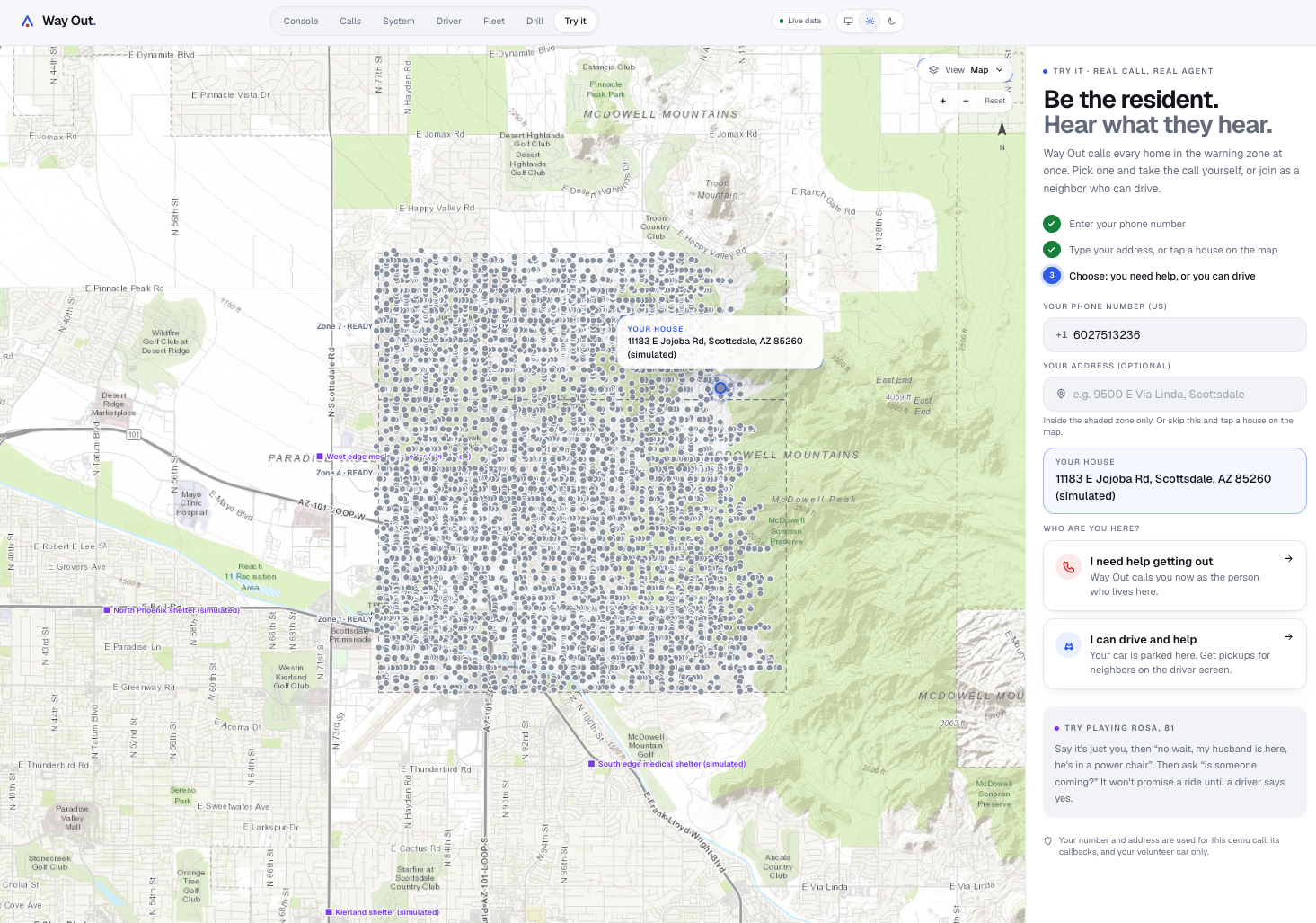
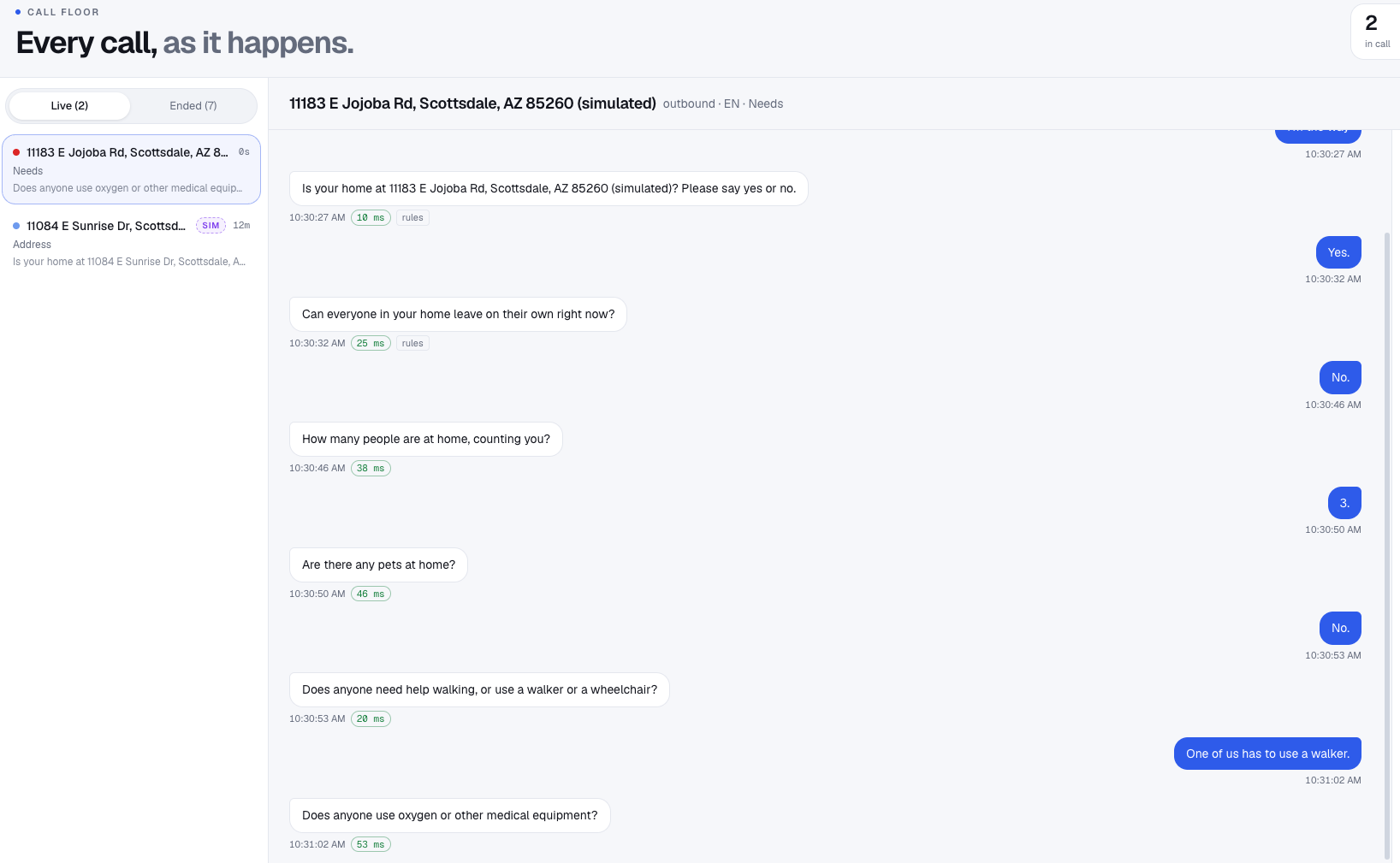
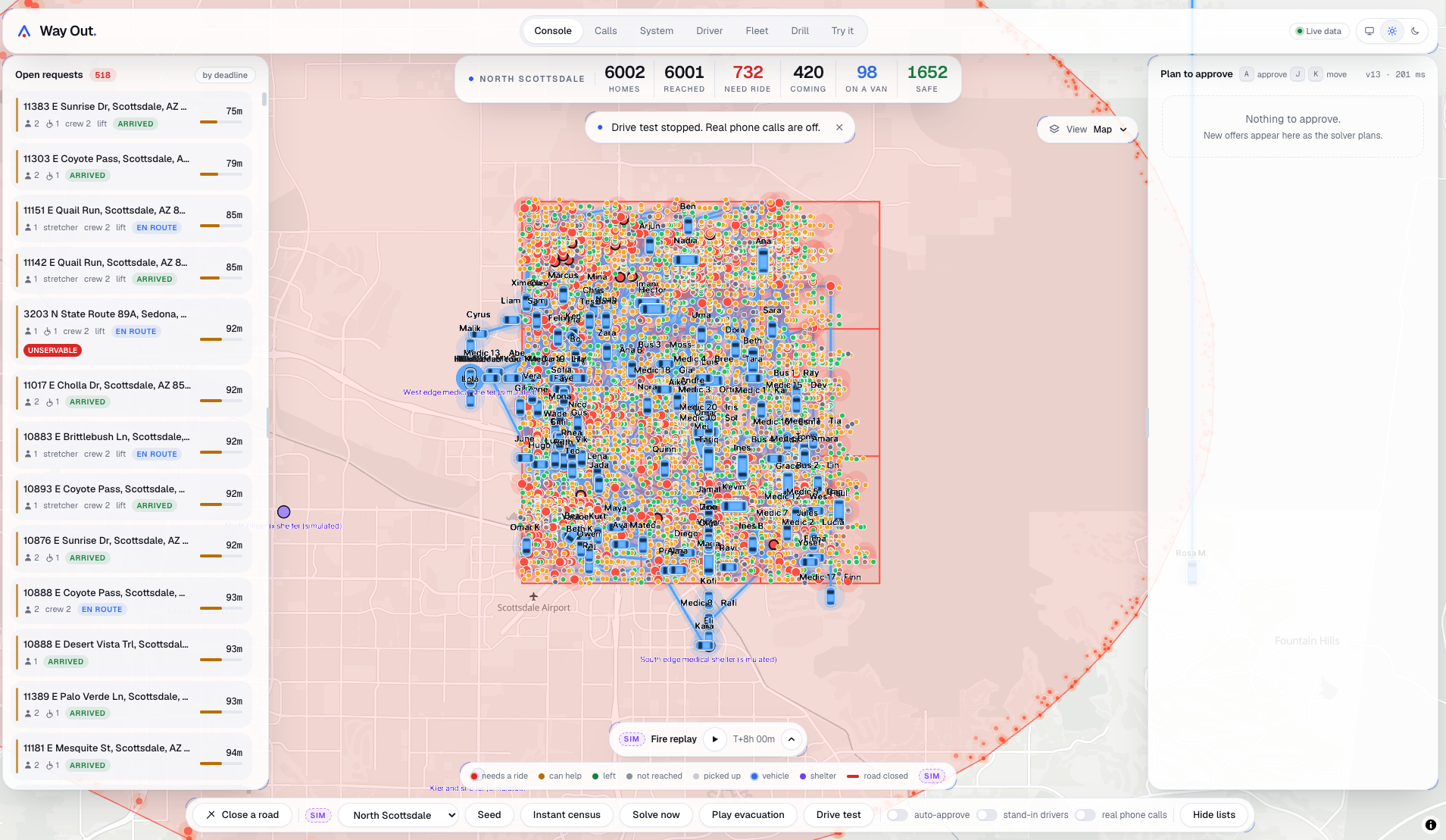
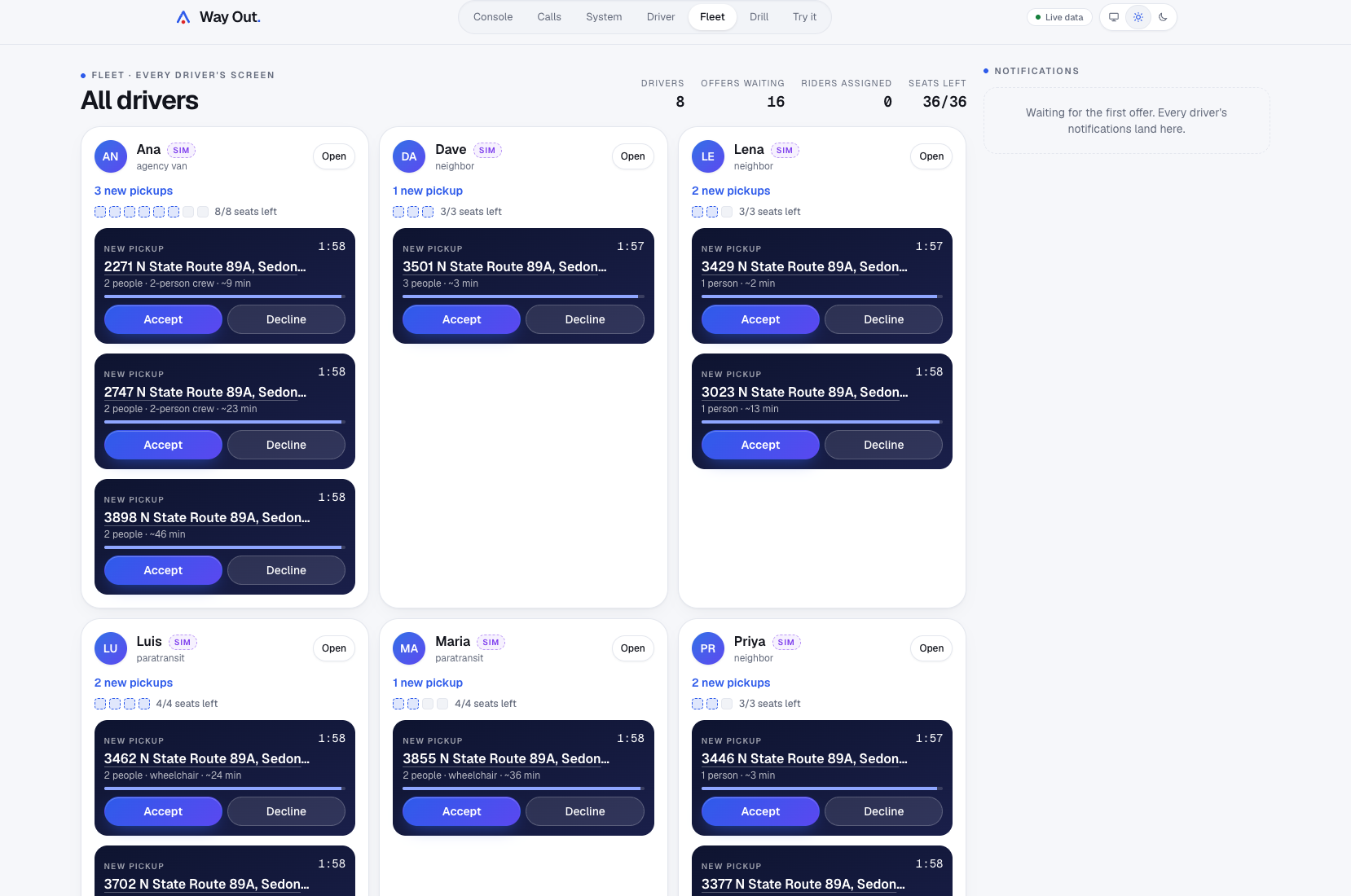
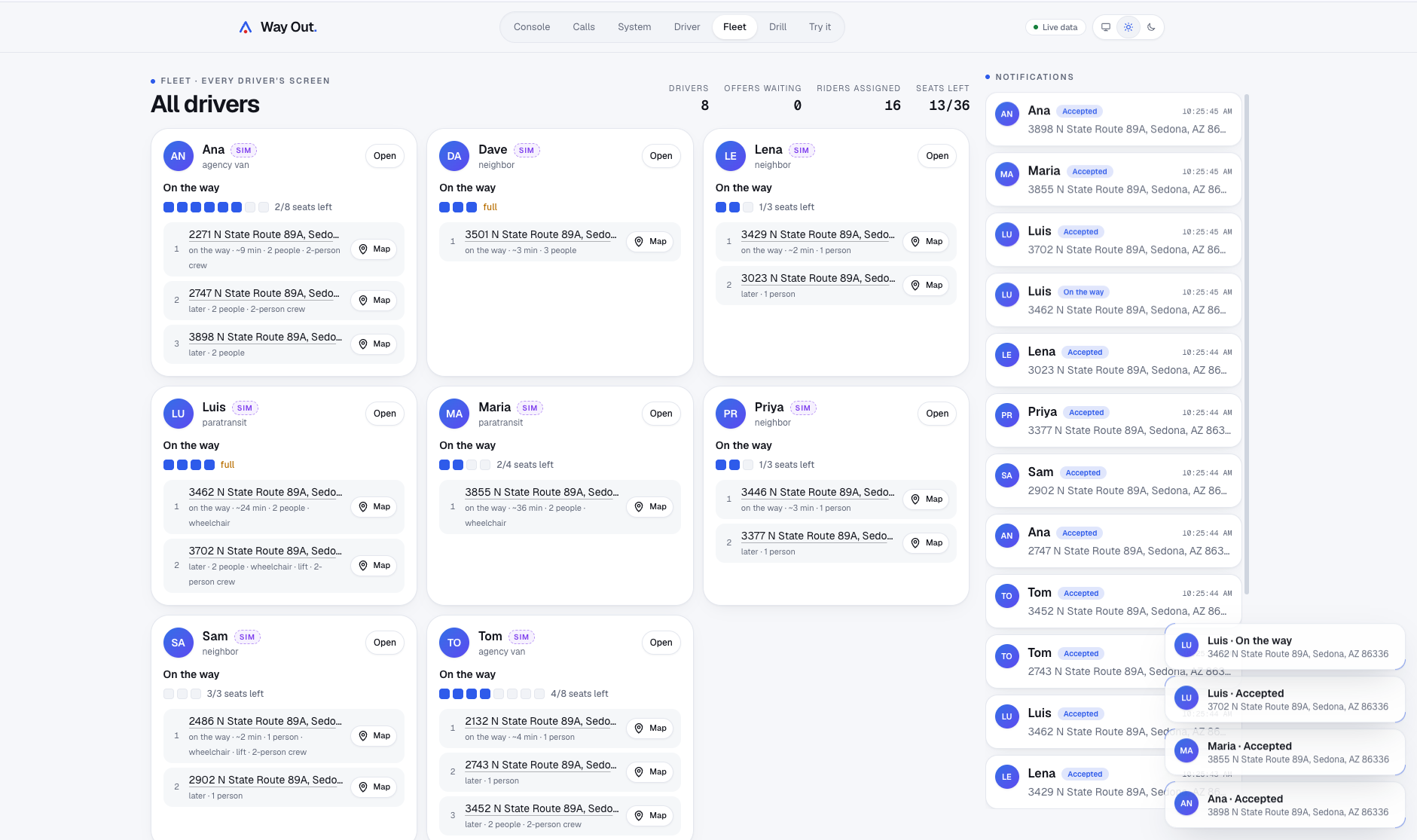
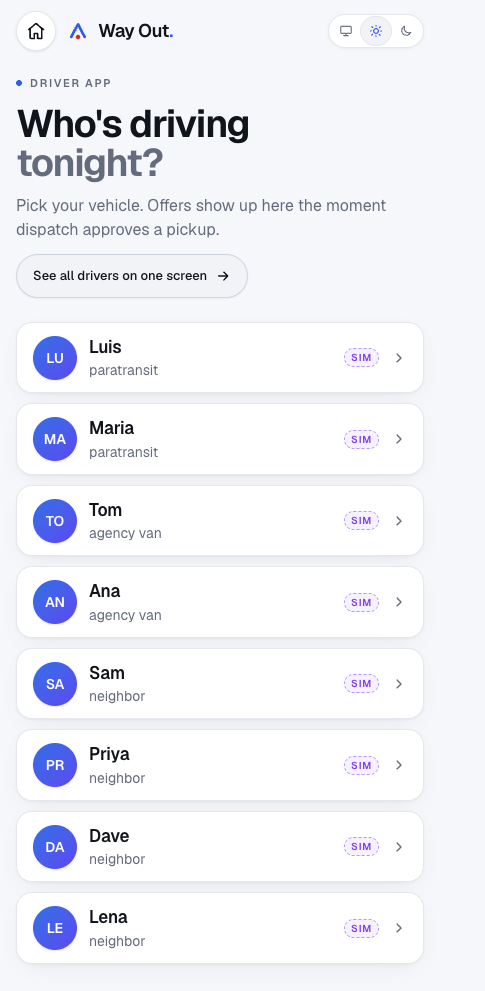
When a zone goes to SET, Way Out calls every home (English or Spanish), learns who needs a ride and what help they need, and matches them with neighbors and agency vans like a ride-hail app: filling every seat before the fire's deadline and never sending a driver into the fire's path. Drivers accept on their phone; only then is the resident called back with the driver's name and ETA. No ride is ever promised before a driver says yes.
How we built it
Architecture: Cartesia phone calls → FastAPI on Vultr (Gemini interprets, code decides) → MongoDB Atlas change streams → live Next.js maps on Vercel, with TinyFish triggering calls and Tiger Data replaying the fire.
Gemini Flash turns each answer into a structured household record (JSON schema), including mid-call corrections; Gemini embeddings catch duplicate callers. Claude is the fallback interpreter. MongoDB Atlas is the single source of truth; change streams push every update live to the dispatcher map and driver phones, and accepts are atomic so two drivers can't take the same pickup. Tiger Data stores fire detections in a hypertable; time_bucket powers the fire replay and its activity chart. TinyFish reads the county's Ready / Set / Go page and starts dialing when a zone changes. Vultr runs dev, staging and production API containers behind Caddy, deployed by GitHub Actions. Dispatch is Uber-style batched matching, solved with the Hungarian algorithm: $\min \sum_{i,j} c_{ij}x_{ij}$, where $c_{ij}$ is pickup time and pairs that miss the deadline $d_h = T_{\text{fire}}(h) - 10\,\text{min}$ aren't allowed.
Challenges we ran into
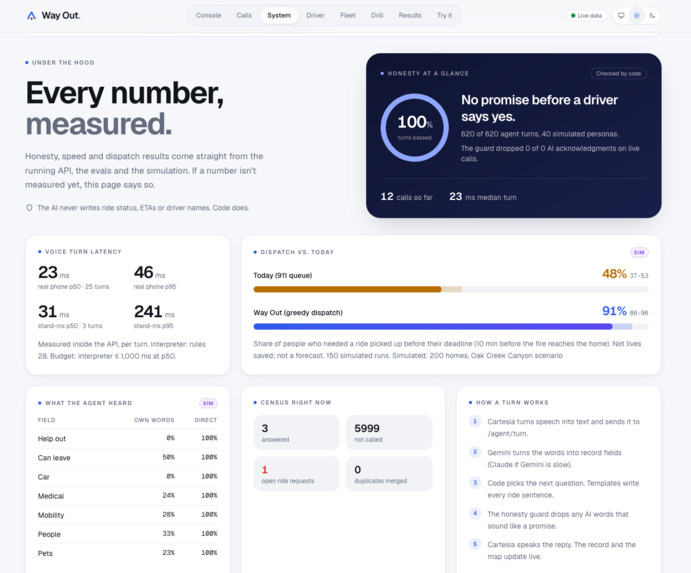
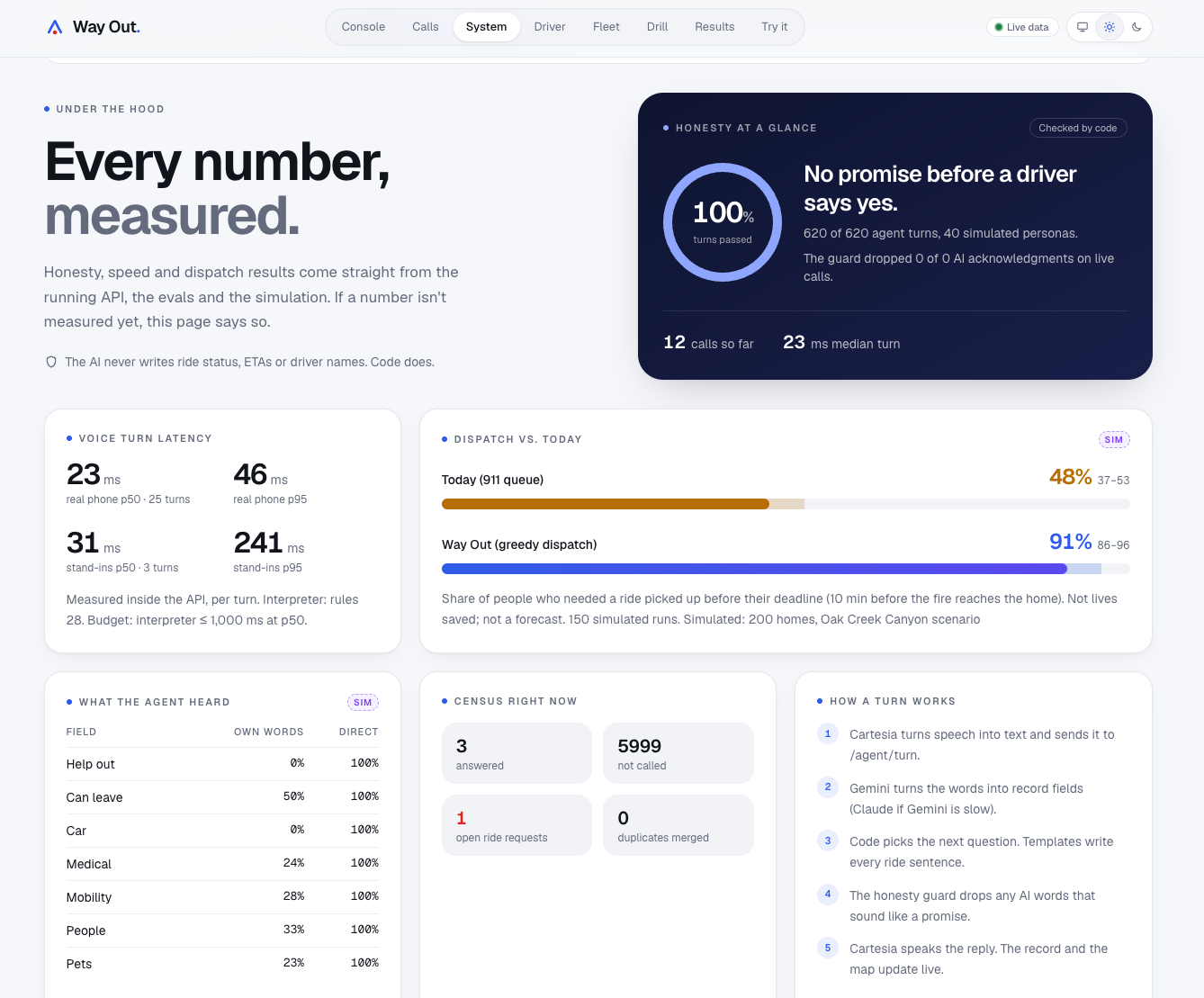
Making "no promises" a property of the code, not the prompt: every ride sentence is a status template, guarded after the model. Two drivers tapping the same offer at once: solved with a single atomic update. Nearest-driver dispatch leaves others waiting longer; batched matching with seat capacity fixed it. Our own drive tests started calling our real phones, so simulations now never ring real numbers.
Accomplishments that we're proud of
620 / 620 agent turns made no promise before a driver accepted. In simulation, Way Out picked up 91% of people who needed a ride before their deadline, vs 48% waiting on 911 (200 homes, 50 runs per setting). 669 automated tests and three live environments with CI/CD.
What we learned
The hard part isn't the vehicles; it's knowing, in minutes, who needs help and what they need. And honesty has to be designed in: "help is on the way" before it is does real harm.
What's next for Way Out
A pilot with a county emergency office, more languages, photo hazard reports, and the same engine for floods and extreme heat.
Built With
- caddy
- cartesia
- claude
- deck.gl
- docker
- fastapi
- gemini
- github-actions
- maplibre
- mongodb-atlas
- motor
- next.js
- openfreemap
- pytest
- python
- react
- tailwindcss
- tiger-data
- timescaledb
- tinyfish
- typescript
- vercel
- vultr
- websockets


