-
-
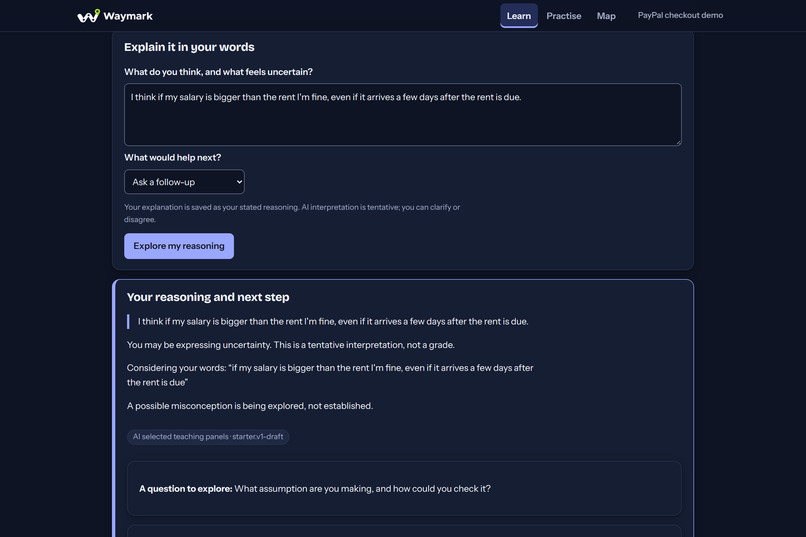
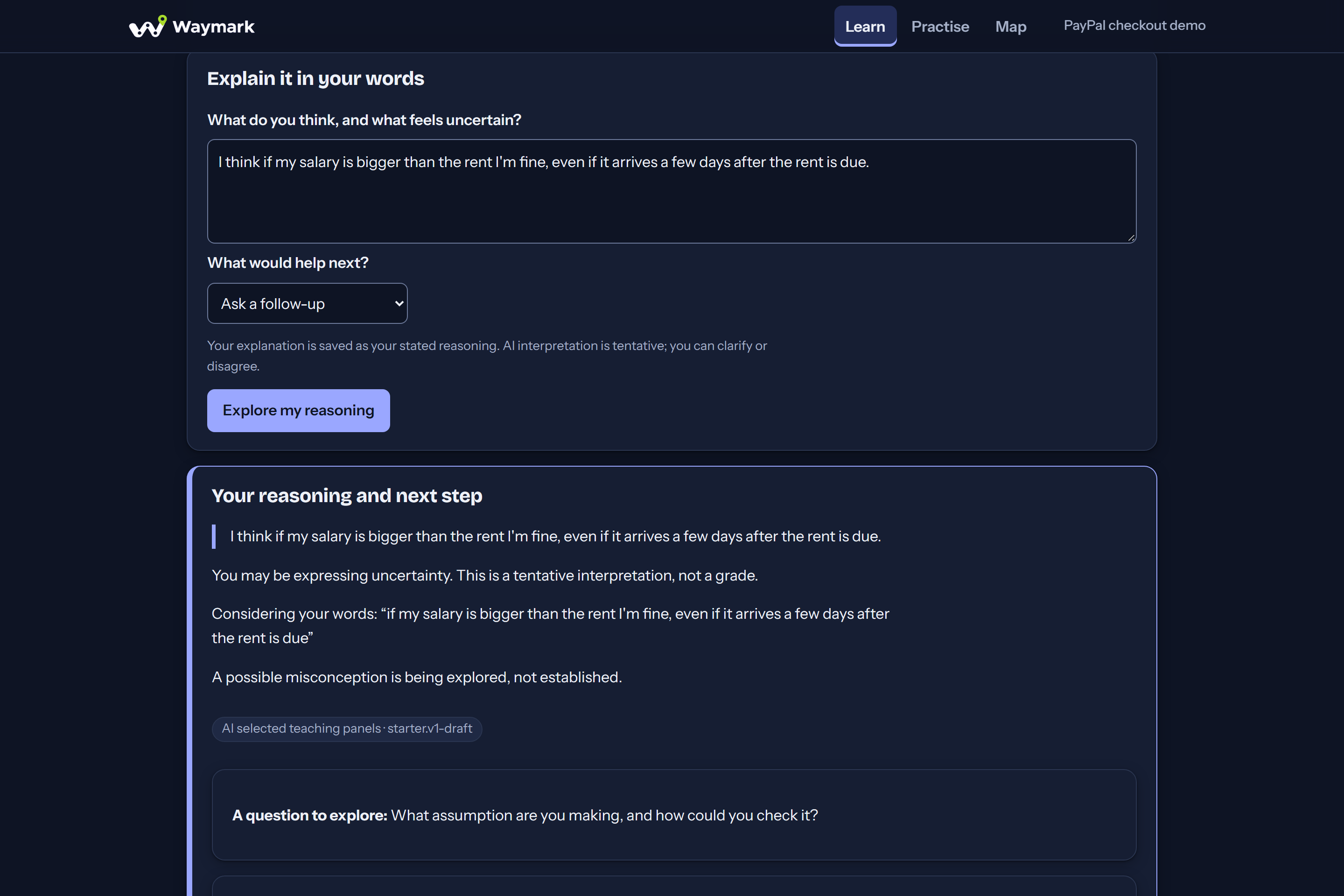
The AI tutor’s reply to a learner’s free-text reasoning
-
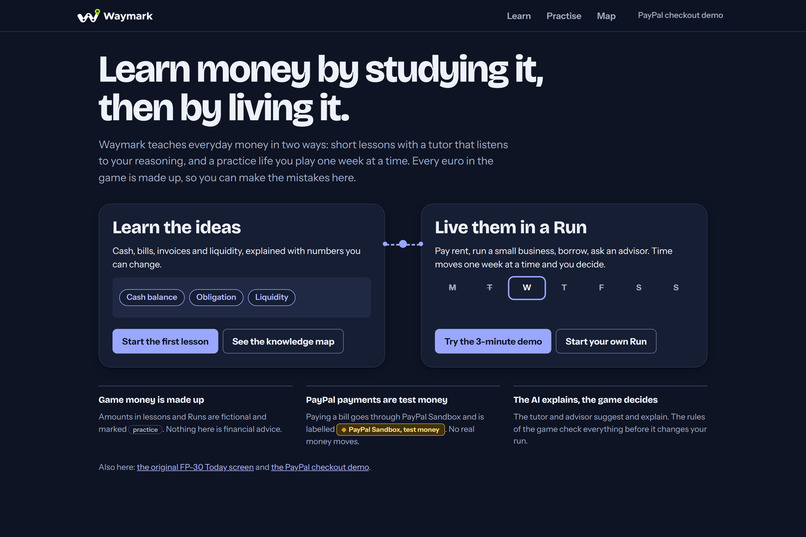
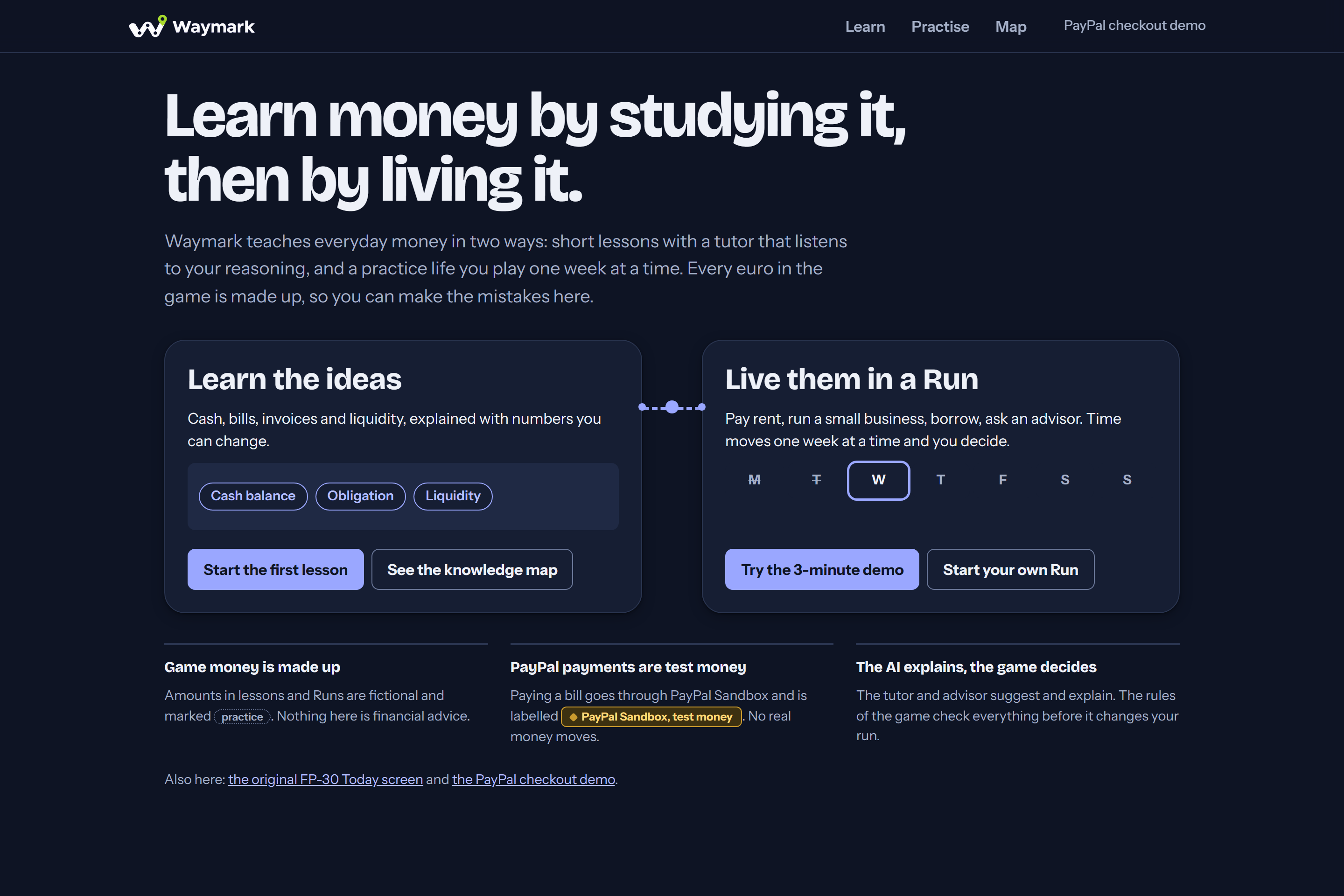
Landing page
-
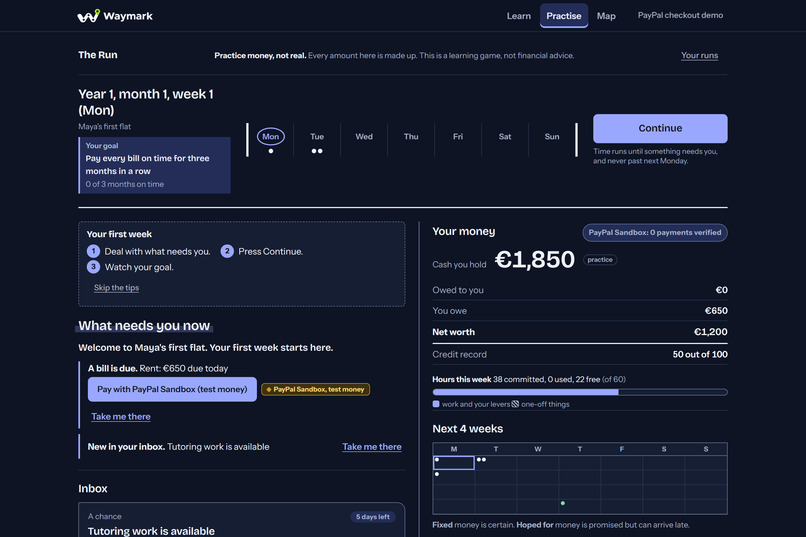
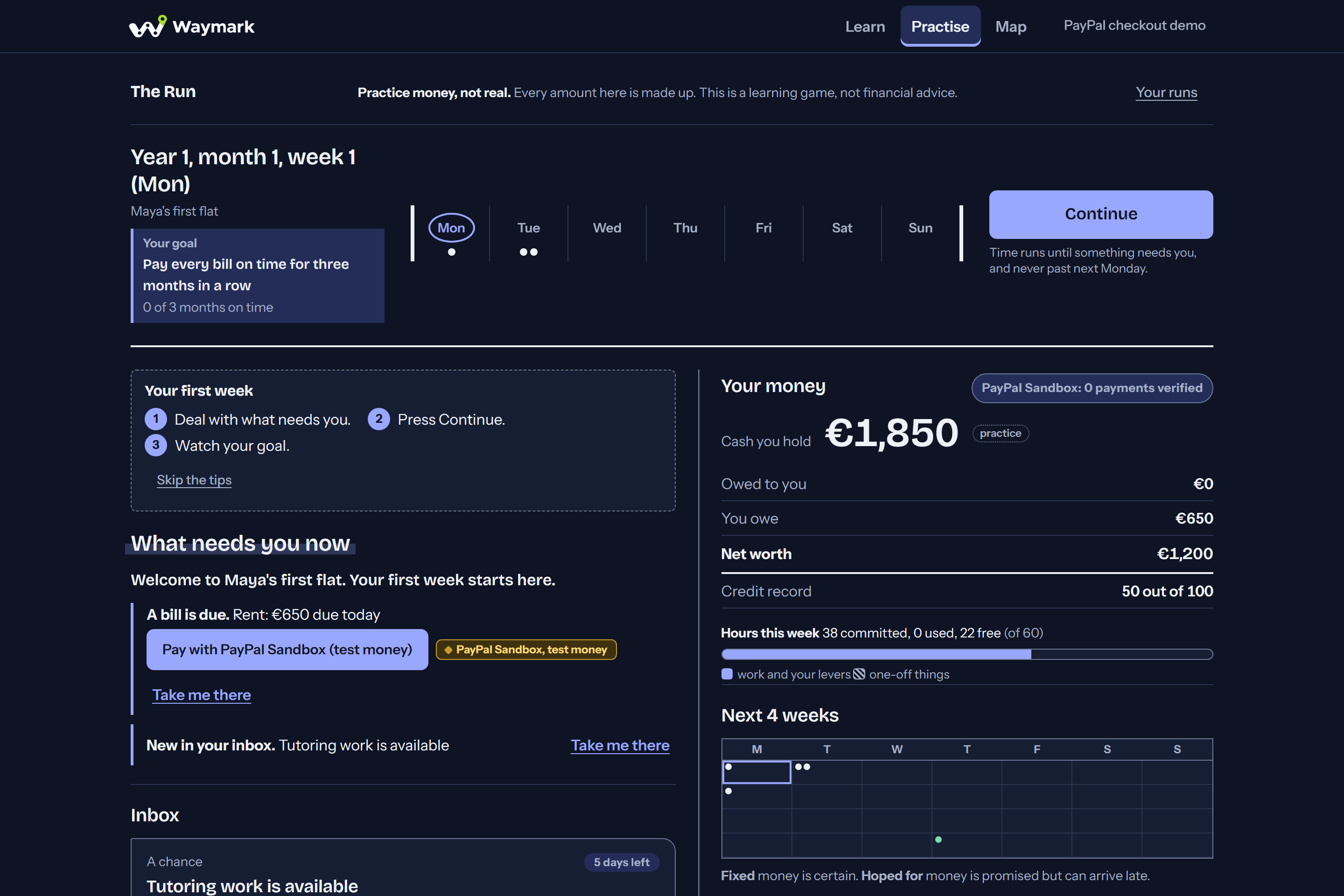
A Run dashboard
-
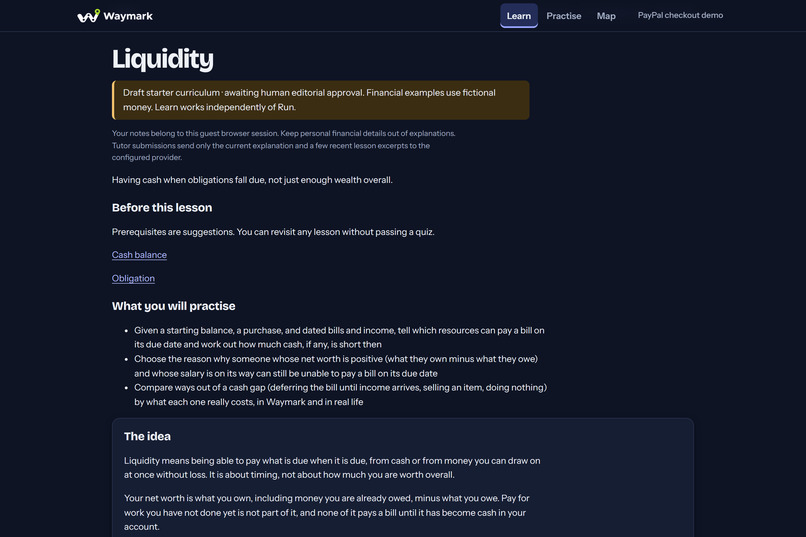
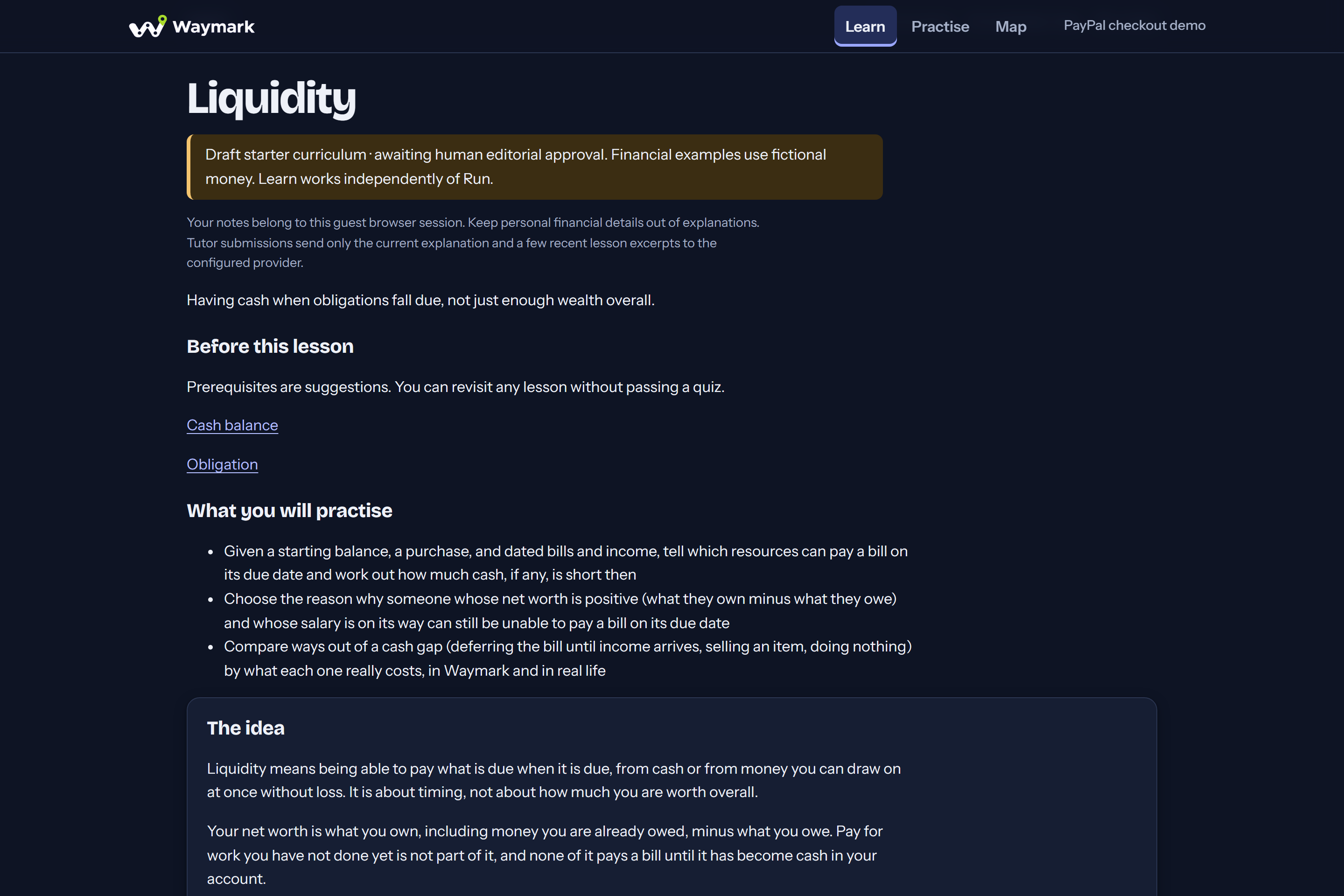
The Liquidity lesson
-
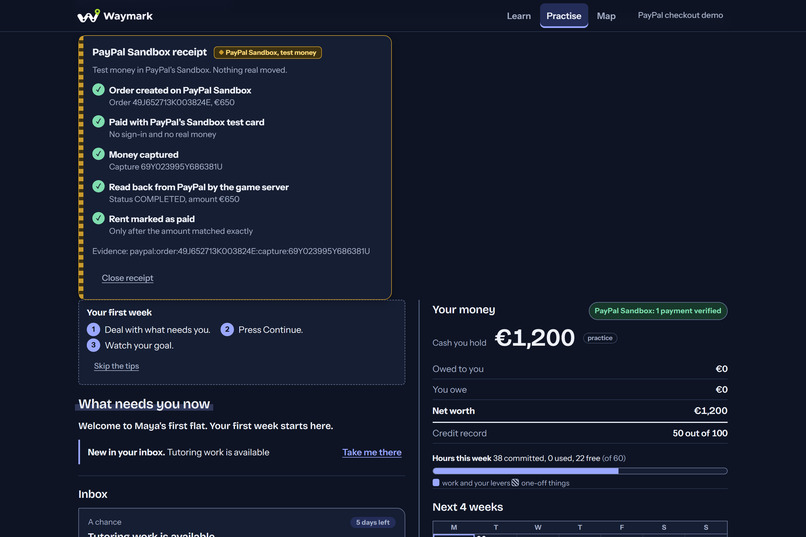
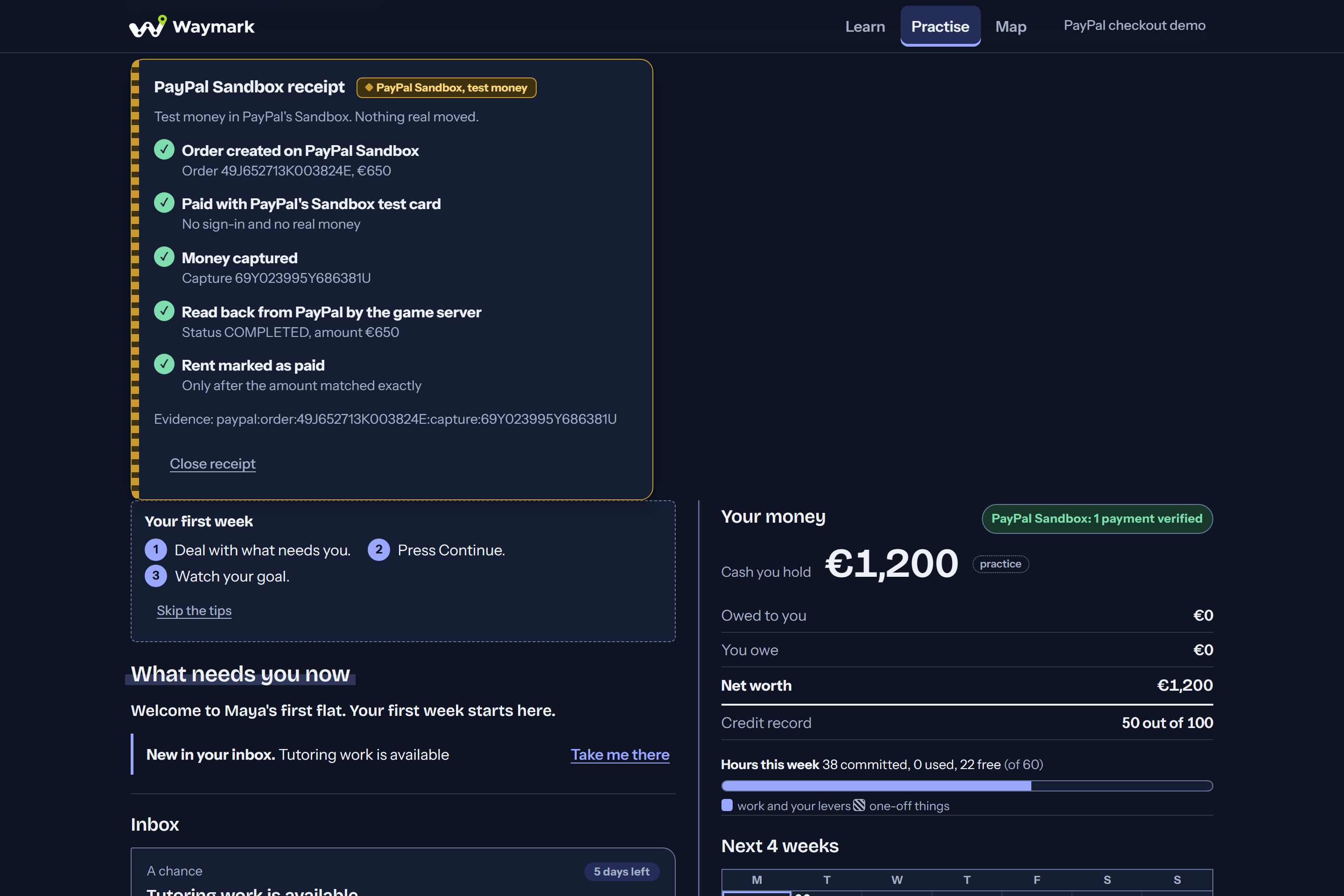
A verified PayPal Sandbox receipt
-
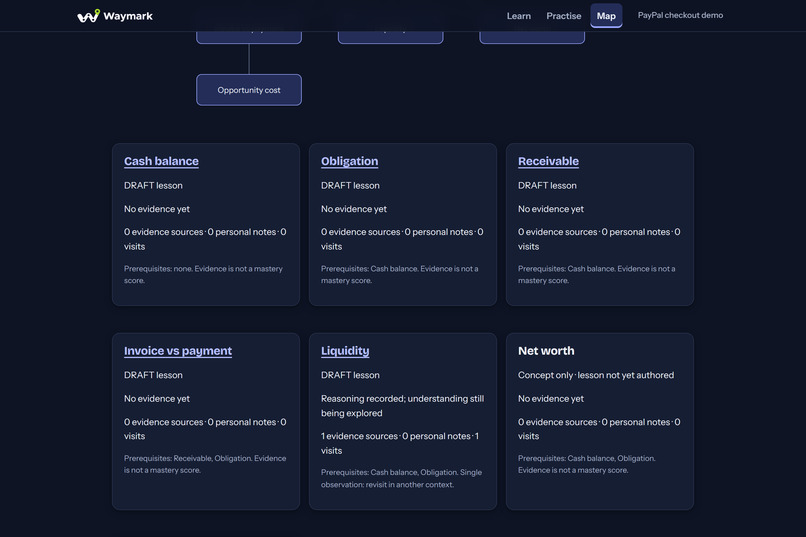
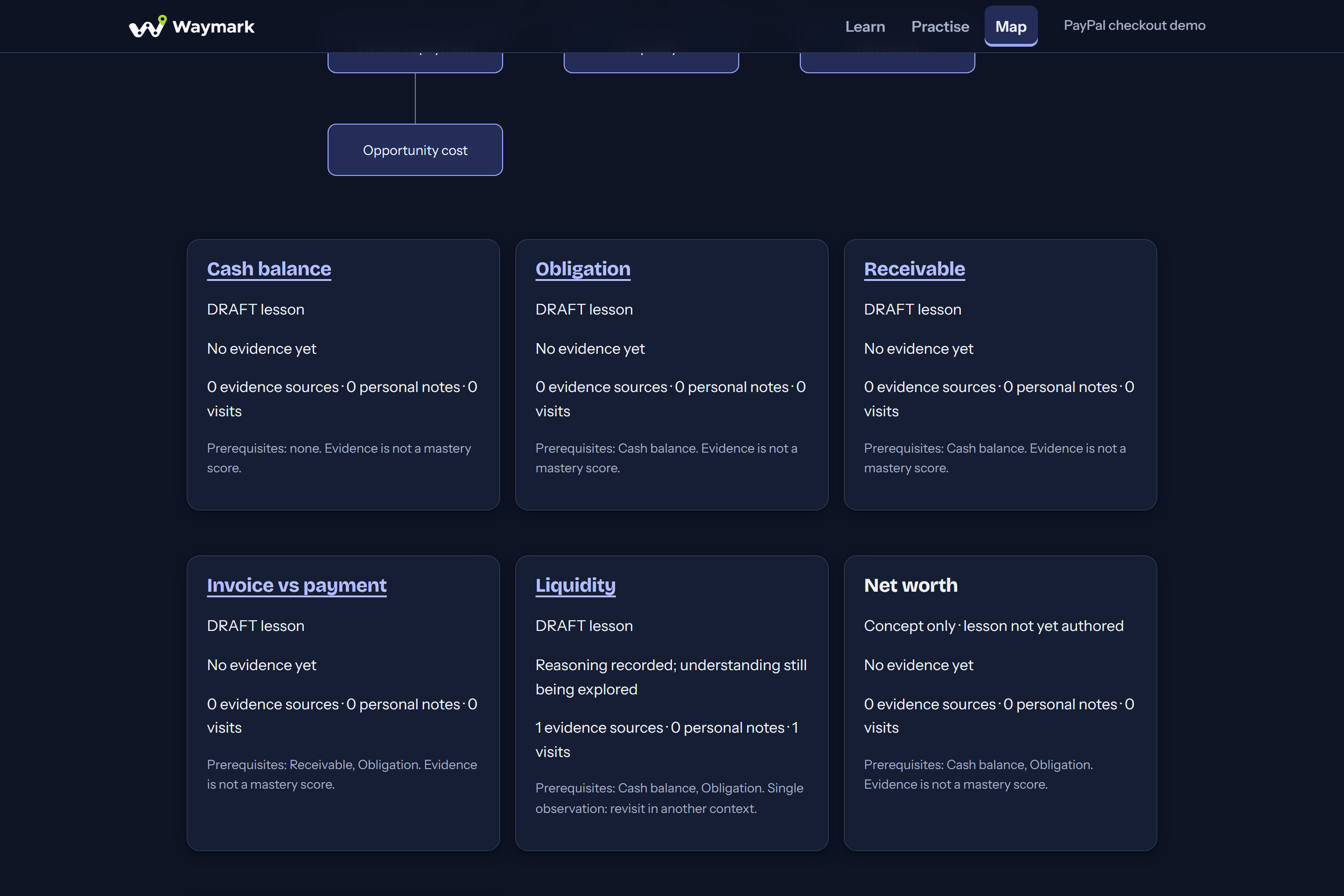
The knowledge map, with Liquidity marked “understanding still being explored”
Inspiration
Most financial education teaches us what concepts mean. Far less of it lets us experience what happens when those concepts collide with real decisions.
You might understand liquidity in a lesson, but what happens when rent is due, payday is weeks away, and an opportunity competes for your limited money and time?
That gap between knowing and deciding inspired Waymark.
We wanted to create a learning experience where financial understanding isn't just tested through correct answers. It's developed through explanations, experimentation, consequences, and reflection.
What it does
Waymark is an AI-powered financial learning platform with two connected experiences: Learn and Practise.
Learn — Understand the ideas
Waymark's learning environment combines structured financial education with adaptive AI teaching.
Learners can:
- Explore lessons about financial concepts such as liquidity, obligations, and cash flow.
- Explain their reasoning in their own words rather than relying exclusively on multiple-choice answers.
- Receive contextual AI follow-ups that explore possible misconceptions and guide understanding.
- Work through interactive exercises and examples.
- Save personal notes and explore a knowledge map showing which concepts they've encountered and where their understanding is still developing.
The knowledge map distinguishes evidence of learning from demonstrated mastery. A single correct response doesn't automatically mean someone understands a concept.
Practise — Live the decisions
Waymark Run is a persistent financial life simulation.
Players can begin from different circumstances, including moving into a first flat, starting a small business, or rebuilding after debt.
Each scenario brings competing demands on money and time:
- Rent, bills, credit, and financial obligations.
- Income and uncertain opportunities.
- Service businesses, inventory, invoices, and cash flow.
- Limited time, fatigue, and longer-term consequences.
The simulation progresses through weeks and months. Decisions affect what happens next, and players can revisit financial ideas through contextual links back to Learn.
PayPal — Connect the simulation to real payment infrastructure
Waymark integrates PayPal Sandbox directly into its simulated financial experience.
Players can complete test payments for eligible obligations and see verified receipts and resulting economic state changes.
Behind the interface, the integration uses durable transaction records, payment reconciliation, idempotency protections, and persistent simulation history.
It is not merely a payment button: the payment is connected to an obligation in the simulated world, and its verified outcome becomes part of that world's history.
All transactions use Sandbox test money; no real funds are transferred.
How we built it
Waymark was developed as a full-stack TypeScript application with a structured learning system, deterministic financial simulation, persistent PostgreSQL storage, AI-powered teaching, and PayPal's Sandbox APIs.
The learning system separates authored financial concepts and exercises from personal learner evidence. Its AI tutor uses Nebius-hosted language models to provide contextual explanations and follow-up questions while retaining structured application control over exercises and learning state.
The simulation uses deterministic state transitions and recorded events so that financial consequences can be reproduced and verified independently of AI-generated wording.
For payments, we implemented PayPal Orders-based checkout, authoritative settlement records, reconciliation, and safeguards against duplicate or conflicting captures. The Run's durable history is linked to verified payment events rather than treating the browser as the authority.
We also built an integrated interface connecting learning, simulation, notes, progress, and payment receipts.
Development involved extensive AI-assisted engineering, with multiple coding and review agents used for implementation, testing, independent review, and release preparation. The project was directed and coordinated as an individual effort.
Challenges we ran into
One of the biggest challenges was reconciling two fundamentally different systems: a simulation where players can experiment with hypothetical choices, and real external payment infrastructure that requires authoritative, irreversible transaction handling.
A simulated financial decision can be replayed. A completed PayPal capture cannot simply be rewritten.
We therefore had to establish a durable boundary between hypothetical gameplay and committed payment events.
Other important challenges included:
- Preventing duplicate settlement under concurrent requests.
- Handling interrupted, delayed, or contradictory payment responses.
- Recovering receipts and state after reloads and server restarts.
- Ensuring that payment amounts and currencies match committed obligations.
- Keeping the AI tutor grounded in structured financial context rather than allowing generated language to define financial truth.
- Designing a learning experience where incomplete understanding remains visible instead of being reduced to a misleading score.
Several payment edge cases were uncovered through independent review and resolved with targeted regression tests.
Accomplishments we're proud of
We're particularly proud of bringing several substantial systems together into one working experience:
- A standalone, interactive financial learning platform.
- Free-text reasoning with adaptive AI responses.
- A personal knowledge map based on accumulated learning evidence.
- A persistent economic life simulation with meaningful financial decisions.
- Contextual navigation between learning and simulated situations.
- Real PayPal Sandbox checkout integrated into durable Run history.
- Recovery from interrupted requests, repeated attempts, and application restarts.
- Automated testing spanning financial invariants, PostgreSQL persistence, and real browser journeys.
The resulting product demonstrates a complete path from learning an idea to experiencing its consequences and verifying a financial transaction.
What we learned
Building Waymark reinforced an important principle: an AI system can help explain a financial decision, but it should not be the authority that determines whether money moved or what happened to the underlying accounts.
We learned to separate deterministic financial logic from generative teaching, to treat ambiguous payment responses conservatively, and to make evidence and uncertainty visible in both learning and payments.
We also learned how much work goes into making a product coherent across education, simulation, AI, and financial infrastructure—not just making each individual feature function.
What's next
Waymark is a foundation for a broader form of experiential financial education.
Future directions include expanding the curriculum, developing more life scenarios and economic systems, improving the AI teaching and verification process, and studying how simulated decisions influence long-term understanding.
The current curriculum remains in draft and requires further editorial validation. Waymark is an educational prototype, not personalized financial advice.
Our long-term ambition is to make financial learning something people can understand, experience, question, and apply.
Learn money by living it.
Built With
- ai-agents
- artificial-intelligence
- drizzle-orm
- financial-literacy
- fintech
- generative-ai
- gpt-oss
- nebius-ai
- next.js
- node.js
- paypal
- paypal-sandbox
- playwright
- postgresql
- react
- tailwind-css
- typescript
- vitest
