Inspiration
While helping a local home care agency, I saw how many of their potential clients struggled to apply for and maintain Medicaid coverage. The forms were difficult to understand, document requirements were easy to miss, and families often did not know what to do after they filled out the form.
This experience inspired building a tool to help people understand the convoluted Medicaid process. That's Waylight!
What it does
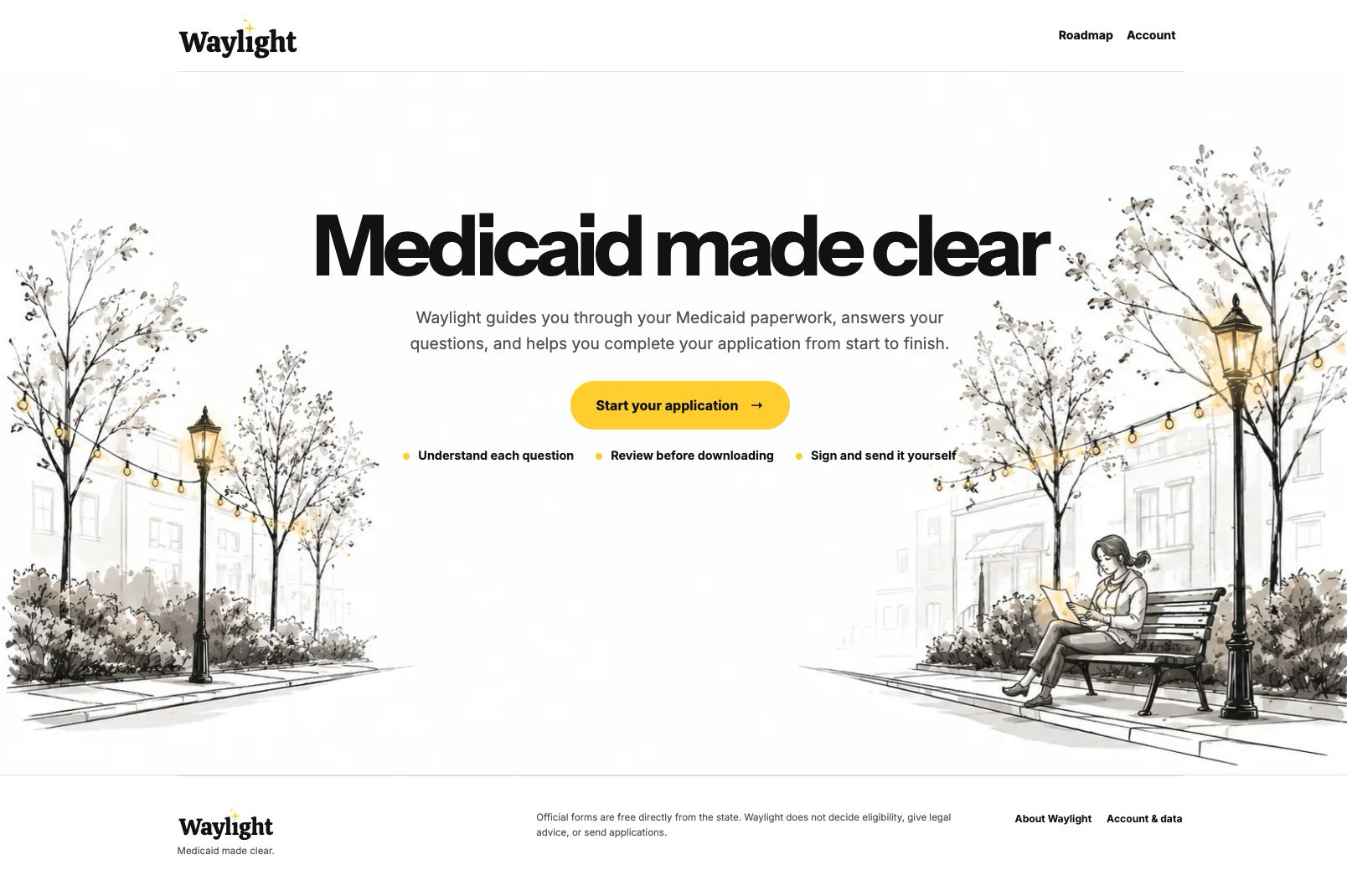
Waylight turns the Medicaid application into an AI-guided conversation. Instead of navigating the process alone, users answer one question at a time and can ask the Waylight AI assistant for help at any point.
Waylight can explain unfamiliar terms and next steps, extract relevant information from documents, and fill out the application for the user.
Users begin by selecting their state. The assistant references primary-source Medicaid materials published by each state, allowing it to answer questions using official information. Users can also provide documents, which Waylight reads to extract relevant details for their application.
After the interview, Waylight finalizes the answers in the form, flags anything missing or conflicting, and provides the document for review. Once the document is generated, Waylight explains how to submit it through official state channels.
How we built it
Waylight was built primarily with ChatGPT and Codex. GPT‑5.6 in ChatGPT helped conduct deep research into state-specific Medicaid requirements, official source materials, and application field mappings. We worked through several research iterations to refine the product scope and initial knowledge base.
Codex then independently verified the research, cross-referenced the PDF mappings, and reviewed the product's planned specs. The UX/UI was designed and refined with GPT‑5.6 Sol, Codex, and Paper.design.
Codex then turned the research, designs, and product vision into a React and TypeScript web app. The application is deployed on Vercel.
The application engine uses reviewed JSON definitions to control question sequencing, conditional logic, validation, and field placement. Zod validates the application state. PDF-lib and Fontkit fill and render the document inside the browser. PDF.js extracts selectable text from supporting PDFs, and Tesseract.js performs local OCR when needed.
The Waylight AI assistant runs on OpenAI GPT‑5.4 mini through the Vercel AI SDK/Vercel AI Gateway.. The assistant is grounded in reviewed state source materials and operates separately from the deterministic application engine.
Firebase Authentication provides passwordless email-link sign-in. Firestore stores account preferences and assistant usage limits, while Firebase Admin verifies authenticated requests.
Codex’s Computer Use capabilities helped connect Firebase and Vercel, including project setup, authentication configuration, environment variables, and deployment verification.
Challenges we ran into
The first challenge was turning a flat government PDF into a reliable digital application. Every applicant-facing field had to be researched, modeled, mapped, and calibrated. Conditional sections, long answers, signature placement, and form revisions all required explicit handling.
The second challenge was balancing useful AI assistance with deterministic paperwork. The assistant needed to explain the process and answer follow-up questions without inventing state rules or changing application answers. We separated the AI conversation from the application engine and grounded responses in primary-source materials.
Finally, document extraction and PDF generation had to happen inside the browser. We also had to connect passwordless Firebase authentication, Vercel Functions, and streamed AI responses into one responsive experience.
Accomplishments that we're proud of
Waylight now completely covers Indiana’s Medicaid Application. It supports all 35 sections and 635 reviewed applicant-facing fields and can generate the full application packet for the user.
We also researched Medicaid and home-care assistance pathways across all 50 states and Washington, D.C. That work supports Waylight’s current nationwide resource directory and establishes a research foundation for adding more state applications.
The reusable interview engine, AI assistant, document extraction, validation system, PDF-mapping framework, and state-source architecture give Waylight a strong foundation for a broader release. New states can be added through reviewed source materials and field maps without rebuilding the product from scratch.
What's next for Waylight
The next step is formally launching Waylight and finding early users in Indiana. We plan to work with individuals, families, caregivers, and home-care organizations to understand how the product performs during real Medicaid applications and improve it based on their feedback.
At the same time, we will begin expanding into additional states by validating official source materials and building new application field maps. The Indiana launch will help us strengthen the product and its expansion process before a broader release.
Built With
- codex
- firebase
- gpt-5.6
- node.js
- react
- tailwind
- tesseract
- typescript
- vercel
- vite


Log in or sign up for Devpost to join the conversation.