🧭 WayFinder
Indoor navigation for blind students — with no beacons, no floor-plan hardware, and no infrastructure. Just a phone camera.









A student should not need a stranger to find third period.
❤️ The problem: the indoor navigation gap
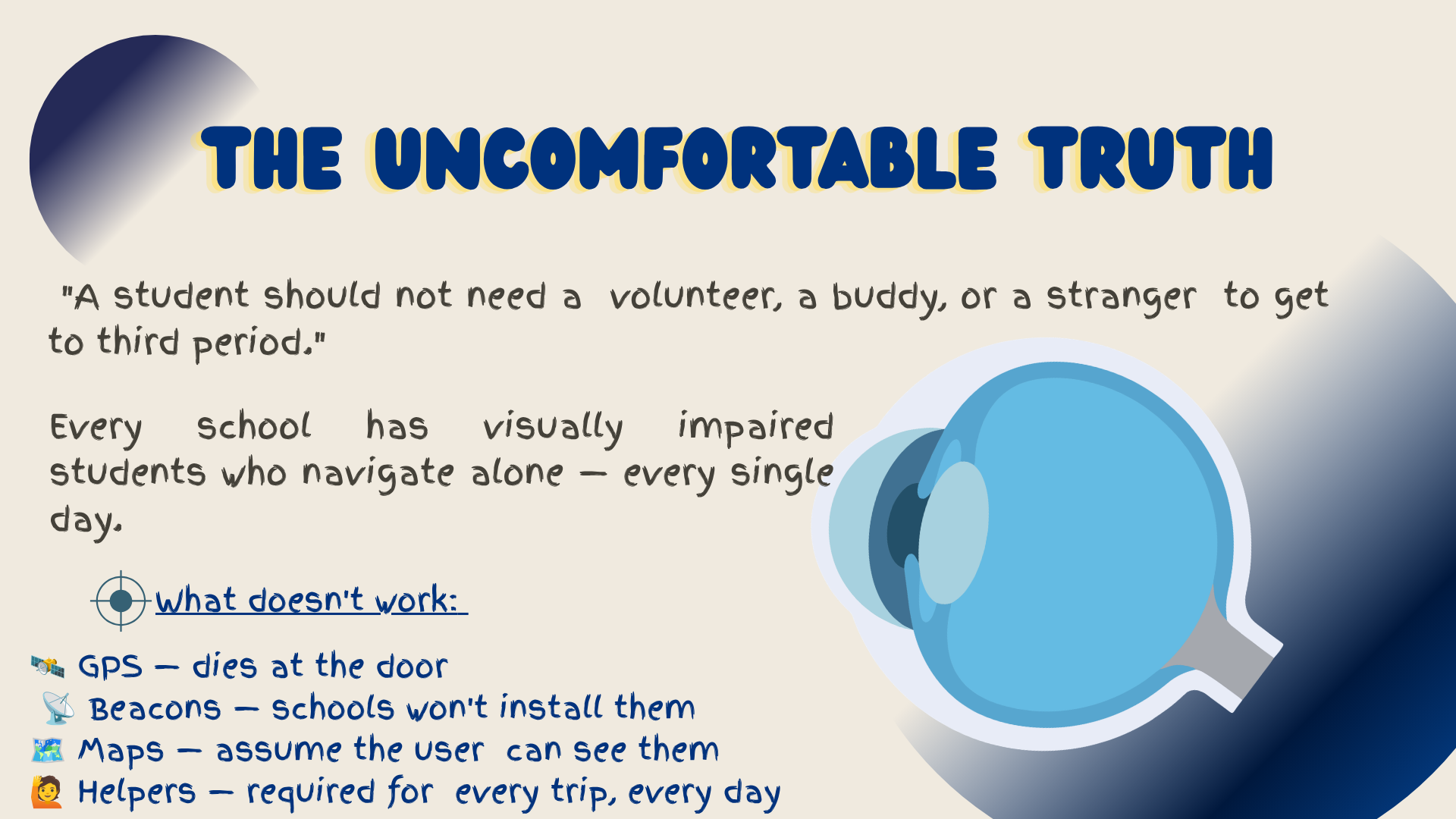
Outdoors, a blind pedestrian has turn-by-turn GPS in their pocket. Indoors, that pocket goes silent.
| The reality | The consequence |
|---|---|
| 🛰️ GPS dies indoors — concrete, steel and roofs block satellite signals | No usable positioning in the buildings where students actually spend their day |
| 📡 Beacon systems need installation — per-beacon cost, gateways, battery swaps, re-surveys when furniture moves | Schools never deploy them, and accuracy collapses in crowded hallways |
| 🗺️ Floor-plan apps assume sight | A map you cannot see is not navigation |
| 🦮 Guide dogs cost tens of thousands and have multi-year waitlists | Independence is rationed to a tiny fraction of the people who need it |
| 🙋 So they ask for help — every day, every trip | Dependence, anxiety, missed classes |
The numbers are not small. At least 2.2 billion people live with vision impairment, and people with sight loss spend an estimated 80–90% of their time indoors. Unaddressed vision impairment costs an estimated $410B a year in lost productivity. In the UK alone, only one in four registered blind and partially sighted working-age adults is employed — a figure unchanged since 1991.
And the users told us exactly what they need: a Sensors (2020) survey of 25 blind experts ranked locating a specific room by number as their top indoor need; a 2025 survey of 42 visually impaired navigators found 76% struggle with obstacles and 69% with route finding.
WayFinder answers that with software. Zero hardware in the building. Zero cost per classroom.
✨ What WayFinder does
Say it out loud, and walk:
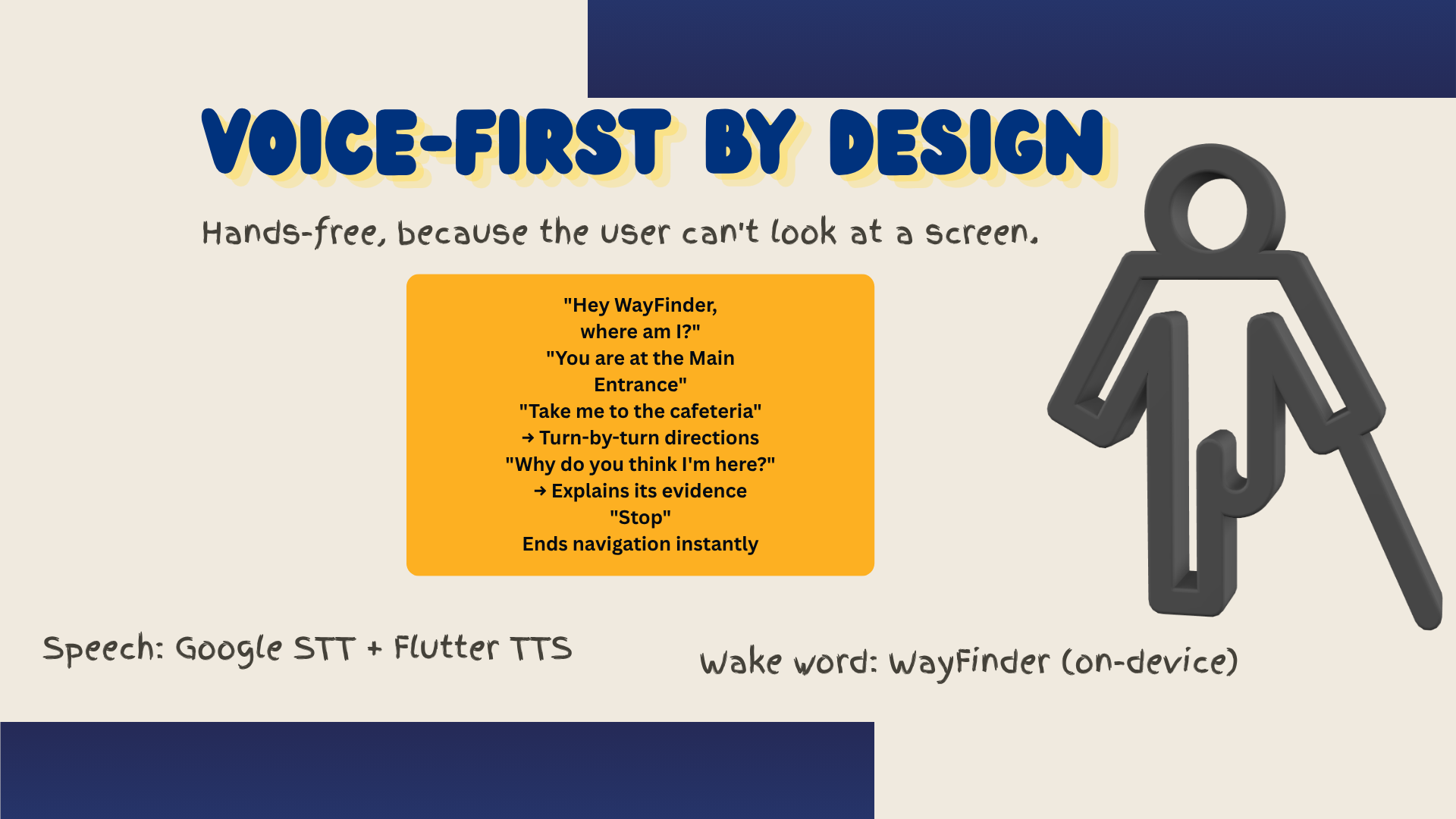
🗣️ "Hey WayFinder, take me to my 3rd-period chemistry class."
| Capability | What the student actually hears | |
|---|---|---|
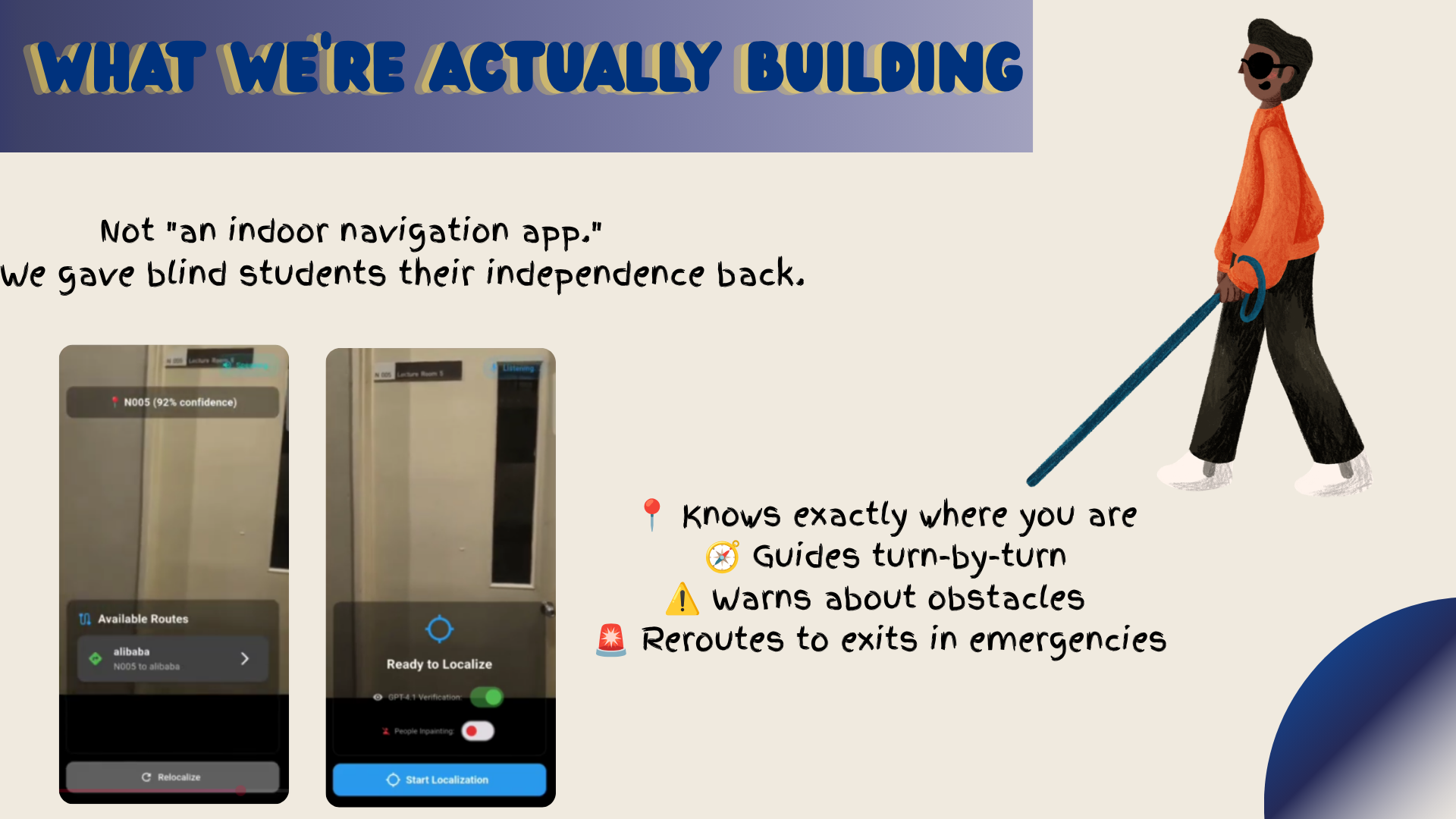
| 📍 | Locates the student from the camera view | "You are at the Main Entrance." |
| 🧭 | Guides turn-by-turn to the destination | "Continue straight, then turn left." |
| ⚠️ | Warns about people in the path | "Caution: people ahead." |
| 🧠 | Explains its reasoning on request | "I can see the blue lockers and the trophy case." |
| 🔔 | Alerts the teacher before arrival | Teacher gets a heads-up before the door opens |
| 🚨 | Reroutes to the nearest exit in an emergency | "Emergency — exit is 12 steps to your right." |
| 🔄 | Recovers if the student drifts off route | Re-localizes and walks them back onto the path |
Everything is hands-free. No screen to read, no button to hunt for.
🏗️ Architecture
🧑🦯 STUDENT — hands-free, eyes-free
│ 🎙️ "Hey WayFinder, take me to chemistry"
│ (Porcupine wake word on-device → Google STT → GPT-4 intent parsing)
▼
┌────────────────────── 📱 Flutter App (Android, TalkBack-friendly) ──────────────────────┐
│ │
│ 📷 Camera frames ───────────────────────────────┐ │
│ │ │
│ 📍 Localization (RAG retrieval) ◄──────────────┤ │
│ 🧭 Navigation (waypoint match + compass + │ │
│ crowd-adaptive thresholds) │ │
│ 🔉 Flutter TTS ──► 🔊 spoken guidance in earbuds │
│ │
└───────────────────────────────┬──────────────────────────────────────────────────────────┘
│ HTTP (embedding requests)
▼
┌──────────────── 🧠 Vision Server · FastAPI + PyTorch (GPU) ──────────────────────────────┐
│ │
│ 1️⃣ YOLOv8-seg → find people in the frame │
│ 2️⃣ Stable Diffusion 2.0 → inpaint them out (clean the scene) │
│ 3️⃣ DINOv2 → fingerprint the scene as a 768-dim vector │
│ │
└───────────────────────────────┬──────────────────────────────────────────────────────────┘
│
▼
┌──────────────── ☁️ Supabase · PostgreSQL ────────────────────────────────────────────────┐
│ maps · map_nodes · navigation_paths · path_waypoints · place_embeddings │
└──────────────────────────────────────────────────────────────────────────────────────────┘
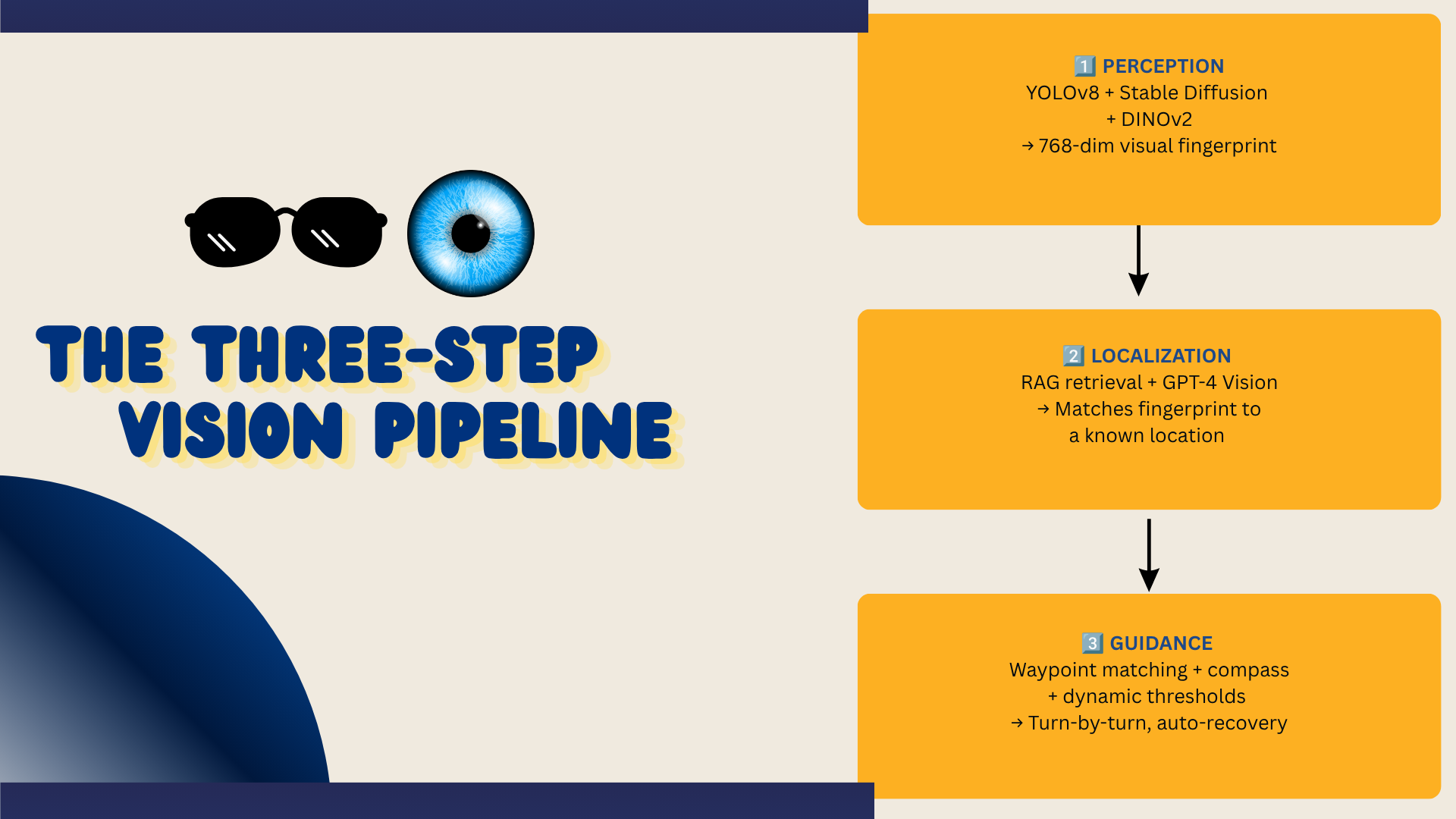
🔬 The pipeline in three steps
| Step | Layer | What happens |
|---|---|---|
| 1️⃣ | Perception | See the scene → remove the people → turn it into a fingerprint |
| 2️⃣ | Localization | Match the fingerprint against known places, then verify with GPT-4 Vision |
| 3️⃣ | Guidance | Walk the recorded route waypoint by waypoint, and recover if the student drifts |
🚶 How a route gets recorded (the part schools will love)
Teacher walks the hallway with the phone facing forward
        │
        ├── every ~2 seconds ──► 📸 reference image
        │                        🧠 768-dim embedding
        │                        🧭 heading
        │                        ↩️  turn type
        ▼
   path_waypoints table  ──►  replayable turn-by-turn route
No CAD files. No mapping crew. No annotation labor. Walk it once and it exists.
🎯 Why the hard parts are actually solved
Most camera-based indoor navigation fails for one boring reason: hallways are full of people, and a crowded corridor never looks like the reference photo. WayFinder handles it head-on.
| Challenge | Our answer |
|---|---|
| 🧑🤝🧑 Crowds break visual matching | YOLOv8-seg finds people → Stable Diffusion inpaints them out → then embed. Matching happens against the hallway, not against whoever is standing in it |
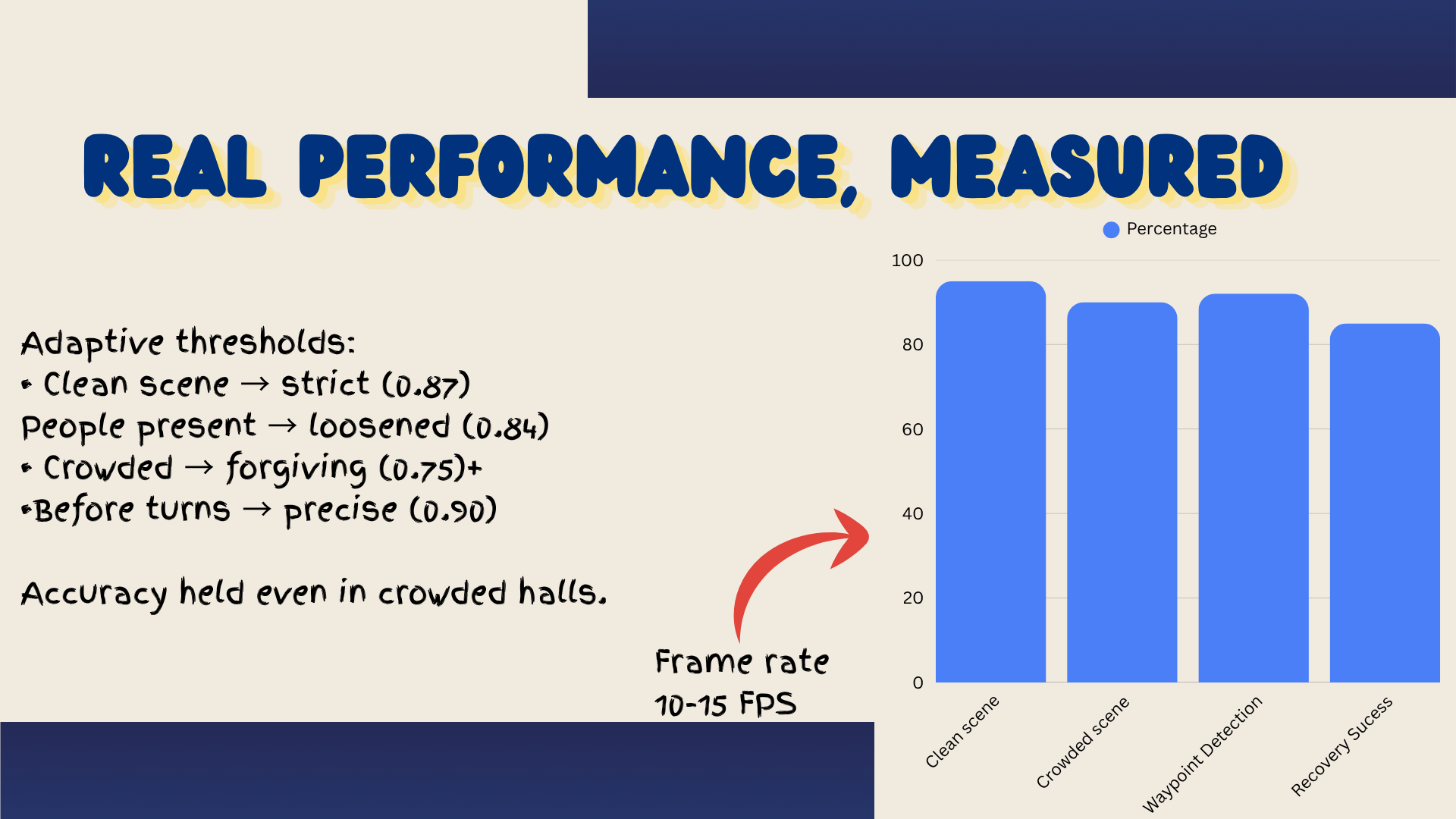
| 🎚️ One threshold can't fit every scene | Crowd-adaptive matching: 0.87 clean · 0.84 with 1–2 people · 0.75 crowded · 0.90 before a turn (extra precision exactly where a mistake is dangerous) |
| 🧭 "Am I facing the right way?" | Compass heading + spoken orientation before the first step |
| 🤔 "How do I know it's not guessing?" | GPT-4 Vision verifies the match, and the app can explain the evidence behind its answer |
| 🚶 Students drift off path | Auto-recovery: re-localize, then walk them back onto the route |
| 🌐 Latency on a phone | GPU inference gateway + realtime/quality modes (SD_REALTIME_MODE) |
| 🔌 No internet? | On-device YOLO11n TFLite for local detection, cloud only for the heavy lifting |
📊 Measured results
| Metric | Clean scene | Crowded scene |
|---|---|---|
| 🎯 Localization accuracy | 95% | 90% |
| 🧭 Waypoint detection | 92% | — |
| 🔄 Recovery success | 85% | — |
| ⚡ Navigation frame rate | 10–15 FPS | 10–15 FPS |
Thresholds are documented and tunable in a single file — no retraining to adapt to a new school.
🌍 Social Good, concretely
| Pillar | How WayFinder delivers |
|---|---|
| ♿ Accessibility & inclusion | Replaces a $50k guide dog or a $10k beacon install with software on a phone the student already owns |
| 🎓 Education & empowerment | Directly serves SDG 4 (equal access, disability-sensitive facilities) and SDG 10 (inclusion regardless of disability), and operationalizes UNCRPD Articles 9 and 24 |
| 🏥 Safety | Head-to-ground awareness, arrival alerts, and emergency exit rerouting |
| 🌱 Scalability | No procurement, no installation, no maintenance — deployable to any school with Wi-Fi, including underfunded and low- and middle-income regions |
We also validated with a blind user, and changed the app based on what he told us. That feedback loop is the difference between an accessibility demo and accessibility infrastructure.
🛠️ Built with
Flutter · Dart · Python · FastAPI · PyTorch · DINOv2 · YOLOv8-seg / YOLO11n · Stable Diffusion 2.0 · GPT-4 / GPT-4 Vision · Porcupine wake word · Google STT · Flutter TTS · Supabase / PostgreSQL
🧩 What we built during the event
Built during EvoHacks 2.0: the Flutter app (voice assistant, localization, navigation engine, compass, admin tools for floors, locations and route recording), the FastAPI vision gateway (detection → inpainting → embedding), the Supabase schema and storage layout, and the full navigation pipeline from camera frame to spoken instruction.
Pre-existing / third-party components: open-source pretrained models (DINOv2, YOLOv8/YOLO11n, Stable Diffusion 2.0), the Porcupine wake-word engine, Google STT, Flutter TTS, Supabase, and the OpenAI API. We designed the pipeline, recorded real routes in a real school, tuned the thresholds, and can explain every layer.
🚀 Try it
# 1. Vision server (GPU machine)
cd scripts && pip install -r ../requirements.txt
python dinov2_http_gateway.py        # http://YOUR_IP:8000

# 2. Database
#    run database_scheme.sql in Supabase, create reference-images + maps buckets

# 3. App
flutter pub get && flutter run
🔭 What's next
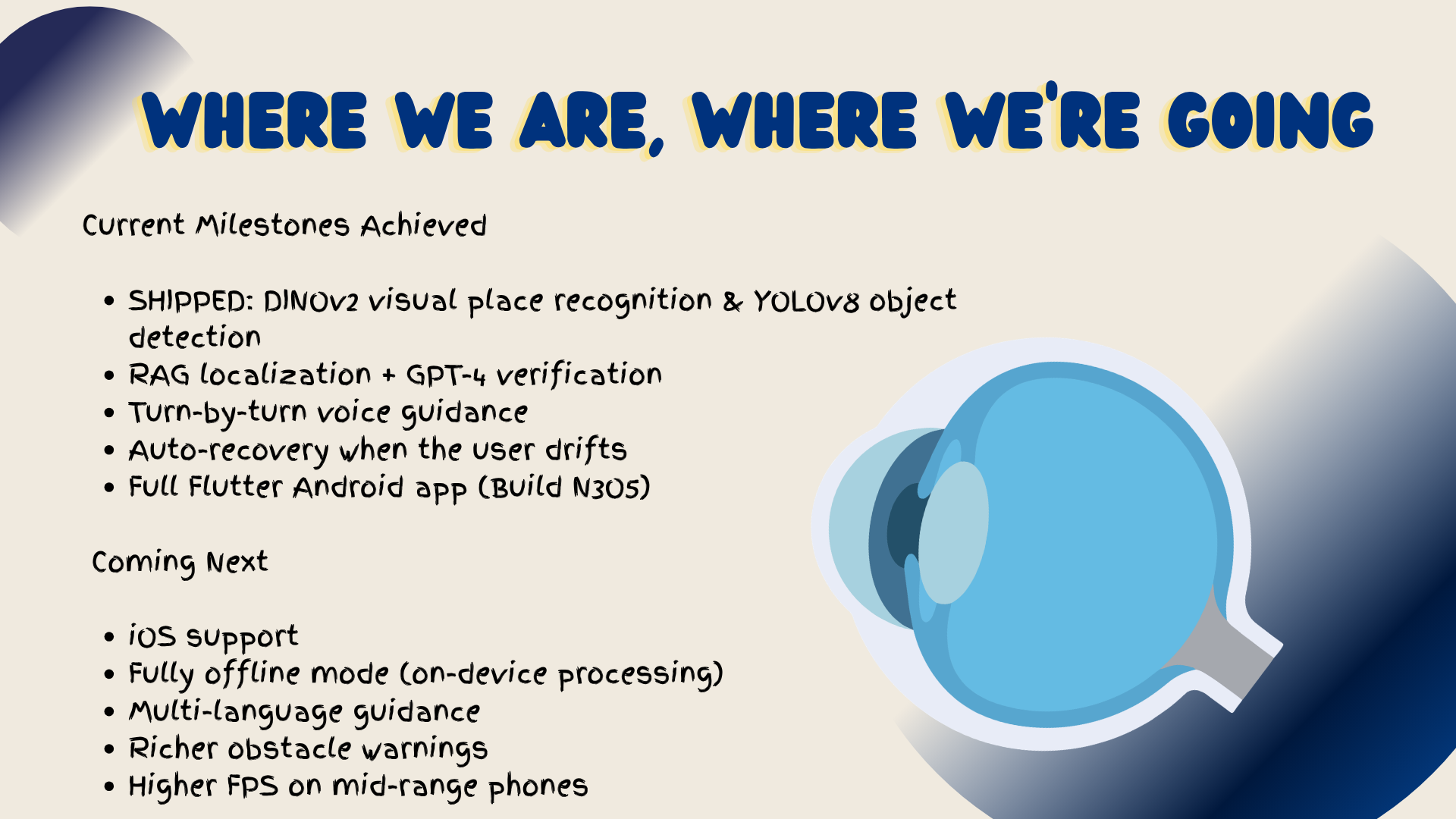
🍎 iOS support · 📴 fully on-device embeddings · 🌐 multi-language guidance · 🚧 richer obstacle classes (doors, stairs, wet floors) · ⚡ higher FPS on mid-range phones
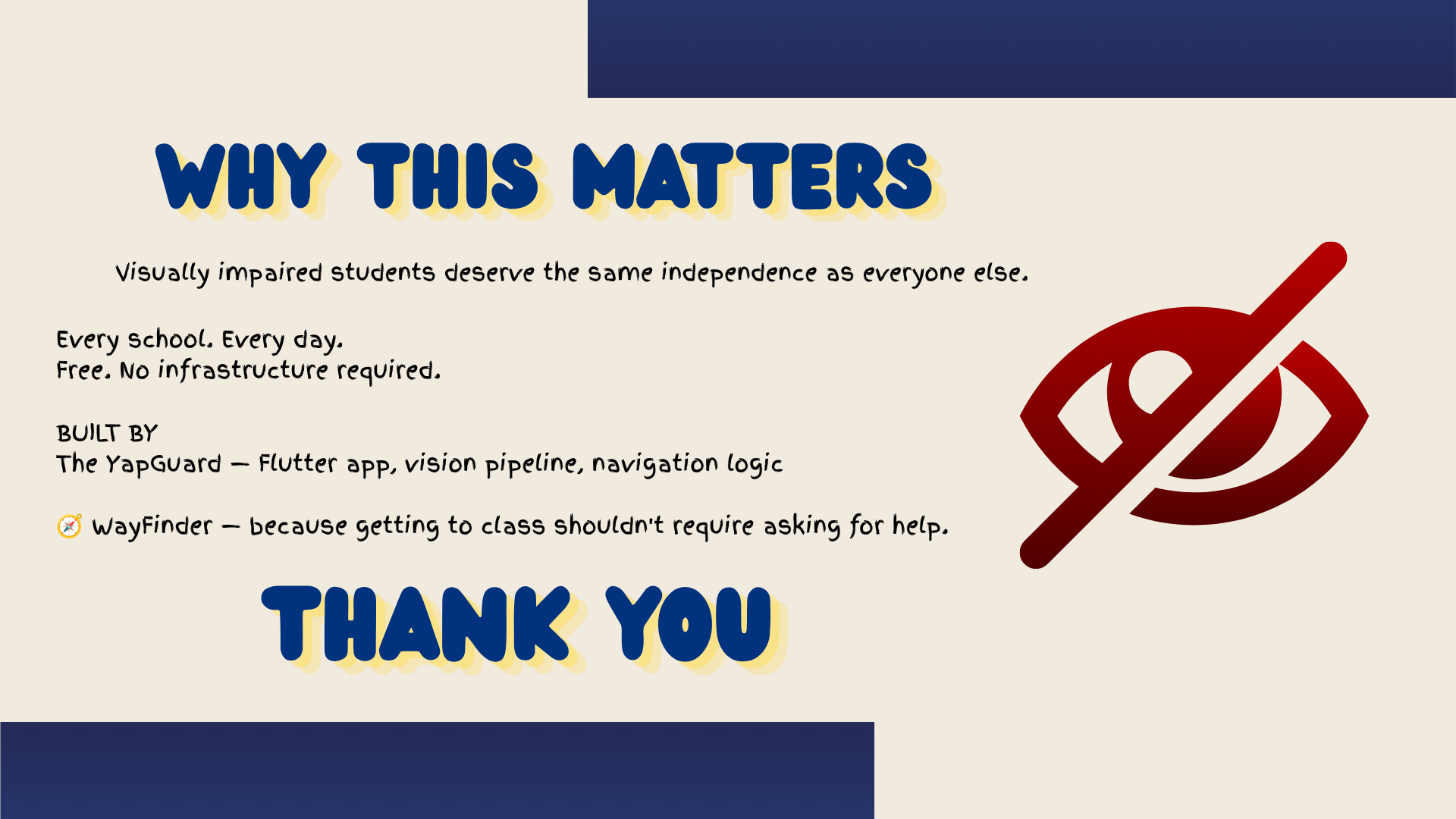
**WayFinder** — because getting to class shouldn't require asking for help. 🧭❤️
Built With
- accessibility
- ai
- assistive-technology
- computer-vision
- dart
- deep-learning
- dinov2
- fastapi
- flutter
- flutter-tts
- google-stt
- gpt-4
- indoor-navigation
- machine-learning
- natural-language-processing
- picovoice-porcupine
- postgresql
- python
- pytorch
- rag
- stable-diffusion
- supabase
- visual-place-recognition
- yolov8
