Inspiration
Having a learning roadmap is useful, but a roadmap alone does not always tell a learner where they currently are or what they should focus on next.
As a beginner, I found that having a long list of topics can sometimes create another question: "Where am I supposed to start?"
I wanted to build something that could make a learning roadmap more personal and easier to follow.
That idea became WayFinder — a beginner-friendly web app that helps learners understand their current position in a learning path and identify what they should learn next.
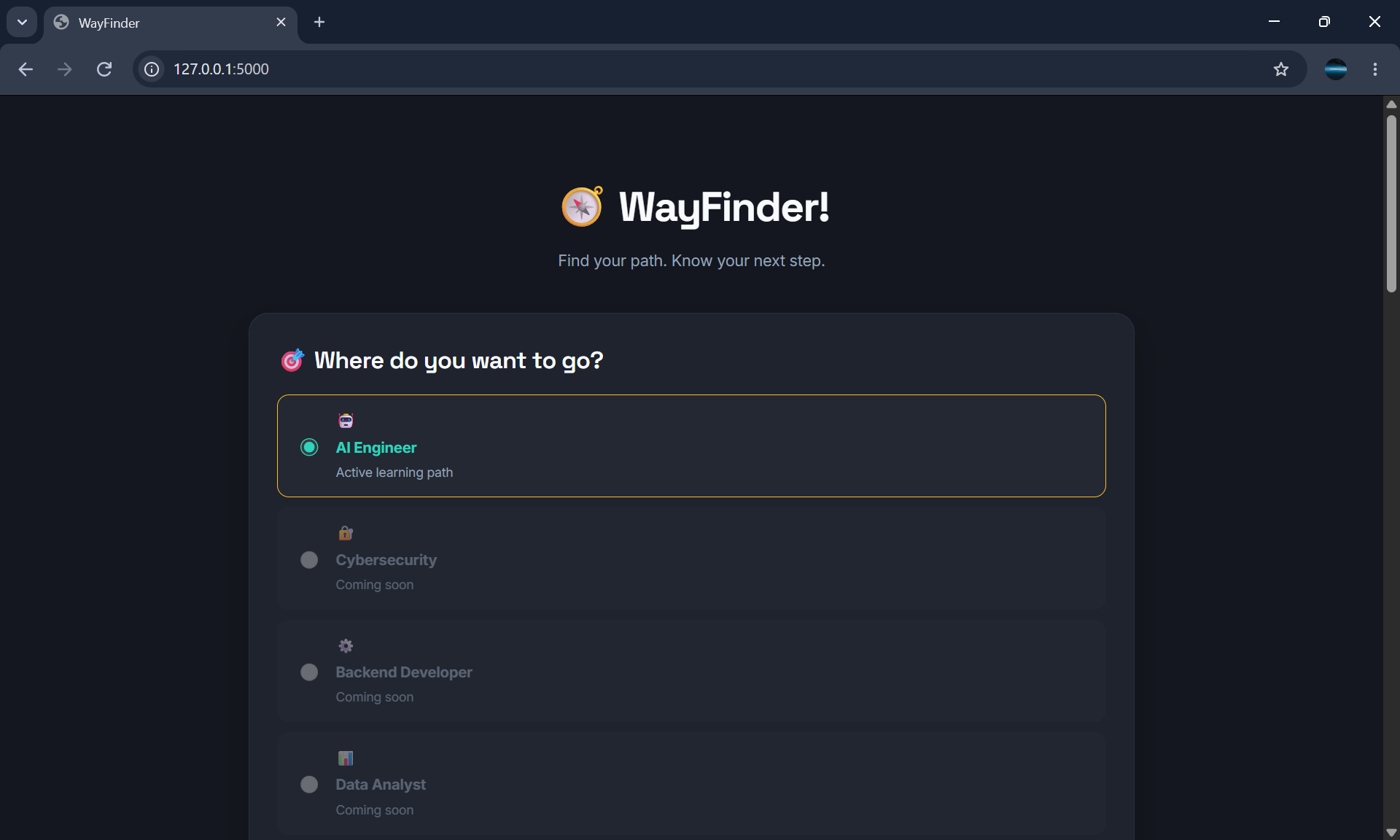
Currently, WayFinder focuses on the AI Engineer learning path.
What it does
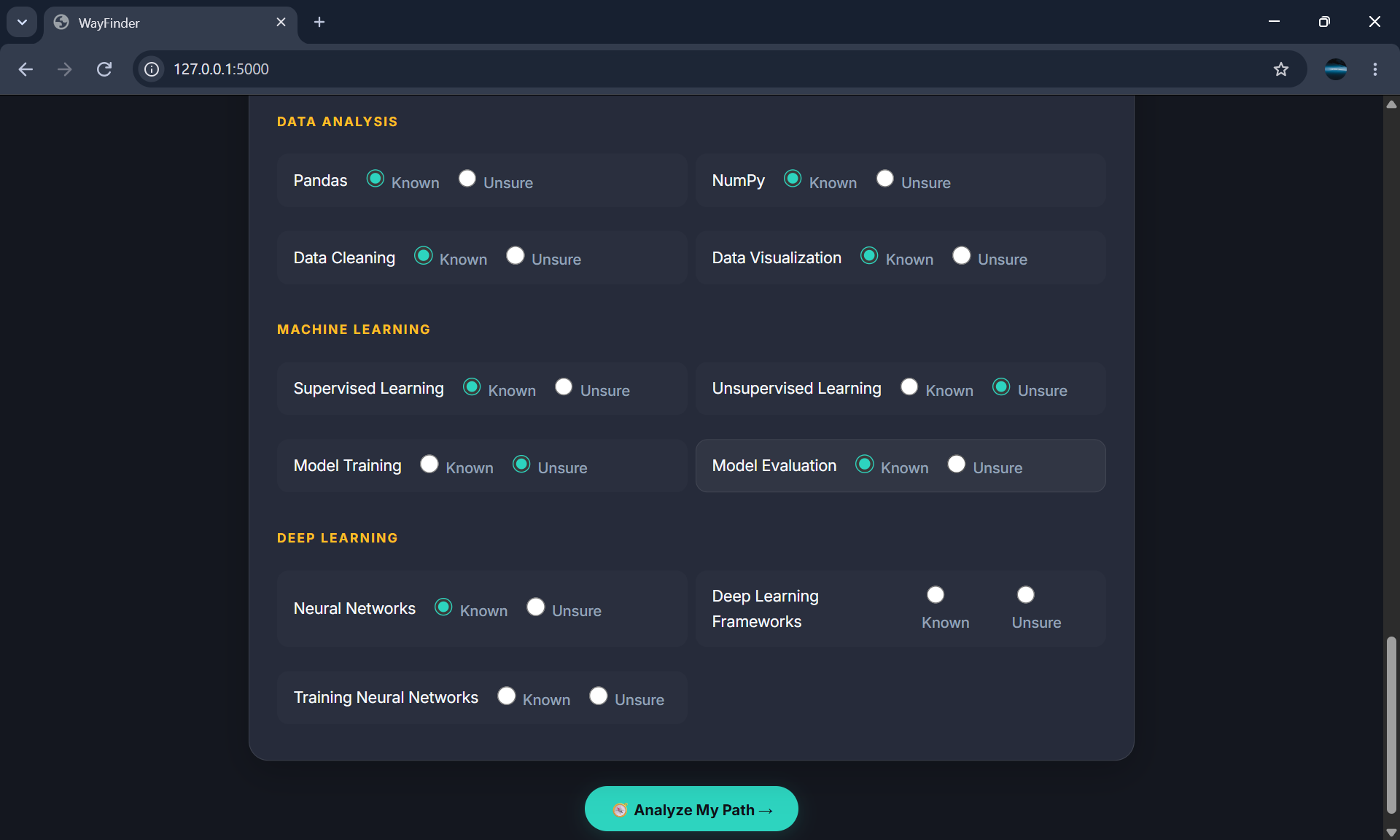
WayFinder allows users to choose a learning goal and mark their skills based on their understanding:
- Known — the skill is understood.
- Unsure — the skill has been learned or encountered, but is not fully understood.
- Unlearned — the skill has not been learned yet.
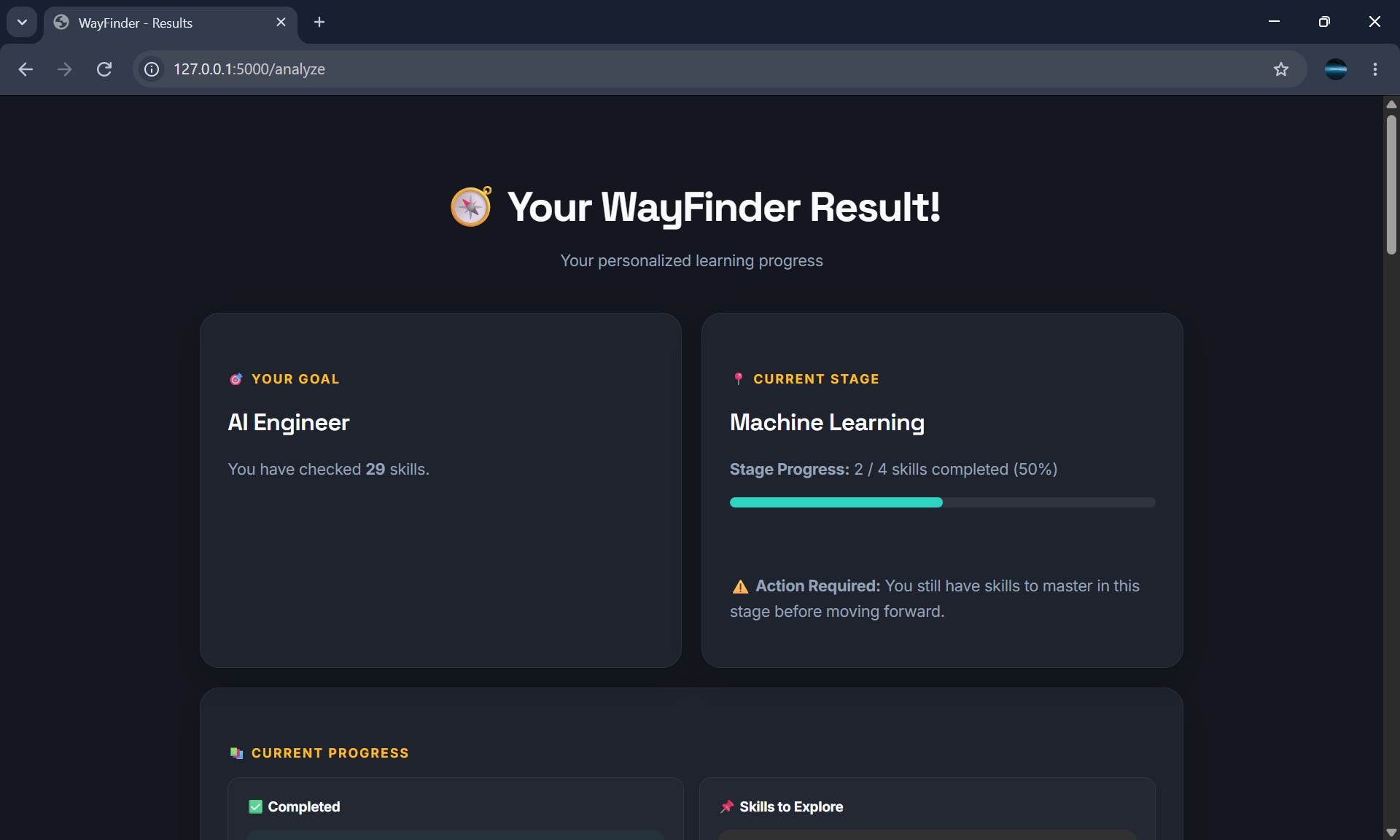
WayFinder analyzes this information against its learning roadmap and determines the user's current stage and progress.
The result shows the user's:
- Goal
- Current Stage
- Progress
- Detected Skills
- Next Step
- Recommended learning resources
- Full learning roadmap
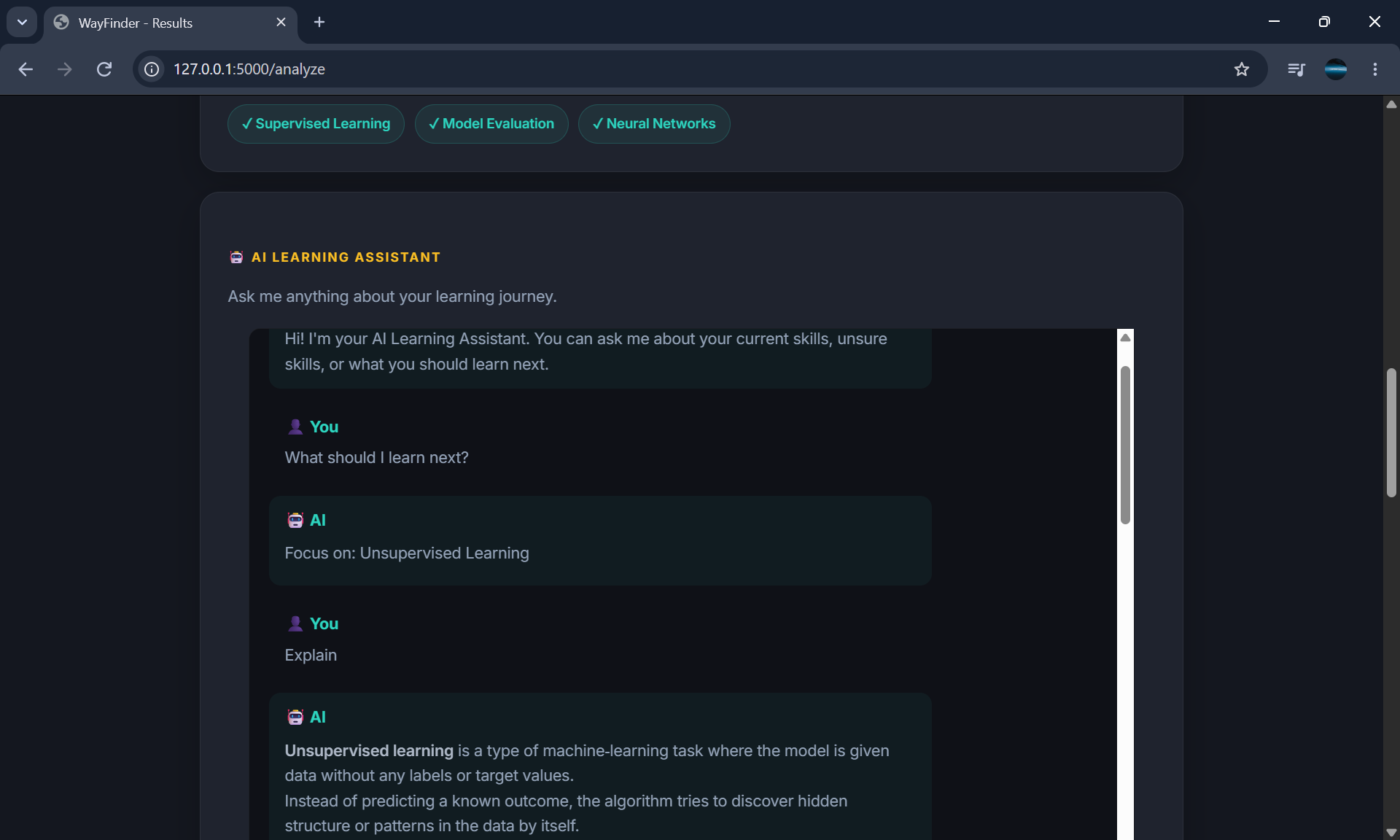
WayFinder also includes an AI Learning Assistant powered by the Groq API. The assistant receives the user's learning context, allowing it to provide explanations and guidance that are relevant to the user's current position.
How we built it
I built WayFinder step by step, starting with the learning roadmap and then developing the application around it.
The development process was:
Idea → Learning Roadmap → Flask Application → Skill Detection → Progress Analysis → Result Page → AI Learning Assistant → Testing → UI Polish
The roadmap is stored as structured JSON data. Flask handles the application logic, including skill tracking, stage detection, progress calculation, and next-step determination.
The frontend was built using HTML, CSS, and JavaScript.
For the AI Learning Assistant, I integrated the Groq API and provided it with relevant learning context, including the user's goal, learned skills, unsure skills, current stage, and roadmap position.
Challenges we ran into
One of the biggest challenges was debugging the learning logic.
I had to make sure that skills marked as unsure were not accidentally treated as mastered skills. I also needed to correctly determine the user's current stage based on the order of the learning roadmap.
Another challenge was making the AI assistant follow the application's learning context instead of independently choosing a different learning path.
I tested different edge cases, including:
- No skills selected
- All skills learned
- All skills marked as unsure
- AI/API errors
- Completing the entire roadmap
- Messages exceeding the input limit
These tests helped me find and fix logic problems that were not always obvious during normal usage.
Accomplishments that we're proud of
I'm proud that I was able to turn the initial idea into a working web application with a complete learning flow.
WayFinder can now take a user's skill input, determine their current stage, calculate their progress, identify their next step, provide learning resources, display the full roadmap, and provide contextual AI assistance.
I'm also proud of the testing and refinement process. Instead of only testing the normal user flow, I tested multiple edge cases and improved the application based on the problems I found.
What we learned
Through this project, I learned much more than just Python.
I learned how to:
- Build a web application using Flask
- Connect frontend and backend
- Work with JSON data
- Integrate an external API
- Design application logic around structured data
- Debug logic problems
- Handle errors
- Test edge cases
- Improve a project through iteration
More importantly, I learned that building a project is not only about making the main feature work. A usable application also needs to handle unexpected inputs, keep different parts of the system consistent, and be tested from different perspectives.
This project also taught me how to use AI as a development and learning assistant while still understanding and testing the code myself.
What's next for WayFinder
WayFinder is currently focused on the AI Engineer learning path, but the system was designed with the possibility of supporting additional learning paths.
Future improvements could include:
- Adding more career learning paths
- More personalized learning recommendations
- Better handling of partially understood skills
- More learning resources
- Improved progress tracking over time
- More context-aware AI assistance
The goal is to make WayFinder more useful for learners who know what they want to learn, but are not always sure what their next step should be.

Log in or sign up for Devpost to join the conversation.