Inspiration
The challenge proposed by Marshall Wace was to "explore New Worlds." Our team spent over an hour brainstorming in an attempt to define what makes a new world. We played around with ideas of the cosmos and astrophysics, then went the opposite way with marine life and the depths of our very own oceans. We considered exploring what makes technology inaccessible and unreachable to certain groups of people and how to overcome that, but ultimately we settled on the simple answer: our very own world, the one we fancy ourselves greatly knowledgeable in, and how ignorant we really are to it.
Market research shows that over 70% of people looking to travel around the world are overwhelmed by how much information there is to consume before locking in a travel destination. In many cases, the factors preventing travellers from exploring new worlds aren't financial or logistical, but caps of self-doubt and decision paralysis. This is supported by the note that a further 60% of people claim they're overwhelmed by the amount of options they're presented with when it comes to picking where to go next.
There is a significant gap in the market where a tool such as ours could live. Products comparable to ours are comprised generally of either one-man developer passion projects or overengineered tools offered by travel companies built to make customers spend the most they can.
With that noted, our team decided to spend this hackathon bridging said gap and finding a way to offer something fun and useful to travellers whilst keeping it profitable and scalable.
What it does
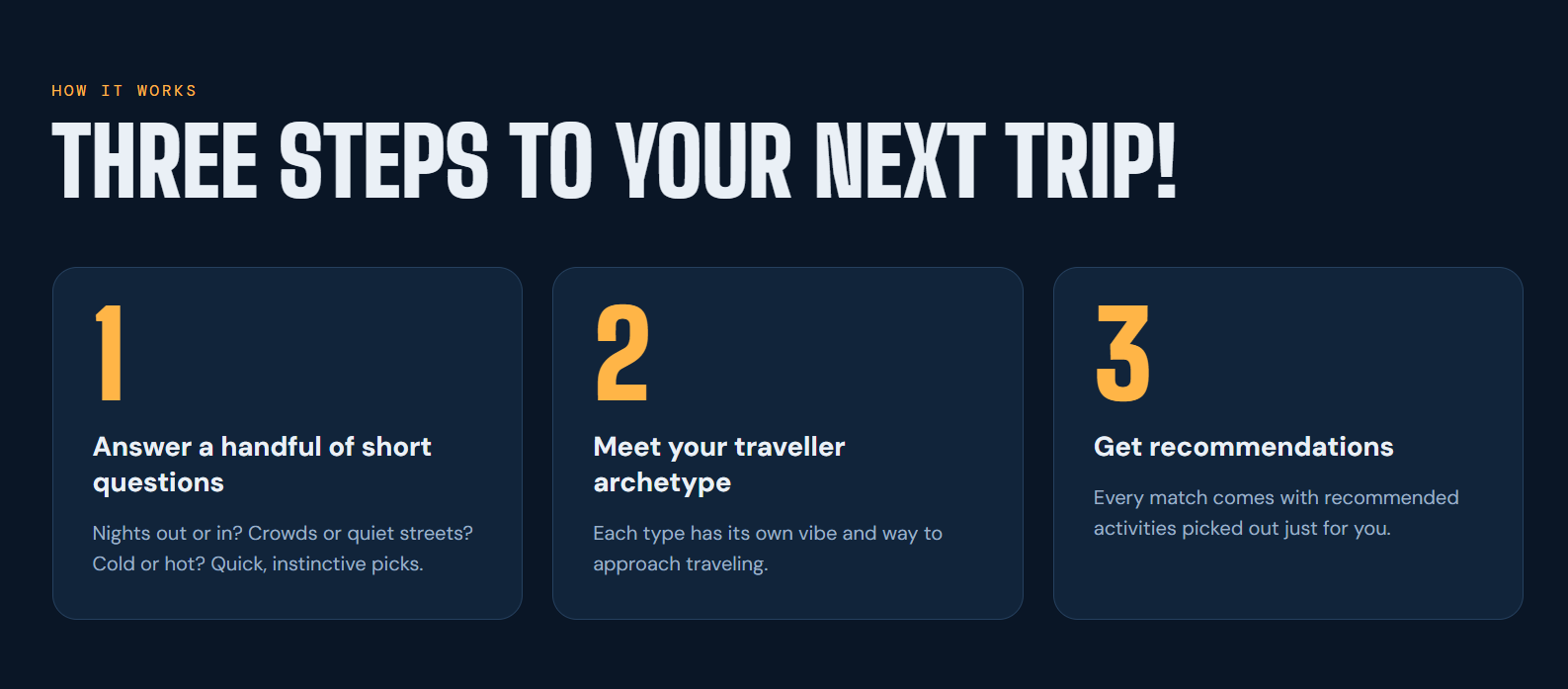
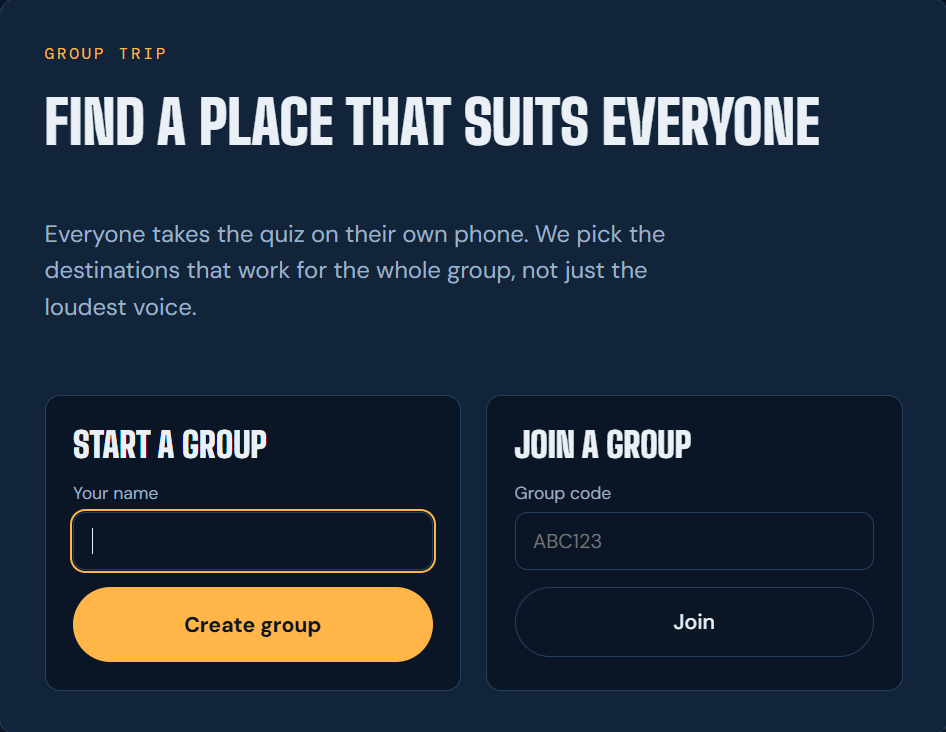
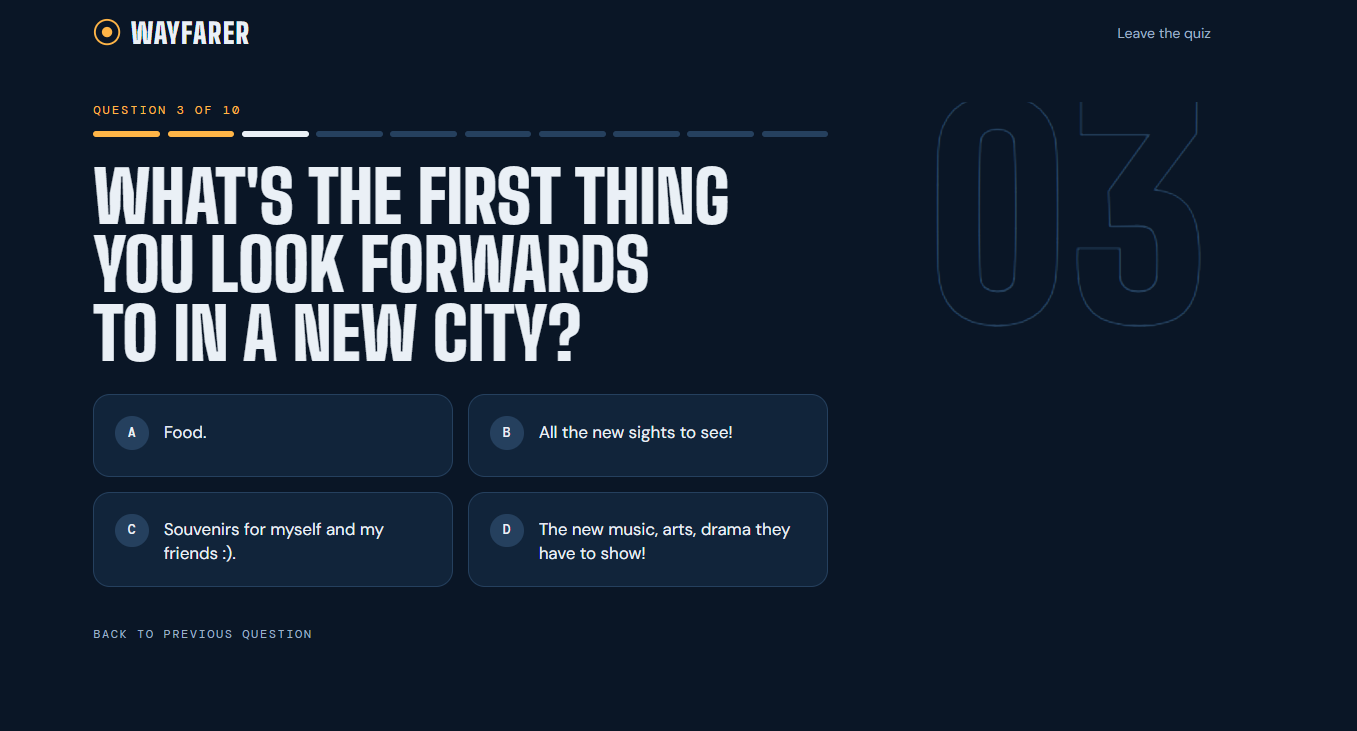
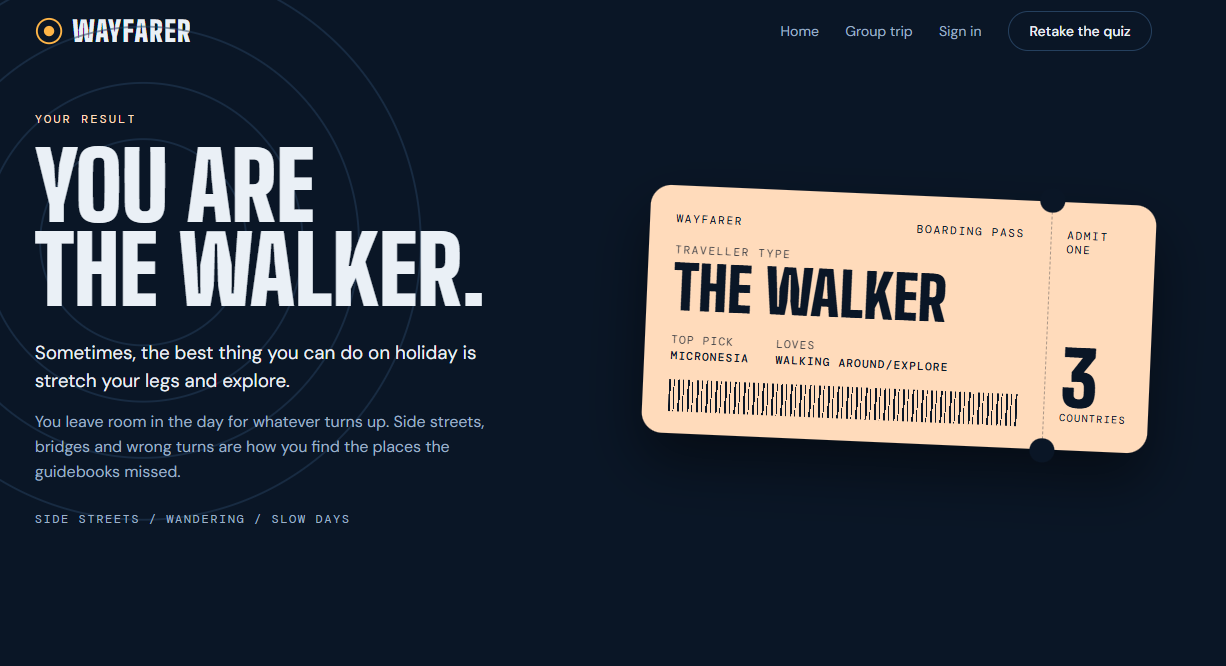
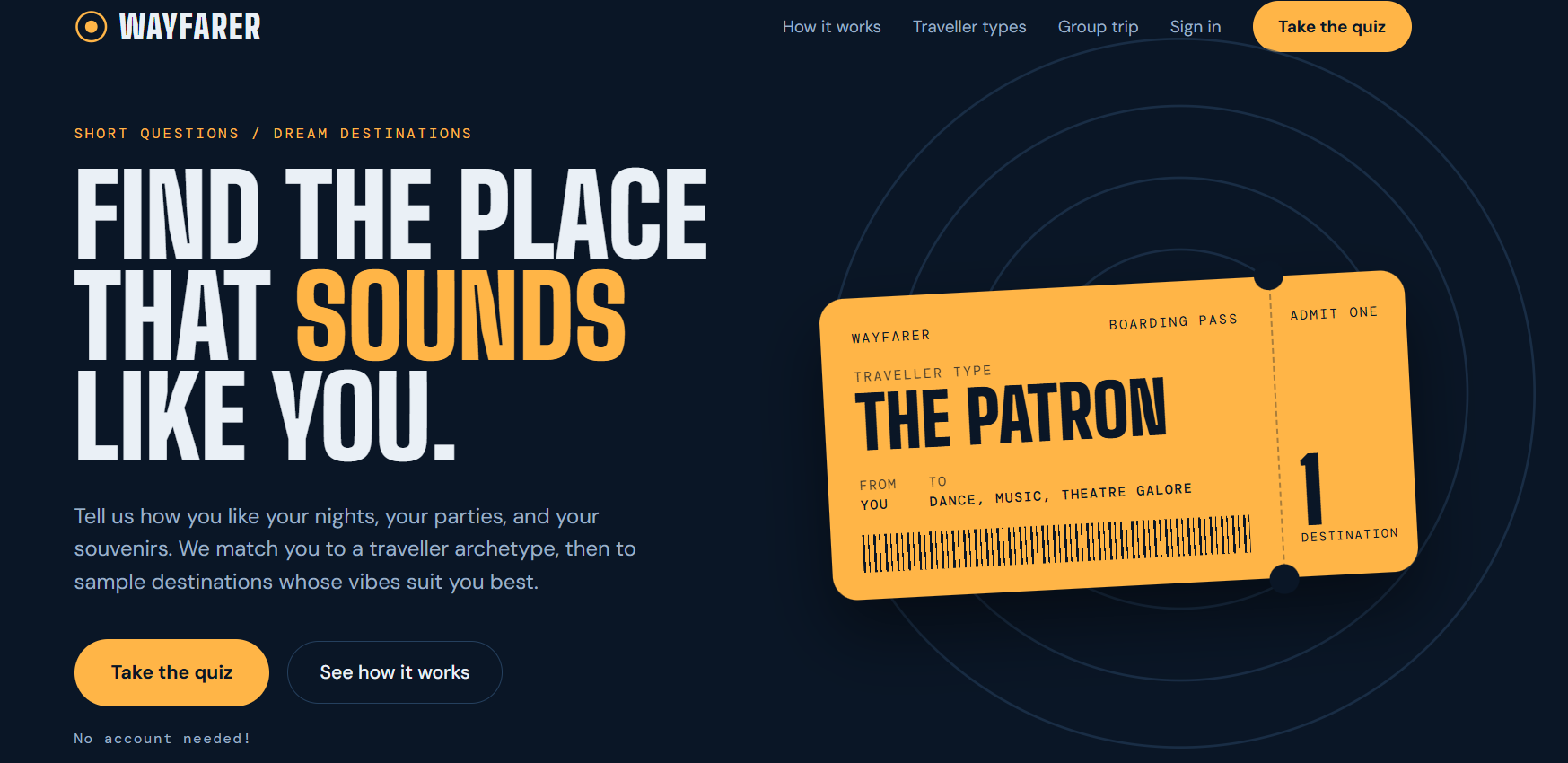
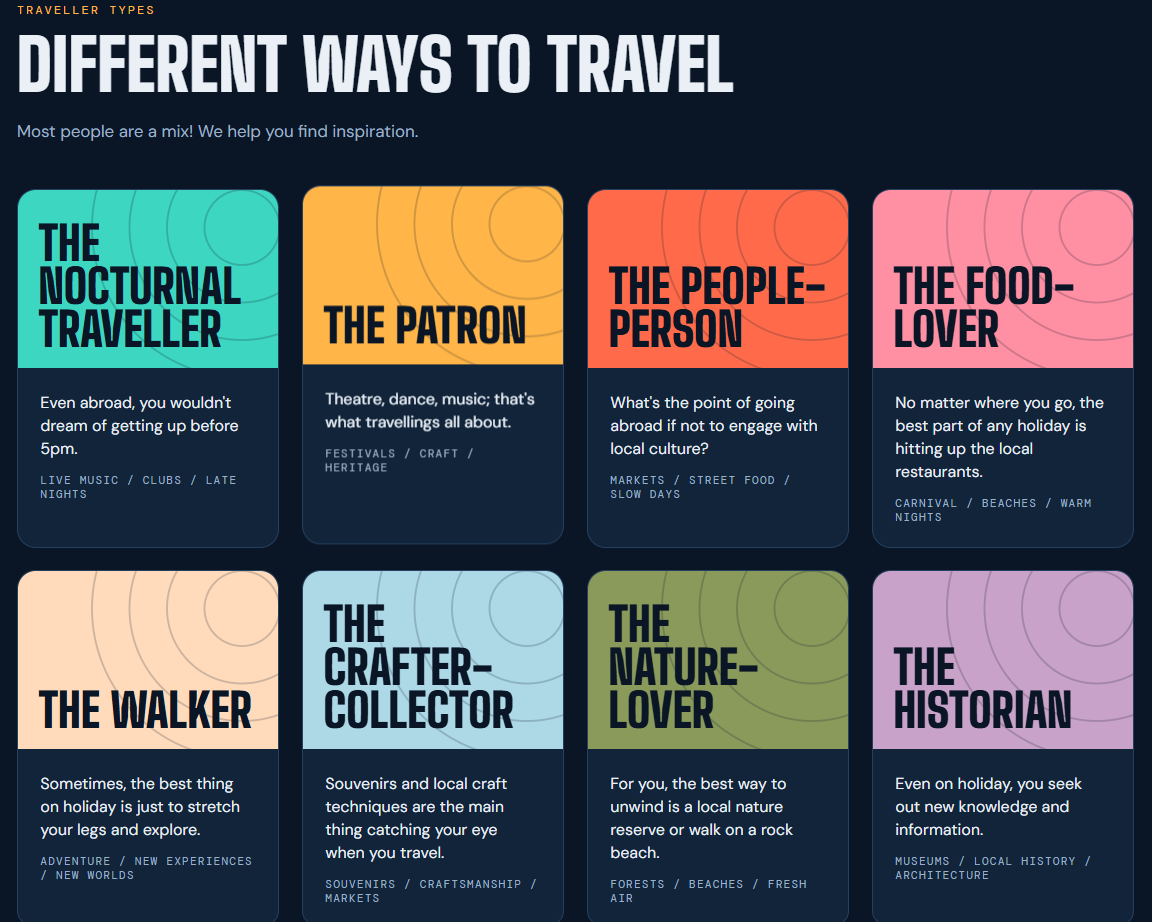
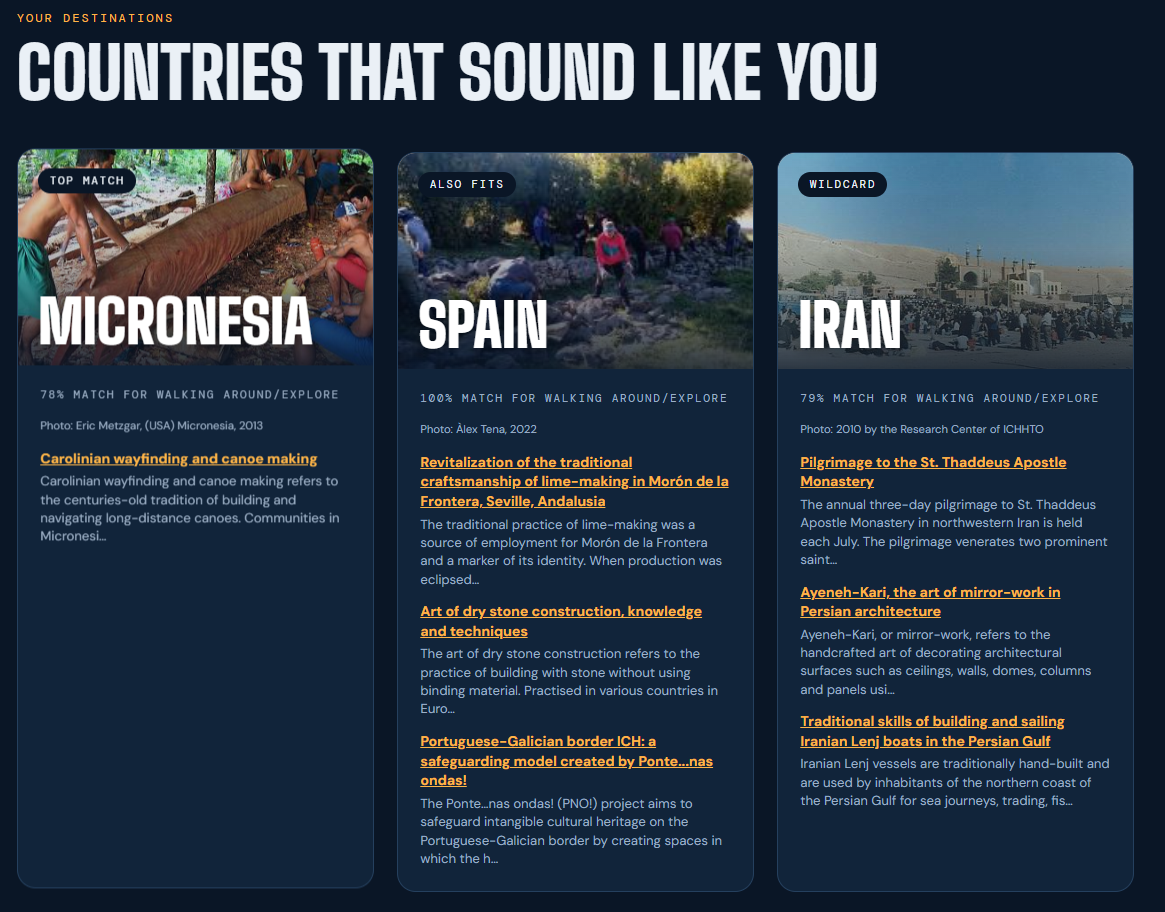
Our product is a simple website that allows the user to take a short 10-question personality quiz to determine what sort of traveller the user is. Some archetypes include the historian, the nature-lover, and the foodie. Once the user is assigned a type, our site pulls from UNESCO's databases to identify 3 countries that match with the user's archetype, offering options from popular touristic destinations to hidden gems. The site will then also suggest activities the user might be interested in doing in each location, for instance local festivals, cultural activities, or museums of interest.
More adeptly, though, what our product does is dispel decision paralysis and make finding new and unfamiliar worlds a significantly more approachable venture. Two minutes and a ten-question quiz is all it takes!
How we built it
The database was built in supabase. The datasets I found include:
- UNESCO Intangible Heritage Database
- Our World In Data Seasonal Global Temperatures
I then used Google Colab and the python libraries pandas, numpy, and files to clean the datasets, make new dataframes for required fields, convert this into csv files and exporting them. Once this was complete, I opened the csv files in google sheets to check them in detail before importing them into the tables created in supabase.
Tables were created by running SQL commands to create the fields and declare the primary keys (PKs) and foreign keys (FKs). Then the csv files were imported.
The process of linking the tables was fairly difficult as I had to decide which fields would work best as PKs and FKs. I used gemini to generate the table fields of the linking tables after I prompted it with which ones I thought should be the PK/FKs.
I ended up adding an extra countries table as the unesco dataset used the iso3 country codes whereas the weather app used the 2 character country codes.
The concept_categories table was created to group the "primary concepts" of the activities listed in the unesco dataset into our traveller archetypes for accurate matching.
The quiz works by assigning features from the concept_categories table to each answer and tallying up the prominence of each feature at the end
Challenges we ran into
Early into the weekend, our goal was to match personality archetypes to locations with AI with Gemini. We planned the functionality around exporting the quiz results as JSON and sending them to Gemini as a prompt. After a few hours of planning and development, everything broke and Gemini would not respond to requests. We spent a further couple of hours attempting to fix what had broken (to no avail), and ultimately came to the conclusion that for the sake of arriving at an MVP by the end of the hackathon, we would have to shift the goalpost back and categorise the users deterministically.
Ultimately, our team is satisfied with the results and we're all aware that, with more data and time, the product is in a position to get better and scale up. There is potential for future AI integration, but we do not see it as a detriment that we had to change our original plan halfway through.
Accomplishments that we're proud of
We had to work with people we had never worked with before, with technologies we had never worked with before, in what was every team member's first proper hackathon. We had to overcome pressure and self-doubt as well as doing our best to maintain communication and professionalism in an environment where time was of the essence.
As a team, we're proud of the divide of workload and our project management. We're happy with our efforts in learning and adapting to new technologies necessary for the product development, and ultimately, we're happy that we managed to enjoy it and think of a solution we are genuinely passionate about, that we all agree is both useful as well as fun to develop.
What we learned
During this project, we built up both our technical and our soft skills. We learned how to collect, clean, and manage relevant data, and we learned how to use several new, relevant tools that we'd had no experience with previously. We learned how important market research is in the early planning stages and being patient with the brainstorming process before committing to an idea, with the goal of maximising efficient development time.
Just as importantly though, we learned the value of good communication within the team. With proper communication we could avoid wasting time resolving pointless merge conflicts and either working on the same thing or being stuck waiting for a teammate to finish a prerequisite to your task. This also enabled us to truly understand each other and each other's strengths and appropriately split the workload as a result. We saw that many other useful skills emerge from simply communication, that includes time management, efficiency, and problem solving.
What's next for Wayfarer
Our product's quality is directly proportional to the quality and size of our data. This weekend we pulled from one UNESCO database of about 360 records, but the aim is to collect and track cultural activities, festivals, food spots, and much more in real-time both through other trustworthy databases and social media.
Our goals are higher personalisation of results and more information to interact with as a result, for instance price prediction and itinerary generation.
Built With
- colab
- javascript
- npm
- python
- sql
- supabase
- vite

