Inspiration
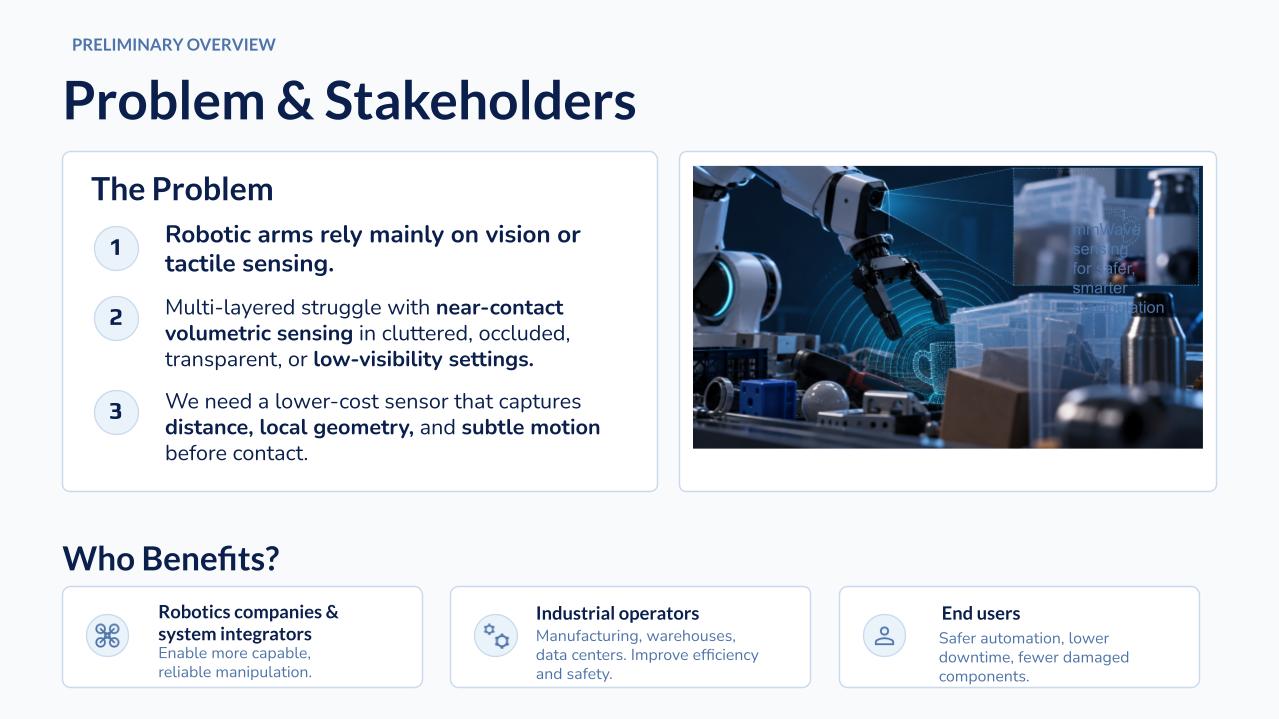
Robots are becoming increasingly capable, but reliable interaction with the physical world remains difficult. Robotic manipulation typically relies on vision for perception and tactile sensing for contact, both of which have limitations in challenging environments such as occlusion, poor visibility, and difficult-to-see materials.
That led us to ask: What if we could give robots another sense?
We began exploring millimeter-wave (mmWave) radar and its potential to provide robots with information about their immediate surroundings before physical contact.
What it does
Wavvy explores using mmWave radar for pre-touch robotic perception.
Our proposed solution is to mount an mmWave sensor near a robotic gripper and investigate whether radar measurements can provide useful information about distance, local geometry, and subtle motion as the robot approaches an object.
Rather than replacing cameras or tactile sensors, our goal is to explore whether mmWave can provide an additional sensing modality that makes robotic manipulation more robust.
How we built it
Wavvy is currently in the early research and design stage, so we have not built the physical system yet.
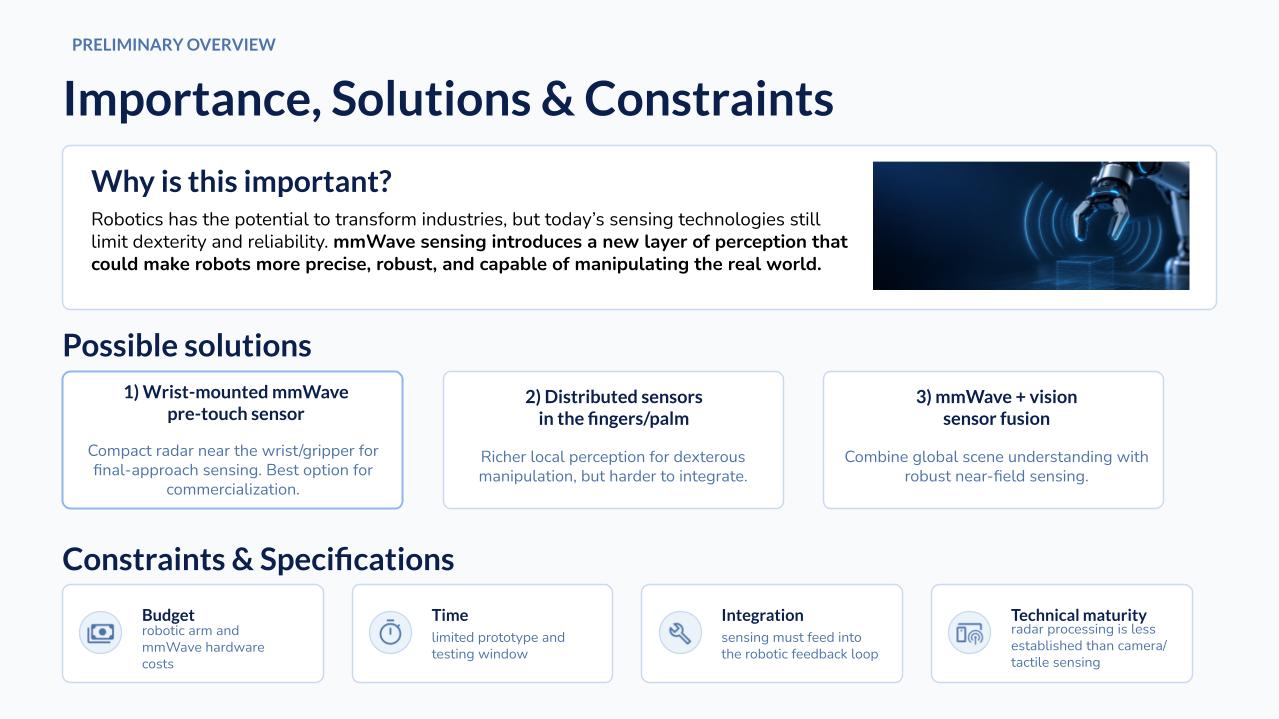
So far, we have defined the problem, researched existing robotic sensing approaches, explored potential applications of mmWave radar, and compared several possible system concepts. From this work, we narrowed our initial direction to a wrist-mounted mmWave sensor for pre-touch perception.
Our next step is to translate this concept into a working prototype and begin experimentally evaluating what information the sensor can reliably provide.
Challenges we ran into
Our biggest challenge so far has been narrowing a broad technology into a specific, testable robotics problem.
mmWave radar has several potentially useful properties, but demonstrating that a sensor can detect something is very different from showing that its measurements provide actionable information for robotic manipulation.
We have also had to consider practical constraints including hardware cost, available development time, integration complexity, and how we can meaningfully evaluate the value of mmWave sensing.
Accomplishments that we're proud of
Our biggest accomplishment at this stage is solidifying the problem and solution direction.
We explored several concepts, including distributed mmWave sensing across a robotic hand and combining mmWave with vision. We ultimately narrowed our initial focus to wrist-mounted pre-touch sensing, giving us a specific hypothesis that we can prototype and test.
What we learned
Our early research has taught us that adding a new sensing modality to a robot is not valuable simply because it provides more data. The important question is whether that data provides new, reliable, and actionable information that improves how the robot interacts with its environment.
This insight helped us move from broadly exploring mmWave robotics to a much more focused question: Can mmWave provide useful pre-touch perception for robotic manipulation?
What's next for Wavvy
Next, we plan to select and integrate the mmWave hardware, develop our first prototype, and design experiments to characterize what the sensor can reliably perceive at close range.
From there, we will evaluate whether those measurements can meaningfully contribute to robotic manipulation and explore more advanced approaches such as distributed sensing and mmWave + vision sensor fusion.

Log in or sign up for Devpost to join the conversation.