-
-
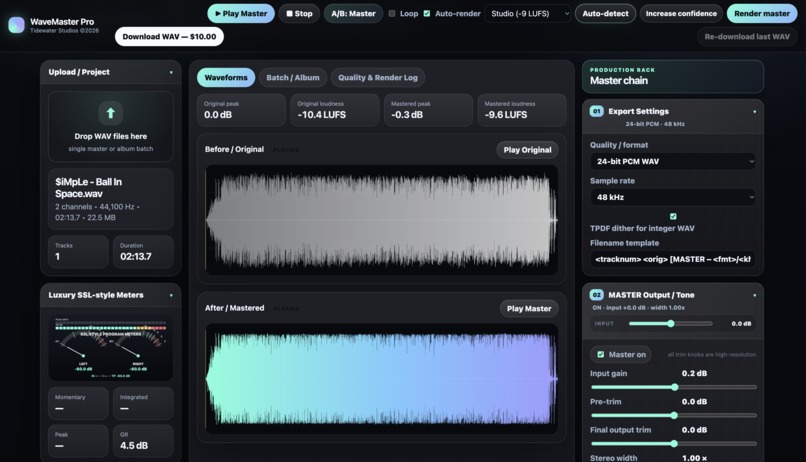
WaveMaster Professional
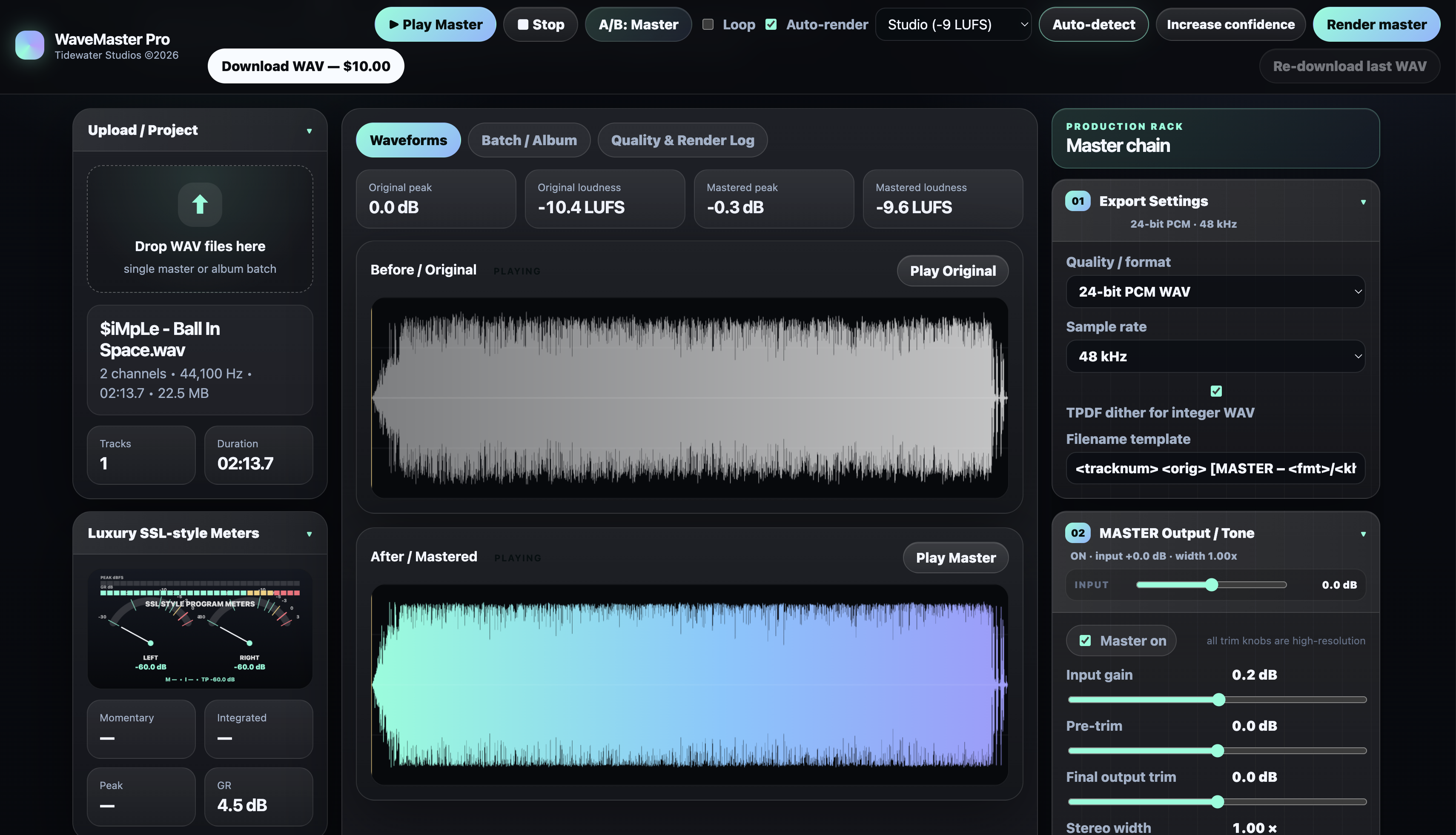
WaveMaster Professional
Inspiration
WaveMaster Professional grew out of my experience learning from mastering engineer Robert Honablue in Brooklyn, New York, whose credits include work connected to artists such as Led Zeppelin, Miles Davis, and Wu-Tang Clan.
One of the most important things he taught me was that great mastering is not about using the most complicated chain possible. It is about understanding why each part of the chain is there and applying it with intention. When he reviewed my mastering process, he confirmed that I was using the same fundamental approach he used professionally.
That validation inspired me to turn my workflow into software that could help other artists prepare their music for release.
What it does
WaveMaster Professional takes finished audio mixes and transforms them into polished, release-ready masters.
It helps artists and producers improve the clarity, balance, loudness, and overall presentation of their music before distributing it to streaming platforms.
What began as a single-track mastering tool has evolved into a broader album-production suite, allowing users to work through multiple songs as part of one consistent release workflow.
How we built it
WaveMaster Professional was developed over approximately eight months.
The first version was written in Python and focused on one mastering workflow. I continued testing, rebuilding, and refining the system until it grew into a complete set of tools for preparing both individual tracks and full albums.
A major goal throughout development was to translate a real mastering workflow into a product that feels approachable. The software handles the technical processing while giving artists a practical way to move from a finished mix to a polished master.
Challenges we ran into
Audio encoding was one of the earliest and most difficult challenges.
During the first iterations, audio data would sometimes become corrupted during processing, causing the resulting waveforms to sound scrambled. I also encountered latency and playback issues that made it difficult to create a reliable user experience.
Solving those problems required repeated testing across different audio files, formats, and processing conditions. Each failure helped reveal another edge case in the audio pipeline.
Eventually, I was able to stabilize the encoding and processing workflow and bring those individual pieces together into the version of WaveMaster Professional that exists today.
Accomplishments that we're proud of
I am especially proud that WaveMaster Professional has allowed me to build a vertically integrated workflow for my independent label.
Recording, mixing, and mastering can now be handled in-house using a process grounded in professional mastering principles. Instead of relying on several disconnected tools or services, I was able to turn a proven studio workflow into one cohesive platform.
I am also proud that the project grew beyond its original purpose. It started as a personal mastering tool and became a complete suite capable of supporting an album from the final mix stage through release preparation.
What we learned
The biggest lesson was the importance of having a large and varied collection of test material.
A mastering workflow may perform well on one song and struggle with another, so testing across different genres, recording styles, loudness levels, and mix conditions was essential.
I also learned how valuable it is to share unfinished work with friends and other musicians. Their reactions often revealed usability issues and opportunities that were difficult to notice while working alone.
Building WaveMaster Professional reinforced that strong creative software comes from a combination of technical testing, real-world feedback, and a clear understanding of the people who will use it.
What's next for WaveMaster Professional
The current SaaS version is working well, so the immediate focus is continuing to improve its reliability and user experience.
I am also exploring a desktop version of WaveMaster Professional. A desktop application could offer artists and engineers a more integrated local workflow while complementing the accessibility of the browser-based platform.
The long-term vision is to make professional release preparation more accessible to independent artists without removing the knowledge, care, and creative judgment that make mastering valuable.


Log in or sign up for Devpost to join the conversation.