-
-
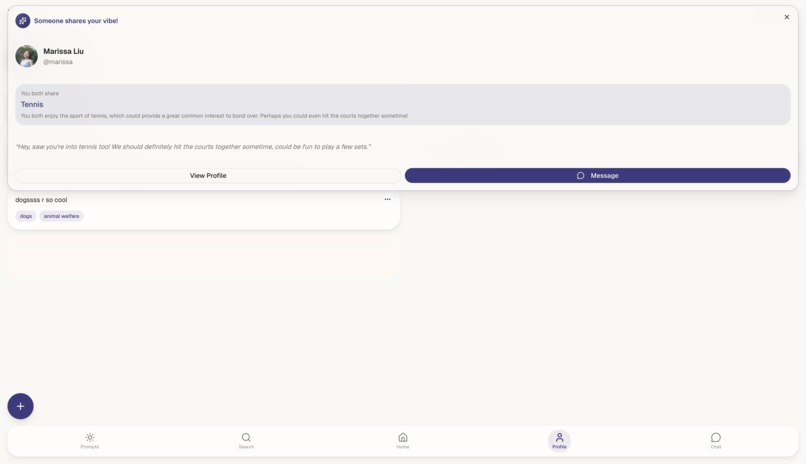
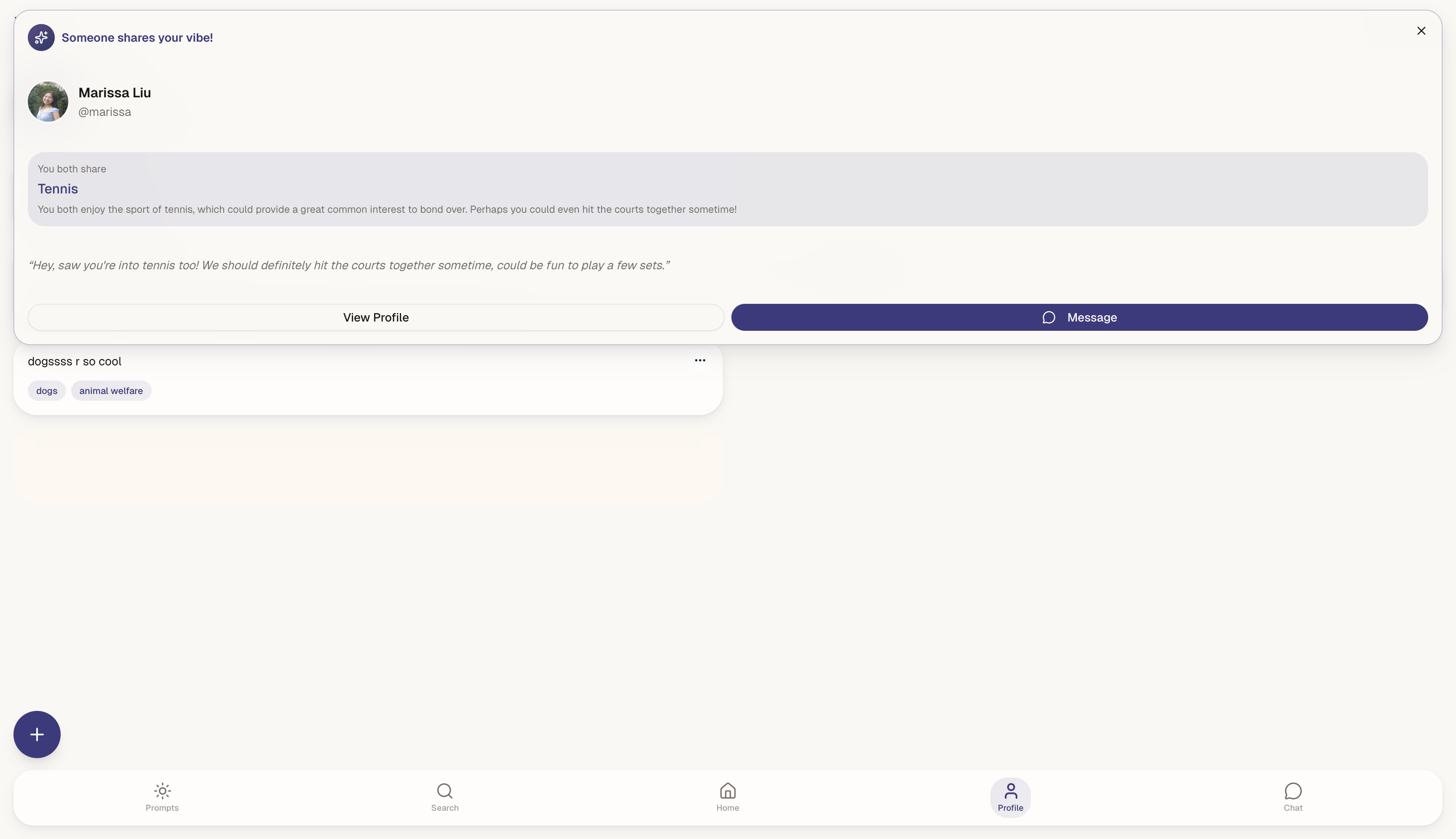
Friend suggestion
-
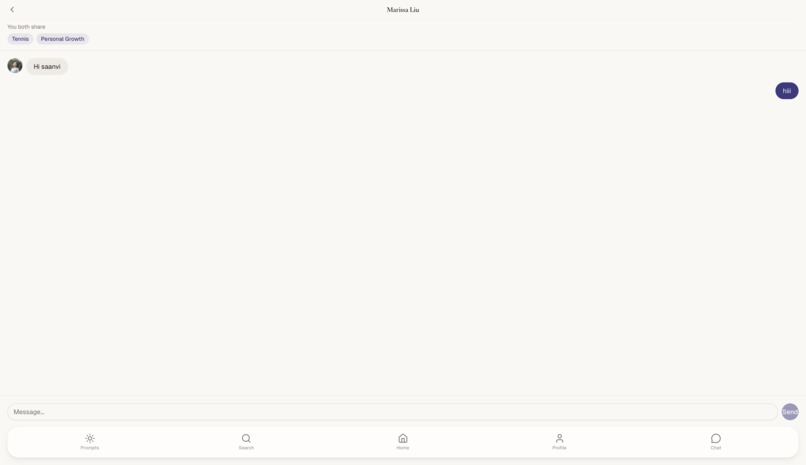
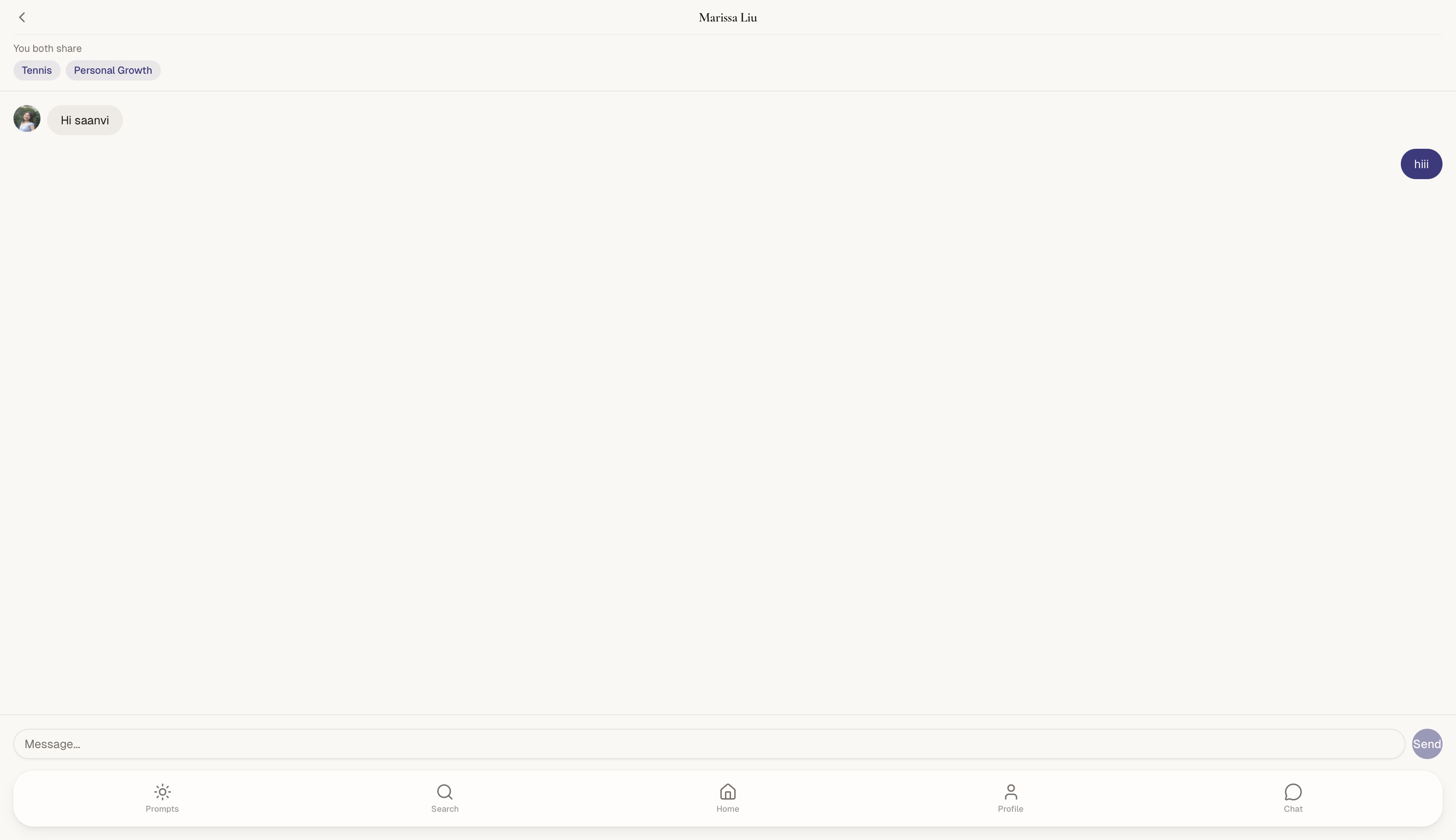
Message window, note the shared interests bubbles
-
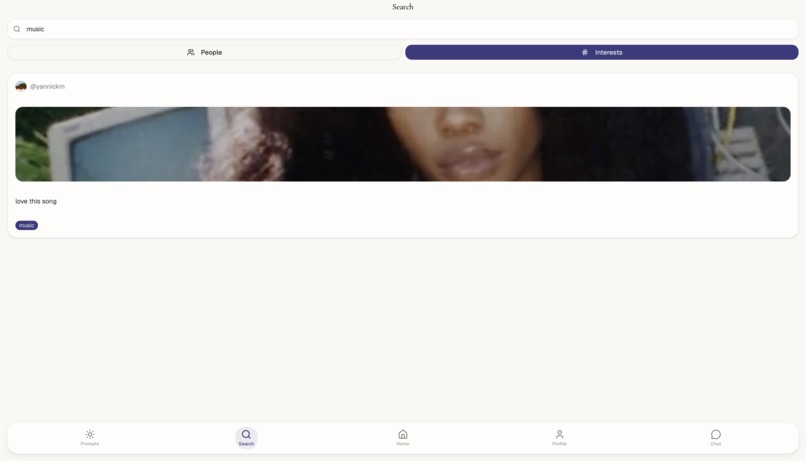
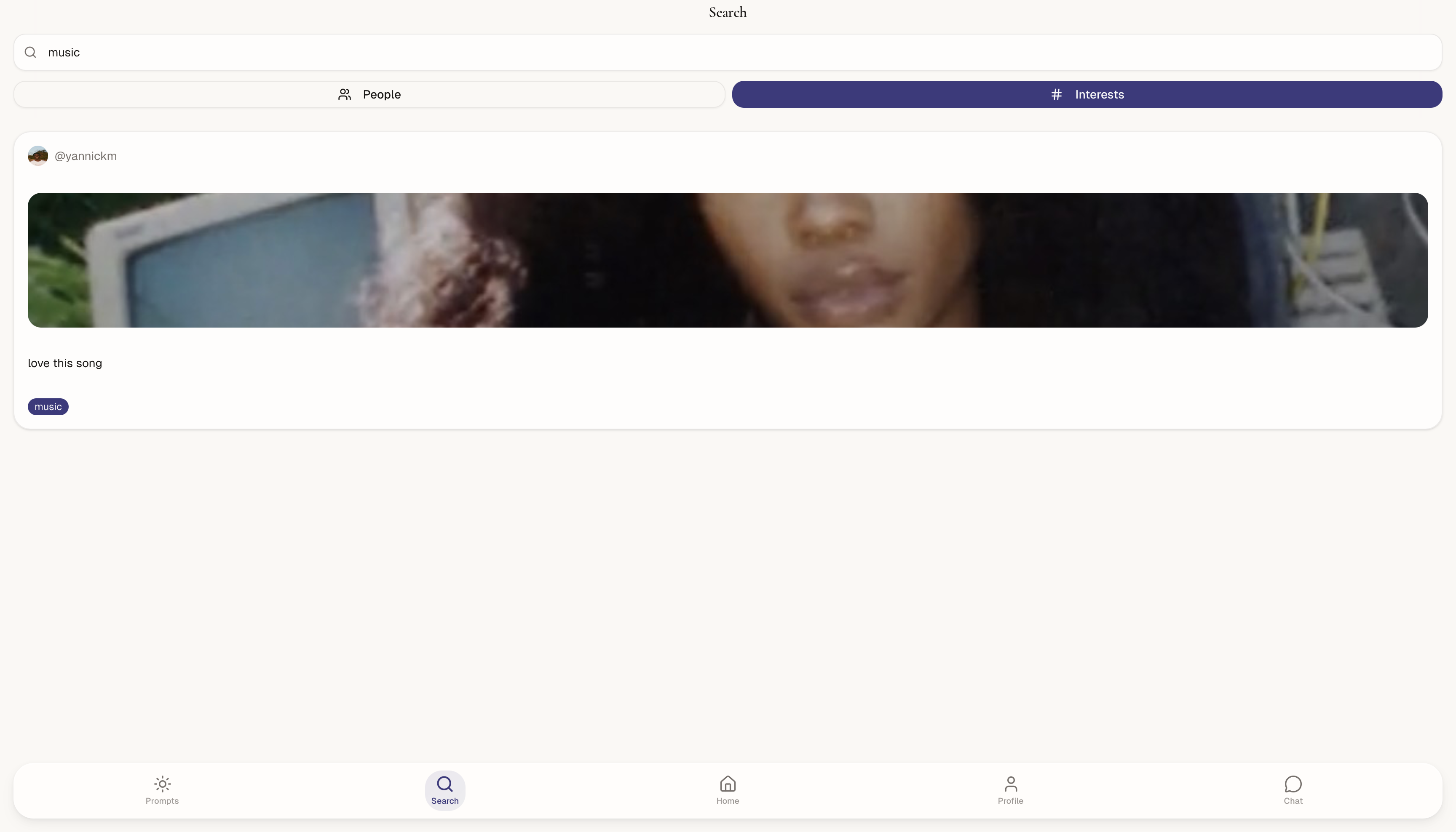
Looking for people based on interests ("music" in this case)
-
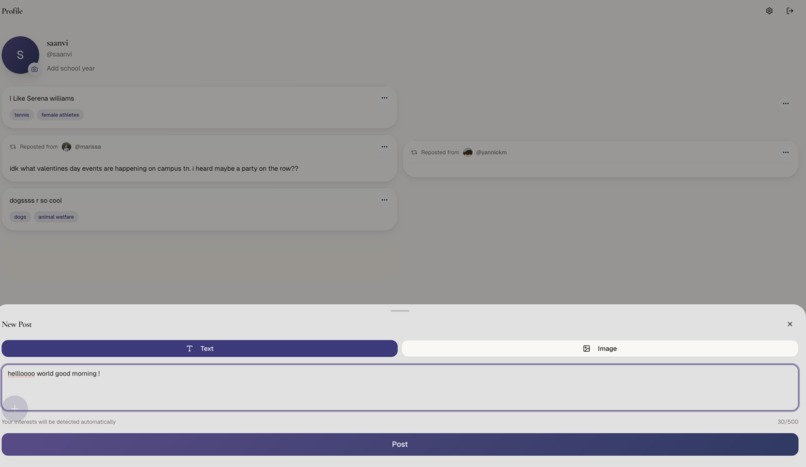
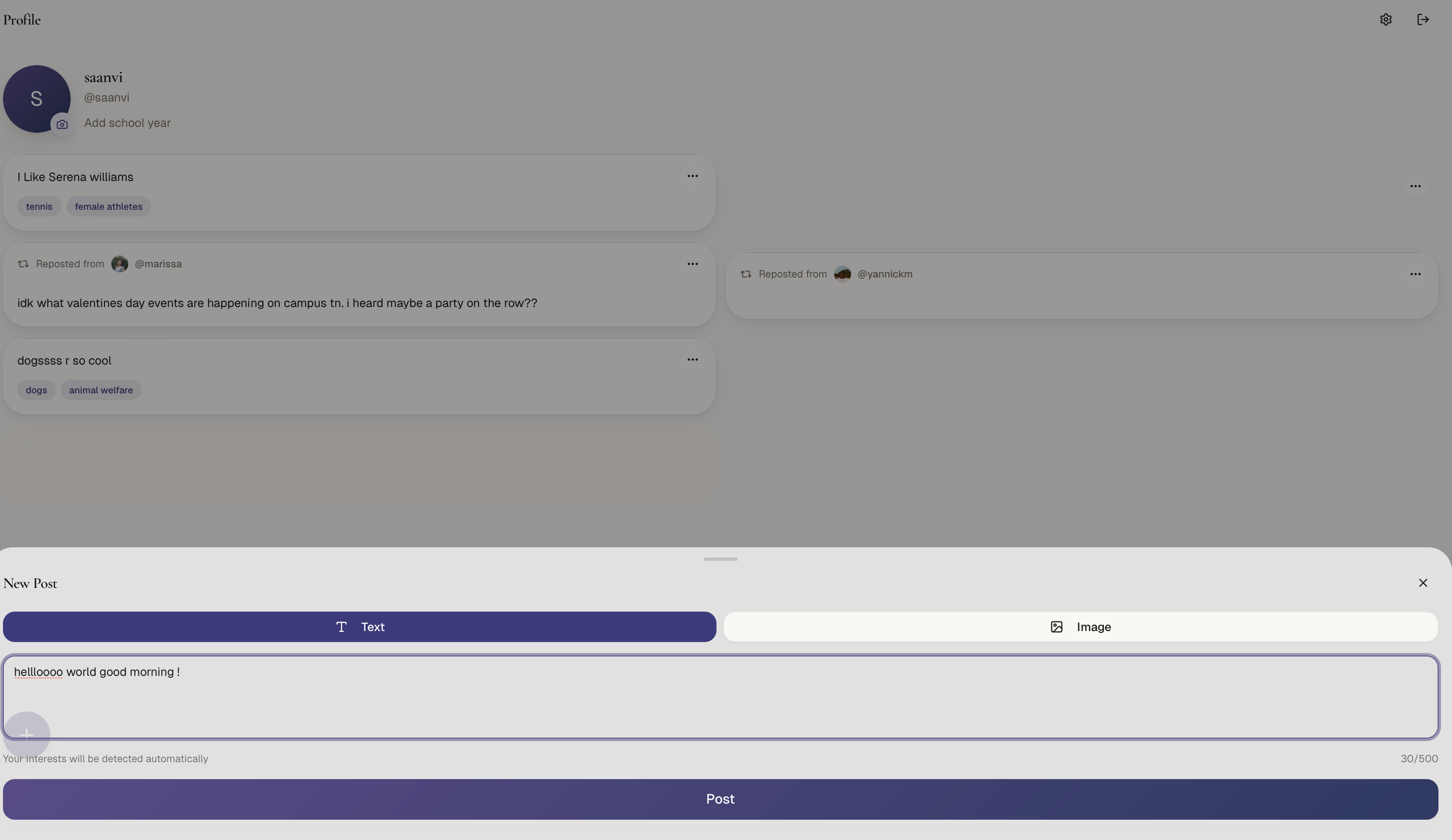
profile and posting
Inspiration
We live in the most connected era in history, yet loneliness on college campuses is quietly at an all-time high. Making new friends often feels harder than ever, not because of a lack of platforms, but because of how those platforms shape behavior. Traditional social media turns connection into performance. Vanity metrics reward polished visibility rather than genuine interaction, reinforcing a "Stanford bubble" where students circulate the same content and faces instead of forming new connections. We wanted to build the opposite of that experience. A platform designed for discovery rather than performance, where shared interests matter more than polished personas. Wavelength was inspired by a simple belief: the thoughts people share when they aren't performing are the strongest foundation for genuine community. By removing vanity metrics and letting AI quietly surface common interests and discover connections, we aim to make meeting people feel organic and easy again.
What it does
Wavelength is a mobile-first social platform that helps students make spontaneous, genuine connections on campus. Users build expressive profiles with customizable text and image widgets in a Pinterest-style masonry layout. Every day, the app serves a fresh prompt so students can share perspectives and discover what others are thinking across campus. Prompt ideas are informed by AI and shaped by community activity. When someone posts, Claude analyzes the content to extract interests semantically, not just by matching keywords. That means Wavelength can understand themes and intent behind what people share. Those interests drive matching: when two users align on at least three interests, Wavelength creates a match and generates an AI-powered conversation starter tailored to their overlap.To reduce social pressure, usernames are hidden by default in the feed, so engagement starts with ideas rather than clout. Matched users can chat in real time, message directly from a post, and even form one-click group chats around shared discussions. Profiles are “live” instead of static, meaning that a user’s profile will appear differently to each viewer, with AI pushing content with most shared interest at the top of the profile. Additional features include people and interest search, reposting, customizable avatars, and a lightweight iOS-inspired interface that works smoothly across devices. The result is a platform built for authentic self-expression, lower-pressure interaction, and easier real-world connection.
How we built it
We built Wavelength using Next.js (App Router) and TypeScript for a strong, scalable React foundation. Our UI leverages Tailwind CSS and shadcn/ui for a modern, mobile-first design and clean component structure. Supabase provides our backend, including authentication, PostgreSQL database, real-time sync, and file storage. We designed our schema and set up Row Level Security (RLS) for privacy, then used Supabase Storage for user-uploaded images and widget content.For AI features, we integrated Claude (Anthropic) for semantic interest extraction from user posts, intelligent interest matching between users, and personalized conversation starter generation. The system uses a dual-layer approach: keyword-based extraction as a fast fallback, with Claude providing deeper semantic analysis when available.We organized our team's work around core user journeys such as profile creation, prompts, matching, and chat. We iterated quickly using modular components and ran SQL migrations for database changes. We deployed on Vercel for seamless, production-ready hosting, and had our friends use the app in order to get it up to standards. This enabled rapid previews, fast iteration, and easy sharing with users and judges.
Challenges we ran into
UI turned out to be a bit of a struggle as a team with no frontend experience, as we relied on AI to do most of it, and there were small bugs that required manual debugging and careful prompting to fix. Additionally, working with Supabase was challenging due to the finicky nature of databases, especially around Row Level Security policies for the real-time chat system. Getting RLS right for conversations, participants, and messages required careful thought to avoid issues like infinite recursion in policy checks.
Accomplishments that we're proud of
None of us have participated in many hackathons before, so being able to ideate and complete the project end to end within a short period of time is something we are definitely proud of. We learned how to utilize several new technologies, such as Claude, Vercel, and Supabase. Most importantly, we built a solution to a problem that we personally have faced: meeting new people at college. After freshman year, we all found it difficult to meet new friends, so being able to build something that helps mitigate that is definitely our biggest success here.
What we learned
Throughout building Wavelength, we deepened our understanding of modern full-stack development and rapid prototyping. We learned how to architect production-grade applications using Next.js and TypeScript, and how to leverage Supabase for real-time data, authentication, and secure storage. Designing efficient database schemas and writing Row Level Security policies taught us the importance of privacy and security from day one.Working with Tailwind CSS and shadcn/ui improved our ability to quickly iterate on mobile-first designs, while integrating features like real-time matching, daily prompts, and widget-based profiles challenged us to build flexible and reusable components. Integrating Claude for semantic interest extraction taught us how to design systems with graceful AI fallbacks. We also saw firsthand the value of clear team communication and version control, especially when collaborating on complex features under tight deadlines. Most importantly, we gained experience translating user needs into tangible features and delivering a polished, end-to-end product in a short timeframe.
What's next for Wavelength
We’re excited to keep building Wavelength into the go-to platform for real campus connection.A major next step is group-scoped prompts: dorms, clubs, classes, and student orgs will be able to host their own time-bound prompts so members can respond, repost, and organically form sub-communities around shared experiences.
Beyond that, we’re planning: Campus graph expansion with school-by-school rollouts and verified campus onboarding Smarter matching controls so users can tune for friendships, collaborators, event buddies, or niche-interest circles Event and IRL layers that turn strong matches into meetups, study sessions, and club discovery moments Retention loops like weekly reflection summaries and “people you should meet this week” recommendations Creator-lite campus tools that let student communities run themed drops, mini challenges, and collaboration threads
Long term, our goal is to make Wavelength the social layer for campus life: less performance, more belonging, and more real friendships that start online and continue offline.
Built With
- claude
- node.js
- postgresql
- python
- react
- sql
- tailwind
- typescript

Log in or sign up for Devpost to join the conversation.