Inspiration
Crypto makes it incredibly easy to interact with a token. A user can discover a token, connect a wallet, and swap it within minutes. The difficult part is knowing what is actually happening underneath that transaction.
Experienced blockchain users can investigate smart contracts, ownership, liquidity, holder distribution, and verification status. For beginners, however, these signals are scattered across different tools and are often difficult to interpret.
We built WaveBlock around a simple question:
What if you could understand the potential risk of a token before you swap it?
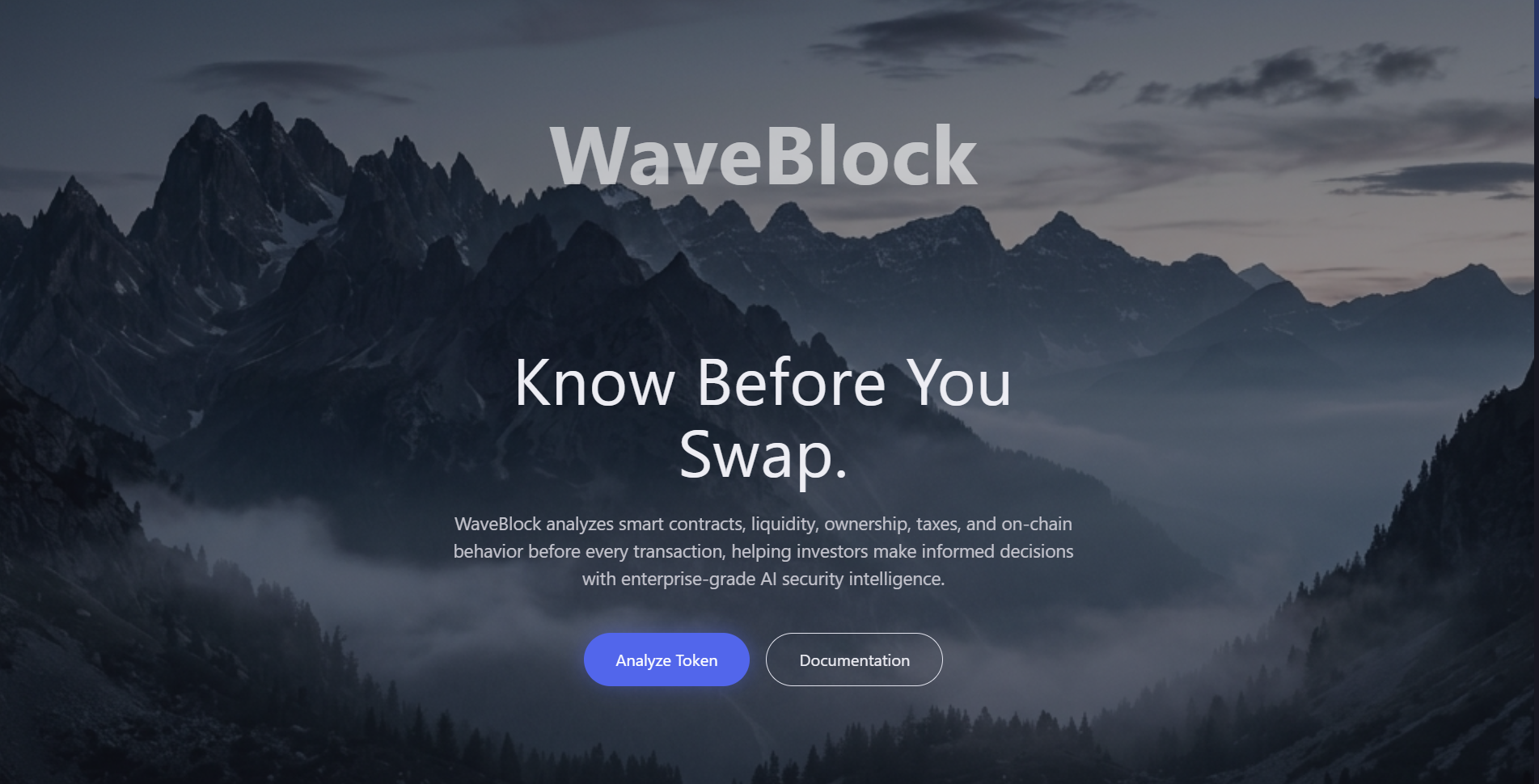
WaveBlock — “Know the Risk Before You Swap.” — brings multiple blockchain security signals together and converts them into an understandable AI-powered Trust Report.
Our goal was not to build another crypto trading interface. We wanted to build a pre-swap intelligence layer that helps users understand what they are interacting with before committing a transaction.
What it does
WaveBlock allows users to enter a token's contract address and analyze it before interacting with it.
The application evaluates blockchain and token-level signals including:
- Contract verification
- Token ownership status
- Liquidity information
- Holder concentration
- Potential risk indicators
- On-chain token information
These signals are presented through a Trust Report designed to turn technical blockchain information into information that a normal user can understand.
Instead of forcing users to interpret raw blockchain data, WaveBlock focuses on answering:
What should I know about this token before I interact with it?
The architecture also includes a Solidity-based trust registry that can store a cryptographic hash of an analysis, creating a verifiable record without putting the complete report on-chain.
How we built it
WaveBlock is built as a Next.js application with a TypeScript/React frontend and server-side API routes.
The blockchain layer uses Ethereum/EVM-compatible infrastructure to retrieve token information and analyze on-chain signals. ethers.js is used for blockchain interaction, while Solidity is used for the project's trust-registry smart contract.
The application is structured around several major components:
Token Analysis: A user submits a token contract address. The backend validates the address and retrieves relevant blockchain information.
Blockchain Intelligence: The application gathers token metadata and security-relevant signals such as ownership and holder information.
Trust Report: The collected information is organized into a structured report containing risk indicators and explanations.
AI Analysis: An LLM layer translates technical blockchain signals into human-readable explanations rather than simply displaying raw values.
Trust Registry: The Solidity contract uses a cryptographic hash of a Trust Report, allowing the existence and integrity of a report to be verified without storing the entire report on-chain.
Database Layer: Prisma is used to structure application data such as users, wallets, analyses, and Trust Reports.
Frontend: Next.js and React provide the interface for token analysis, reports, and wallet-related interactions.
Challenges we ran into
Turning blockchain data into meaningful risk information
The biggest challenge was not retrieving blockchain data. It was deciding what that data actually means to a user.
A token having high holder concentration, for example, does not automatically mean it is a scam. Similarly, contract verification does not automatically mean a token is safe.
We therefore designed WaveBlock around risk signals rather than absolute claims. The product should inform users about potential risks rather than pretend that an algorithm can guarantee whether a token is safe.
AI reliability and API limitations
Integrating the AI layer introduced practical challenges around model availability, latency, quotas, and API reliability.
During development, we encountered API quota limitations and had to work around them while testing Trust Report generation.
This taught us an important lesson: AI is only one component of the product. The underlying blockchain data needs to remain useful even when the AI layer is unavailable.
Wallet authentication
Wallet-based authentication was significantly more complicated than traditional email/password authentication.
We experimented with wallet connection and Sign-In with Ethereum-style authentication, but getting the complete authentication flow working reliably across development and deployment environments required debugging both frontend wallet behavior and backend session handling.
Balancing transparency and simplicity
Blockchain applications can easily overwhelm users with information.
Our challenge was to avoid building a dashboard full of numbers while still giving users enough evidence to understand why a token might be risky.
This led us toward the Trust Report concept: expose the important signals while using AI to explain them in simpler language.
Accomplishments that we're proud of
- Built an end-to-end token risk analysis platform
- Integrated blockchain data into a user-facing security workflow
- Created an AI-powered Trust Report
- Implemented a Solidity-based cryptographic trust registry
- Combined blockchain signals such as ownership, liquidity, verification, and holder concentration
- Built the project using a modern Next.js architecture
Most importantly, we moved beyond the idea of “AI + crypto” and built a system around a specific user decision:
Should I understand this token better before I interact with it?
What we learned
Building WaveBlock taught us that blockchain security is not about finding one magical indicator.
Risk is contextual.
A token's contract, ownership, liquidity, holder distribution, and other signals need to be considered together. We also learned that AI is most useful here as an interpretation layer, not as the source of truth.
We learned several practical engineering lessons:
- Production environments behave differently from local development.
- Secrets and environment variables are part of deployment architecture.
- Blockchain data needs careful interpretation before being presented as a security signal.
- AI outputs should not replace deterministic data.
- Wallet authentication introduces a fundamentally different user/session model.
- A good security product should communicate uncertainty instead of making absolute claims.
What's next for Waveblock
WaveBlock is currently focused on token-level pre-swap analysis. The next stage is to make the analysis substantially deeper.
Potential improvements include:
- Real-time liquidity and liquidity-lock analysis
- Deployer wallet behavior analysis
- Historical transaction pattern analysis
- Contract vulnerability detection
The long-term vision is to make WaveBlock a security intelligence layer between users and blockchain transactions — helping people understand what they are about to interact with before they click Swap.
Built With
- ai
- blockchain
- css3
- ether.js
- etherium
- motion
- next.js
- postgresql
- prisma
- react
- solidity
- tailwind
- typescript
- web3

Log in or sign up for Devpost to join the conversation.