-
-
Logo
-
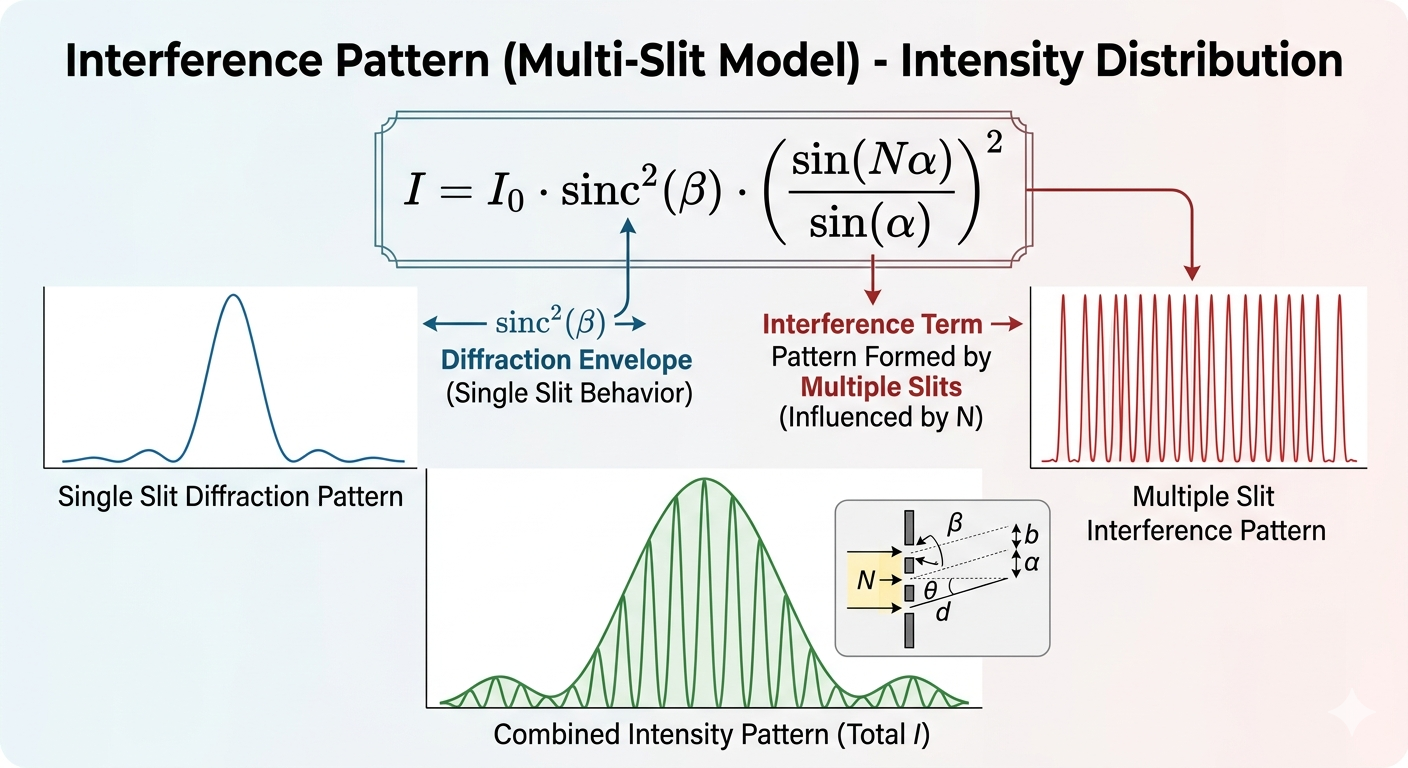
Interference Pattern (Multi-Slit Model)
-
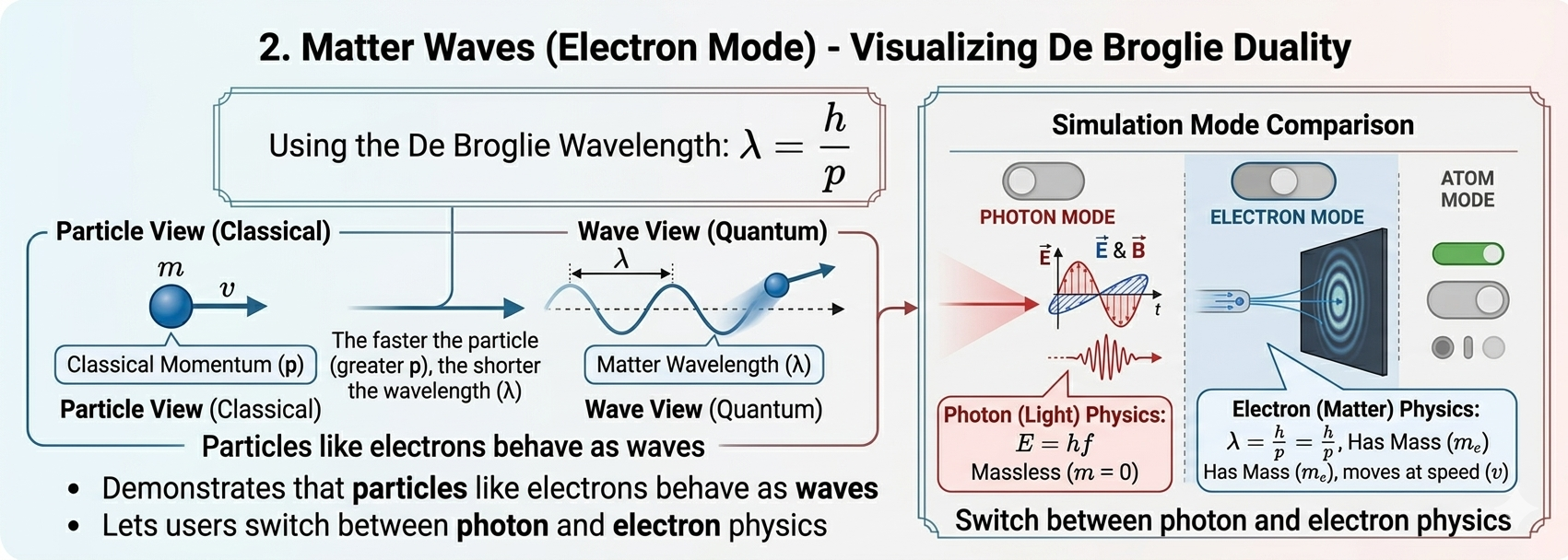
Matter Waves (Electron Mode)
-
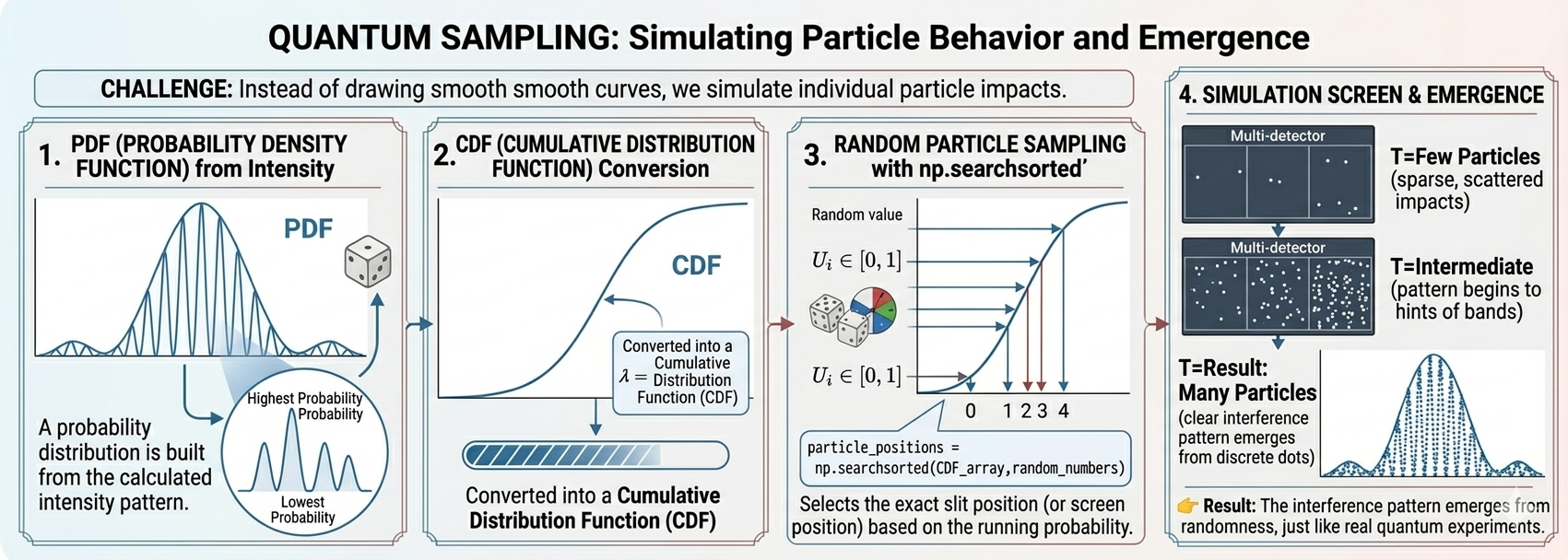
Quantum Sampling
🚀 Inspiration
The inspiration for Wave-Particle Duality Simulator came from one of the most fascinating and counterintuitive experiments in physics—the double-slit experiment.
We were intrigued by a simple yet profound question: How can something behave as both a particle and a wave?
While textbooks explain this concept mathematically, it often lacks intuitive understanding. We wanted to bridge that gap by creating a visual, interactive simulation where users can see quantum behavior emerge in real time and even manipulate it.
⚙️ What it does
This project is an interactive simulation that demonstrates wave-particle duality using the double-slit experiment.
It allows users to:
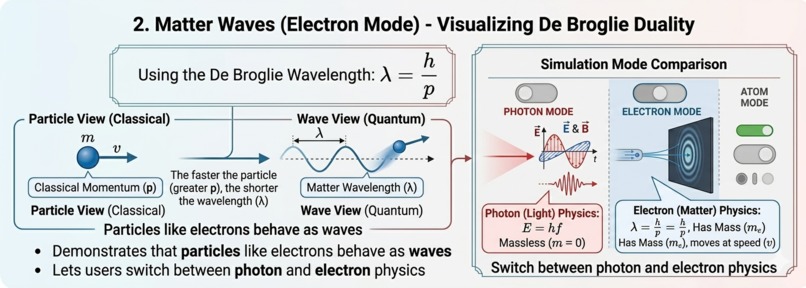
- Switch between photon mode (light waves) and electron mode (matter waves)
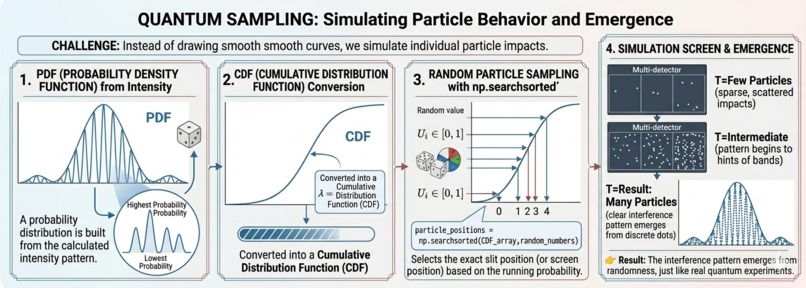
- Observe how individual particles gradually form an interference pattern
- Toggle the observer effect, which collapses the interference pattern
- Experiment with parameters like wavelength, slit width, and separation
- Visualize multi-wavelength interference using color
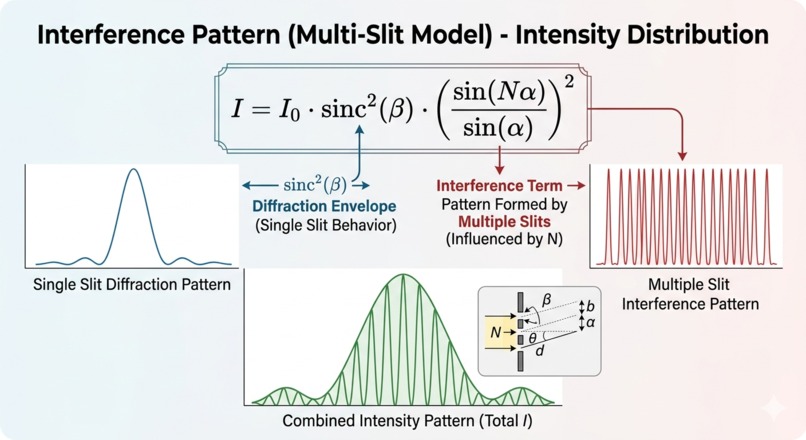
At its core, the simulation models intensity using:
$$ I = I_0 \cdot \text{sinc}^2(\beta) \cdot \left(\frac{\sin(N\alpha)}{\sin(\alpha)}\right)^2 $$
And in electron mode, it applies the de Broglie relation:
$$ \lambda = \frac{h}{p} $$
🛠️ How we built it
We built the project using:
- Python + Pygame → for real-time rendering and UI
- NumPy → for high-performance vectorized physics computations
Key components include:
- A physics engine that computes interference patterns
- A probabilistic sampling system using CDF-based particle generation
- A wave simulation module that visualizes amplitude and intensity fields
- A state-driven UI system for switching modes and controls
Instead of plotting static graphs, we simulate thousands of particles per frame, allowing patterns to emerge naturally from probability distributions.
⚠️ Challenges we ran into
- Numerical stability: Handling edge cases like ( \sin(x)/x ) near zero without division errors
- Performance optimization: Rendering thousands of particles per frame without lag
- Balancing realism vs usability: Keeping physics accurate while making controls intuitive
- Visual clarity: Designing a UI that explains complex quantum behavior without overwhelming users
- Scaling electron physics: Adapting ( \lambda = h/p ) into a visually meaningful simulation
🏆 Accomplishments that we're proud of
- Successfully simulating quantum interference using particle sampling, not just equations
- Creating a system where random particle hits form structured patterns over time
- Implementing the observer effect, showing wavefunction collapse interactively
- Combining physics, computation, and design into a single cohesive experience
- Turning a complex concept into something users can experiment with and understand
🧠 What we learned
- How probability distributions drive real-world quantum phenomena
- The power of NumPy vectorization for real-time simulations
- How to translate abstract physics into interactive visual systems
- The importance of UX in scientific tools
- That learning becomes far more effective when users can explore instead of just observe
🔮 What's next for Wave-Particle Duality Simulator
We see this project evolving into a full educational and research tool:
- 🌐 Web version (React + WebGL) for global accessibility
- 🤖 AI-powered explanations to guide users in real time
🧪 More experiments:
- Quantum tunneling
- Schrödinger wave evolution
- Entanglement visualization
🎮 Enhanced challenge mode for gamified learning
📊 Real-time analytics and graphing tools
🧑🏫 Integration into classroom and e-learning platforms

Log in or sign up for Devpost to join the conversation.