
wattwarden: energy-governed AI agents on Arm CPUs
Track: Cloud AI. Repo: https://github.com/jemsbhai/wattwarden (MIT, license visible in About). New work created during the submission period, built on our previously published open source packages pollard (1.5.1) and jsonld-ex (0.7.4), and on the TOML operation-level energy model (FLAIRS-39).
The pitch
Arm sells performance per watt, but a developer on an Arm cloud box cannot see watts: Graviton, Axion, and Ampere VMs expose no energy counters, and pollard, our agent governance framework, documents that its only energy meter is NVML for local GPUs. wattwarden closes that documented gap. It gives pollard a predictive Arm CPU energy meter built on the TOML operation model, a benchmark sweep driver with a lab-grade evidence trail, an SLO advisor that recommends serving configurations from measured data, and the capability no measured-energy meter can have: a joule budget that refuses an oversized model call BEFORE it dispatches.
One afternoon on a Google Axion c4a-standard-16 and one evening on a Pixel 8 Pro produced six logged experiments, five refuted hypotheses (three of them our own, documented in public), the meter's first calibrated on-device energy profile, and a reproducible finding about llama-server that we could not find documented anywhere.
Measured results (every number traces to a logged experiment)
Gains ledger, all one-line configuration changes surfaced by the tool:
| optimization | baseline | optimized | gain | evidence |
|---|---|---|---|---|
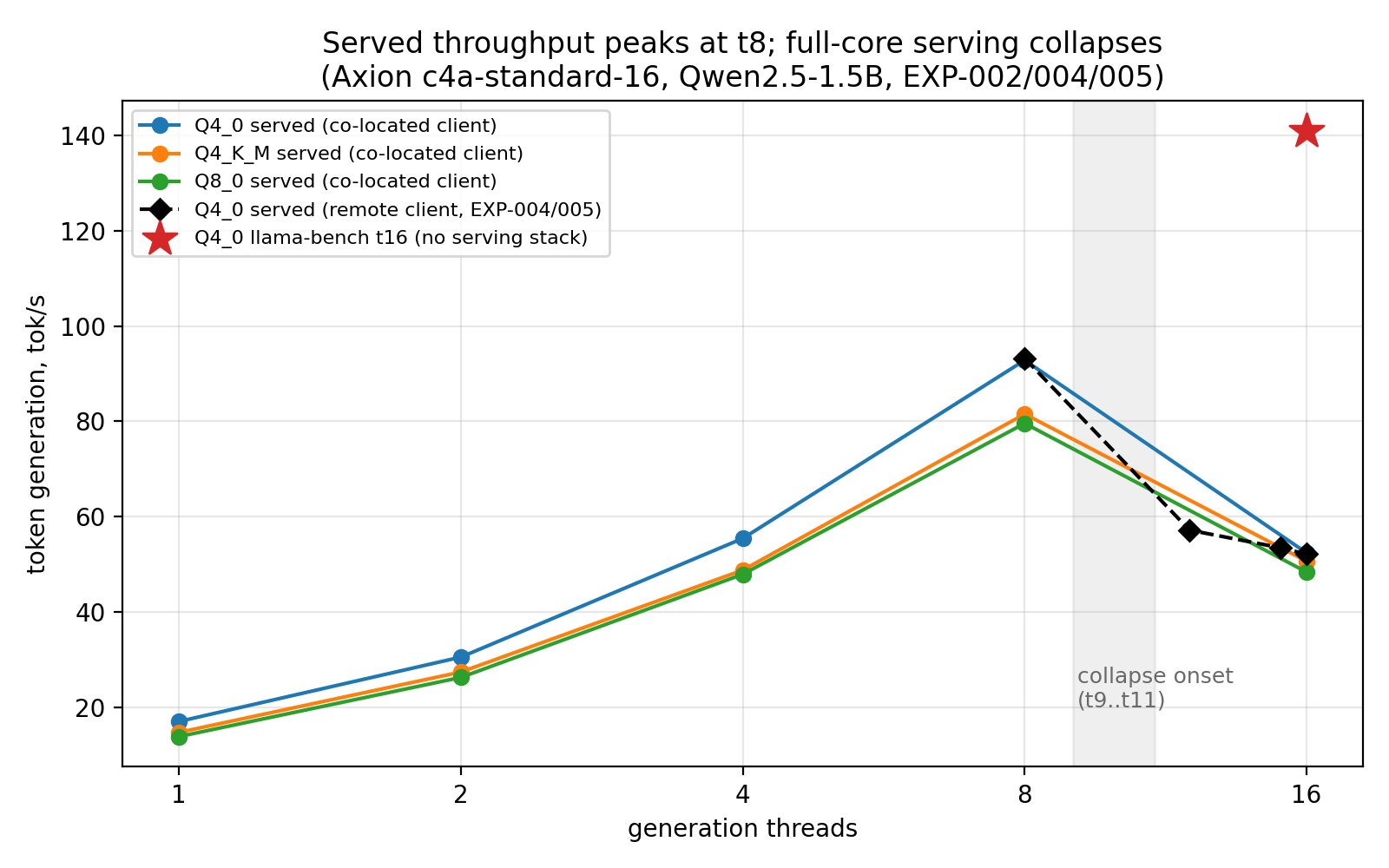
| Serving thread count (t16 to t8) | 52.4 tok/s | 92.8 tok/s | +77% throughput | EXP-002, EXP-004 |
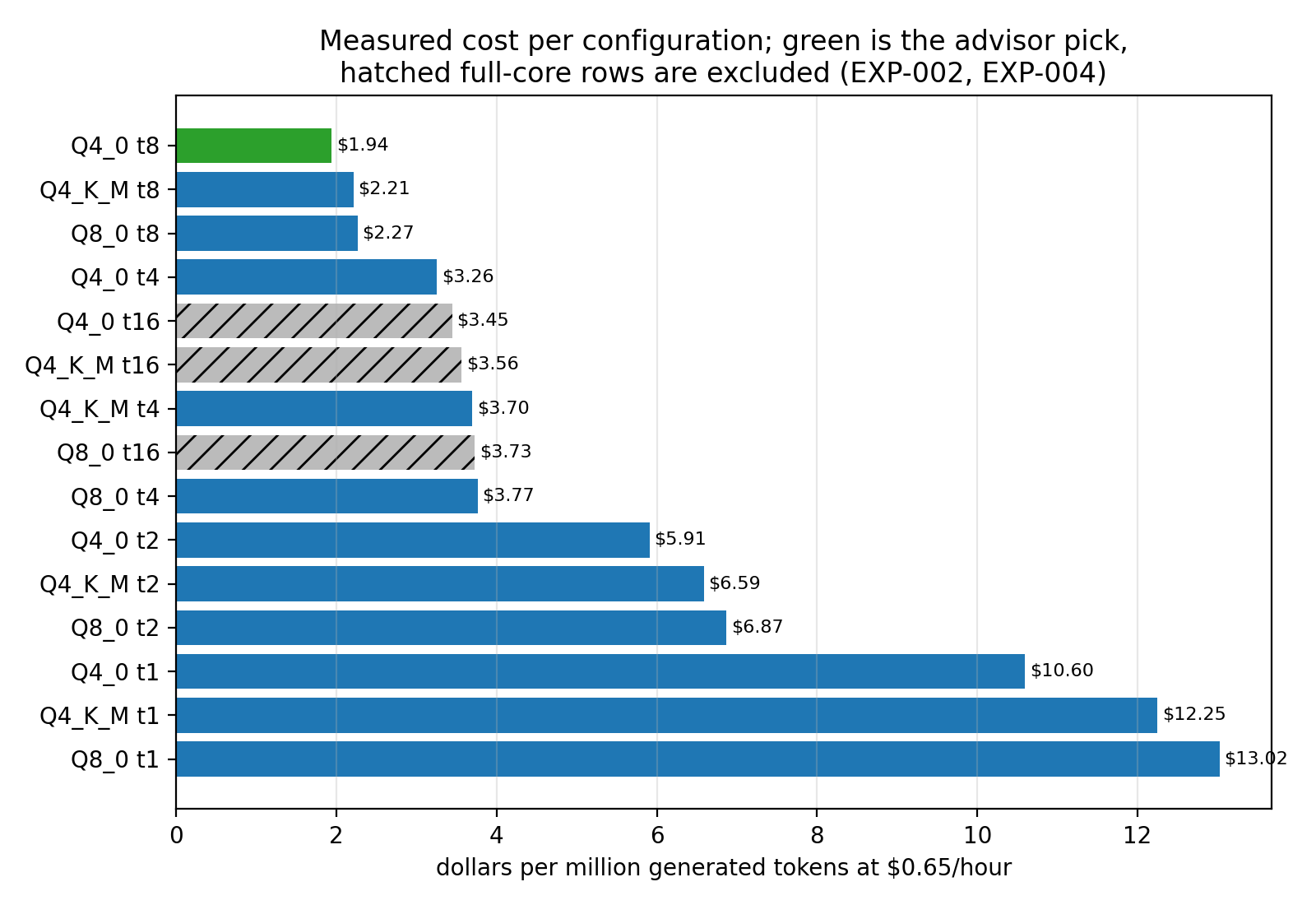
| Cost at recommended config | 3.45 $/Mtok | 1.94 $/Mtok | -44% cost | EXP-002 + advisor |
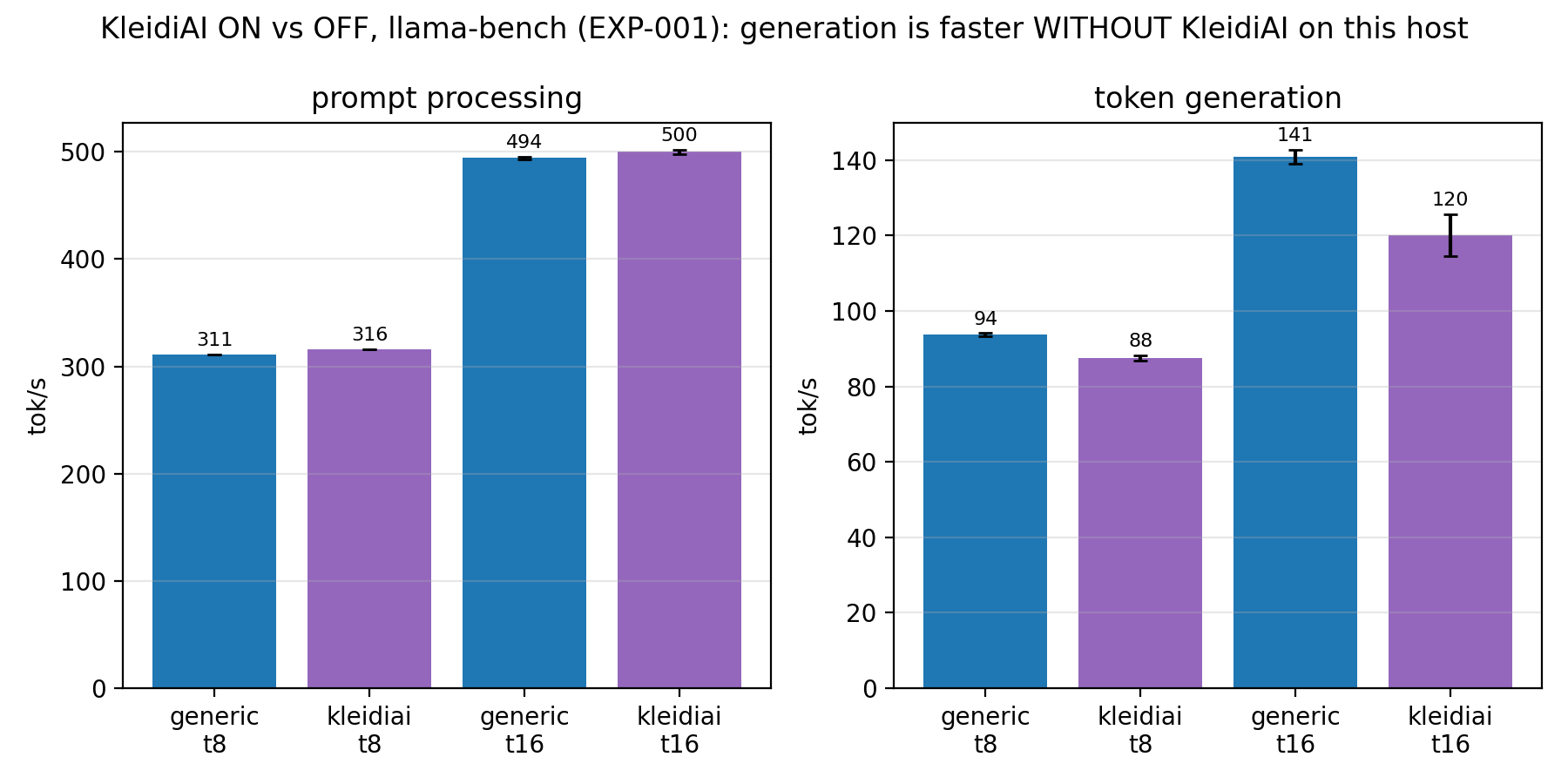
| Build flag for decode (KleidiAI to generic, t16) | 120.1 tok/s | 140.9 tok/s | +17% | EXP-001 |
| Quantization (Q8_0 to Q4_0, t8 served) | 79.6 tok/s | 92.8 tok/s | +17% | EXP-002 |
| Model size (Q8_0 to Q4_0) | 1.89 GB | 1.07 GB | -44% | file sizes |
Three findings judges can reproduce from our scripts:
- KleidiAI is not automatically the fast path. Pre-registered ablation (EXP-001): on Axion V2 with llama.cpp commit 6fed9f6ff, the KleidiAI build LOSES token generation by 6.5% (t8) and 14.7% (t16) against the generic Arm build, because the generic path already runtime-repacks Q4_0 into arch-dispatched kernels. We attested this with a sampling profile: 60.4% of decode self time in ggml_gemv_q4_0_4x8_q8_0 via the repack path. The lesson is the product: measure per workload and silicon, do not assume the branded flag.
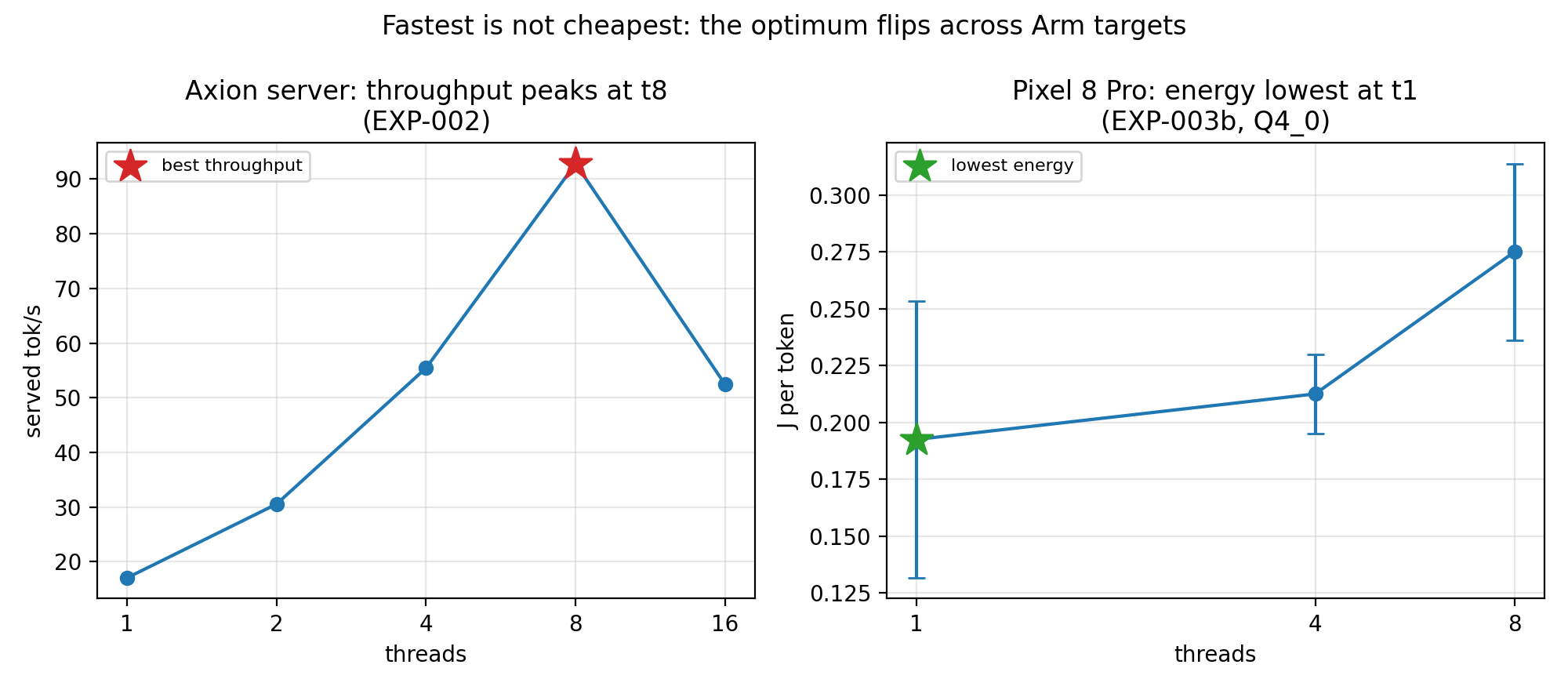
- llama-server collapses at high thread counts while llama-bench does not. Served throughput peaks at t8 (92.8 tok/s) and falls ~40% by t16 on the same binary that benches 140.9 tok/s at t16. We tested and refuted two mechanisms (client co-location, EXP-004; one-spare-core, EXP-005), bounded the onset to t9..t11, and recorded the cause as unexplained. The operational rule stands and the advisor enforces it.
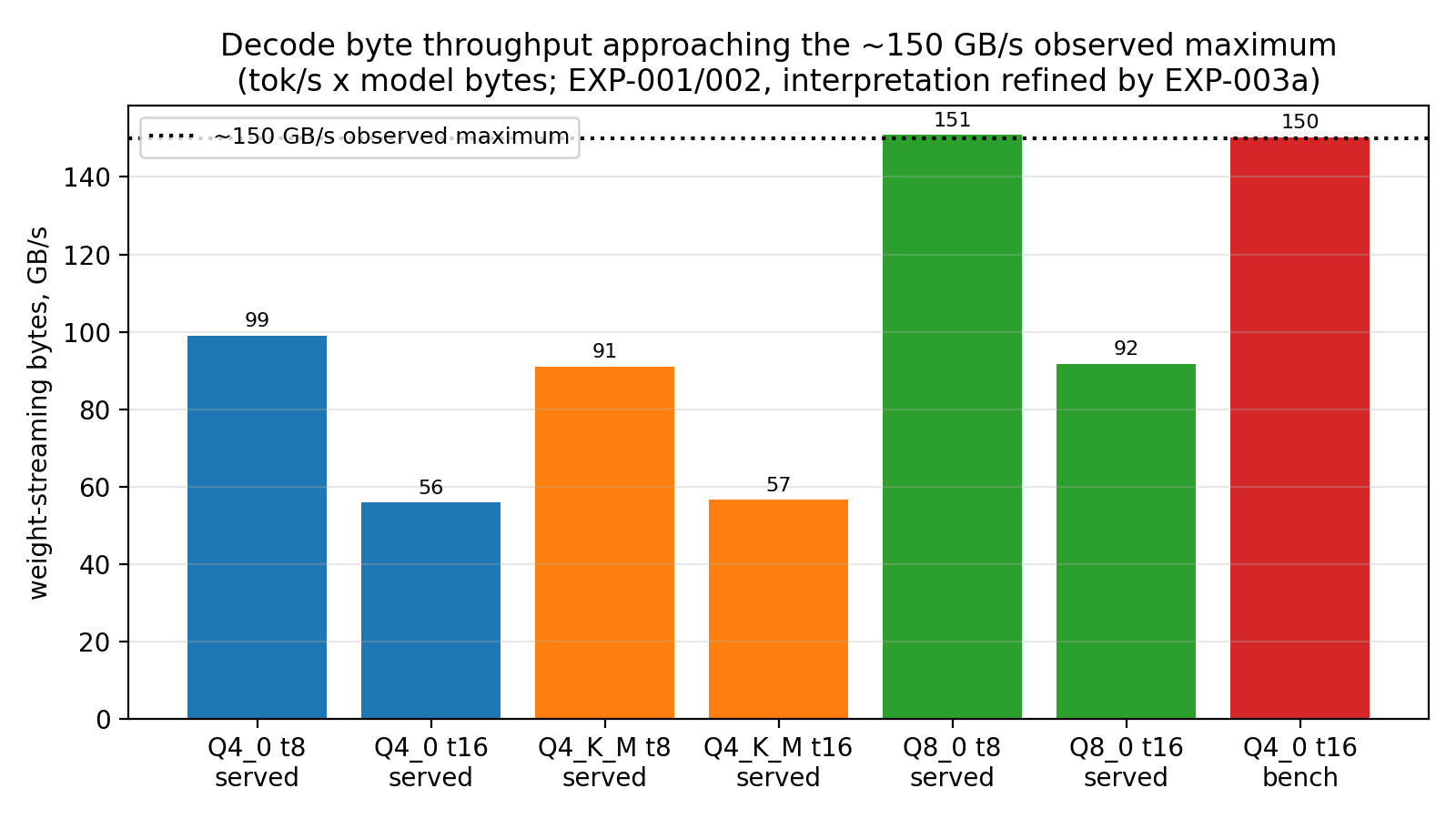
- Decode time on this host obeys a clean law: per quant, time per token = A + B/t with R^2 of 0.999 to 1.0000 (EXP-003a fit of the sweep data). The serial floor A is quant-INDEPENDENT (~4 to 4.6 ms): per-token overhead, not weight streaming, sets the fast limit. The highest observed streaming rate is ~150 GB/s, an approached upper range consistent with the TOML model's bandwidth-priced decode but not yet a demonstrated wall. Our own pre-registered cross-quant bandwidth probe was refuted as ill-conditioned, and that refutation is in the logbook too.
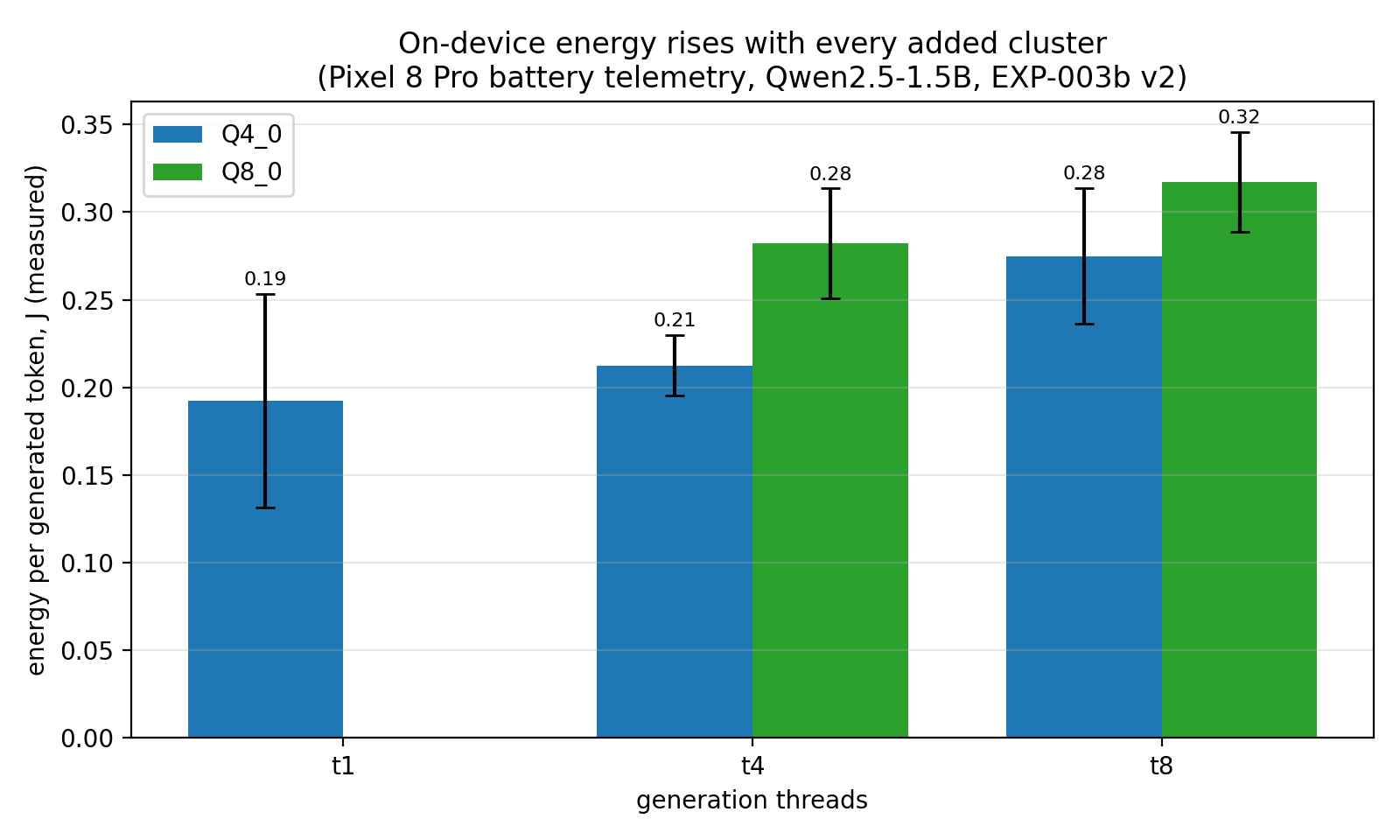
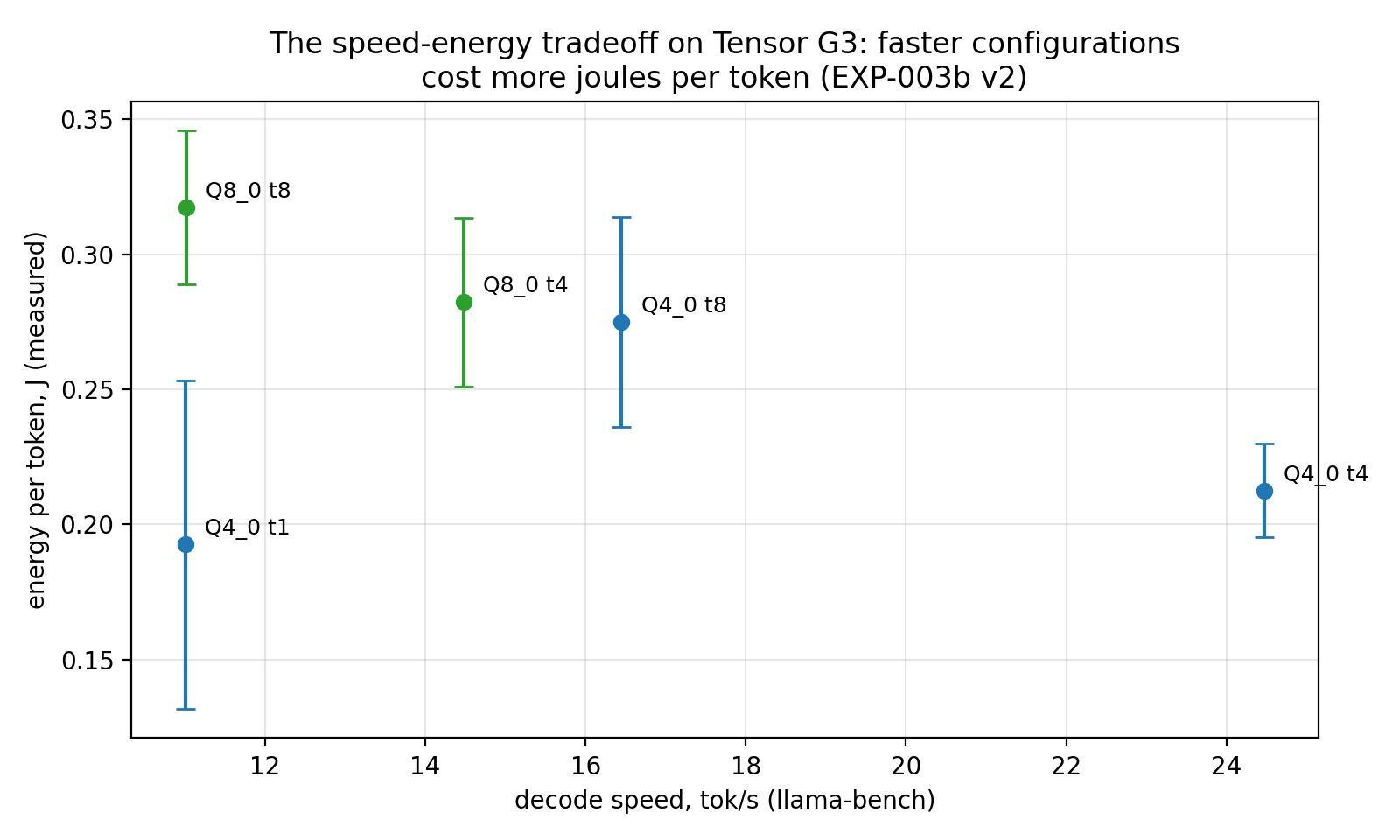
- Energy, measured on-device (EXP-003b): battery telemetry on a Pixel 8 Pro (Tensor G3) calibrated the meter's first profile at 88.3 pJ per DRAM byte and 84.6 pJ per MAC, system level, with Qwen2.5-1.5B Q4_0 costing about 0.2 J per generated token. Energy per token RISES with every added core cluster (0.19 at t1, 0.21 at t4, 0.28 at t8): on big.LITTLE silicon the fastest configuration is not the cheapest, the mirror image of the server story. The experiment's own coverage audit caught an estimator undercount before results were filed, rescuing one pre-registered prediction from a false refutation; a third prediction was refuted and stands recorded as such.
What the tool does
- sweep: launches one cold llama-server per condition, walks quant x threads, measures client-side TTFT and tokens/s, and writes frozen configs, environment snapshots, and raw per-request records.
- advise: recommends the best measured configuration under a TTFT SLO and prices it in dollars per million tokens. Our Axion run: Q4_0 at 8 threads, 92.8 tok/s, 14.8 ms TTFT, 1.94 $/Mtok, with full-core rows visibly excluded and the exclusion cited to its experiments.
- meter: TomlCpuMeter speaks pollard's meter protocol, charging predicted joules per model call from GQA-aware operation counts, and implements precheck estimation so Budget(extra={"joules": N}) can refuse a call pre-dispatch, with an auditable MeterPrecheckRefusal strict mode.
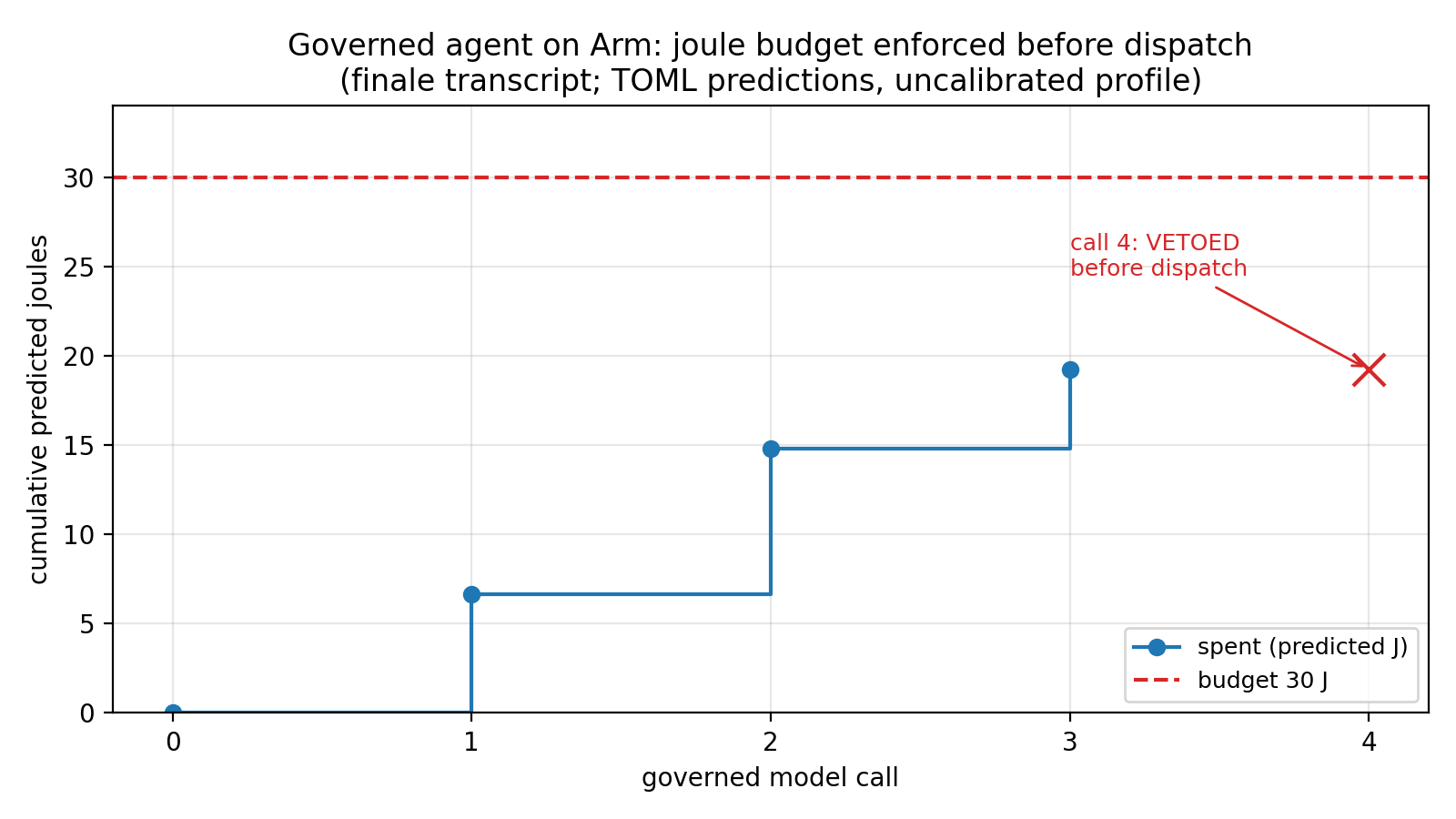
- governed agent: examples/governed_agent.py runs a real agent loop against llama-server on Arm; calls accrue predicted joules until an oversized request is vetoed before it ever reaches the server.
Live transcript from the Axion box (c4a-standard-16, llama-server at the advisor's own recommended config, Q4_0 t8):
budget: 30.0 J (predicted, TOML neoverse-v2), 5 steps
call 1: precheck 6.83 J, charged 6.65 J, spent 6.65 / 30.0 J
call 2: precheck 6.83 J, charged 8.16 J, spent 14.80 / 30.0 J
call 3: precheck 6.84 J, charged 4.41 J, spent 19.21 / 30.0 J
VETOED BEFORE DISPATCH: budget exceeded for joules
final charges: {'joules': 19.212732359220713, 'steps': 3.0, 'tokens': 301.0}
note: joule figures are TOML-model predictions on an uncalibrated
profile; calibration is EXP-003. Throughput and step data are real.
The fourth request (an oversized treatise with max_tokens 100000) was refused by the meter's precheck against the remaining budget and never reached llama-server. The full run tree persists in a pollard SQLite store for report and HTML export.
Honesty contract, enforced in code: measured values carry method and uncertainty; predicted joules are labeled predicted; the energy profile ships with calibrated=False until the calibration experiment (EXP-003) fits its constants, and the advisor refuses to print an uncalibrated joule column. Two of our own pre-registered hypotheses were refuted this session; both refutations are in the public logbook.
How it uses Arm
Built and evaluated on Google Axion (Neoverse V2, silicon-attested by Arm Performix: MIDR 0x410fd4f1); KleidiAI built, benchmarked, and honestly ablated against llama.cpp's generic Arm repack path; Arm Performix used for hotspot profiling and exportable run artifacts (two runs committed), with its dlopen symbolization limits documented; perf on Arm PMU counters for kernel identity; the model registry and DRAM model are tuned to Arm serving realities (dotprod, i8mm, SVE2 feature detection guided host selection).
Reproducibility and DX
Everything is a public MIT repo: 80 passing tests, an append-only experimental logbook with pre-registered hypotheses, a findings file, a banned-vocabulary prose gate, provisioning and experiment scripts that took a fresh Arm VM to first data in under twenty minutes, and raw artifacts (llama-bench JSON, Performix exports, perf tables) committed next to the conclusions they support. Setup instructions live in the README; the sweep, advisor, and governed agent each run with one command.
What's next
EXP-003b is now complete: the energy profile is calibrated against a real Arm SoC with power telemetry (Pixel 8 Pro battery counters, on-device), giving the meter its first calibrated=True profile at 88.3 pJ per DRAM byte and 84.6 pJ per MAC, with measured cost near 0.2 J per generated token and the finding that energy per token rises with every added cluster on big.LITTLE silicon. The coverage audit in that experiment caught and corrected an estimator undercount before results were filed, rescuing one pre-registered prediction from a false refutation; a third prediction was refuted and is recorded as such. pollard 1.5.1 already ships an MCP registry bridge (registry_from_mcp), so the governed agent's next milestone is discovering jsonld-ex's 53-tool MCP server under the same joule budget. An always-free Ampere A1 endpoint (Neoverse N1) extends the cross-silicon story and gives judges a live target.

Log in or sign up for Devpost to join the conversation.