Inspiration
We joined this hackathon driven by the excitement of hands-on learning and the chance to explore “Power as a Service.” Although our initial microgrid rental concept didn’t quite fit, that pivot led us to a fresh idea: WattsID, a port-level energy tracker that brings fairness and clarity to shared power systems.
What it does
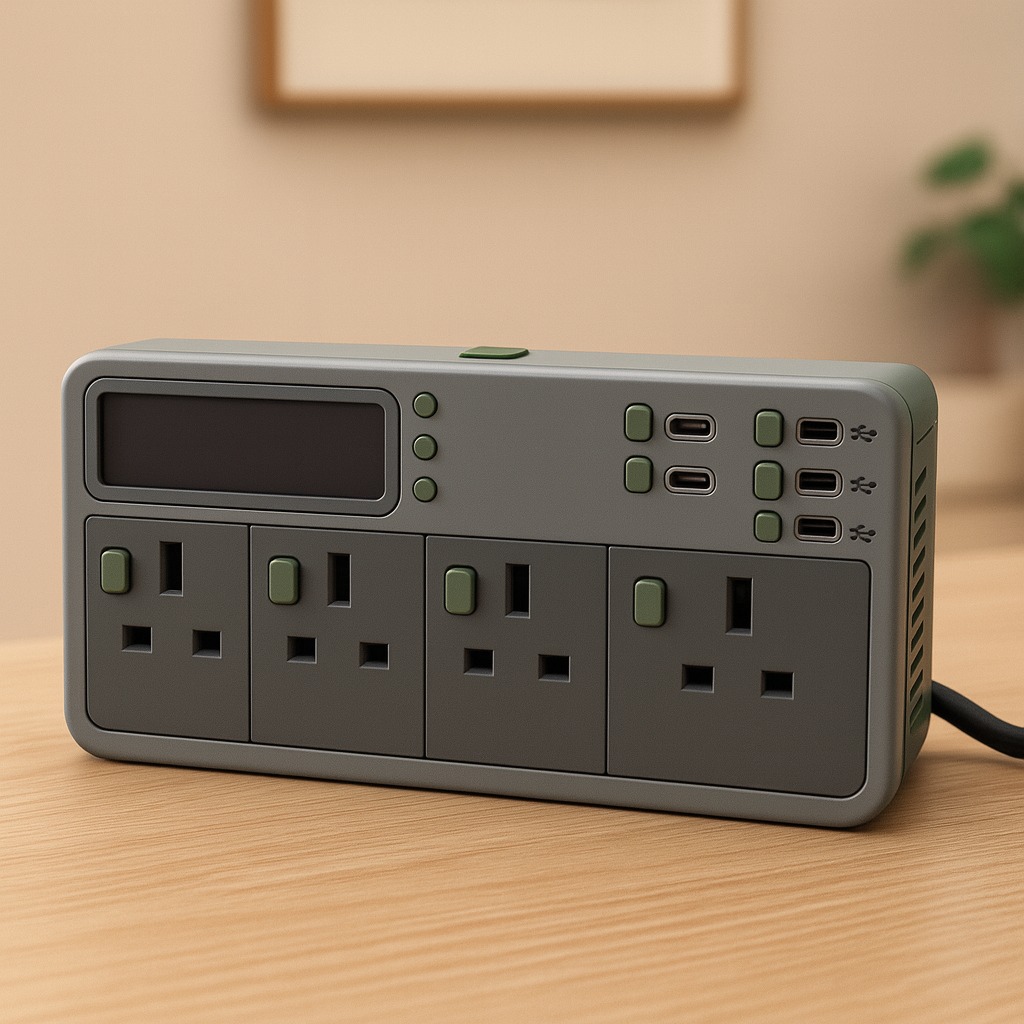
WattsID is conceived as a simple, rugged enclosure housing:
- Four independent current-sensing channels (one per output port)
- A microcontroller that logs each channel’s usage over time
- Wireless connectivity (e.g. Wi-Fi or LoRa) to stream data to a dashboard
- A lightweight dashboard concept showing live per-port graphs and threshold alerts
How we “built” it
- Concept sketches & enclosure illustration: A realistic sketch and AI generated images and video which captures size, port layout, and mounting points.
- Theoretical design document: Block diagrams outline sensor selection, microcontroller choice, power budget, and data-flow architecture.
- Workflow spec: Sequence diagrams describe how readings move from sensors → microcontroller → network → dashboard.
Challenges we ran into
- Staying within scope: Quickly realizing “Power as a Service” required a narrower focus than a full system rental.
- Port-level isolation on paper: Designing four separate measurement channels without crosstalk took several rounds of block-diagram refinement.
Accomplishments that we’re proud of
- Clear, focused concept: We distilled our broad interest in clean energy into a single, novel feature—port-level metering.
- High-fidelity enclosure render: Our illustration shows exactly how WattsID would look and mount in real installations.
- Comprehensive design doc: Every system component and data flow is specified, ready for hardware prototyping.
What we learned
- A strong idea can emerge from a pivot. By refocusing our hackathon entry, we found a truly innovative angle.
- Early diagramming is invaluable. Investing time in block and sequence diagrams helped us spot design pitfalls before hardware work begins.
- Simplicity wins. A focused feature set (one device, four ports) is easier to explain, sketch, and ultimately build.
What’s next for WattsID
- Prototype phase: Turn sketches into a basic breadboard design to validate sensor isolation and power-budget calculations.
- Enclosure iteration: Refine the CAD model for manufacturability and weatherproofing.
- Proof-of-concept firmware: Develop minimal code to read one channel and send a sample packet over Wi-Fi.
- User feedback planning: Draft simple surveys and interview scripts to gather requirements from real MSMEs before full hardware build.
Built With
- chatgpt
- googleveo3
- proteus
- python
- spline


Log in or sign up for Devpost to join the conversation.