-

-
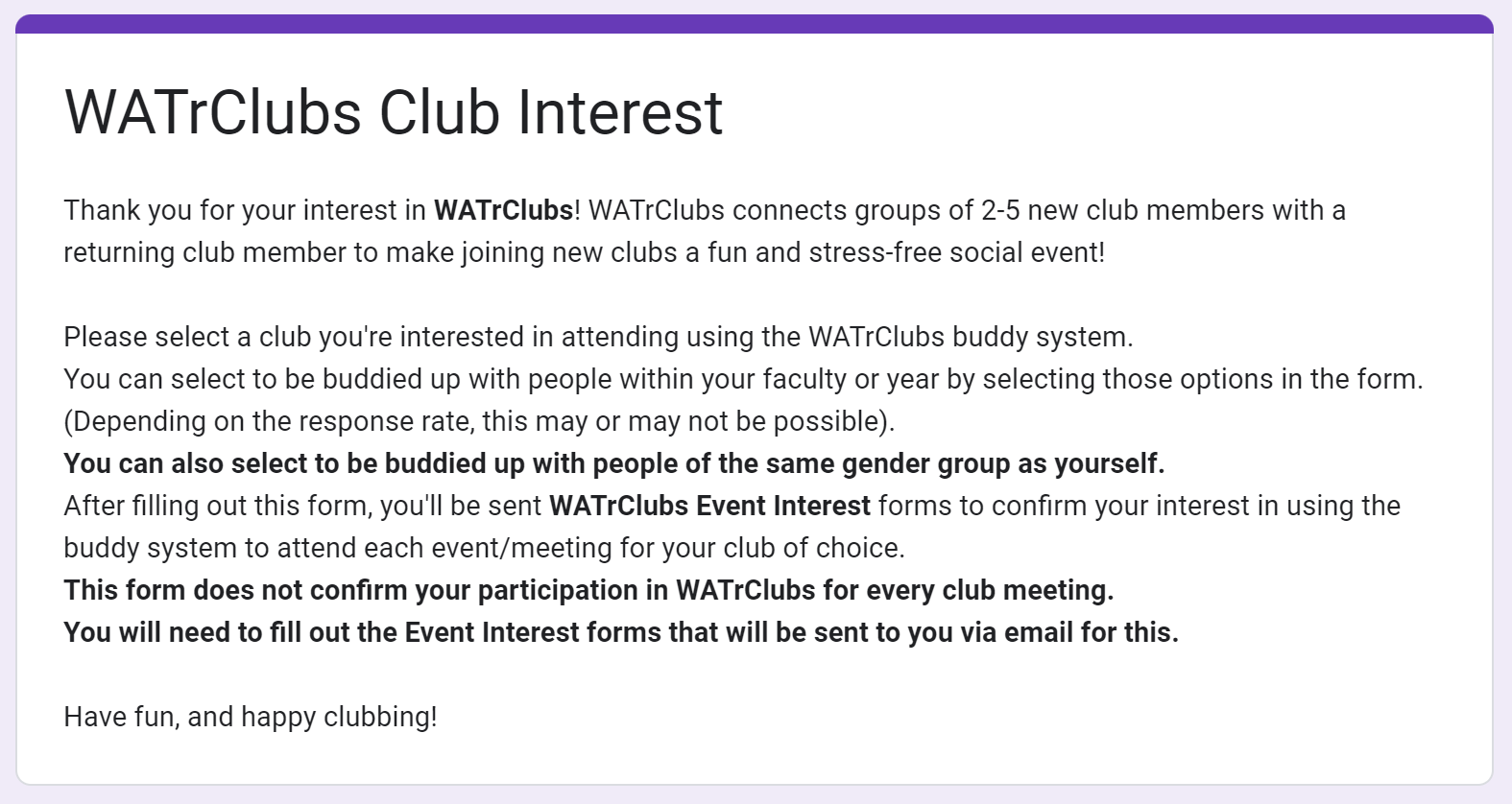
Interest Form
-
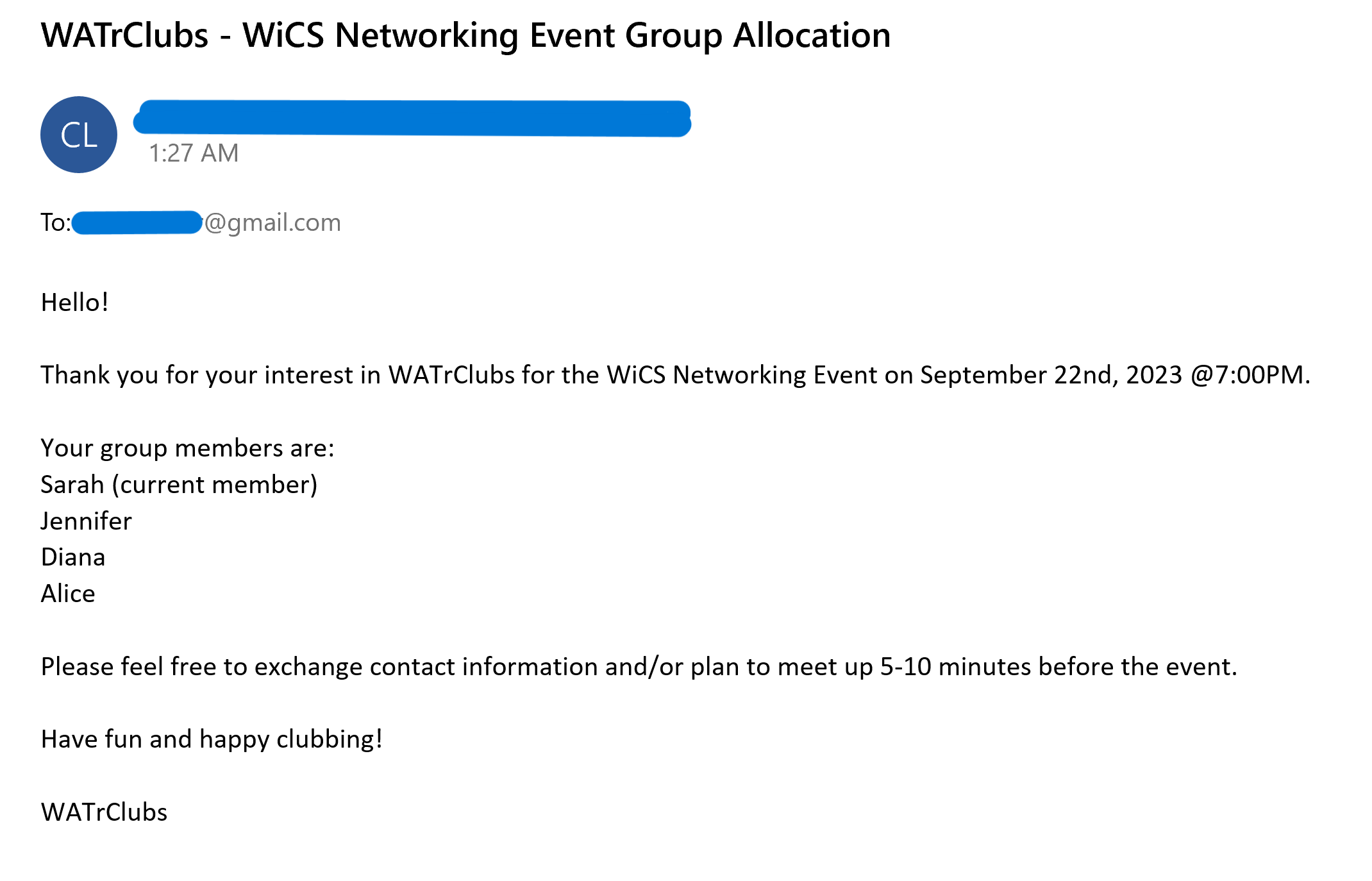
WATrClubs Group Allocation Email
-
WATrClub groups of new members matched with a current club member
-
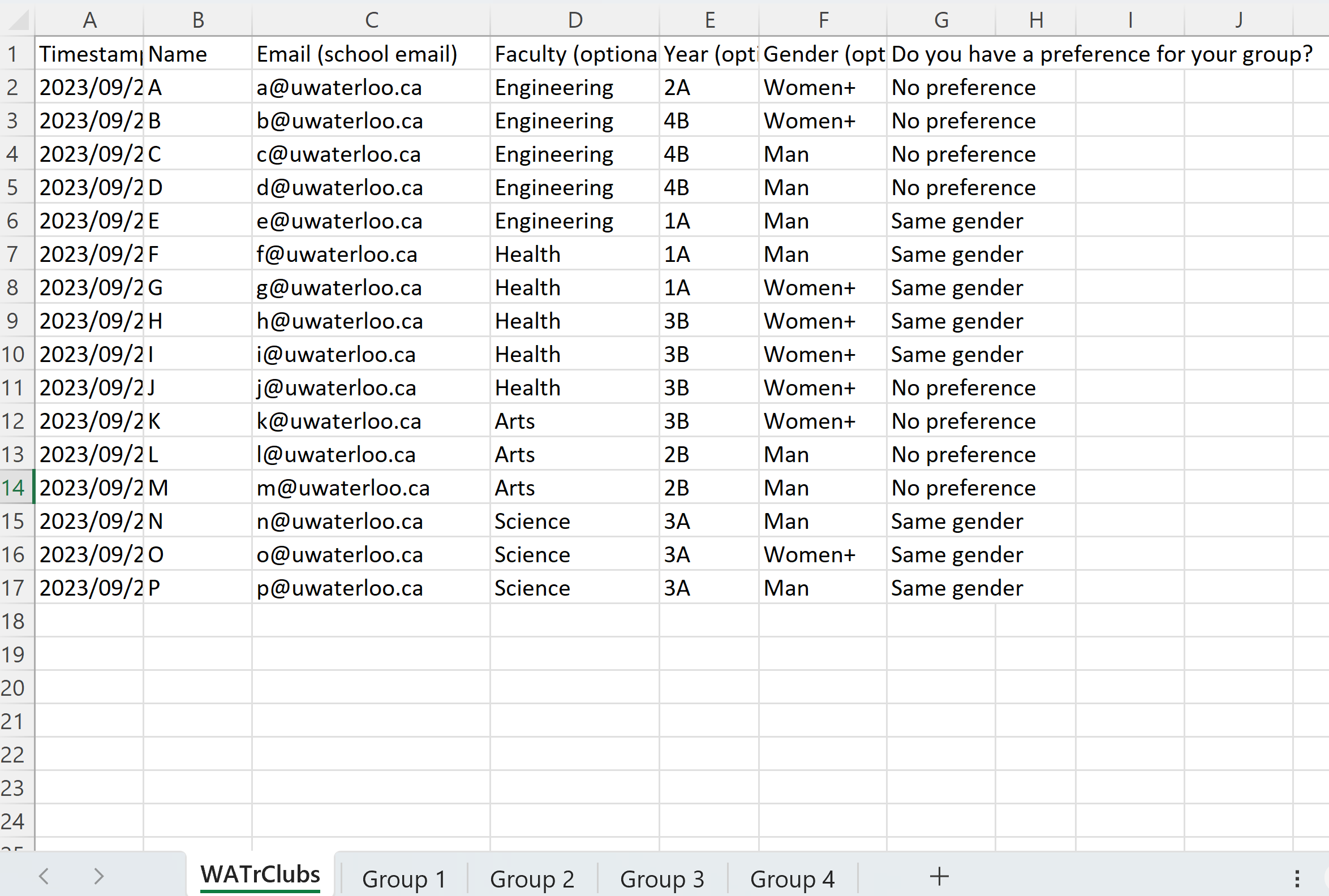
Form Responses
-
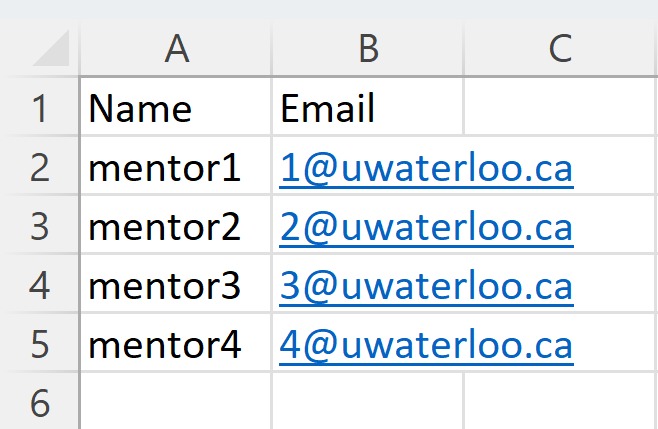
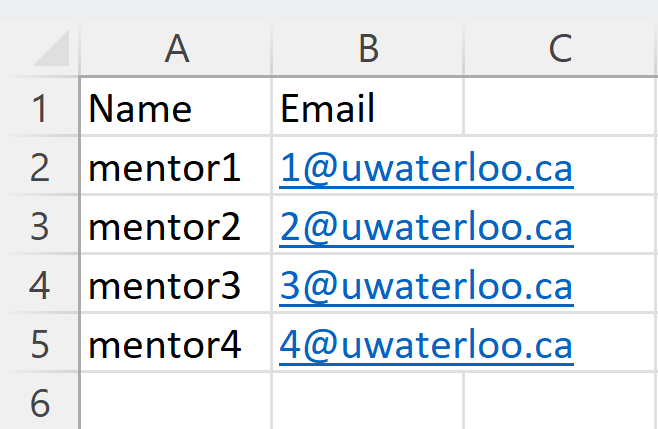
Current Club Members


Inspiration
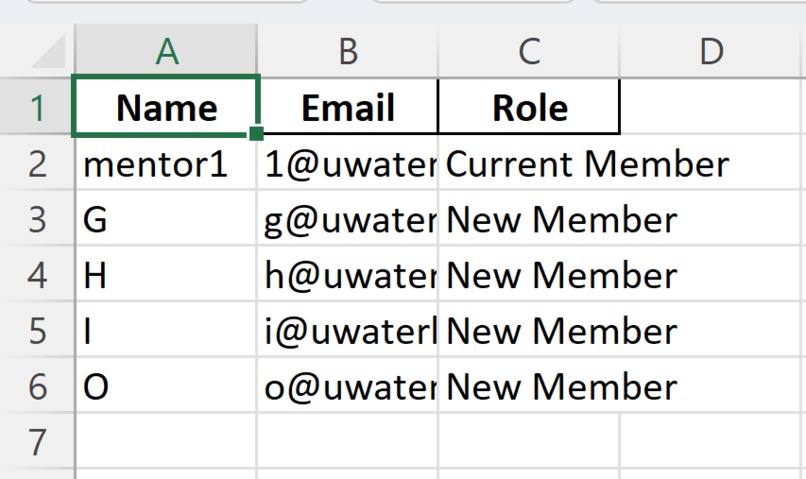
In brainstorming areas in which gender inclusivity can be improved, we came across a finance club at Laurier where student population is extremely male-dominated. Upon discussing with our friend who joined the club, we found out that she wouldn't go if she didn't know anyone else there. Thus, we determined that this is likely the reason stopping many potential members from joining especially with the male-dominated environment being even more intimidating. We wanted to create a solution that allows students to meet members at the clubs prior to an event or meeting so that they would have someone to attend with.
What it does
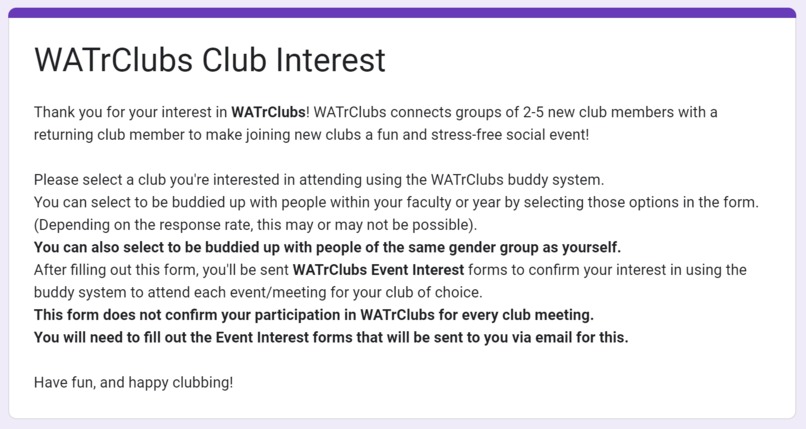
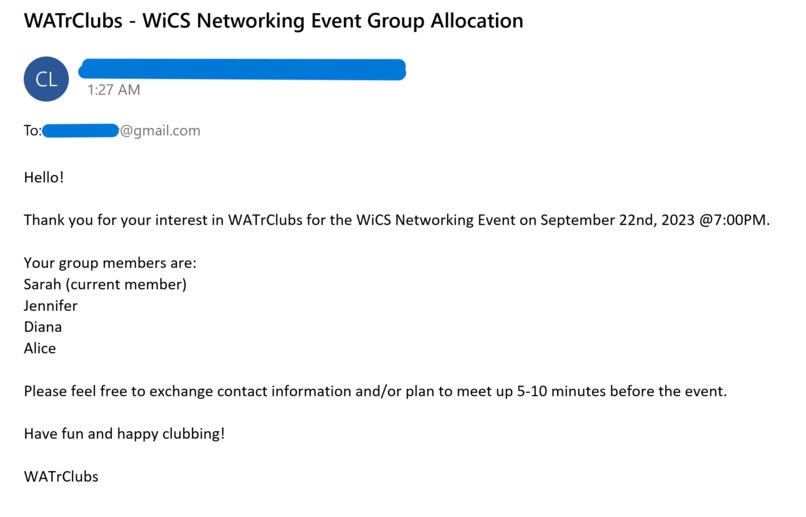
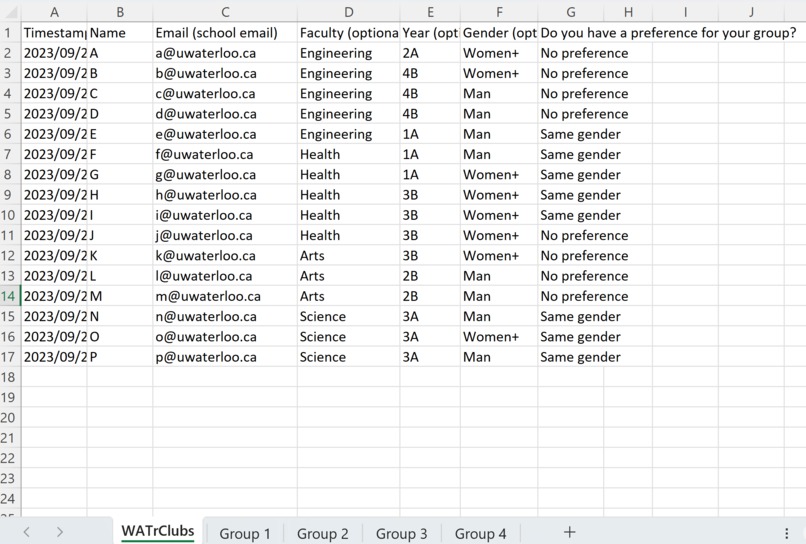
WATrClubs matches a group of 2-5 new students looking to join a club with a current member. This eliminates some of the anxiety of attending an event/meeting alone. Interested students fill out this Google Form: https://forms.gle/LNvGnzN5X4nvp8RE7 to indicate which clubs they want to join. They have the option to provide their faculty and year if they want to be matched with others in the same faculty/year. There is also an option to select if they want a same gender group or have no preference as, going back to the initial gender inclusivity issue at certain clubs, having a small group of women+ in a male-dominated environment for example can help eliminate some of the social anxiety. After the form is filled out, about a week before each event, the students are matched with a group including a current club member to then chat beforehand or arrange to meet up 5-10 minutes before the event starts.
How we built it
The user side uses Google Forms and email as it is often the simple, default choice that doesn't require students to enter their information into a random site or download any apps. Switching platforms may be feasible as WATrClubs gains users and credibility; however, at the start, any additional steps or unfamiliar platforms may deter users. The form information is processed and groups are created using a Python script with the pandas library that can read the Excel files of form responses and sort the students into groups.
Challenges we ran into
Our main challenge was trying to improve the user experience and create a platform that students would actually use. For example, given our target audience is those who do not feel comfortable attending events/meetings alone, we needed to ensure that the matching process was not intimidating as it still involves an extent of putting yourself out there and meeting other strangers. One potential issue was the uncertainty of who gets put into the groups and if they would be responsive/actually show up to the event. Thus, we decided that every group would have a current club member and since they are voluntarily taking part in the initiative, unresponsiveness or not attending the event should not be a significant issue. The current club members participating in WATrClubs are likely enthusiastic to invite more members and can take on somewhat of a mentorship role of answering questions and showing new members how the club works.
Accomplishments that we're proud of
WATrClubs helps promote gender diversity in clubs, making it easier for women+ to join and participate in male-dominated settings. Additionally, it helps students make meaningful connections in an otherwise daunting club environment. Promoting club activities helps students deal with the academically rigorous university culture, which improves their mental health and wellbeing. It also grows club sizes, and builds relationships in students from all faculties and years.
What we learned
While working on this project in Python, our team experienced significant personal and professional growth. We learned the importance of collaboration and effective communication, as our project required close coordination to align our ideas with coding efforts. Additionally, our skills working with Excel in python improved as we tackled various challenges and implemented our algorithm, enhancing our problem-solving abilities. We gained valuable insights into the user-centered design and the intricacies of addressing the real-world problems of student anxieties in joining clubs alone, and the gender gap seen in some clubs. Overall, this project not only enhanced our technical skills but also taught us the value of teamwork, empathy, and innovation in software development.
What's next for WATrClubs
One of our next steps includes creating a 24/7 server for automated email form submissions would involve setting up robust hosting infrastructure to ensure uninterrupted service, implementing a scheduling system for sending out emails at specified intervals, and continuously monitoring and optimizing server performance and email deliverability to maintain a reliable and efficient automated email system. Migrating WATrClubs to an app in the future can make it easier for students to keep track of their participation, and meet the new and returning club members prior to the meetings via messages. We expect to be working closely with the clubs on WATrClubs to gain quick access to their club event meeting dates and times, allowing us to release our forms in a timely fashion. Given WATrClubs expected success, we plan to be able to expand to other universities, namely Wilfrid Laurier University, as we are familiar with the clubs and have recognized a similar need for such an app. Finally, ongoing security measures and user feedback integration would be essential for long-term success.


Log in or sign up for Devpost to join the conversation.