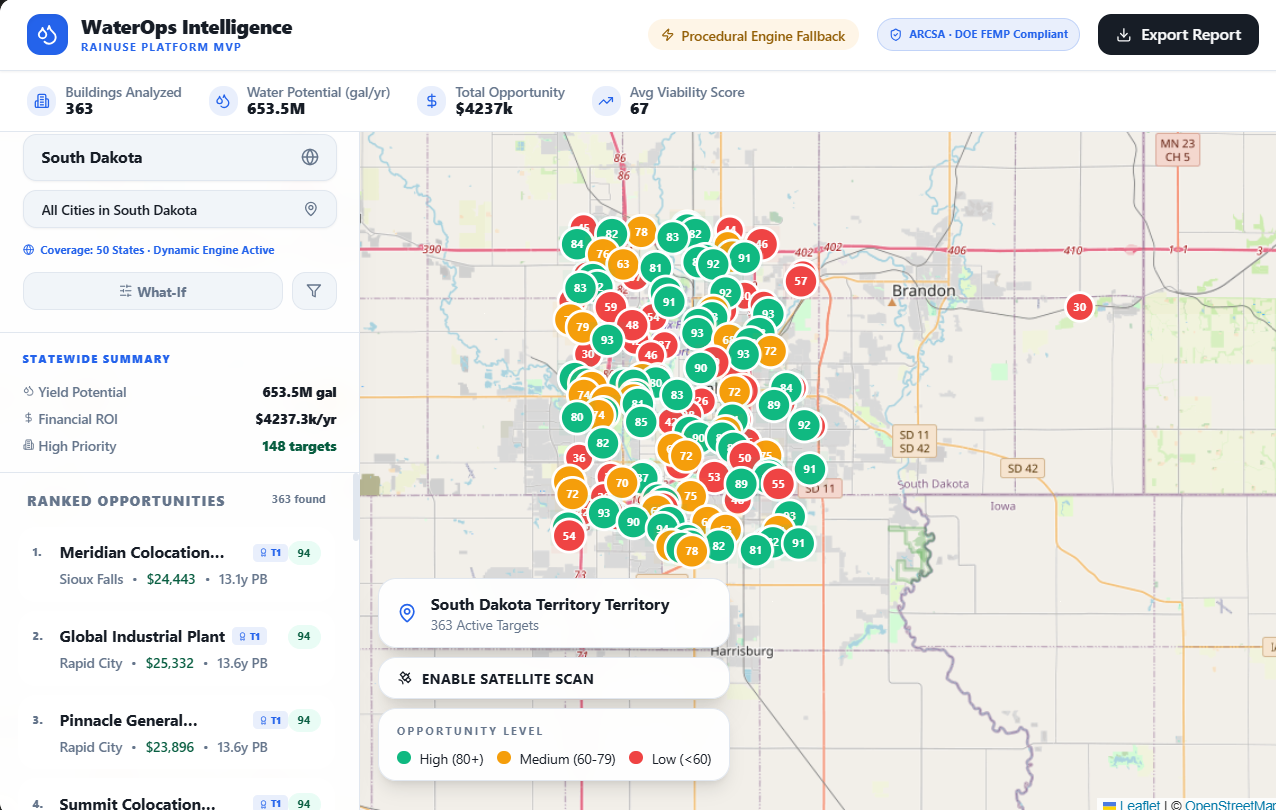
We built WaterOps Intelligence to solve a real sales problem: companies like Grundfos should not have to manually search through thousands of buildings to find strong prospects for commercial water recycling systems. We were inspired by the idea of turning a slow, manual prospecting process into a smart, data-driven platform that quickly highlights the best opportunities.
Our project uses a hybrid data approach. We connected live building-location data from OpenStreetMap through the Overpass API, then combined it with environmental and financial benchmark data such as rainfall, water costs, and regional incentives. Because exact roof measurements, cooling tower detection, and some infrastructure details are not easily available in a hackathon setting, we modeled those features using realistic assumptions and procedural simulation. This allowed us to create a working prototype that feels practical while still being grounded in real-world logic.
The heart of the platform is our Viability Index, which scores buildings based on factors such as roof size, rainfall potential, utility cost savings, cooling tower presence, and ESG or climate-related value. This score helps sales teams instantly distinguish between low-priority and high-priority prospects. We also included a financial model that estimates annual savings, rebates, and payback period, so the platform is not just identifying buildings, but also showing why they are worth pursuing.
One of the most exciting things we learned was how powerful it is to combine spatial data, sustainability metrics, and business reasoning into one tool. We also learned how important it is to explain assumptions clearly, especially when mixing live data with simulated infrastructure insights.
One of our biggest challenges was balancing realism with hackathon speed. Building a full satellite vision pipeline and connecting to multiple enterprise-grade datasets was beyond the scope of a weekend build, so we designed a hybrid architecture that demonstrates the full product concept while remaining feasible in limited time. Another challenge was making the scoring model easy for judges and users to understand, so we focused on keeping the system transparent and tied to financial outcomes.
Overall, WaterOps Intelligence shows how AI can transform commercial sustainability sales from a guessing game into a more precise, scalable, and data-informed process.


Log in or sign up for Devpost to join the conversation.