-
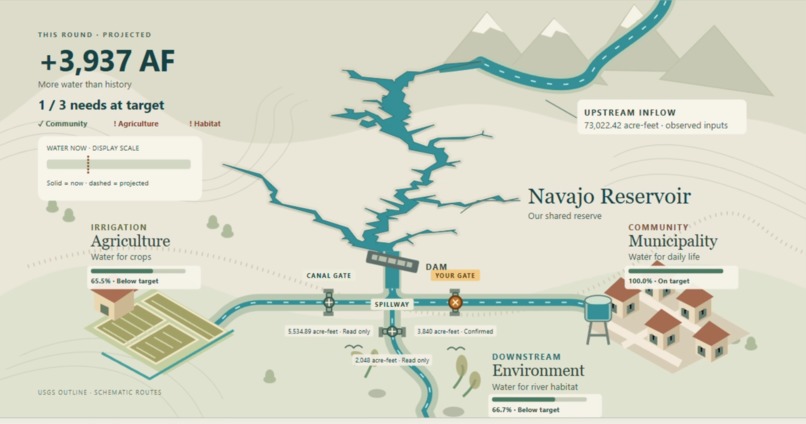
Gameplay
Inspiration
Water shortages are usually explained through charts, reports, and giant datasets. Those can show what happened, but they do not always make it clear why managing a shared water supply is difficult.
We wanted to turn real environmental data into something people could actually experience.
Water Replay uses real historical observations from NASA's SWOT mission to recreate Navajo Reservoir as a multiplayer sustainability simulation. Instead of simply looking at historical water data, participants step into the system and make decisions themselves.
Three players share the same reservoir:
- Community water
- Agriculture and irrigation
- Downstream environmental flow
Each group needs water, but everyone draws from the same limited supply. The challenge is to retain more water than the historical outcome without failing any of the three needs.
What it does
Each scenario begins with a real historical period at Navajo Reservoir.
NASA SWOT data provides the observed reservoir trajectory, while additional historical water data provides context such as inflow, releases, and evaporation.
Players then create a counterfactual version of that same period.
Each participant controls one stakeholder and adjusts how much water their system receives. Every decision changes the shared reservoir and the options available to the other players.
At the end of each round, the game reveals what NASA actually observed and compares it with the team's simulated outcome.
Simply saving the most water does not win. Community reliability, agricultural demand, and downstream environmental needs must all remain above their required levels.
The goal is to make sustainability tradeoffs easy to understand by letting people experience them instead of just reading about them.
How we built it
The frontend is built with React and TypeScript, using SVG to render the interactive reservoir world and Framer Motion for transitions and visual feedback.
SpacetimeDB powers the realtime multiplayer system. It maintains the authoritative state of each match, including:
- connected participants
- stakeholder roles
- water allocations
- projected reservoir state
- round results
- shared simulation state
When one player changes their water allocation, SpacetimeDB immediately synchronizes that decision with every other participant. A decision made from a phone can instantly change the reservoir shown on another device.
The historical scenarios are built from real environmental data.
We use NASA SWOT / Hydrocron data for Navajo Reservoir (lake ID 7720009733) to establish the real observed reservoir trajectory. Additional operational water data is normalized and aligned with the SWOT observations to explain what happened during each historical interval.
A deterministic simulation engine then keeps the historical environmental conditions fixed while replacing the human water-allocation decisions with the players' choices.
This lets us ask a simple question:
Under the same historical conditions, could a different set of decisions have produced a more sustainable outcome?
The simulation is intentionally presented as a simplified counterfactual, not as a hydrological forecast.
We also integrated Grok Voice as an AI analyst inside the simulation. Players can speak naturally to Grok to ask about the current reservoir state, understand why a round changed, compare their decisions with the historical outcome, or explore possible allocation changes. Grok does not control the simulation or invent the results—the underlying deterministic model remains authoritative, and Grok explains the real game state and verified simulation outputs.
Development process
We built Water Replay incrementally, accelerated with Cursor and OpenAI Codex.
Instead of asking AI to generate the entire project at once, we divided development into verified stages:
- Retrieve and normalize real NASA and water-management data
- Build and test the simulation independently
- Add realtime multiplayer with SpacetimeDB
- Build the initial playable client
- Transform the interface into an interactive 2D water-management world
- Add visual feedback, historical comparisons, and presentation polish
Each stage was tested and debugged before the next system depended on it.
This was especially important because the project combines external scientific datasets, simulation logic, realtime state synchronization, and an interactive multiplayer interface.
Challenges
One of the biggest challenges was finding a reservoir with enough usable SWOT data to support the simulation. Our original plan used Lake Powell, but the observations available to us were missing the storage-change data we needed. We eventually moved to Navajo Reservoir, which provided a much stronger dataset for the project.
Another challenge was combining independent historical datasets. Satellite observations and operational water data do not perfectly describe the same system in the same way, so we had to carefully normalize units, align time periods, filter invalid observations, and explicitly account for differences instead of pretending the datasets matched perfectly.
Realtime multiplayer introduced another layer of complexity. Every participant needs to see the same authoritative world while still controlling only their own stakeholder. SpacetimeDB allowed us to keep the shared simulation synchronized while validating which actions each player is allowed to perform.
Finally, making the system understandable was as difficult as making it work. Early versions looked like dashboards full of numbers and input fields. We redesigned the application around a visual reservoir world so players can see water entering the reservoir, flowing toward different stakeholders, and changing the shared outcome in real time.
What we learned
The biggest thing we learned is that presenting data can be just as important as collecting it.
NASA already provides incredible information about Earth's water systems. The difficult part is turning that information into something people can understand and care about.
We also learned how powerful realtime multiplayer can be for explaining shared-resource problems. When another participant takes more water and your own options immediately change, the sustainability problem becomes much more intuitive than it is on a static chart.
Water Replay is ultimately an experiment in turning real environmental history into an interactive learning experience.
Today, the scenario is Navajo Reservoir.
The same idea could eventually be applied to other reservoirs and environmental systems, creating collaborative simulations for education, public engagement, and sustainability training.
Built With
- framer-motion
- grokvoice
- react
- spacetimedb
- typescript


Log in or sign up for Devpost to join the conversation.